Viewing as
Teacher view: planning notes, the answers to every question, and the teacher copies of the files.
Physics · Forces
Acceleration and velocity–time graphs
Use \(a = \Delta v \div t\), interpret velocity–time graphs, and use \(v^2 - u^2 = 2as\) (and the area under a graph at Higher tier).
Teacher resources
The teacher copies: slides with the questions built in, the answers, and anything else attached to this lesson for whoever is teaching it.
- Acceleration and velocitytime graphs - Teacher Slides.pptx Teacher The lesson slides with the teacher's notes on each slide, and every question and mark scheme built in. Built from the lesson script on 30 September 2026. View
- Acceleration and velocitytime graphs - Teacher Notes.docx Teacher The complete notes with the teacher's notes and every model answer in full. Built from the lesson script on 30 September 2026. View
Student handouts
The same files the students see, to print or hand out.
- Acceleration and velocitytime graphs.pptx Built from the lesson script on 30 September 2026. View
- Acceleration and velocitytime graphs - Completed Notes.docx The full notes for the lesson, to revise from. Built from the lesson script on 30 September 2026. View
- Acceleration and velocitytime graphs - Exam Questions.docx Built from the lesson script on 30 September 2026. View
Warm-up
Answer each one, then check.
-
1
What is velocity?
Show answerHide answer
Speed in a given direction
-
2
What is the unit of acceleration?
Show answerHide answer
Metres per second squared (m/s²)
-
3
What does deceleration mean?
Show answerHide answer
Slowing down
-
4
What is the gradient of a graph?
Show answerHide answer
Change in y divided by change in x
-
5
What is the acceleration of free fall near Earth?
Show answerHide answer
About 9.8 m/s²
Learning Objectives
- 1Recall and apply a = Δv ÷ t.
- 2Draw and interpret velocity–time graphs.
- 3Use the gradient to find acceleration.
- 4Use the area under a velocity–time graph to find distance (Higher tier).
- 5Apply \(v^2 - u^2 = 2as\).
ACCELERATION
acceleration \(=\) change in velocity \(\div\) time taken \(a = \dfrac{\Delta v}{t}\)
For uniform acceleration \(v^2 - u^2 = 2as\) (given on the equation sheet). Near Earth's surface a freely falling object accelerates at about 9.8 m/s².
A Velocity–Time Graph
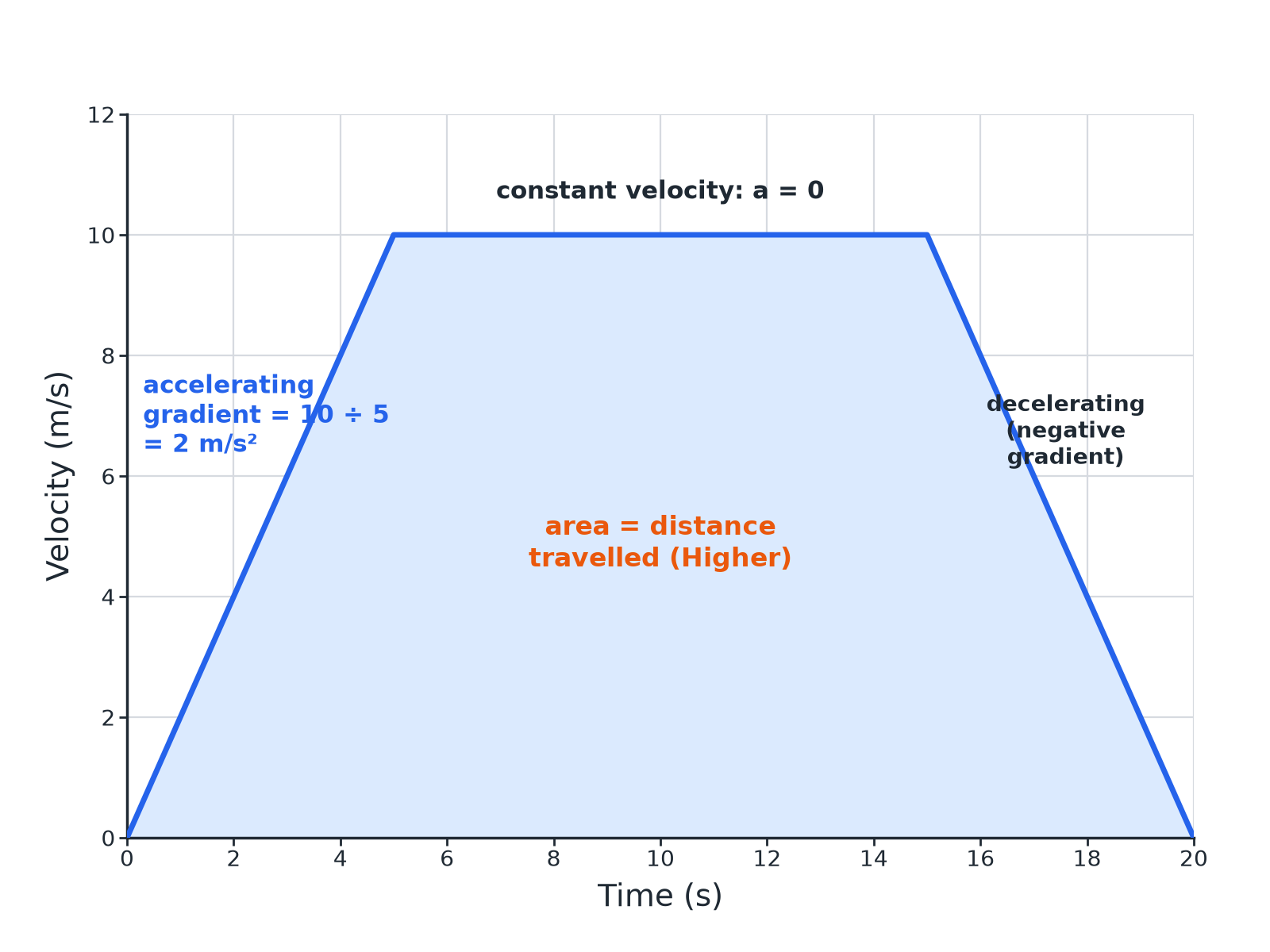
Gradient = acceleration; area = distance.
Calculating Acceleration
A car accelerates from rest to 12 m/s in 4.0 s. Calculate its acceleration.
Show the solutionHide the solution
- 1 Change in velocity \(12 - 0 = 12\) m/s
- 2 Substitute \(a = 12 \div 4.0\)
- 3 Answer \(a = 3.0\) m/s²
Answer3.0 m/s²
Using v² − u² = 2as
A car starts at 10 m/s and accelerates at 2.0 m/s² over a distance of 100 m. Calculate the final speed.
Show the solutionHide the solution
- 1 Write the equation \(v^2 - u^2 = 2as\)
- 2 Substitute \(v^2 - 10^2 = 2 \times 2.0 \times 100\)
- 3 Rearrange \(v^2 = 100 + 400 = 500\)
- 4 Square root \(v = 22.4\) m/s
Answer22 m/s (2 s.f.)
Area Under a Graph (Higher)
Use the graph (accelerating from 0 to 10 m/s in 5 s, constant for 10 s, then stopping in 5 s) to find the distance travelled.
Show the solutionHide the solution
- 1 Section 1 (triangle) \(\tfrac{1}{2} \times 5 \times 10 = 25\) m
- 2 Section 2 (rectangle) \(10 \times 10 = 100\) m
- 3 Section 3 (triangle) \(\tfrac{1}{2} \times 5 \times 10 = 25\) m
- 4 Total \(25 + 100 + 25 = 150\) m
Answer150 m
Free Fall
A ball is dropped from rest from a height of 20 m. Ignoring air resistance, calculate its speed on landing. a = 9.8 m/s².
Show the solutionHide the solution
- 1 Write the equation \(v^2 = 2as\)
- 2 Substitute \(v^2 = 2 \times 9.8 \times 20 = 392\)
- 3 Answer \(v = 19.8\) m/s
Answer19.8 m/s
Reading the Graph
Key features.
-
Gradient
The acceleration; negative gradient means deceleration.
-
Horizontal line
Constant velocity (zero acceleration).
-
Area
Distance travelled (Higher tier); count squares for curves.
-
Units
m/s for velocity, m/s² for acceleration.
Acceleration Practice
A train slows from 30 m/s to 10 m/s in 50 s. Calculate its acceleration. What does the sign tell you?
1. Change in velocity.
2. Divide by time.
A good answer shows: a = (10 − 30) ÷ 50 = −0.40 m/s². The negative value shows deceleration.
Can I...?
- 1Recall a = Δv ÷ t.
- 2Calculate acceleration.
- 3Use the gradient of a v–t graph.
- 4Use the area under a v–t graph.
- 5Use \(v^2 - u^2 = 2as\).
- 6Estimate everyday accelerations.
- 7Give units.
- 8Read a graph.
Summary & Exam Focus
- \(a = \Delta v \div t\).
- \(v^2 - u^2 = 2as\).
- v–t gradient = acceleration; area = distance.
- Free fall: a ≈ 9.8 m/s².
Exam focus
A car accelerates from rest to 12 m/s in 4.0 s. Calculate the acceleration. (2 marks) (2 marks)
Divide the change in velocity by time.
Key terms
The vocabulary this lesson expects you to use. Each one is linked from the first place it appears above.
- Acceleration
- The rate of change of velocity.
- Deceleration
- Slowing down.
- Velocity–time graph
- A graph of velocity against time.
- Uniform acceleration
- Constant acceleration.
- Free fall
- Falling under gravity alone.
- Gradient
- How steep a line is.
Questions and answers
10 questions set on this lesson, with the mark schemes and model answers open.
A car accelerates from rest to a velocity of 12 m/s in 4.0 s. Calculate the acceleration of the car. Use the equation: acceleration = change in velocity ÷ time taken
Mark scheme — 2 marks available
- Correct substitution — 1 mark
- 3.0 m/s² — 1 mark
Model answer
\(12 \div 4.0 = 3.0\) m/s²
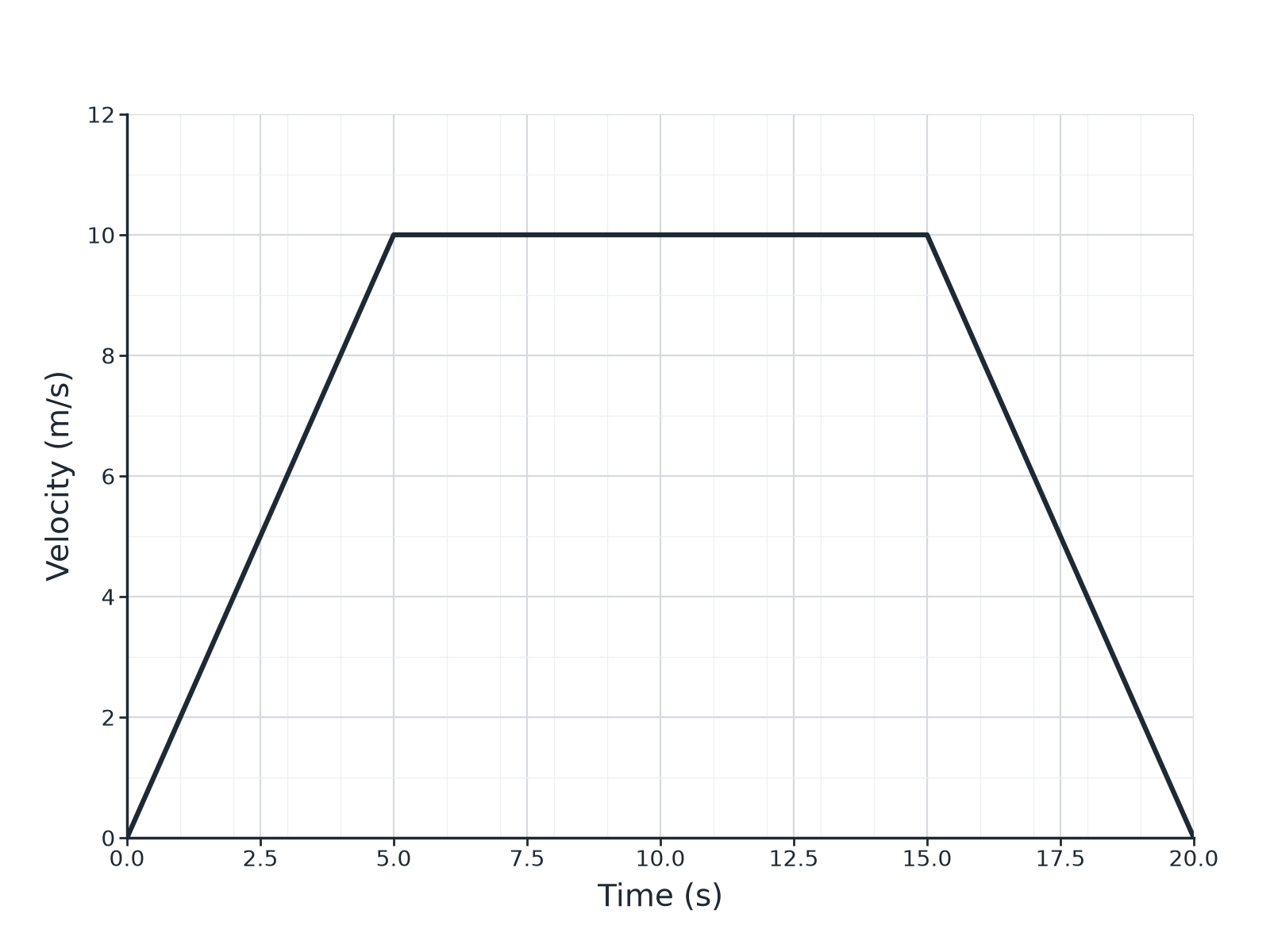
The graph shows the velocity of a cyclist. (a) Calculate the acceleration in the first 5 s. (b) Describe the motion between 5 s and 15 s.
Mark scheme — 4 marks available
- Change in velocity 10 m/s — 1 mark
- 2.0 m/s² — 1 mark
- Constant velocity — 1 mark
- 10 m/s — 1 mark
Model answer
(a) \(10 \div 5 = 2.0\) m/s². (b) Constant velocity of 10 m/s (zero acceleration).
A car starts at 10 m/s and accelerates uniformly at 2.0 m/s² over a distance of 100 m. Calculate its final velocity. Use the equation: (final velocity)² − (initial velocity)² = 2 × acceleration × distance
Mark scheme — 3 marks available
- Correct substitution — 1 mark
- v² = 500 — 1 mark
- 22 m/s — 1 mark
Model answer
\(v^2 = 10^2 + 2 \times 2.0 \times 100 = 500\); \(v = 22\) m/s (22.4)
Use the velocity–time graph in question 2 to calculate the total distance travelled by the cyclist.
Mark scheme — 3 marks available
- Areas of the three sections — 1 mark
- 25 + 100 + 25 — 1 mark
- 150 m — 1 mark
Model answer
Area = ½ × 5 × 10 + 10 × 10 + ½ × 5 × 10 = 25 + 100 + 25 = 150 m.
A ball is dropped from rest from a height of 20 m. Assume no air resistance. The acceleration of free fall is 9.8 m/s². Calculate the speed of the ball when it lands.
Mark scheme — 3 marks available
- Uses v² = 2as — 1 mark
- 392 — 1 mark
- 19.8 m/s — 1 mark
Model answer
\(v^2 = 2 \times 9.8 \times 20 = 392\); \(v = 19.8\) m/s
The unit of acceleration is...
Why: Metres per second squared.
Acceleration is the gradient of a...
Why: Change in velocity per second.
From 0 to 20 m/s in 5 s gives...
Why: 20 ÷ 5.
A negative gradient on a v–t graph shows...
Why: The velocity is falling.
Free fall near Earth has acceleration about...
Why: The acceleration due to gravity.