Viewing as
Teacher view: planning notes, the answers to every question, and the teacher copies of the files.
Physics · Forces
Distance, displacement, speed and velocity
Distinguish distance and displacement, speed and velocity, recall typical speeds, and use \(s = vt\).
Teacher resources
The teacher copies: slides with the questions built in, the answers, and anything else attached to this lesson for whoever is teaching it.
- Distance displacement speed and velocity - Teacher Slides.pptx Teacher The lesson slides with the teacher's notes on each slide, and every question and mark scheme built in. Built from the lesson script on 30 September 2026. View
- Distance displacement speed and velocity - Teacher Notes.docx Teacher The complete notes with the teacher's notes and every model answer in full. Built from the lesson script on 30 September 2026. View
Student handouts
The same files the students see, to print or hand out.
- Distance displacement speed and velocity.pptx Built from the lesson script on 30 September 2026. View
- Distance displacement speed and velocity - Completed Notes.docx The full notes for the lesson, to revise from. Built from the lesson script on 30 September 2026. View
- Distance displacement speed and velocity - Exam Questions.docx Built from the lesson script on 30 September 2026. View
Warm-up
Answer each one, then check.
-
1
What is the unit of speed?
Show answerHide answer
Metres per second (m/s)
-
2
What is speed?
Show answerHide answer
How fast something moves
-
3
What is a vector?
Show answerHide answer
A quantity with size and direction
-
4
What is a scalar?
Show answerHide answer
A quantity with size only
-
5
Convert 2 minutes to seconds.
Show answerHide answer
120 s
Learning Objectives
- 1Distinguish distance (scalar) from displacement (vector).
- 2Distinguish speed from velocity.
- 3Recall typical speeds and use a speed = distance ÷ time.
- 4Recall and apply \(s = vt\) and calculate average speed.
- 5Explain qualitatively that circular motion has constant speed but changing velocity (Higher tier).
SPEED AND VELOCITY
distance travelled \(=\) speed \(\times\) time \(s = vt\)
Distance and speed are scalars. Displacement and velocity are vectors: velocity is speed in a given direction.
Distance and Displacement
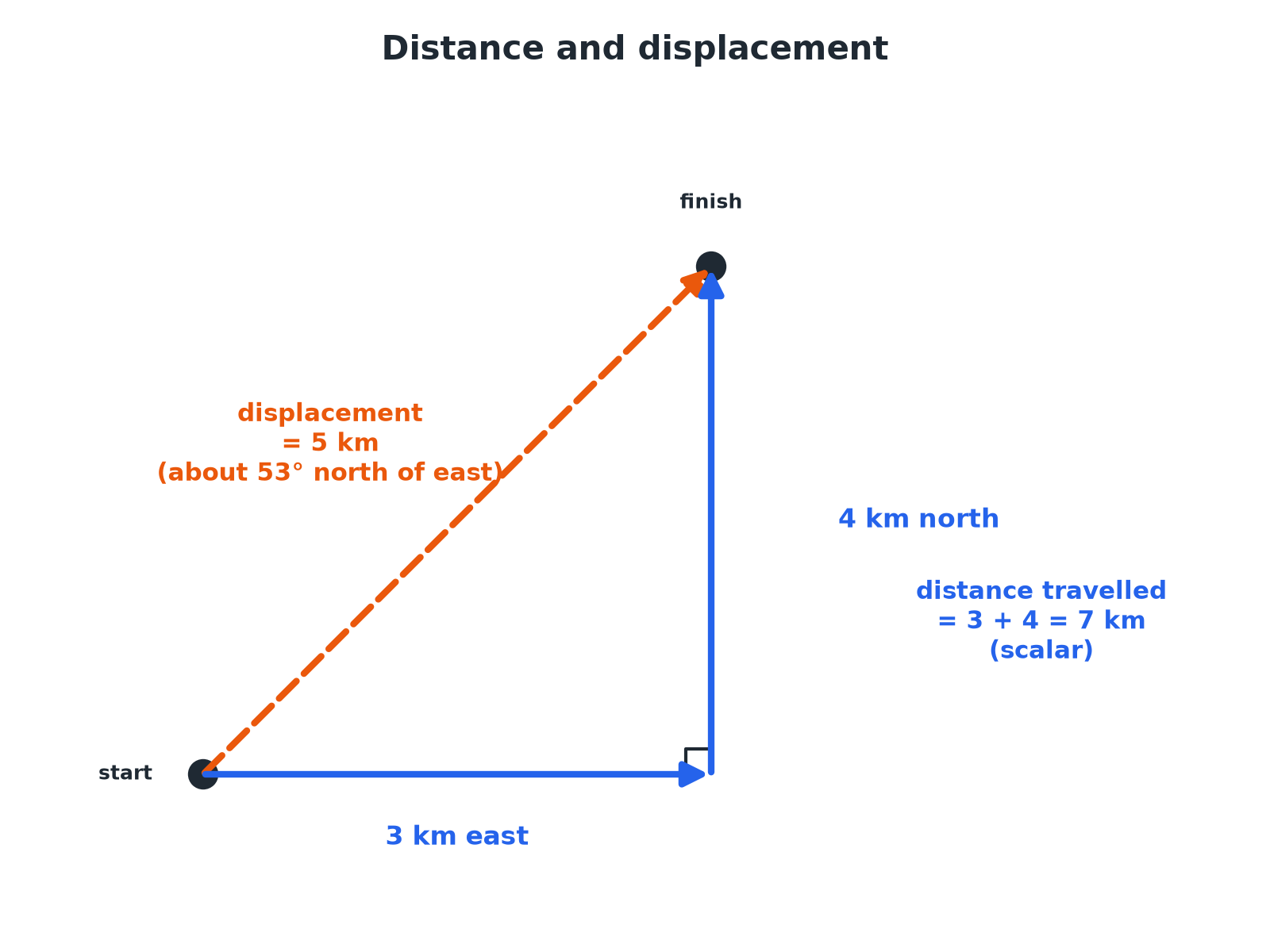
Displacement is the straight-line distance with its direction.
Typical Speeds
Learn these values.
-
Walking
Typical speed (m/s): 1.5
-
Running
Typical speed (m/s): 3
-
Cycling
Typical speed (m/s): 6
-
Car
Typical speed (m/s): 25
-
Train
Typical speed (m/s): 55
-
Plane
Typical speed (m/s): 250
-
Sound in air
Typical speed (m/s): 330
Distance from Speed
A runner travels at 3.0 m/s for 2.0 minutes. How far do they run?
Show the solutionHide the solution
- 1 Convert time \(2.0\) min \(= 120\) s
- 2 Substitute \(s = vt = 3.0 \times 120\)
- 3 Answer \(s = 360\) m
Answer360 m
Average Speed
A cyclist travels 1500 m in 5.0 minutes. Calculate the average speed.
Show the solutionHide the solution
- 1 Convert time \(5.0\) min \(= 300\) s
- 2 Rearrange \(v = s \div t\)
- 3 Answer \(v = 1500 \div 300 = 5.0\) m/s
Answer5.0 m/s
Distance and Displacement
A person walks 3 km east then 4 km north. Find the distance travelled and the displacement.
Show the solutionHide the solution
- 1 Distance \(3 + 4 = 7\) km
- 2 Displacement \(\sqrt{3^2 + 4^2} = 5\) km
- 3 Direction About 53° north of east
AnswerDistance 7 km; displacement 5 km at 53° north of east.
Circular Motion (Higher)
A car drives round a roundabout at a constant 10 m/s. Explain whether its velocity is constant.
Show the solutionHide the solution
- 1 Speed Constant at 10 m/s
- 2 Direction The direction of travel keeps changing
- 3 Velocity A vector, so a change in direction is a change in velocity
AnswerThe speed is constant but the velocity changes because the direction changes.
Practical Measurement
Measure speed.
-
Measure
Use a ruler or tape measure for distance and a stopwatch (or light gates) for time.
-
Average speed
Total distance divided by total time.
-
Non-uniform motion
Real motion rarely has constant speed, so calculate an average.
-
Variation
Speed depends on age, terrain, fitness and distance.
Journey Times
A car travels 120 km in 1.5 hours. Calculate its average speed in km/h and in m/s. How long would sound take to travel 660 m?
1. Convert units.
2. Use v = s ÷ t.
A good answer shows: 80 km/h; 80 ÷ 3.6 = 22 m/s. Sound: t = 660 ÷ 330 = 2.0 s.
Can I...?
- 1Define distance and displacement.
- 2Define speed and velocity.
- 3Use \(s = vt\).
- 4Calculate average speed.
- 5Recall typical speeds.
- 6Convert units.
- 7Explain circular motion.
- 8Give direction for a vector.
Summary & Exam Focus
- \(s = vt\).
- Displacement and velocity are vectors.
- Speed of sound in air about 330 m/s.
- Circular motion: constant speed, changing velocity.
Exam focus
A runner travels at 3.0 m/s for 120 s. Calculate the distance. (2 marks) (2 marks)
Multiply speed by time.
Key terms
The vocabulary this lesson expects you to use. Each one is linked from the first place it appears above.
- Distance
- How far an object moves; a scalar.
- Displacement
- Distance in a straight line from start to finish with direction; a vector.
- Speed
- Distance travelled per unit time; a scalar.
- Velocity
- Speed in a given direction; a vector.
- Average speed
- Total distance divided by total time.
- Uniform motion
- Motion at constant speed in a straight line.
Questions and answers
10 questions set on this lesson, with the mark schemes and model answers open.
A runner travels at a steady speed of 3.0 m/s for 120 s. Calculate the distance travelled. Use the equation: distance travelled = speed × time
Mark scheme — 2 marks available
- Correct substitution — 1 mark
- 360 m — 1 mark
Model answer
\(3.0 \times 120 = 360\) m
A cyclist travels 1500 m in 5.0 minutes. Calculate the average speed in m/s.
Mark scheme — 3 marks available
- Converts to 300 s — 1 mark
- Correct substitution — 1 mark
- 5.0 m/s — 1 mark
Model answer
\(t = 300\) s; \(v = 1500 \div 300 = 5.0\) m/s
Explain the difference between distance and displacement.
Mark scheme — 2 marks available
- Distance: how far, no direction — 1 mark
- Displacement: straight line with direction — 1 mark
Model answer
Distance is how far an object moves (a scalar). Displacement is the straight-line distance from the start to the finish in a particular direction (a vector).
A person walks 3 km east and then 4 km north. Calculate (a) the distance travelled (b) the magnitude of the displacement.
Mark scheme — 3 marks available
- 7 km — 1 mark
- Pythagoras — 1 mark
- 5 km — 1 mark
Model answer
(a) 7 km. (b) \(\sqrt{3^2 + 4^2} = 5\) km.
A car travels round a roundabout at a constant speed. Explain why its velocity is changing.
Mark scheme — 3 marks available
- Velocity is a vector — 1 mark
- Direction changes — 1 mark
- So velocity changes with constant speed — 1 mark
Model answer
Velocity is speed in a given direction. The car's direction keeps changing, so its velocity changes even though the speed is constant.
Which is a vector?
Why: It has direction.
A typical walking speed is about...
Why: About 1.5 m/s.
The speed of sound in air is about...
Why: Typical value.
A car at 20 m/s for 10 s travels...
Why: 20 × 10.
Average speed is...
Why: Use the whole journey.