Viewing as
Teaching this? The teacher view adds 2 files, the mark schemes and the model answers.
Physics · Forces
Momentum and its conservation
Use \(p = mv\), and apply conservation of momentum to collisions and explosions (Higher tier).
Warm-up
Answer each one, then check.
-
1
What is velocity?
Show answerHide answer
Speed in a given direction
-
2
What is mass?
Show answerHide answer
The amount of matter in an object
-
3
What is a closed system?
Show answerHide answer
A system with no external forces or energy transfer
-
4
What does conserved mean?
Show answerHide answer
Stays the same in total
-
5
What is a collision?
Show answerHide answer
When two objects hit each other
Learning Objectives
- 1Define momentum and recall the equation.
- 2State the principle of conservation of momentum.
- 3Calculate momentum before and after collisions and explosions.
- 4Explain examples such as collisions using momentum.
MOMENTUM
momentum \(=\) mass \(\times\) velocity \(p = mv\)
In a closed system the total momentum before an event is equal to the total momentum after the event. Momentum is a vector, measured in kg m/s.
A Collision
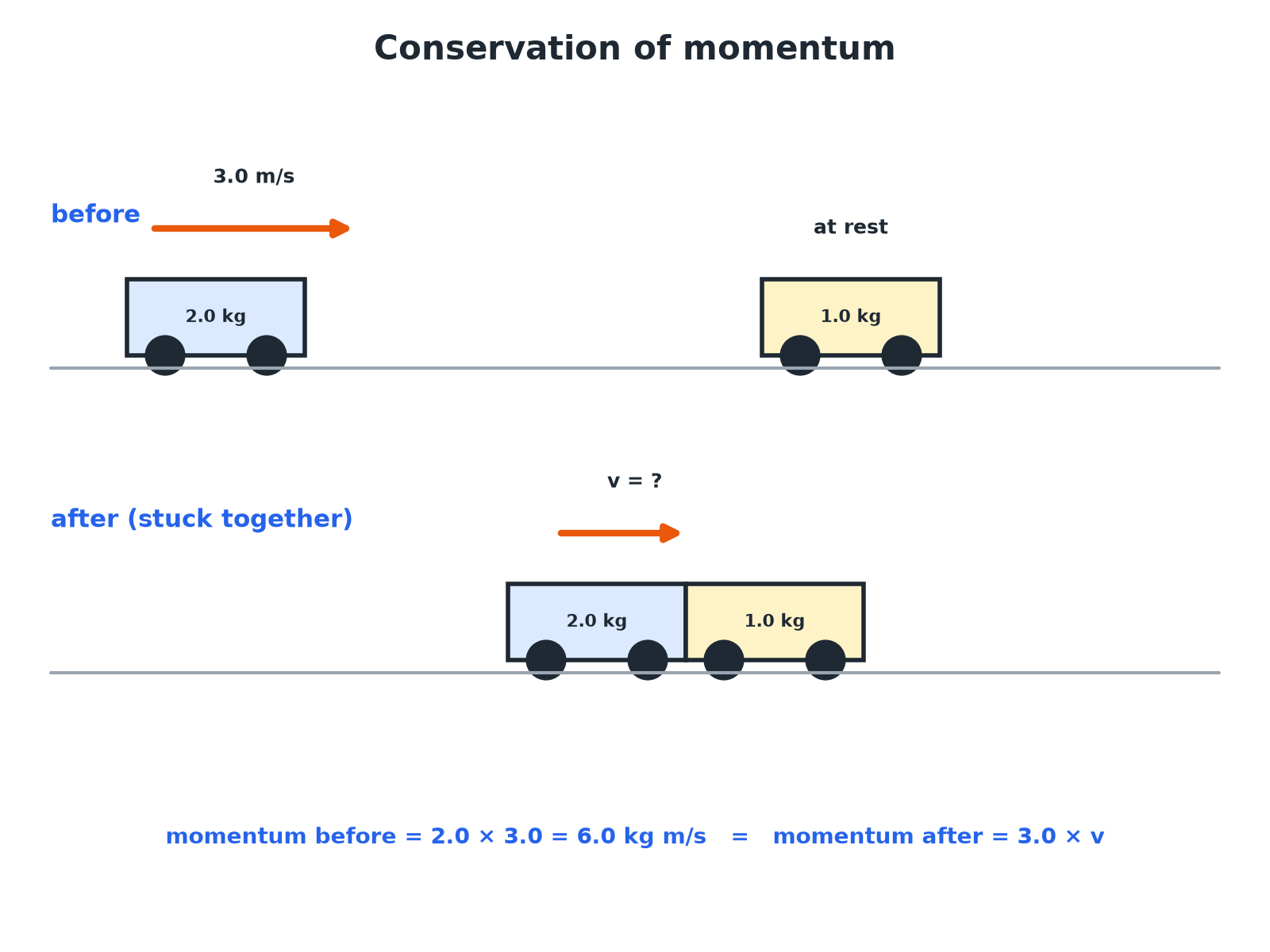
Momentum before = momentum after.
Calculating Momentum
A car of mass 1500 kg moves at 20 m/s. Calculate its momentum.
Show the solutionHide the solution
- 1 Write the equation \(p = mv\)
- 2 Substitute \(p = 1500 \times 20\)
- 3 Answer \(p = 30\,000\) kg m/s
Answer30 000 kg m/s
Collision: Objects Stick Together
A 2.0 kg trolley moving at 3.0 m/s hits a stationary 1.0 kg trolley. They stick together. Calculate their velocity after the collision.
Show the solutionHide the solution
- 1 Momentum before \(2.0 \times 3.0 + 1.0 \times 0 = 6.0\) kg m/s
- 2 Momentum after \((2.0 + 1.0) \times v = 3.0v\)
- 3 Conservation \(3.0v = 6.0\)
- 4 Answer \(v = 2.0\) m/s
Answer2.0 m/s in the original direction.
Explosion
A 4.0 kg gun fires a 0.020 kg bullet at 200 m/s. Calculate the recoil velocity of the gun.
Show the solutionHide the solution
- 1 Momentum before 0 (both at rest)
- 2 Bullet \(0.020 \times 200 = 4.0\) kg m/s forwards
- 3 Gun \(4.0 \times v = -4.0\)
- 4 Answer \(v = -1.0\) m/s
Answer1.0 m/s backwards.
Key Ideas
Use direction carefully.
-
Vector
Choose a positive direction; motion the other way is negative.
-
Closed system
No external forces (such as friction) act.
-
Kinetic energy
Not always conserved in collisions; momentum is.
-
Units
kg m/s.
Stick Together
A 1.5 kg trolley moving at 2.0 m/s collides with a stationary 0.50 kg trolley and they stick together. Find the velocity after the collision.
1. Find the total momentum before.
2. Divide by the total mass.
A good answer shows: Momentum before = 3.0; after (2.0 kg) v = 1.5 m/s.
Can I...?
- 1Define momentum.
- 2Use \(p = mv\).
- 3State conservation of momentum.
- 4Solve a sticking collision.
- 5Solve a recoil problem.
- 6Use positive and negative directions.
- 7Explain momentum in collisions.
- 8Give units.
Summary & Exam Focus
- \(p = mv\).
- Closed system: momentum before = momentum after.
- Momentum is a vector.
- Explosion from rest: total momentum zero.
Exam focus
A car of mass 1500 kg moves at 20 m/s. Calculate its momentum. (2 marks) (2 marks)
Multiply mass by velocity.
Key terms
The vocabulary this lesson expects you to use. Each one is linked from the first place it appears above.
- Momentum
- Mass multiplied by velocity.
- Conservation of momentum
- Total momentum before an event equals total momentum after in a closed system.
- Closed system
- A system with no external forces.
- Collision
- Two objects hitting each other.
- Recoil
- The backward movement of a gun when fired.
- Explosion
- When objects push apart from rest.
Practice questions
Have a go at each one before you open its answer.
-
Question 1 Calculate 2 marks
A car of mass 1500 kg travels at 20 m/s. Calculate the momentum of the car. Use the equation: momentum = mass × velocity
Show answerHide answer
Model answer
\(1500 \times 20 = 30\,000\) kg m/s
Mark scheme
- Correct substitution — 1 mark
- 30 000 kg m/s — 1 mark
-
Question 2 Calculate 4 marks
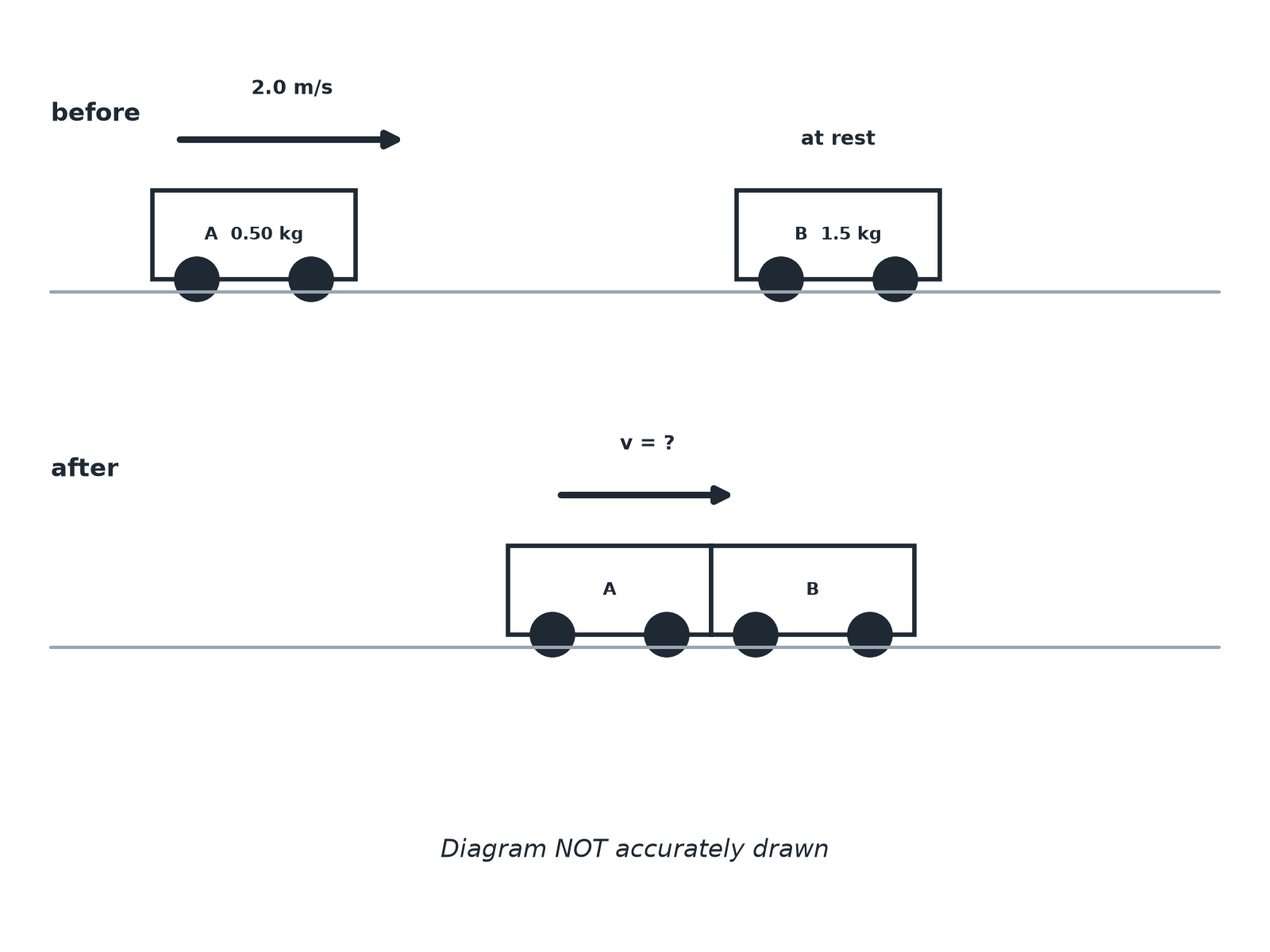
The diagram shows a trolley A colliding with a stationary trolley B. After the collision they stick together. Calculate the velocity of the trolleys after the collision.
Show answerHide answer
Model answer
Momentum before \(= 0.50 \times 2.0 + 0 = 1.0\) kg m/s. After: \((0.50 + 1.5) \times v = 1.0\), so \(v = 0.50\) m/s
Mark scheme
- Momentum before 1.0 kg m/s — 1 mark
- Total mass 2.0 kg — 1 mark
- Equates momentum — 1 mark
- 0.50 m/s — 1 mark
-
Question 3 Explain 3 marks
A moving ball hits a stationary ball and they move apart. Use the idea of conservation of momentum to explain what happens to the total momentum.
Show answerHide answer
Model answer
In a closed system the total momentum before the collision equals the total momentum after; momentum is transferred from the first ball to the second.
Mark scheme
- Total momentum before equals after — 1 mark
- Closed system — 1 mark
- Momentum transferred between the balls — 1 mark
-
Question 4 Calculate 4 marks
A gun of mass 4.0 kg fires a bullet of mass 0.020 kg at a speed of 200 m/s. Calculate the recoil speed of the gun.
Show answerHide answer
Model answer
Momentum of bullet \(= 0.020 \times 200 = 4.0\) kg m/s. Gun: \(4.0 \times v = 4.0\), so \(v = 1.0\) m/s (opposite direction)
Mark scheme
- Momentum of bullet 4.0 kg m/s — 1 mark
- Total momentum before is zero — 1 mark
- Equates momentum — 1 mark
- 1.0 m/s backwards — 1 mark
-
Question 5 Explain 2 marks
Explain why momentum is a vector quantity.
Show answerHide answer
Model answer
It has both magnitude (mass × speed) and direction (the direction of the velocity).
Mark scheme
- Mass times velocity — 1 mark
- Has direction — 1 mark
Quick check
-
Momentum is calculated by...
Show answerHide answer
D: mass × velocity
p = mv.
-
A 2 kg object at 5 m/s has a momentum of...
Show answerHide answer
A: 10 kg m/s
2 × 5.
-
In a closed system the total momentum is...
Show answerHide answer
B: conserved
Before = after.
-
Momentum is a...
Show answerHide answer
C: vector
It has direction.
-
A gun recoils because...
Show answerHide answer
D: momentum is conserved
The bullet gains momentum forwards so the gun gains it backwards.
Downloads
Free to keep, print and annotate.
- Momentum and its conservation.pptx Built from the lesson script on 30 September 2026. View
- Momentum and its conservation - Completed Notes.docx The full notes for the lesson, to revise from. Built from the lesson script on 30 September 2026. View
- Momentum and its conservation - Exam Questions.docx Built from the lesson script on 30 September 2026. View
Something here looks wrong?
Tell us what and we will go and look. It goes to whoever writes these pages, nobody else, and we do not ask who you are — so there is nothing to sign and nothing comes back to you.