Viewing as
Teacher view: planning notes, the answers to every question, and the teacher copies of the files.
Physics · Forces
Scalars, vectors and forces
Distinguish scalar and vector quantities, describe contact and non-contact forces, and represent forces as vectors.
Teacher resources
The teacher copies: slides with the questions built in, the answers, and anything else attached to this lesson for whoever is teaching it.
- Scalars vectors and forces - Teacher Slides.pptx Teacher The lesson slides with the teacher's notes on each slide, and every question and mark scheme built in. Built from the lesson script on 30 September 2026. View
- Scalars vectors and forces - Teacher Notes.docx Teacher The complete notes with the teacher's notes and every model answer in full. Built from the lesson script on 30 September 2026. View
Student handouts
The same files the students see, to print or hand out.
- Scalars vectors and forces.pptx Built from the lesson script on 30 September 2026. View
- Scalars vectors and forces - Completed Notes.docx The full notes for the lesson, to revise from. Built from the lesson script on 30 September 2026. View
- Scalars vectors and forces - Exam Questions.docx Built from the lesson script on 30 September 2026. View
Warm-up
Answer each one, then check.
-
1
What is a force?
Show answerHide answer
A push or a pull
-
2
What is the unit of force?
Show answerHide answer
The newton (N)
-
3
Give an example of a quantity with direction.
Show answerHide answer
Velocity
-
4
What is friction?
Show answerHide answer
A force that opposes motion between surfaces
-
5
What does a longer arrow mean on a force diagram?
Show answerHide answer
A bigger force
Learning Objectives
- 1Distinguish scalar quantities from vector quantities.
- 2Represent a vector using an arrow.
- 3Describe contact and non-contact forces with examples.
- 4Describe the interaction between pairs of objects that produce a force on each object.
SCALARS AND VECTORS
Scalar quantities have magnitude only. Vector quantities have magnitude and direction.
A vector is drawn as an arrow: the length shows the magnitude and the arrowhead shows the direction. Force is a vector quantity.
Forces as Vectors
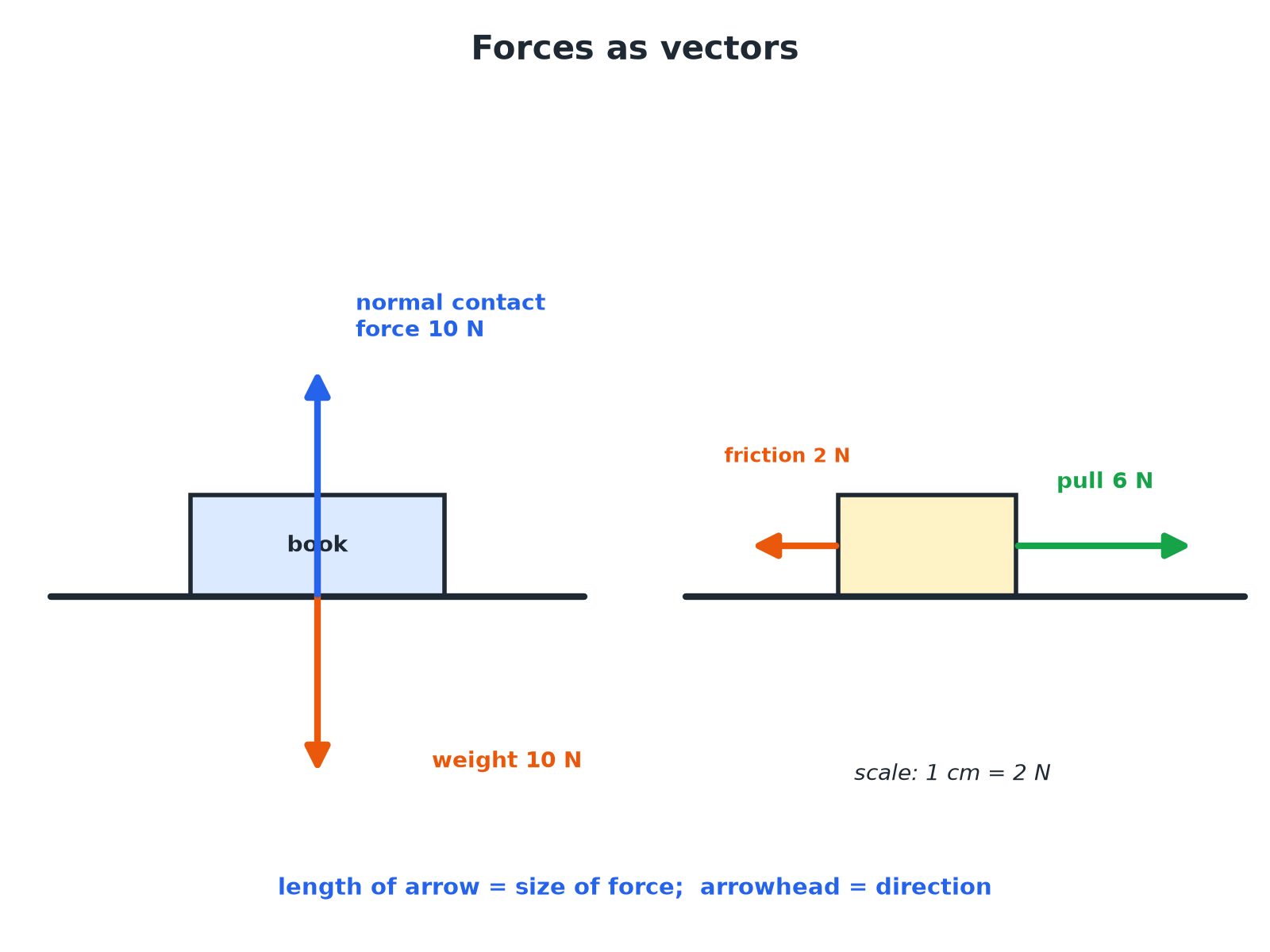
The longer the arrow, the larger the force.
Scalar or Vector?
Learn which is which.
-
Distance
Vector (size and direction): Displacement
-
Speed
Vector (size and direction): Velocity
-
Mass
Vector (size and direction): Force and weight
-
Energy, time, temperature
Vector (size and direction): Acceleration and momentum
Contact or Non-contact?
Contact forces (objects touching)
- Friction.
- Air resistance.
- Tension.
- Normal contact force.
Non-contact forces (objects separated)
- Gravitational force.
- Electrostatic force.
- Magnetic force.
Drawing a Force Vector
Draw an arrow to represent a force of 6 N to the right. Use a scale of 1 cm = 2 N.
Show the solutionHide the solution
- 1 Length \(6 \div 2 = 3\) cm
- 2 Direction An arrowhead pointing right
AnswerA 3 cm arrow pointing to the right.
Interaction Pairs
Two magnets are brought close together with their north poles facing. Describe the forces.
Show the solutionHide the solution
- 1 Force on each magnet Each magnet exerts a force on the other
- 2 Direction Like poles repel, so each force points away from the other magnet
- 3 Type Non-contact, because the magnets are not touching
AnswerEach magnet pushes the other away: equal and opposite non-contact forces.
Key Points
Use the right words.
-
Force is a vector
It has a size in newtons and a direction.
-
Pairs of forces
When two objects interact, each exerts a force on the other.
-
Scale
Choose a scale so the arrows fit on the page.
-
Examples
Name the force and its direction: 'friction to the left'.
Sort Them
Sort into scalar and vector: mass, velocity, distance, acceleration, time, force. Then say whether each of these forces is contact or non-contact: friction, gravity, magnetic force, tension.
1. Does it have direction?
2. Are the objects touching?
A good answer shows: Scalars: mass, distance, time. Vectors: velocity, acceleration, force. Contact: friction, tension. Non-contact: gravity, magnetic force.
Can I...?
- 1Define scalar and vector.
- 2Give examples of each.
- 3Draw a vector arrow to scale.
- 4List contact forces.
- 5List non-contact forces.
- 6Describe an interaction pair.
- 7Use the word magnitude.
- 8Write force directions.
Summary & Exam Focus
- Scalar: magnitude only. Vector: magnitude and direction.
- Force is a vector.
- Contact: friction, tension, air resistance, normal contact force.
- Non-contact: gravity, electrostatic, magnetic.
Exam focus
State whether velocity is a scalar or a vector quantity. (1 mark) (1 marks)
Vector: it has direction.
Key terms
The vocabulary this lesson expects you to use. Each one is linked from the first place it appears above.
- Scalar
- A quantity with magnitude only.
- Vector
- A quantity with magnitude and direction.
- Contact force
- A force between objects that are touching.
- Non-contact force
- A force between objects that are separated.
- Magnitude
- The size of a quantity.
- Newton
- The unit of force.
Questions and answers
10 questions set on this lesson, with the mark schemes and model answers open.
Give one example of a scalar quantity and one example of a vector quantity.
Mark scheme — 2 marks available
- A scalar quantity — 1 mark
- A vector quantity — 1 mark
Model answer
Scalar: any of distance, speed, mass, time, energy. Vector: any of force, velocity, displacement, acceleration.
Some forces are contact forces and some are non-contact forces. Give one example of each.
Mark scheme — 3 marks available
- Contact example — 1 mark
- Non-contact example — 1 mark
- Correct link to touching or separated — 1 mark
Model answer
Contact: friction, air resistance, tension or normal contact force. Non-contact: gravitational, electrostatic or magnetic force.
A force of 6 N acts to the right on an object. Draw an arrow to represent this force. Use a scale of 1 cm = 2 N.
Mark scheme — 2 marks available
- Length 3 cm — 1 mark
- Arrowhead pointing right — 1 mark
Model answer
An arrow 3 cm long pointing to the right.
Explain the difference between speed and velocity.
Mark scheme — 2 marks available
- Speed has no direction — 1 mark
- Velocity has direction — 1 mark
Model answer
Speed is a scalar: it has magnitude only. Velocity is a vector: it has both magnitude and direction.
A book rests on a table. Describe the forces acting on the book. State the type of each force.
Mark scheme — 3 marks available
- Weight downwards, non-contact gravitational — 1 mark
- Normal contact force upwards, contact — 1 mark
- Equal in size or balanced — 1 mark
Model answer
The weight of the book acts downwards (a non-contact gravitational force). The normal contact force from the table acts upwards (a contact force). The two forces are equal in size.
Which of these is a vector?
Why: It has direction.
Which is a contact force?
Why: The objects are touching.
Which is a scalar quantity?
Why: It has no direction.
The length of a force arrow shows the...
Why: Longer means bigger.
Gravitational force is a...
Why: Objects do not need to touch.