Viewing as
Teaching this? The teacher view adds 2 files, the mark schemes and the model answers.
Physics · Magnetism and electromagnetism
Poles and magnetic fields
Describe the forces between magnetic poles, the difference between permanent and induced magnets, and the shape and direction of magnetic field lines.
Warm-up
Answer each one, then check.
-
1
Name a magnetic material.
Show answerHide answer
Iron, steel, nickel or cobalt
-
2
What is a force?
Show answerHide answer
A push or a pull
-
3
What is a non-contact force?
Show answerHide answer
A force acting without objects touching
-
4
What do we call the ends of a magnet?
Show answerHide answer
Poles
-
5
What do we use to find north?
Show answerHide answer
A compass
Learning Objectives
- 1Describe the forces between magnetic poles.
- 2Describe permanent and induced magnets.
- 3Describe the magnetic field of a bar magnet and draw its field lines.
- 4Explain how a compass shows the direction of a magnetic field and why it shows the Earth has a magnetic field.
- 5Describe how to plot a magnetic field with a compass.
MAGNETIC POLES
Like poles repel and unlike poles attract. These forces are non-contact forces. A magnetic field is the region around a magnet where a force acts on another magnet or on a magnetic material.
The force is strongest at the poles, where the field lines are closest together. Field lines point from north to south outside the magnet.
Magnetic Field of a Bar Magnet
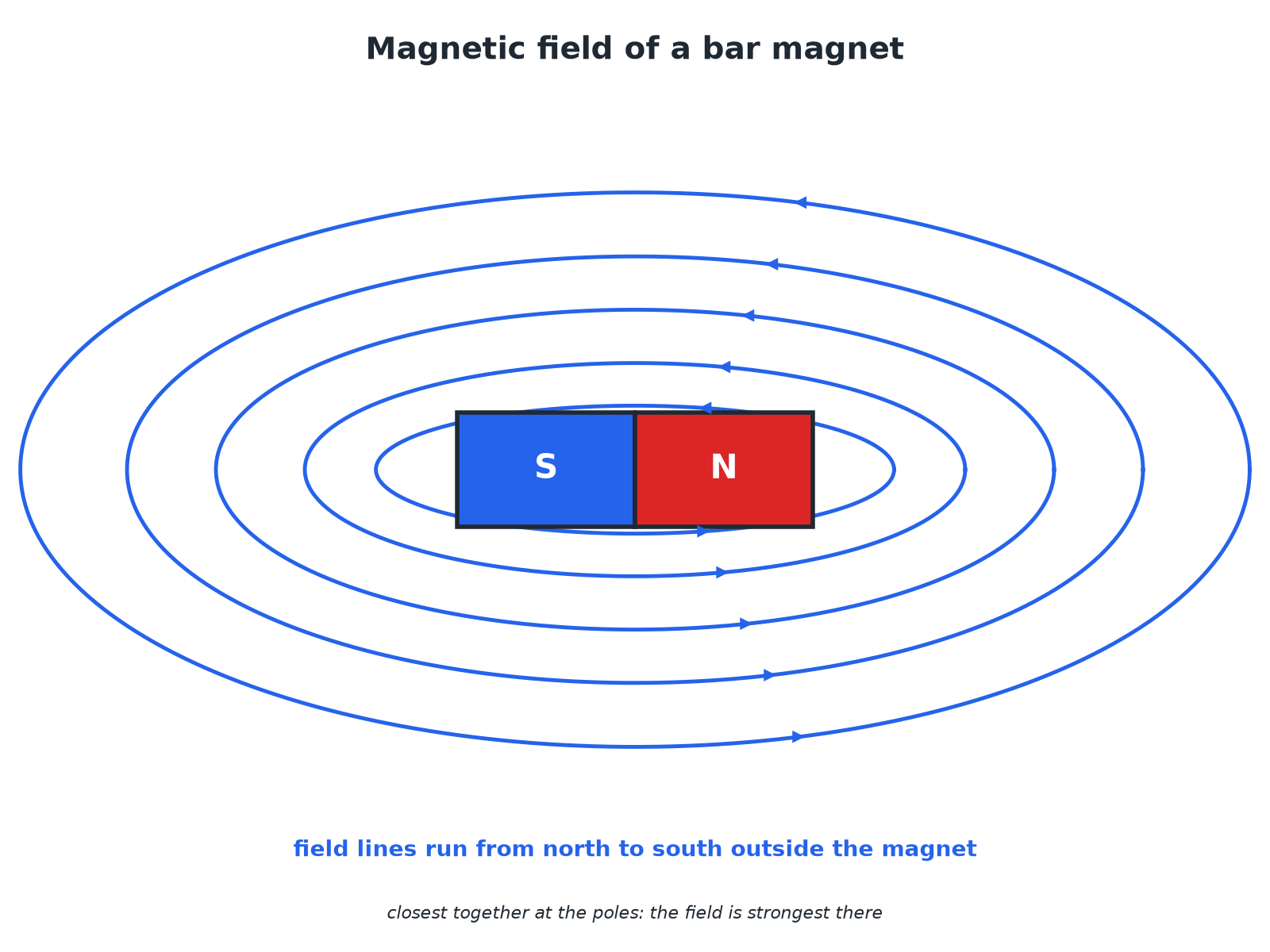
Field lines are closest at the poles.
Plotting a Magnetic Field with a Compass
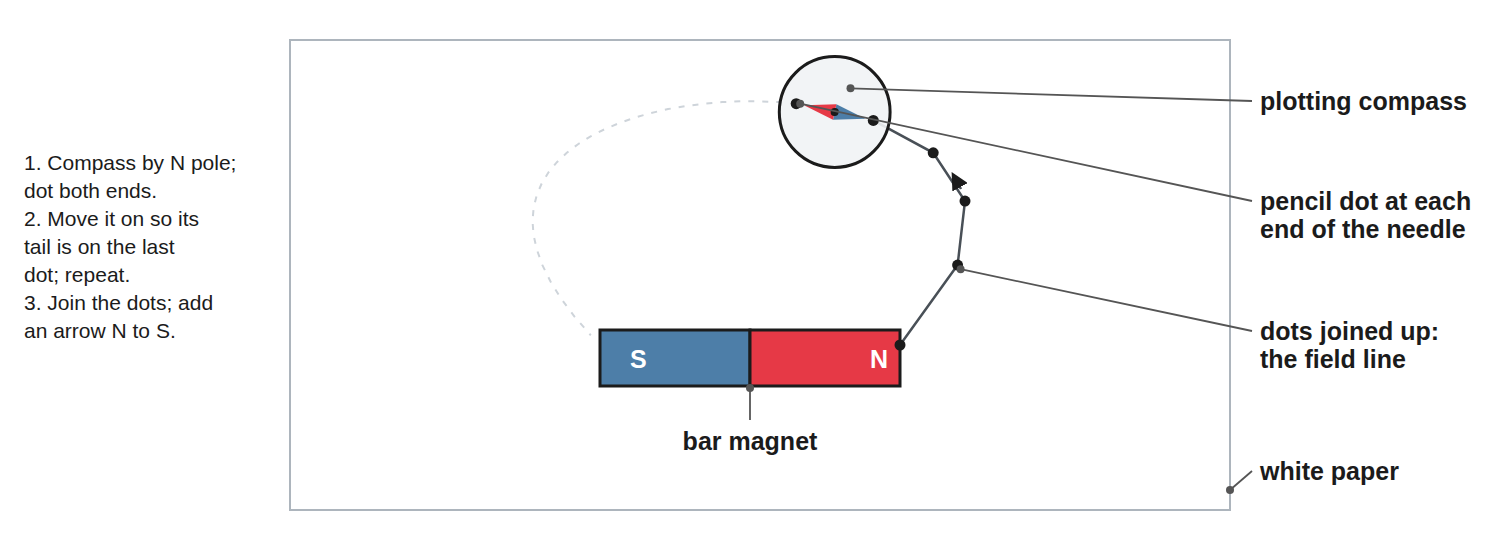
Mark each end of the needle, then move the compass.
Permanent or Induced?
Permanent magnet
- Always has its own magnetic field.
- Made of hard magnetic material.
- Can attract AND repel another magnet.
Induced magnet
- Becomes a magnet only while in another magnetic field.
- Made of a magnetic material such as iron.
- Always ATTRACTED to the magnet; loses most magnetism when removed.
Magnetic Forces
Learn the rules.
-
North and south poles near each other
What happens: Attract
-
Two north poles (or two south poles)
What happens: Repel
-
A magnet near an unmagnetised iron nail
What happens: Nail becomes an induced magnet and is attracted
-
Compass needle near a magnet
What happens: Needle lines up with the field
Why a Compass Points North
Explain why the needle of a compass points towards the Earth's north.
Show the solutionHide the solution
- 1 The compass needle A small bar magnet free to turn
- 2 The Earth Has its own magnetic field, like a giant bar magnet
- 3 Result The needle lines up with the Earth's field and points along it
AnswerThe Earth has a magnetic field and the needle aligns with it.
Key Points
Learn these.
-
Direction
Field lines run from north to south outside the magnet.
-
Strength
Stronger where the lines are closer together.
-
Distance
The field gets weaker as you move away.
-
Magnetic materials
Iron, steel, cobalt and nickel.
Field Lines
Sketch the field lines between a north pole and a south pole facing each other, then between two north poles. Add arrows.
1. Lines leave N, enter S.
2. Lines never cross.
A good answer shows: Between N and S: lines run from N to S across the gap. Between two N poles: lines curve away from each other and never join.
Can I...?
- 1State the rules for poles.
- 2Describe permanent and induced magnets.
- 3Name magnetic materials.
- 4Draw a bar magnet field.
- 5Put arrows on field lines.
- 6Describe a compass.
- 7Explain the Earth's field.
- 8Describe plotting a field.
Summary & Exam Focus
- Like poles repel, unlike poles attract.
- Field lines run north to south.
- Induced magnets are always attracted.
- A compass shows the Earth has a magnetic field.
Exam focus
Explain why an iron nail is attracted to a magnet. (2 marks) (2 marks)
The nail becomes an induced magnet.
Key terms
The vocabulary this lesson expects you to use. Each one is linked from the first place it appears above.
- Magnetic pole
- The end of a magnet where the force is strongest.
- Magnetic field
- The region around a magnet where a force acts on another magnet or a magnetic material.
- Permanent magnet
- A magnet that always produces its own magnetic field.
- Induced magnet
- A material that becomes magnetic only when in a magnetic field.
- Field line
- A line showing the direction of the force on a north pole.
- Compass
- A small magnet that lines up with a magnetic field.
Practice questions
Have a go at each one before you open its answer.
-
Question 1 State 2 marks
State what happens when (a) two north poles are brought together and (b) a north pole and a south pole are brought together.
Show answerHide answer
Model answer
(a) They repel. (b) They attract.
Mark scheme
- Repel — 1 mark
- Attract — 1 mark
-
Question 2 Describe 2 marks
What is the difference between a permanent magnet and an induced magnet?
Show answerHide answer
Model answer
A permanent magnet always has its own magnetic field. An induced magnet becomes a magnet only when it is in another magnetic field, and loses most of its magnetism when removed.
Mark scheme
- Permanent: always magnetic — 1 mark
- Induced: only magnetic in a field — 1 mark
-
Question 3 Explain 3 marks
A student brings one end of a bar of iron near a magnet. The iron is attracted. Explain why the iron is always attracted and never repelled.
Show answerHide answer
Model answer
The iron becomes an induced magnet. The end nearest the magnet becomes the opposite pole to the magnet's pole, and unlike poles attract.
Mark scheme
- Iron becomes an induced magnet — 1 mark
- Nearest end is the opposite pole — 1 mark
- Unlike poles attract — 1 mark
-
Question 4 Describe 4 marks
Describe how you would use a plotting compass to plot the magnetic field of a bar magnet.
Show answerHide answer
Model answer
Place the magnet on paper and draw round it. Put the compass near one pole and mark the positions of both ends of the needle with dots. Move the compass so that one end is on the last dot and mark again. Repeat and join the dots to make a field line. Repeat from different starting points.
Mark scheme
- Magnet on paper, compass near a pole — 1 mark
- Mark both ends of the needle — 1 mark
- Move compass along and repeat; join the dots — 1 mark
- Repeat from other starting points and add arrows from north to south — 1 mark
-
Question 5 Explain 2 marks
A compass needle points north. Explain what this tells you about the Earth.
Show answerHide answer
Model answer
The needle is a magnet and it lines up with the Earth's magnetic field, so the Earth has a magnetic field.
Mark scheme
- Needle lines up with a magnetic field — 1 mark
- The Earth has a magnetic field — 1 mark
Quick check
-
Like magnetic poles...
Show answerHide answer
B: repel
Like poles repel.
-
Field lines outside a magnet go from...
Show answerHide answer
C: north to south
That is the convention.
-
The magnetic field is strongest...
Show answerHide answer
D: near the poles
Lines are closest.
-
An induced magnet is...
Show answerHide answer
A: magnetic only while in a field
It loses magnetism when removed.
-
A compass works because the Earth has...
Show answerHide answer
B: a magnetic field
The needle lines up with it.
Downloads
Free to keep, print and annotate.
- Poles and magnetic fields.pptx Built from the lesson script on 30 September 2026. View
- Poles and magnetic fields - Completed Notes.docx The full notes for the lesson, to revise from. Built from the lesson script on 30 September 2026. View
- Poles and magnetic fields - Exam Questions.docx Built from the lesson script on 30 September 2026. View
Something here looks wrong?
Tell us what and we will go and look. It goes to whoever writes these pages, nobody else, and we do not ask who you are — so there is nothing to sign and nothing comes back to you.