Viewing as
Teacher view: planning notes, the answers to every question, and the teacher copies of the files.
Physics · Space physics
Life cycle of a star
Describe the life cycle of stars of different masses, including main sequence stars, red giants, white dwarfs, supernovae, neutron stars and black holes, and explain how fusion forms the elements (Physics only).
Teacher resources
The teacher copies: slides with the questions built in, the answers, and anything else attached to this lesson for whoever is teaching it.
- Life cycle of a star - Teacher Slides.pptx Teacher The lesson slides with the teacher's notes on each slide, and every question and mark scheme built in. Built from the lesson script on 30 September 2026. View
- Life cycle of a star - Teacher Notes.docx Teacher The complete notes with the teacher's notes and every model answer in full. Built from the lesson script on 30 September 2026. View
Student handouts
The same files the students see, to print or hand out.
- Life cycle of a star.pptx Built from the lesson script on 30 September 2026. View
- Life cycle of a star - Completed Notes.docx The full notes for the lesson, to revise from. Built from the lesson script on 30 September 2026. View
- Life cycle of a star - Exam Questions.docx Built from the lesson script on 30 September 2026. View
Warm-up
Answer each one, then check.
-
1
What does the Sun produce?
Show answerHide answer
Light and heat
-
2
What force pulls matter together?
Show answerHide answer
Gravity
-
3
What is fusion?
Show answerHide answer
Nuclei joining together to form a larger nucleus
-
4
What is the main element in stars?
Show answerHide answer
Hydrogen
-
5
What is a star?
Show answerHide answer
A huge ball of hot gas
Learning Objectives
- 1Describe the life cycle of a star like the Sun and of a star much more massive than the Sun.
- 2Explain how a stable main-sequence star is formed and how it stays stable.
- 3Explain how fusion in stars forms the elements.
- 4Explain how elements heavier than iron are formed.
STARS
A star forms from a nebula pulled together by gravity. In the main sequence, the inward force of gravity is balanced by the outward pressure from fusion energy, so the star is stable. When the hydrogen runs out, the star changes.
The mass of a star decides how it ends: a star like the Sun becomes a white dwarf; a much more massive star explodes as a supernova.
The Life Cycle of Stars
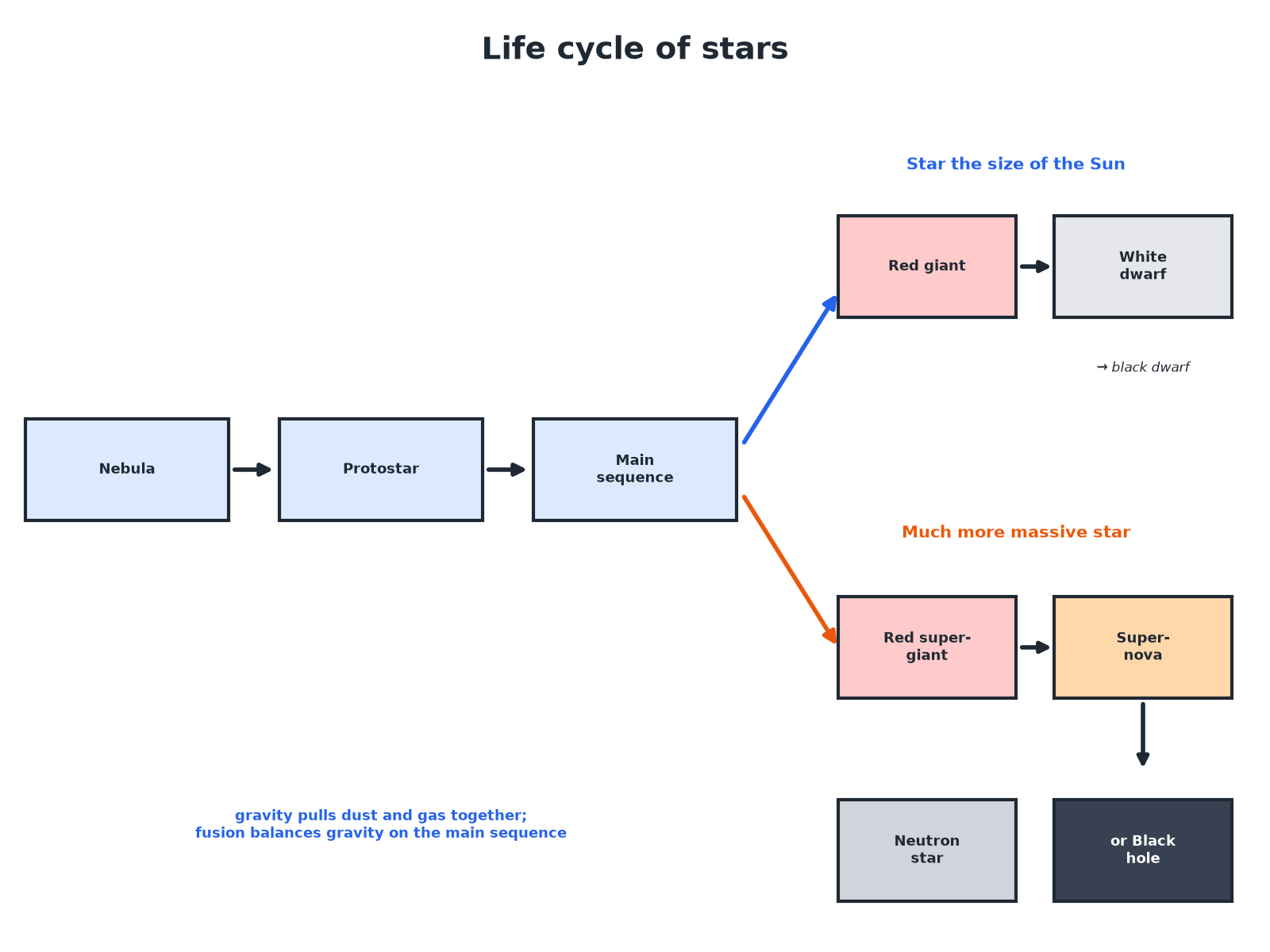
Mass decides the path after the main sequence.
Sun-sized or Massive?
A star like the Sun
- Nebula, protostar, main sequence.
- Expands to a red giant.
- Outer layers drift away; the core shrinks to a white dwarf.
- Cools to a black dwarf.
A much more massive star
- Nebula, protostar, main sequence.
- Expands to a red supergiant.
- Explodes as a supernova.
- Leaves a neutron star or a black hole.
Why a Main Sequence Star Is Stable
Explain why a star stays the same size for billions of years.
Show the solutionHide the solution
- 1 Gravity Pulls the star's matter inwards
- 2 Fusion Hydrogen fuses to helium and releases energy, causing outward pressure
- 3 Balance The forces balance so the star is stable
AnswerInward gravitational force is balanced by outward thermal pressure.
Making the Elements
Explain how heavier elements are formed.
Show the solutionHide the solution
- 1 In stars Nuclear fusion forms elements up to iron
- 2 In a supernova The explosion has enough energy to form elements heavier than iron
- 3 Spread The explosion scatters elements into space; new stars and planets form from them
AnswerFusion makes elements up to iron; supernovae make heavier ones.
Key Points
Learn these.
-
Main sequence
Hydrogen fuses to helium; stable for billions of years.
-
Red giant
Hydrogen runs out; the star expands and cools.
-
Supernova
A massive star explodes.
-
Black hole
An object with gravity so strong that not even light escapes.
Star Story
Write the life story of the Sun and of a star ten times as massive. Where do they differ?
1. Mass controls the ending.
A good answer shows: Sun: nebula, protostar, main sequence, red giant, white dwarf, black dwarf. Massive star: nebula, protostar, main sequence, red supergiant, supernova, neutron star or black hole.
Can I...?
- 1Describe a nebula.
- 2Describe a protostar.
- 3Explain stability.
- 4Follow the Sun's path.
- 5Follow a massive star's path.
- 6Explain fusion and elements.
- 7Define a supernova.
- 8Define a black hole.
Summary & Exam Focus
- Stable when gravity and outward pressure are balanced.
- Sun-sized: red giant, white dwarf, black dwarf.
- Massive: red supergiant, supernova, neutron star or black hole.
- Supernovae form elements heavier than iron.
Exam focus
Describe what happens to a star like the Sun when hydrogen runs out. (3 marks) (3 marks)
Red giant, white dwarf, black dwarf.
Key terms
The vocabulary this lesson expects you to use. Each one is linked from the first place it appears above.
- Nebula
- A cloud of dust and gas from which stars form.
- Main sequence
- The long stable stage of a star's life when hydrogen fuses to helium.
- Red giant
- A large, cool, red star near the end of its life.
- White dwarf
- A small, dense, hot star that is the core of a dead Sun-sized star.
- Supernova
- The explosion of a massive star at the end of its life.
- Black hole
- An object so dense that not even light can escape.
Questions and answers
10 questions set on this lesson, with the mark schemes and model answers open.
Name the stages in the life cycle of a star like our Sun after the main sequence.
Mark scheme — 2 marks available
- Red giant — 1 mark
- White dwarf — 1 mark
Model answer
Red giant, then white dwarf (then black dwarf).
Explain why a star on the main sequence is stable.
Mark scheme — 3 marks available
- Gravity acts inwards — 1 mark
- Fusion energy gives outward pressure — 1 mark
- The forces balance — 1 mark
Model answer
The inward force of gravity is balanced by the outward pressure from the energy released by nuclear fusion, so the star neither collapses nor expands.
Describe the life cycle of a star that is much more massive than the Sun.
Mark scheme — 4 marks available
- Nebula / protostar / main sequence — 1 mark
- Red supergiant — 1 mark
- Supernova — 1 mark
- Neutron star or black hole — 1 mark
Model answer
A cloud of dust and gas collapses under gravity to form a protostar, then a main sequence star. When hydrogen runs out it expands into a red supergiant, then explodes as a supernova, leaving a neutron star or a black hole.
Explain why some elements heavier than iron are found on Earth even though they cannot be made in the main sequence.
Mark scheme — 3 marks available
- Supernova forms heavier elements — 1 mark
- Elements thrown into space — 1 mark
- Incorporated into new stars and planets — 1 mark
Model answer
Elements heavier than iron are made in the explosion of a supernova, which has enough energy. The explosion throws the elements into space, where they form part of new stars and planets.
Explain how the Sun formed and why the Sun is stable.
Mark scheme — 4 marks available
- Gravity pulls dust and gas together — 1 mark
- Fusion begins — 1 mark
- Gravity acts inwards — 1 mark
- Balanced by outward pressure — 1 mark
Model answer
Dust and gas were pulled together by gravity. The star got hot and dense enough for nuclear fusion to start. It is stable as the inward gravitational force balances the outward pressure from fusion energy.
A star forms from a...
Why: A cloud of dust and gas.
The Sun will become a...
Why: Not massive enough.
A massive star ends its life in a...
Why: An explosion.
In the main sequence, hydrogen fuses to make...
Why: Hydrogen to helium.
Elements heavier than iron are made in...
Why: Enough energy.