Viewing as
Teacher view: planning notes, the answers to every question, and the teacher copies of the files.
Physics · Space physics
Red-shift and the Big Bang
Describe red-shift as evidence that the universe is expanding, describe the Big Bang theory, and discuss dark matter and dark energy (Physics only).
Teacher resources
The teacher copies: slides with the questions built in, the answers, and anything else attached to this lesson for whoever is teaching it.
- Red-shift and the Big Bang - Teacher Slides.pptx Teacher The lesson slides with the teacher's notes on each slide, and every question and mark scheme built in. Built from the lesson script on 30 September 2026. View
- Red-shift and the Big Bang - Teacher Notes.docx Teacher The complete notes with the teacher's notes and every model answer in full. Built from the lesson script on 30 September 2026. View
Student handouts
The same files the students see, to print or hand out.
- Red-shift and the Big Bang.pptx Built from the lesson script on 30 September 2026. View
- Red-shift and the Big Bang - Completed Notes.docx The full notes for the lesson, to revise from. Built from the lesson script on 30 September 2026. View
- Red-shift and the Big Bang - Exam Questions.docx Built from the lesson script on 30 September 2026. View
Warm-up
Answer each one, then check.
-
1
What is light?
Show answerHide answer
An electromagnetic wave
-
2
What is wavelength?
Show answerHide answer
Distance between corresponding points on adjacent waves
-
3
What colour has the longest wavelength in visible light?
Show answerHide answer
Red
-
4
What is a galaxy?
Show answerHide answer
A huge group of stars
-
5
What is an ambulance siren's pitch change called?
Show answerHide answer
The Doppler effect
Learning Objectives
- 1Explain the observed red-shift of light from distant galaxies.
- 2Explain why red-shift is evidence that the universe is expanding.
- 3Describe the Big Bang theory.
- 4Explain why the red-shift is greater for more distant galaxies.
- 5Describe dark matter and dark energy.
RED-SHIFT
The light from most distant galaxies is shifted towards the red end of the spectrum: its wavelength is increased. This is red-shift. It shows the galaxies are moving away from us, and that the universe is expanding.
The more distant the galaxy, the greater the red-shift, so the faster it is moving away.
Red-shift
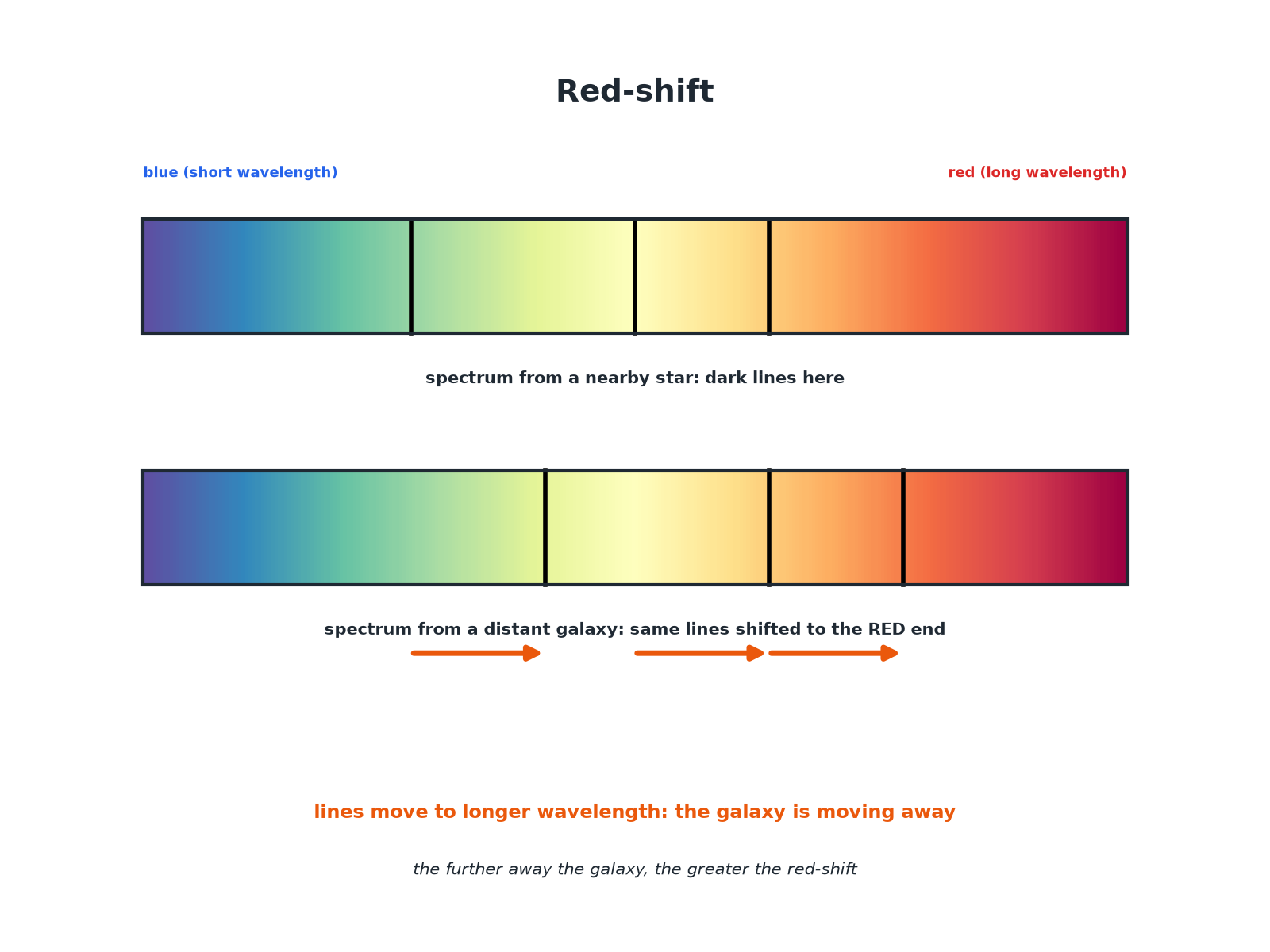
Longer wavelength means redder.
The Big Bang Theory
Follow the steps.
-
1
Start
All the matter and energy in the universe was in a very small, hot, dense point.
-
2
Explosion
It expanded violently about 13.8 billion years ago.
-
3
Expansion
Space itself has been expanding ever since.
-
4
Evidence
Red-shift of galaxies and cosmic microwave background radiation (CMBR).
Evidence for the Big Bang
Learn the two main pieces.
-
Red-shift
What it shows: Galaxies are moving away and the universe is expanding; further galaxies move faster
-
CMBR
What it shows: Leftover microwave radiation from the early universe, in all directions
Red-shift and Distance
Galaxy A has a greater red-shift than galaxy B. What can you conclude?
Show the solutionHide the solution
- 1 Red-shift Greater for A
- 2 Speed A is moving away faster than B
- 3 Distance A is further away than B
AnswerA is moving away faster and is further away than B.
Dark Matter and Dark Energy
What we don't know.
-
Dark matter
Matter we cannot see that explains how galaxies rotate; it interacts gravitationally.
-
Dark energy
A form of energy thought to cause the universe's expansion to accelerate.
-
Open questions
Their nature is not yet understood.
-
Theories change
Scientists keep testing theories with new evidence.
Red-shift Talk
Explain to a partner why red-shift shows that the universe is expanding. Then explain why a galaxy twice as far away seems to move away twice as fast.
1. All galaxies are moving away.
A good answer shows: The wavelengths are lengthened because the galaxies move away; this happens in all directions, so the universe is expanding. Further galaxies show a greater shift, so they move faster.
Can I...?
- 1Define red-shift.
- 2Explain the expansion.
- 3Describe the Big Bang.
- 4Name the evidence.
- 5Explain distance and red-shift.
- 6Define CMBR.
- 7Define dark matter.
- 8Define dark energy.
Summary & Exam Focus
- Light from distant galaxies is shifted to longer wavelengths.
- The universe is expanding.
- Big Bang: small, hot, dense start about 13.8 billion years ago.
- Evidence: red-shift and CMBR.
Exam focus
State what red-shift shows about the universe. (1 mark) (1 marks)
It is expanding.
Key terms
The vocabulary this lesson expects you to use. Each one is linked from the first place it appears above.
- Red-shift
- The increase in the observed wavelength of light from distant galaxies because they are moving away.
- Big Bang theory
- The theory that the universe began from a very small, hot, dense region and has been expanding ever since.
- CMBR
- Cosmic microwave background radiation; leftover microwaves from the early universe.
- Dark matter
- Matter that does not emit light but has gravitational effects.
- Dark energy
- An unknown energy thought to be driving the accelerating expansion of the universe.
- Expanding universe
- The idea that space is getting larger over time.
Questions and answers
10 questions set on this lesson, with the mark schemes and model answers open.
Describe what is meant by red-shift.
Mark scheme — 2 marks available
- Wavelength increases — 1 mark
- Shift towards the red end — 1 mark
Model answer
The wavelength of light from a distant galaxy is longer than expected, shifted towards the red end of the spectrum.
Explain why red-shift is evidence that the universe is expanding.
Mark scheme — 3 marks available
- Red-shift means the galaxies are moving away — 1 mark
- All directions — 1 mark
- Further galaxies move faster — 1 mark
Model answer
Light from distant galaxies is red-shifted, which means the galaxies are moving away from us. Galaxies in all directions are moving away, and the further they are the faster they move, so the universe is expanding.
Describe the Big Bang theory of the origin of the universe.
Mark scheme — 3 marks available
- Small, hot, dense region — 1 mark
- Explosive expansion — 1 mark
- Still expanding — 1 mark
Model answer
All the matter and energy in the universe was originally in a very small, hot, dense region. It expanded explosively about 13.8 billion years ago and has been expanding since.
Two galaxies are observed. Galaxy P has a greater red-shift than galaxy Q. Explain what this shows about P and Q.
Mark scheme — 3 marks available
- P moving away faster — 1 mark
- Greater red-shift means faster recession — 1 mark
- P is further away — 1 mark
Model answer
P is moving away from us faster than Q. Since galaxies further away show a greater red-shift, P is also further away.
Explain why the discovery of cosmic microwave background radiation (CMBR) supports the Big Bang theory, and state what is still not understood about the universe.
Mark scheme — 4 marks available
- CMBR is leftover radiation from the early universe — 1 mark
- Observed in all directions — 1 mark
- Dark matter not understood — 1 mark
- Dark energy not understood — 1 mark
Model answer
CMBR is radiation left over from the early hot universe, stretched to microwaves as space expanded, seen from all directions, as the Big Bang predicts. The nature of dark matter and dark energy is still not understood.
Red-shift is an increase in the...
Why: Longer wavelength.
Red-shift shows galaxies are moving...
Why: Universe is expanding.
The Big Bang happened about...
Why: Current estimate.
CMBR is...
Why: Microwaves in all directions.
Distant galaxies show...
Why: They move away faster.