Viewing as
Teacher view: planning notes, the answers to every question, and the teacher copies of the files.
Physics · Waves
Ultrasound and seismic waves
Explain how ultrasound and seismic waves are used for detection and exploration, including echo sounding and evidence for the structure of the Earth (Physics only, Higher tier).
Teacher resources
The teacher copies: slides with the questions built in, the answers, and anything else attached to this lesson for whoever is teaching it.
- Ultrasound and seismic waves - Teacher Slides.pptx Teacher The lesson slides with the teacher's notes on each slide, and every question and mark scheme built in. Built from the lesson script on 30 September 2026. View
- Ultrasound and seismic waves - Teacher Notes.docx Teacher The complete notes with the teacher's notes and every model answer in full. Built from the lesson script on 30 September 2026. View
Student handouts
The same files the students see, to print or hand out.
- Ultrasound and seismic waves.pptx Built from the lesson script on 30 September 2026. View
- Ultrasound and seismic waves - Completed Notes.docx The full notes for the lesson, to revise from. Built from the lesson script on 30 September 2026. View
- Ultrasound and seismic waves - Exam Questions.docx Built from the lesson script on 30 September 2026. View
Warm-up
Answer each one, then check.
-
1
What is an echo?
Show answerHide answer
A reflected sound
-
2
What is the speed equation?
Show answerHide answer
\(v = s \div t\)
-
3
What is ultrasound?
Show answerHide answer
Sound with frequency above 20 kHz
-
4
What causes an earthquake?
Show answerHide answer
Movement of the Earth's tectonic plates
-
5
Is a P-wave longitudinal or transverse?
Show answerHide answer
Longitudinal
Learning Objectives
- 1Explain how ultrasound is partially reflected at boundaries and used for imaging.
- 2Use the time taken for an echo to calculate a distance.
- 3Describe P-waves and S-waves and how they provide evidence about the Earth's structure.
- 4Describe echo sounding.
DETECTION AND EXPLORATION
Ultrasound waves are partially reflected when they meet a boundary between two media. The time taken for the echo to return can be used to work out how far away the boundary is.
Seismic waves from earthquakes (P-waves and S-waves) give evidence of the structure of the Earth.
Echo Sounding
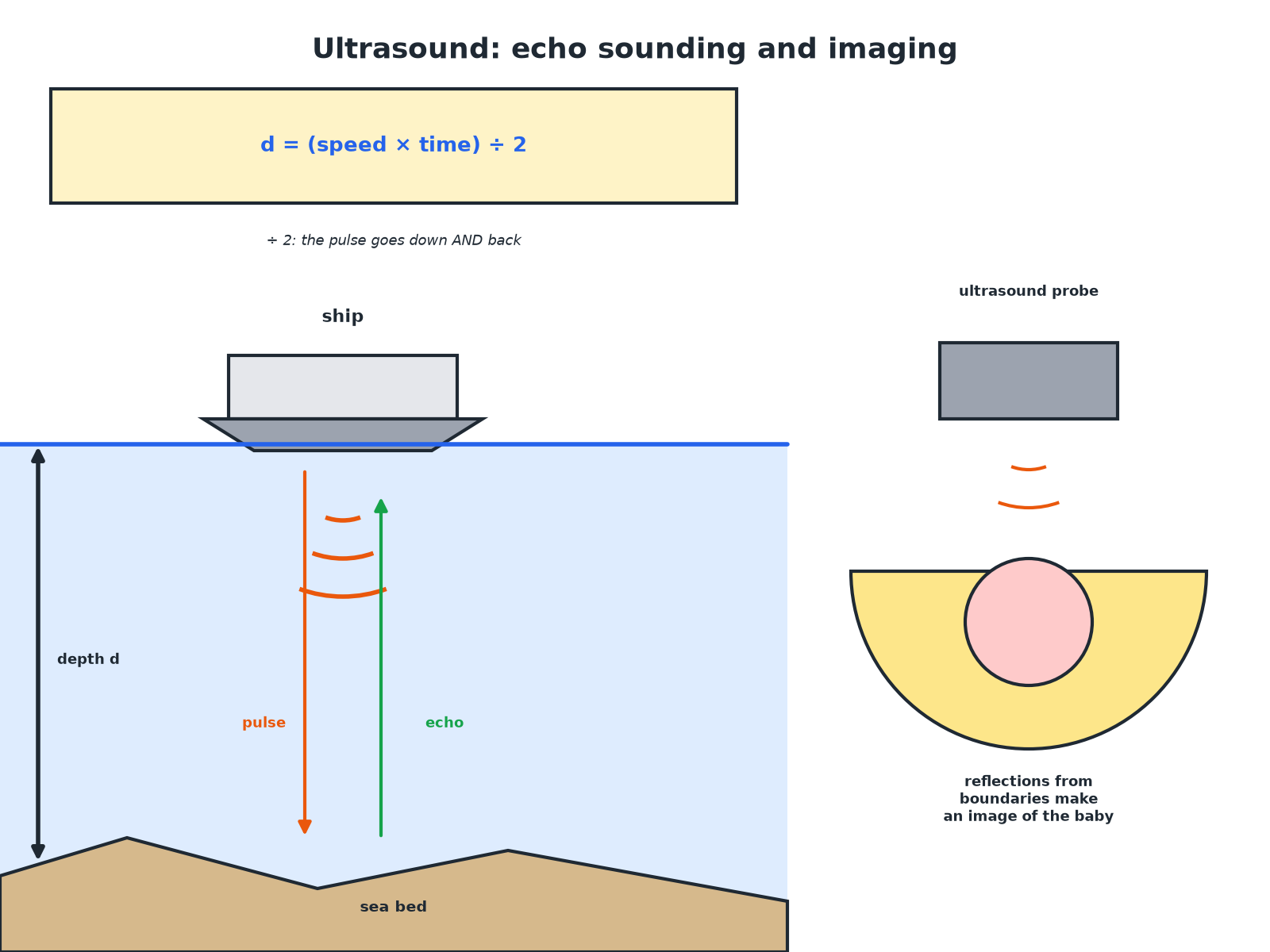
The pulse travels to the boundary and back.
Seismic Waves and the Earth
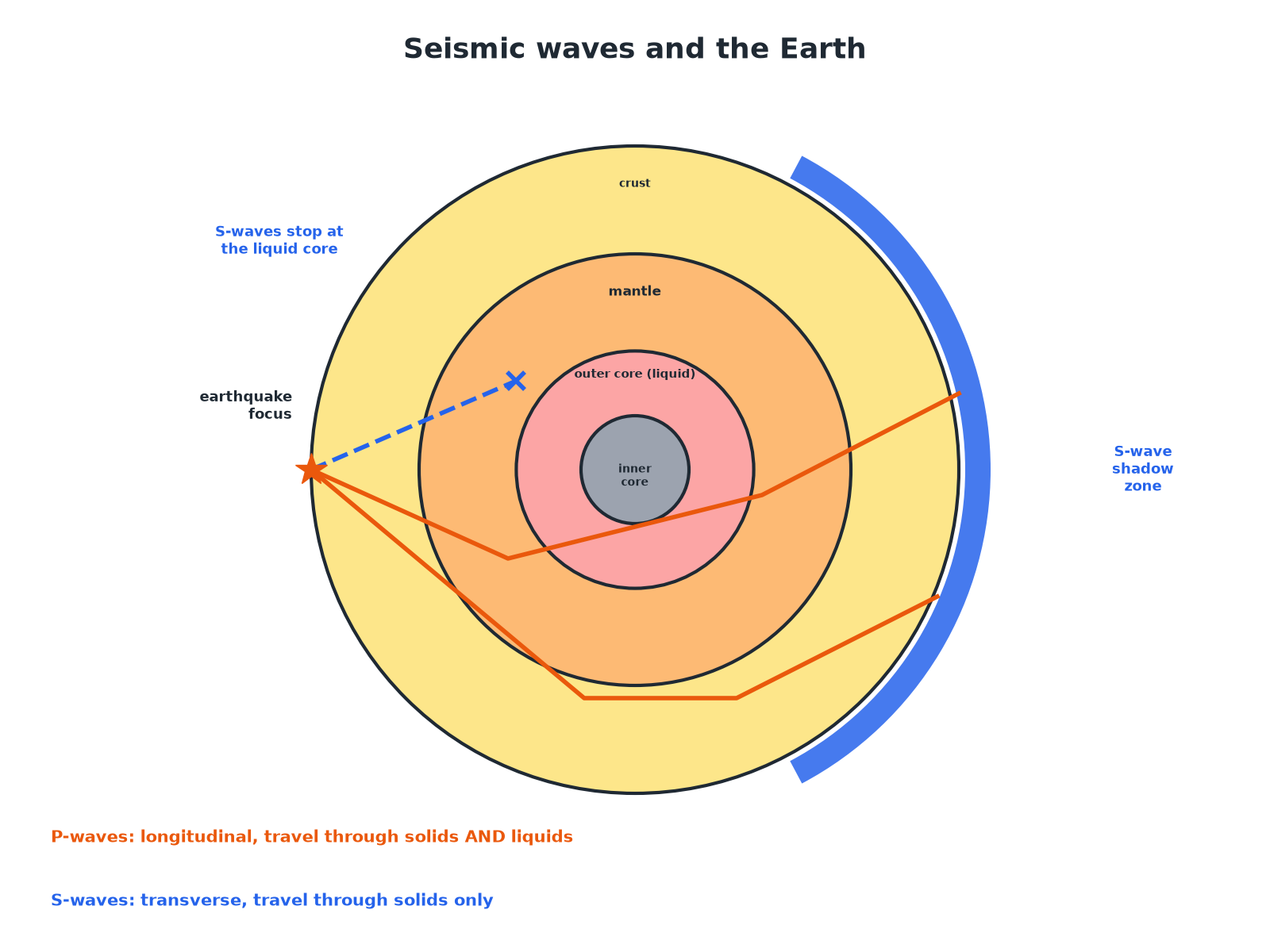
S-waves cannot pass through the liquid outer core.
P-waves and S-waves
P-waves
- Longitudinal seismic waves.
- Travel through solids and liquids.
- Travel faster than S-waves.
- Speed changes between solids and liquids.
S-waves
- Transverse seismic waves.
- Cannot travel through liquids.
- Travel more slowly.
- Stopped by the liquid outer core.
Echo Sounding
A ship sends an ultrasound pulse down and receives the echo 0.40 s later. The speed of sound in sea water is 1500 m/s. Calculate the depth.
Show the solutionHide the solution
- 1 Distance there and back \(1500 \times 0.40 = 600\) m
- 2 Depth is half of this \(600 \div 2 = 300\) m
Answer300 m
Medical Ultrasound
An ultrasound pulse is reflected from a boundary inside the body after 0.000060 s. The speed in tissue is 1500 m/s. Calculate the depth of the boundary.
Show the solutionHide the solution
- 1 Total distance \(1500 \times 0.000060 = 0.090\) m
- 2 Depth \(0.090 \div 2 = 0.045\) m = 4.5 cm
Answer4.5 cm
Evidence for the Core
Explain how S-waves give evidence that part of the Earth's core is liquid.
Show the solutionHide the solution
- 1 S-waves Cannot travel through liquids
- 2 Observation They are not detected on the far side of the Earth
- 3 Conclusion Part of the core (the outer core) must be liquid
AnswerS-waves are blocked by the outer core, so it must be liquid.
Uses
Other examples.
-
Medical imaging
Ultrasound scans of foetuses and organs are safe (non-ionising).
-
Industrial imaging
Ultrasound detects cracks in metal.
-
Echo sounding
Used for water depth and to detect fish or shipwrecks.
-
Seismology
New evidence from seismic waves led to discoveries about parts of the Earth that cannot be observed directly.
Depth Finder
A boat sends out ultrasound and hears the echo after 0.20 s (speed 1500 m/s). Calculate the depth of the water. Explain why the time must be halved.
1. Use s = vt.
2. Halve the distance.
A good answer shows: Distance there and back = 1500 × 0.20 = 300 m; depth = 150 m. The pulse travels to the bottom and back.
Can I...?
- 1Define ultrasound.
- 2Explain echo timing.
- 3Calculate depth by echo.
- 4Describe P-waves.
- 5Describe S-waves.
- 6Explain the liquid core.
- 7Give uses of ultrasound.
- 8Explain why the time is halved.
Summary & Exam Focus
- Ultrasound is partially reflected at boundaries.
- Depth = speed × time ÷ 2.
- P-waves: longitudinal; S-waves: transverse, not through liquids.
- Seismic evidence shows a liquid outer core.
Exam focus
A ship sends out ultrasound and receives the echo 0.40 s later. The speed is 1500 m/s. Calculate the depth of the sea. (3 marks) (3 marks)
Distance there and back, then halve.
Key terms
The vocabulary this lesson expects you to use. Each one is linked from the first place it appears above.
- Ultrasound
- Sound with frequency above 20 kHz.
- Echo
- A reflection of a sound wave.
- Seismic wave
- A wave produced by an earthquake.
- P-wave
- A longitudinal seismic wave.
- S-wave
- A transverse seismic wave that cannot travel through liquids.
- Echo sounding
- Using reflected sound to find depth.
Questions and answers
10 questions set on this lesson, with the mark schemes and model answers open.
A ship sends a pulse of ultrasound towards the sea bed and detects the echo 0.40 s later. The speed of sound in sea water is 1500 m/s. Calculate the depth of the sea at this point.
Mark scheme — 3 marks available
- Correct substitution — 1 mark
- 600 m — 1 mark
- 300 m (halved) — 1 mark
Model answer
Distance there and back = 1500 × 0.40 = 600 m; depth = 600 ÷ 2 = 300 m.
Explain how ultrasound waves can be used to produce an image of an organ in the body.
Mark scheme — 3 marks available
- Partially reflected at boundaries — 1 mark
- Time taken for echoes measured — 1 mark
- Distance calculated and used to form an image — 1 mark
Model answer
Ultrasound is partially reflected at boundaries between different tissues. The time for the echoes to return to a detector is used to work out the distance to each boundary, and the signals are used to build up an image.
S-waves cannot travel through the Earth's outer core. Explain what this tells scientists about the outer core, and how the properties of P-waves give further evidence about the Earth's structure.
Mark scheme — 4 marks available
- S-waves cannot travel through liquids — 1 mark
- So the outer core is liquid — 1 mark
- P-waves travel through solids and liquids at different speeds — 1 mark
- Changes show boundaries between layers — 1 mark
Model answer
S-waves cannot travel through liquids, so the outer core must be liquid. P-waves travel through solids and liquids at different speeds, so their changes in speed and direction show the boundaries between layers of different materials.
State two differences between P-waves and S-waves.
Mark scheme — 2 marks available
- Longitudinal and transverse — 1 mark
- A second difference — 1 mark
Model answer
P-waves are longitudinal and S-waves are transverse. P-waves travel through solids and liquids but S-waves travel only through solids (or P-waves are faster).
Suggest why ultrasound is used rather than X-rays to scan an unborn baby.
Mark scheme — 3 marks available
- Ultrasound non-ionising — 1 mark
- X-rays ionising — 1 mark
- Could damage cells of the baby — 1 mark
Model answer
Ultrasound is non-ionising so it does not damage cells, whereas X-rays are ionising and could cause mutations.
Ultrasound has a frequency...
Why: Above human hearing.
In echo sounding the time is...
Why: So halve it.
S-waves cannot travel through...
Why: They are transverse.
P-waves are...
Why: Compressions and rarefactions.
Seismic evidence shows that the Earth's outer core is...
Why: S-waves do not pass through.