Biology · Defence Against Disease
Discovery and Development of Drugs
A new medicine takes years to reach the pharmacy. This lesson describes where drugs come from, how they are tested in the laboratory and in clinical trials, and why results are checked by other scientists before they are published.
Learning Objectives
- 1Describe how drugs have been discovered from plants and microorganisms.
- 2Describe preclinical testing and the stages of a clinical trial.
- 3Explain the role of a placebo and a double-blind trial.
- 4Explain why the results of testing are checked by peer review before publication.
Retrieval practice
-
1
What is an antibiotic?
Show answerHide answer
A medicine that kills bacteria inside the body.
-
2
What is a vaccine?
Show answerHide answer
A preparation of dead or inactive pathogens that stimulates the production of antibodies.
-
3
What is a painkiller?
Show answerHide answer
A medicine that reduces pain, but does not kill pathogens.
-
4
Why can't antibiotics treat viruses?
Show answerHide answer
Viruses live inside cells and do not have the structures that antibiotics attack.
From plant to pharmacy
People have used plants as medicines for thousands of years, long before anyone knew why they worked. Today, new medicines are made in a very different way: chemists design them, and they go through a long series of tests to prove that they are safe and that they work. The testing is slow and expensive, but it is vital, because a drug that has not been properly tested can do serious harm.
Where drugs come from
Traditionally, drugs were extracted from plants and microorganisms.
-
Digitalis
A heart drug that originates from foxgloves.
-
Aspirin
A painkiller that originates from willow bark.
-
Penicillin
Discovered by Alexander Fleming from the Penicillium mould, which killed bacteria growing on his Petri dishes.
-
Today
Most new drugs are synthesised by chemists in the pharmaceutical industry. The starting point may still be a chemical extracted from a plant.
What a new drug is tested for
New drugs are extensively tested before they can be used to treat patients.
-
Toxicity
Is the drug harmful to cells or the body?
-
Efficacy
Does the drug work, and treat the disease?
-
Dose
How much of the drug is the best amount to give?
Testing a new drug
Testing happens in stages, and a drug stops at any stage where it fails.
-
1
Preclinical testing
Done in a laboratory using cells and tissues, and then live animals. It shows whether the drug is likely to be safe and to work.
-
2
Clinical trial: safety
The drug is first given to healthy volunteers, at a very low dose, to check that it is safe.
-
3
Clinical trial: dose
If it is safe, further trials with patients are carried out to find the optimum dose.
-
4
Clinical trial: efficacy
A larger group of patients is given the drug, to check that it works.
-
5
Peer review and licence
The results are checked by other scientists before they are published and the drug can be used.
Developing a new drug
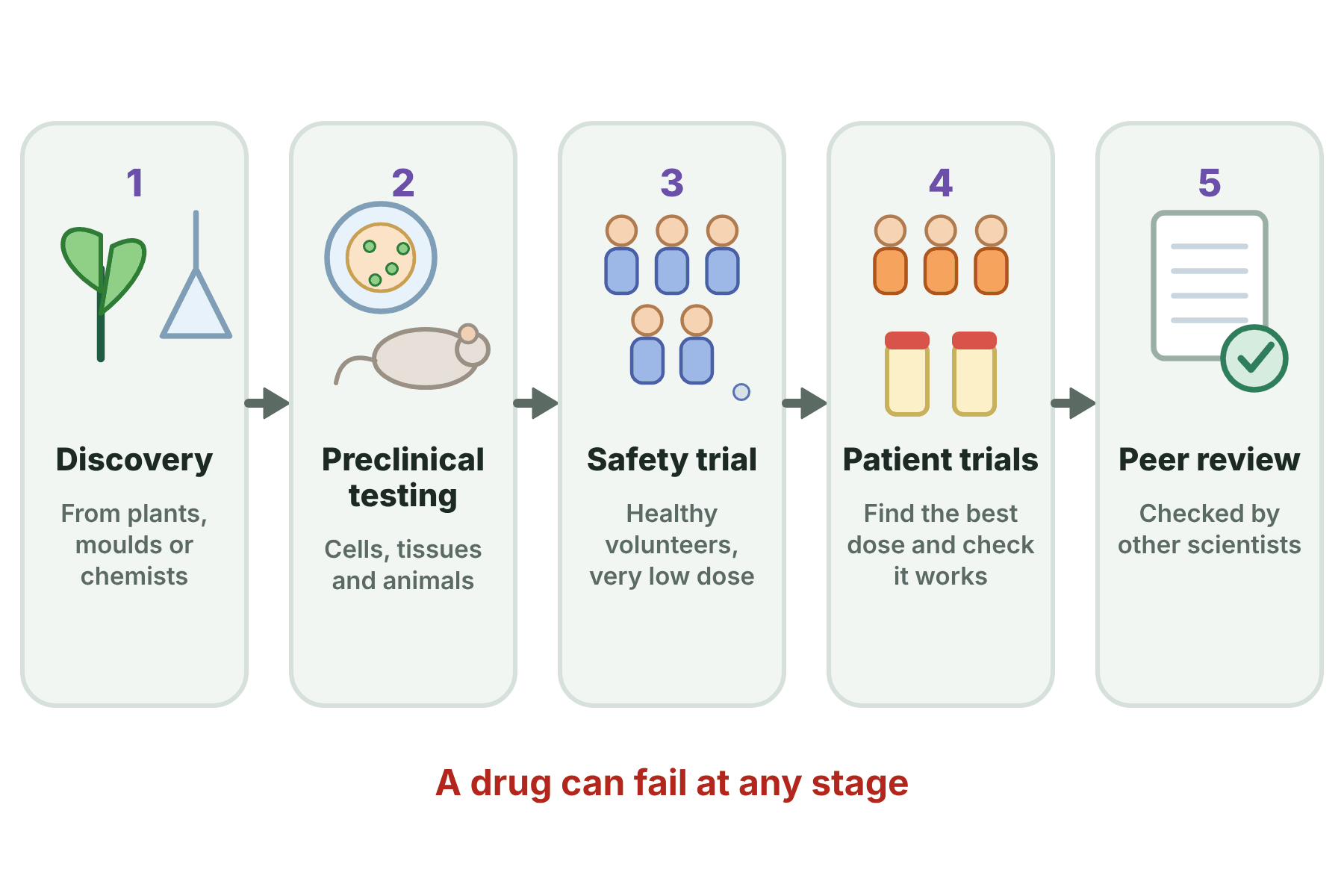
Every new drug goes through these stages before it is used.
Making the trials fair
Patients may feel better simply because they believe they are being treated, so trials are designed to avoid bias.
-
Placebo
A dummy treatment, such as a tablet with no drug in it, given to some patients. It lets scientists see whether the drug has an effect beyond the patient's belief.
-
Blind trial
The patients do not know whether they are getting the drug or the placebo.
-
Double-blind trial
Neither the patients nor the doctors know who has the drug, until the results are collected. This stops the doctors' expectations affecting the results.
-
Large numbers
Using many patients gives more reliable results.
A double-blind trial
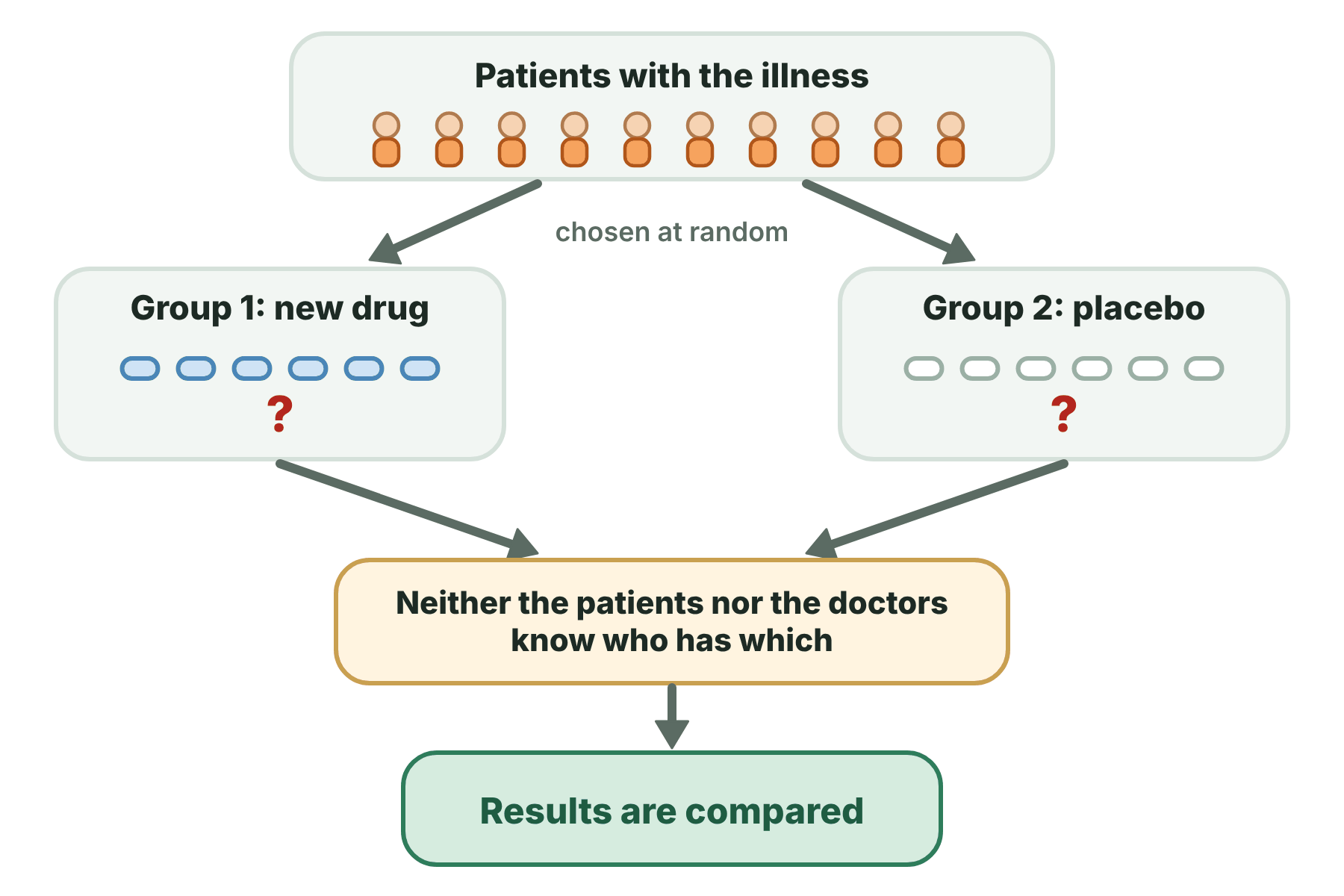
In a double-blind trial nobody knows who has the real drug until the end.
Peer review
Scientists do not accept results just because the people who did the work say they are right.
-
Publishing
The results of tests and trials are written up and published only after scrutiny by peer review.
-
Peer review
Other scientists working in the same field check the methods and the conclusions for mistakes.
-
Why it matters
It stops false or careless claims being published, and other scientists can then repeat the work to see whether they get the same results.
Case study
Penicillin, from a mouldy dish to a medicine
In 1928 Alexander Fleming noticed that bacteria had not grown near a Penicillium mould that had landed on one of his Petri dishes. He realised that the mould made a substance that killed bacteria. It took another decade before Howard Florey and Ernst Chain showed that it was safe and effective in patients, and it was then made in huge quantities during the Second World War. Penicillin was an accidental discovery that needed years of testing and development to become a medicine.
The big idea
A drug must be shown to be safe and to work before it is used on patients.
Drug development
Drug development
-
Sources
- foxglove (digitalis)
- willow (aspirin)
- Penicillium (penicillin)
- chemists
-
Tests
- toxicity
- efficacy
- dose
-
Stages
- preclinical
- healthy volunteers
- patients
-
Fair trials
- placebo
- double-blind
-
Peer review
- checked before publication
Summary and exam focus
- Many drugs were first extracted from plants and microorganisms, and most new ones are made by chemists.
- New drugs are tested for toxicity, efficacy and dose.
- Preclinical testing uses cells, tissues and live animals, and clinical trials use healthy volunteers and patients.
- A placebo and a double-blind design make the trials fair.
- Results are published only after peer review.
Exam focus
Describe how a new drug is tested before it is used to treat patients. (6 marks) (6 marks)
Put the stages in order: preclinical tests (cells, tissues and animals), then clinical trials (healthy volunteers at a low dose, then patients to find the best dose), a placebo and double-blind design, and peer review. Say what each stage is checking for.
Key terms
The words this lesson expects you to use. Each one is linked from the first place it appears above.
- Toxicity
- How harmful a drug is to the body.
- Efficacy
- How well a drug works to treat a disease.
- Dose
- The amount of a drug given.
- Preclinical testing
- Testing a drug on cells, tissues and live animals in the laboratory before it is given to people.
- Clinical trial
- A test of a new drug on healthy volunteers and patients.
- Placebo
- A dummy treatment with no drug in it.
- Double-blind trial
- A trial in which neither the patients nor the doctors know who has the drug and who has the placebo.
- Peer review
- Checking of scientists' work by other scientists before it is published.
You've finished the notes
Check your understanding
Test yourself while it is fresh. Start with the flashcards, then try the exam questions.
Something here looks wrong?
Tell us what and we will go and look. It goes to whoever writes these pages, nobody else, and we do not ask who you are — so there is nothing to sign and nothing comes back to you.