Biology · Defence Against Disease
Antibiotics and Painkillers
Antibiotics cure bacterial disease, but they are useless against viruses, and bacteria are becoming resistant to them. This lesson covers antibiotics and painkillers, what each can and cannot do, and why antibiotic resistance matters.
Learning Objectives
- 1Explain the use of antibiotics and other medicines in treating disease.
- 2Explain why antibiotics cannot be used to treat viral diseases.
- 3Describe how antibiotic-resistant strains of bacteria arise.
- 4Distinguish between antibiotics, which kill pathogens, and painkillers, which treat symptoms.
Retrieval practice
-
1
What is a vaccine?
Show answerHide answer
A preparation of dead or inactive pathogens that makes the body produce antibodies.
-
2
Where do viruses reproduce?
Show answerHide answer
Inside the cells of their host.
-
3
Name a bacterial disease.
Show answerHide answer
Salmonella food poisoning or gonorrhoea.
-
4
What are toxins?
Show answerHide answer
Poisons produced by bacteria.
Medicines for infections
When vaccination fails or is not available, a patient can be given medicines. The medicines that are used for infections fall into two groups: those that attack the pathogen, such as antibiotics, and those that only make the patient feel better, such as painkillers. Understanding the difference matters, because using the wrong medicine does not help and can make matters worse.
Antibiotics
Antibiotics, such as penicillin, are medicines that help to cure bacterial disease by killing the bacteria inside the body.
-
Specific
Each antibiotic works only on certain bacteria, so specific bacteria must be treated with specific antibiotics.
-
Impact
The use of antibiotics has greatly reduced deaths from bacterial diseases, for example from pneumonia and from infected wounds.
-
Not for viruses
Antibiotics cannot kill viral pathogens.
-
A problem
The emergence of strains of bacteria that are resistant to antibiotics is of great concern.
Why antibiotics do not work on viruses
Viruses and bacteria are completely different, so a medicine that kills one does not harm the other.
-
Viruses are inside cells
A virus lives and reproduces inside the body's own cells, where an antibiotic cannot reach it without harming the cell.
-
No cell structures to attack
Antibiotics attack the structures of bacteria, such as their cell walls, which viruses do not have.
-
Hard to design
It is difficult to develop drugs that kill viruses without also damaging the body's tissues.
Painkillers and other medicines
Some medicines treat the symptoms of an illness and do not attack the pathogen.
-
Painkillers
Such as aspirin and paracetamol, reduce pain and fever.
-
Not a cure
They do not kill pathogens. The patient feels better, but the infection is still there until the immune system defeats it.
-
Other medicines
Some reduce symptoms such as a runny nose, but do not kill the pathogen.
Antibiotics and painkillers compared
Antibiotics
- Kill bacteria inside the body
- Cure bacterial disease
- Specific to certain bacteria
- No use against viruses
Painkillers
- Reduce pain and other symptoms
- Do not kill pathogens
- Work for many illnesses
- Do not cure the disease
How antibiotic resistance develops
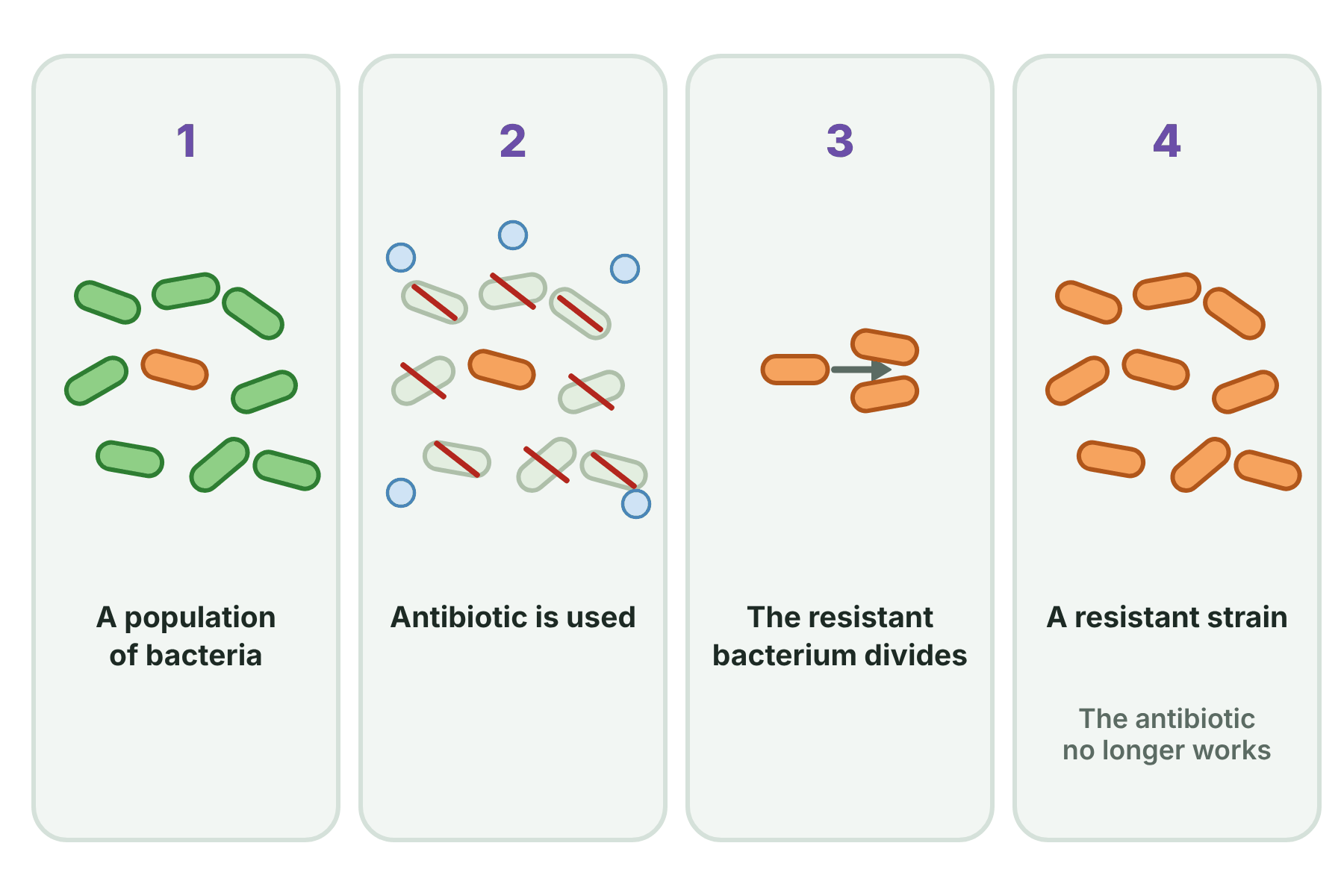
Antibiotics kill the non-resistant bacteria, so the resistant ones survive and reproduce.
How a resistant strain arises
Resistance is a good example of how natural selection works.
-
1
Variation
Bacteria mutate, and by chance one has a gene that makes it resistant to an antibiotic.
-
2
The antibiotic is used
It kills the non-resistant bacteria but not the resistant one.
-
3
Survival
The resistant bacterium survives and reproduces rapidly, passing on its resistance.
-
4
A resistant strain
Soon most of the bacteria in the patient, and then in other people, are resistant.
Reducing antibiotic resistance
The more that antibiotics are used, the more likely it is that resistant strains will appear.
-
Do not overuse
Antibiotics should not be prescribed for minor infections or for viral diseases such as colds.
-
Finish the course
Patients should complete a course of antibiotics so that all the bacteria are killed.
-
Hospital hygiene
Good hygiene stops resistant strains such as MRSA spreading between patients.
-
New antibiotics
Scientists must keep developing new antibiotics.
Case study
Why a doctor will not give antibiotics for a cold
A cold is caused by a virus, so an antibiotic cannot cure it. Taking one would not help the patient, and each unnecessary use of an antibiotic gives bacteria in the body another chance to develop resistance. Doctors therefore advise rest, fluids and painkillers to ease the symptoms while the immune system gets rid of the virus.
The big idea
Antibiotics kill bacteria. They do not kill viruses. Painkillers treat symptoms but do not kill pathogens.
Antibiotics and painkillers
Antibiotics and painkillers
-
Antibiotics
- kill bacteria
- specific
- penicillin
-
Viruses
- not affected
- live inside cells
-
Painkillers
- treat symptoms
- no cure
-
Resistance
- mutation
- survival of resistant bacteria
-
Reducing it
- do not overuse
- finish the course
Summary and exam focus
- Antibiotics kill bacteria inside the body and have reduced deaths from bacterial disease.
- Each antibiotic works on specific bacteria only.
- Antibiotics cannot kill viruses, because viruses live inside cells.
- Painkillers treat symptoms but do not kill pathogens.
- Resistant strains of bacteria arise when antibiotics kill the non-resistant bacteria.
Exam focus
Explain why antibiotic-resistant bacteria are becoming more common. (4 marks) (4 marks)
Tell it as a story in order: a mutation makes one bacterium resistant, the antibiotic kills the others, the resistant one survives and reproduces, and a resistant population builds up. Mention overuse of antibiotics.
Key terms
The words this lesson expects you to use. Each one is linked from the first place it appears above.
- Antibiotic
- A medicine, such as penicillin, that kills bacteria inside the body.
- Penicillin
- The first antibiotic, discovered by Alexander Fleming.
- Painkiller
- A medicine that reduces pain and other symptoms, but does not kill pathogens.
- Resistant
- Not killed by an antibiotic.
- Mutation
- A change in a gene.
- Strain
- A particular type of a species of bacterium.
- MRSA
- A strain of bacteria that is resistant to many antibiotics.
- Symptom
- A sign of illness that a patient feels, such as a fever or pain.
You've finished the notes
Check your understanding
Test yourself while it is fresh. Start with the flashcards, then try the exam questions.
Something here looks wrong?
Tell us what and we will go and look. It goes to whoever writes these pages, nobody else, and we do not ask who you are — so there is nothing to sign and nothing comes back to you.