Biology · DNA and the Genome
DNA, Genes and the Genome
Every cell in your body carries a set of instructions written in DNA. This lesson is for both Combined Science and separate Biology. It covers how DNA is packaged into chromosomes, what a gene is, what the genome is and why scientists wanted to read the whole human genome.
Learning Objectives
- 1Describe DNA as a polymer made of two strands forming a double helix, contained in chromosomes in the nucleus.
- 2Explain what a gene is and how a gene codes for a specific protein.
- 3Define the term genome.
- 4Discuss the importance of understanding the human genome for medicine and for tracing human migration.
Retrieval practice
-
1
Where is the genetic material found in an animal cell?
Show answerHide answer
In the nucleus.
-
2
What is a polymer?
Show answerHide answer
A large molecule made of many small repeating units joined in a chain.
-
3
What are proteins made from?
Show answerHide answer
Long chains of amino acids.
-
4
Which type of cell division makes identical body cells?
Show answerHide answer
Mitosis.
The instructions inside every cell
Almost every cell in your body contains a full set of instructions for building and running you. The instructions are written in a chemical called DNA. This lesson follows them from the whole cell down to a single gene, and then back up to the genome, which is the complete set of genetic material in an organism.
From the nucleus to the gene
The genetic material is packaged in a series of levels, each one smaller than the one before.
-
DNA
The genetic material in the nucleus of a cell is a chemical called DNA. It is a polymer made up of two strands that coil around each other to form a double helix.
-
Chromosomes
The DNA is contained in structures called chromosomes in the nucleus. Each chromosome is made from one very long molecule of DNA. Human body cells have 23 pairs of chromosomes, which is 46 in total.
-
Genes
A gene is a small section of DNA on a chromosome. There are many genes along every chromosome.
-
Genes and proteins
Each gene codes for a particular sequence of amino acids. The amino acids join in that order to make a specific protein.
From the cell to the gene
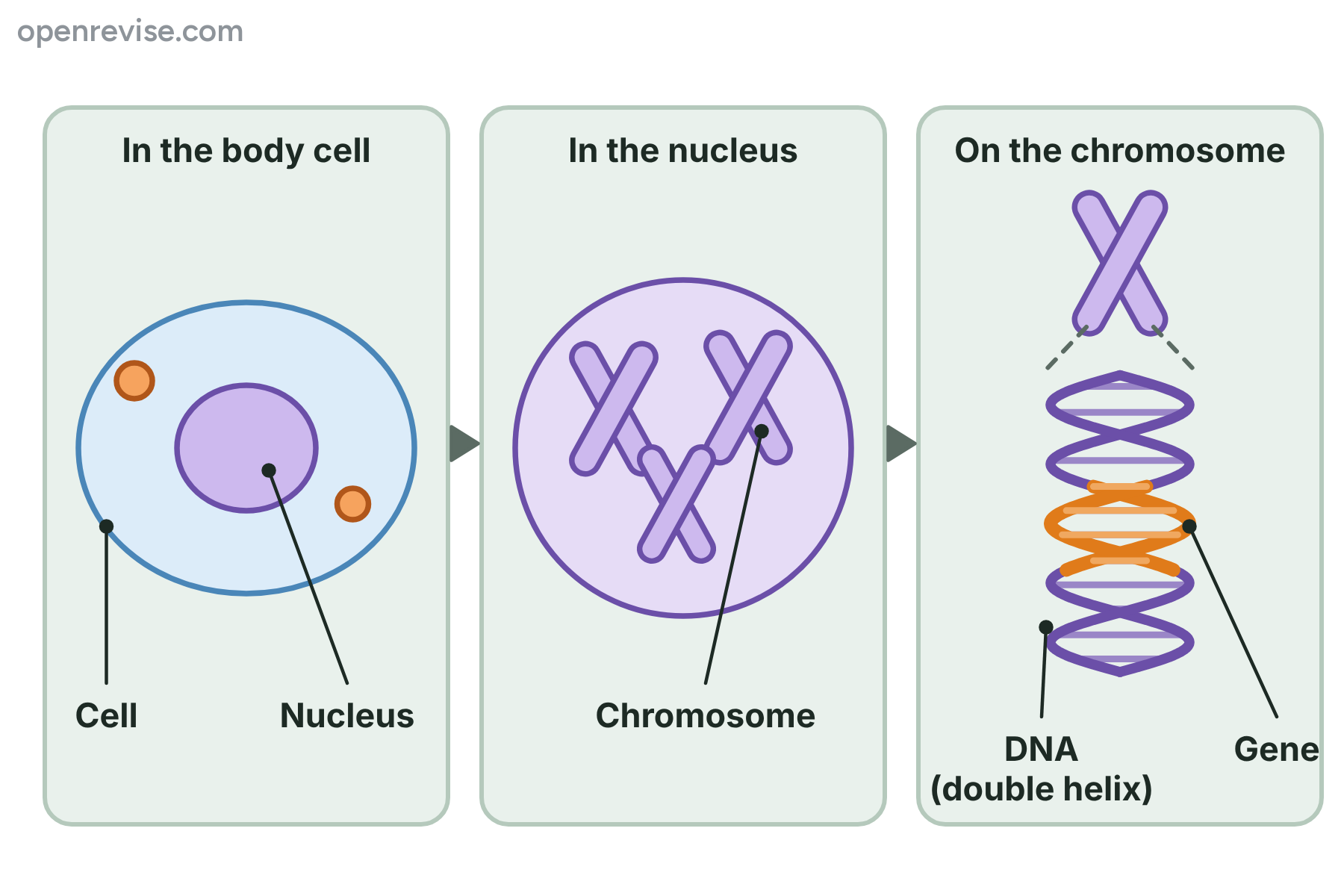
A gene is a small section of the DNA in a chromosome.
From gene to protein
A gene is an instruction for making one protein.
-
1
A gene
A small section of DNA on a chromosome carries the instruction.
-
2
A sequence of amino acids
The gene codes for a particular order of amino acids.
-
3
A protein
The amino acids join in that order to make one specific protein.
-
4
A characteristic
Proteins such as enzymes, hormones and structural proteins decide how a cell works, so they help to control the characteristics of the organism.
The genome
A gene is one instruction. The genome is all of them.
-
Genome
The genome of an organism is the entire genetic material of that organism. It includes all of its DNA, and so all of its genes.
-
The human genome
The whole human genome has now been studied. It has about 3 billion pairs of bases, the chemical letters of the DNA code, and around 20 000 genes.
-
Every species
Every species has its own genome. Apart from identical twins, no two people have exactly the same DNA.
-
A complete list
Knowing the whole genome gives scientists a complete list of the genes to study, instead of finding them one at a time.
Case study
The Human Genome Project
The Human Genome Project was an international research project that began in 1990 and was completed in 2003. Scientists in many countries worked out the order of the bases along all of the human chromosomes and located the genes. The results were shared freely so that any researcher could use them, and the project made reading a genome far quicker and cheaper than it had been.
Why the human genome matters
Knowing the human genome is important in three main ways.
-
Searching for genes linked to disease
Scientists can look through the genome for genes linked to different types of disease. For example, some alleles of the BRCA1 gene raise the risk of breast cancer, so people with a family history can be tested.
-
Inherited disorders
Finding the gene that causes an inherited disorder helps scientists to understand the disorder and to develop treatments for it.
-
Tracing human migration
Comparing the DNA of people from different parts of the world shows how closely related they are, so scientists can trace how early humans spread around the world.
Gene or genome?
A gene
- A small section of DNA on a chromosome
- Codes for a particular sequence of amino acids
- Makes one specific protein
- There are thousands of them in a cell
The genome
- The entire genetic material of an organism
- Includes every gene and all the other DNA
- Different in every species
- The whole human genome has now been studied
The big idea
DNA is the code, a gene is one instruction in it, and the genome is the whole instruction book.
DNA and the genome
DNA and the genome
-
DNA
- a polymer
- two strands
- double helix
-
Chromosomes
- in the nucleus
- made of DNA
- 23 pairs in humans
-
Gene
- small section of DNA
- codes for amino acids
- makes a protein
-
Genome
- all the genetic material
- the human genome has been studied
-
Importance
- genes linked to disease
- inherited disorders
- human migration
Summary and exam focus
- DNA is a polymer of two strands forming a double helix, and it is contained in chromosomes in the nucleus.
- A gene is a small section of DNA on a chromosome that codes for a particular sequence of amino acids.
- The amino acids join in order to make a specific protein.
- The genome is the entire genetic material of an organism, and the whole human genome has now been studied.
- The human genome helps scientists to search for genes linked to disease, to understand and treat inherited disorders and to trace human migration.
Exam focus
Describe what is meant by the genome of an organism and give two reasons why it is important to understand the human genome. (3 marks) (3 marks)
Define the genome in one clear sentence, as the entire genetic material of the organism. Then give two different reasons, one for each remaining mark, such as finding genes linked to disease and tracing how humans migrated. Two versions of the same idea earn only one mark.
Key terms
The words this lesson expects you to use. Each one is linked from the first place it appears above.
- DNA
- The chemical in the nucleus that carries the genetic code, a polymer made of two strands forming a double helix.
- Double helix
- The shape of DNA: two strands coiled around each other.
- Polymer
- A large molecule made of many repeating units joined together.
- Chromosome
- A structure in the nucleus, made of one long molecule of DNA, that carries many genes.
- Gene
- A small section of DNA on a chromosome that codes for a particular sequence of amino acids, to make a specific protein.
- Genome
- The entire genetic material of an organism.
- Amino acid
- A small molecule that is joined in a chain with others to make a protein.
- Protein
- A molecule made of a chain of amino acids, such as an enzyme, a hormone or collagen.
You've finished the notes
Check your understanding
Test yourself while it is fresh. Start with the flashcards, then try the exam questions.
Something here looks wrong?
Tell us what and we will go and look. It goes to whoever writes these pages, nobody else, and we do not ask who you are — so there is nothing to sign and nothing comes back to you.