Biology · DNA and the Genome
The Structure of DNA
This lesson is for separate Biology only: Combined Science students do not need it. It covers DNA as a polymer of four different nucleotides, how the order of the bases makes the genetic code, and, for Higher tier students, how the two strands are held together by complementary base pairs.
Learning Objectives
- 1Describe DNA as a polymer made from four different nucleotides, and describe the parts of a nucleotide.
- 2Describe the sugar-phosphate backbone and explain where the bases are attached.
- 3Explain how a sequence of three bases codes for an amino acid, and how the order of bases controls the protein made.
- 4(Higher tier) Describe complementary base pairing between the two strands of the double helix.
Retrieval practice
-
1
What is DNA?
Show answerHide answer
A polymer, made of two strands forming a double helix, that carries the genetic code.
-
2
What is a gene?
Show answerHide answer
A small section of DNA on a chromosome that codes for a particular sequence of amino acids.
-
3
What are proteins made from?
Show answerHide answer
Amino acids joined together in a chain.
-
4
What is a polymer?
Show answerHide answer
A large molecule made of many repeating units joined together.
A polymer with four building blocks
DNA is a very long molecule, but it is built from just a few kinds of small unit. Each unit is called a nucleotide, and the DNA polymer is a chain of repeating nucleotides. There are only four kinds of nucleotide, and the order in which they are arranged along the strand is the genetic code. This lesson looks at how one nucleotide is built and how thousands of them make a gene.
A polymer made of nucleotides
DNA is a polymer made from four different nucleotides.
-
A nucleotide
Each nucleotide consists of a common sugar and a phosphate group, with one of four different bases attached to the sugar.
-
Four bases
DNA contains four bases, called A, C, G and T (adenine, cytosine, guanine and thymine). The four kinds of nucleotide differ only in which base they carry.
-
Repeating units
The DNA polymer is made up of repeating nucleotide units, joined one after another into a very long strand.
-
The backbone
The long strands of DNA consist of alternating sugar and phosphate sections. Attached to each sugar is one of the four bases.
The structure of DNA
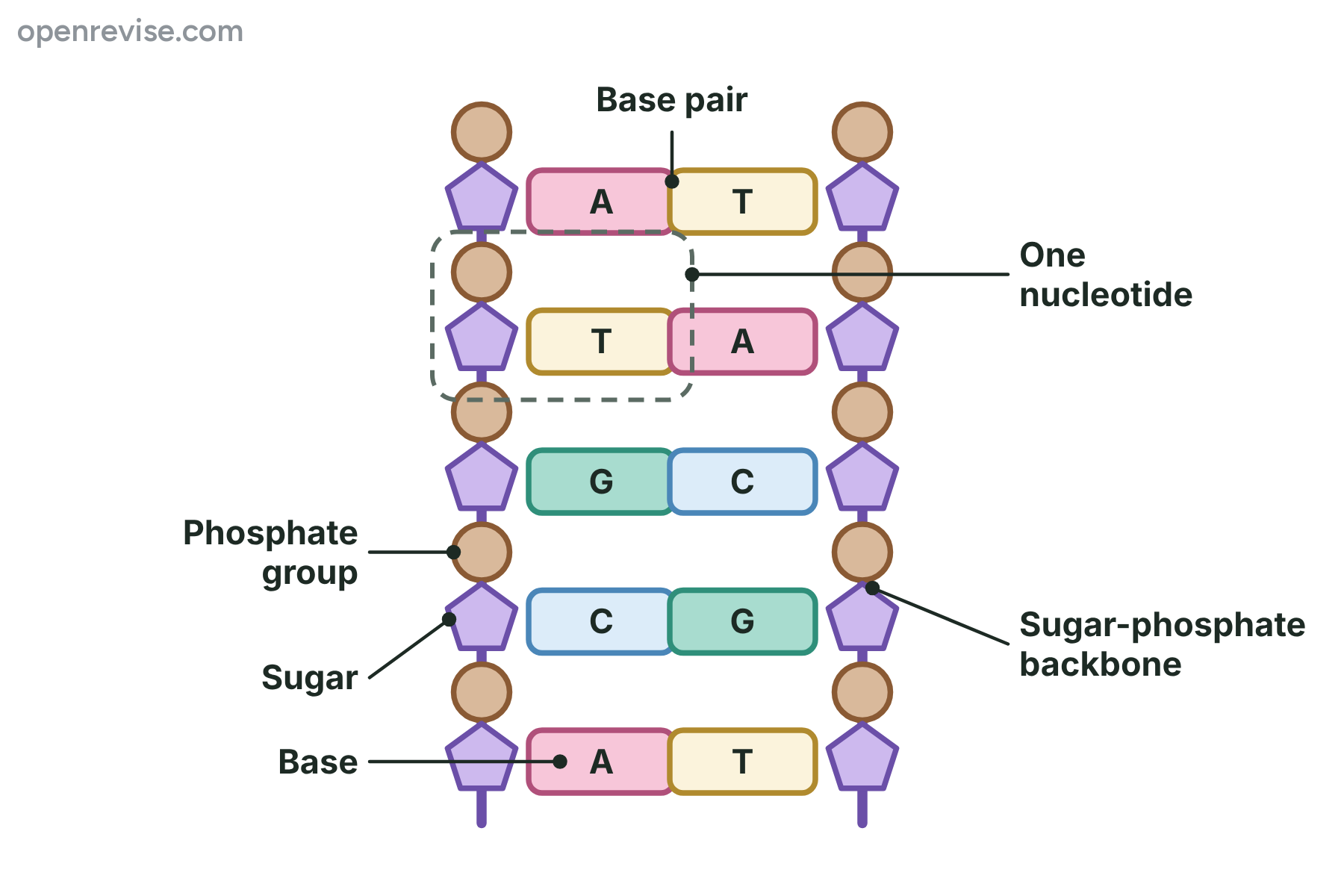
Each nucleotide is a sugar, a phosphate group and one base.
What is the same, and what is different
The same in every nucleotide
- A common sugar
- A phosphate group
- Joined into the backbone, alternating sugar then phosphate
- The same repeating pattern along the whole strand
Different between nucleotides
- The base attached to the sugar
- One of four: A, C, G or T
- This is what makes the code
- The order of the bases along a strand varies
The genetic code
The order of the bases is the information in DNA, in the same way that the order of letters makes the words in a sentence.
-
Three bases, one amino acid
A sequence of three bases is the code for a particular amino acid.
-
Order matters
The order of the bases controls the order in which amino acids are assembled to produce a particular protein.
-
A different order, a different protein
If the order of the bases in a gene changes, the order of the amino acids can change, and a different protein may be made.
-
Long genes
Genes are long. A gene of 900 bases codes for a protein of about 300 amino acids, because every three bases code for one.
How many amino acids does a gene code for?
A section of a gene has 1 200 bases. Every three bases code for one amino acid. How many amino acids does this section code for?
Show the solutionHide the solution
- 1 Use the rule Three bases code for one amino acid
- 2 Divide the number of bases by three \(1200 \div 3\)
- 3 Write the answer 400 amino acids
Answer400 amino acids
Complementary base pairs (Higher tier)
The two strands of the double helix are held together by the bases, which link in pairs across the middle of the helix.
-
Two strands
The two strands run alongside each other, with a base from one strand linked to a base on the other strand.
-
C with G
In the complementary strands, a C is always linked to a G on the opposite strand.
-
T with A
A T is always linked to an A on the opposite strand.
-
Predicting the other strand
If you know the order of bases on one strand you can work out the other strand, because every base has only one partner.
Writing the complementary strand (Higher tier)
One strand of a DNA molecule has the base sequence A T G G C T. Write the base sequence of the complementary strand.
Show the solutionHide the solution
- 1 Recall the pairing rules A pairs with T, T pairs with A, C pairs with G and G pairs with C
- 2 Pair each base in turn A gives T, T gives A, G gives C, G gives C, C gives G, T gives A
- 3 Write out the new strand T A C C G A
AnswerT A C C G A
The big idea
DNA is a chain of nucleotides, and the order of the four bases along the chain is the genetic code.
The structure of DNA
The structure of DNA
-
Polymer
- four different nucleotides
- repeating units
-
Nucleotide
- sugar
- phosphate group
- one base
-
Backbone
- alternating sugar and phosphate
- base on each sugar
-
Bases
- A
- C
- G and T
-
Code
- three bases code for one amino acid
- order controls the protein
-
Base pairs (Higher tier)
- C with G
- T with A
Summary and exam focus
- DNA is a polymer made from four different nucleotides.
- Each nucleotide has a common sugar and a phosphate group with one of four bases attached to the sugar.
- The four bases are A, C, G and T, and the strands have alternating sugar and phosphate sections.
- A sequence of three bases codes for one amino acid, and the order of the bases controls the order of the amino acids in the protein.
- (Higher tier) In the complementary strands, C is always linked to G and T is always linked to A.
Exam focus
Describe the structure of DNA. (4 marks) (4 marks)
Build the answer from the bottom up. Start with the nucleotide (a sugar, a phosphate group and a base), then say how nucleotides join into a strand with alternating sugar and phosphate sections, then name the four bases, and finish with two strands in a double helix. Use the word polymer.
Key terms
The words this lesson expects you to use. Each one is linked from the first place it appears above.
- Nucleotide
- One unit of DNA: a sugar, a phosphate group and one base.
- Base
- The part of a nucleotide that carries the code: A, C, G or T.
- Phosphate group
- The part of a nucleotide that joins to the sugar of the next nucleotide to form the backbone.
- Sugar-phosphate backbone
- The alternating sugar and phosphate sections that run along each strand of DNA.
- Triplet
- A sequence of three bases that codes for one amino acid.
- Complementary base pairs
- The pairs C with G and T with A that link the two strands of DNA together (Higher tier).
- Polymer
- A long molecule made of many repeating units.
- Amino acid
- A small molecule that joins with others to make a protein.
You've finished the notes
Check your understanding
Test yourself while it is fresh. Start with the flashcards, then try the exam questions.
Something here looks wrong?
Tell us what and we will go and look. It goes to whoever writes these pages, nobody else, and we do not ask who you are — so there is nothing to sign and nothing comes back to you.