Biology · Evidence for Evolution and Classification
The Three-domain System and Evolutionary Trees
Classification has changed as scientists have found better evidence. This lesson is for both Combined Science and separate Biology. It covers how microscopes and chemical analysis led to new models of classification, the three-domain system, and how to read an evolutionary tree.
Learning Objectives
- 1Describe the impact of developments in biology on classification systems, including better microscopes and chemical analysis.
- 2Describe the three-domain system of Carl Woese: Archaea, Bacteria and Eukaryota.
- 3Explain what an evolutionary tree shows, and what information scientists use to draw one.
- 4Interpret an evolutionary tree to say which organisms are most closely related.
Retrieval practice
-
1
Who developed the system of classification into kingdom, phylum, class, order, family, genus and species?
Show answerHide answer
Carl Linnaeus.
-
2
What is the binomial name of humans?
Show answerHide answer
Homo sapiens.
-
3
What is the genus of the lion and the tiger?
Show answerHide answer
Panthera.
-
4
What do fossils show?
Show answerHide answer
How much or how little organisms have changed as life developed on Earth.
Classification is a model, not a fact
The Linnaean system is based on what organisms look like, but looks can mislead, and what scientists know has changed. As evidence of internal structures became more developed because of improvements in microscopes, and the understanding of biochemical processes progressed, new models of classification were proposed. The system we use today is one of several that have been replaced as the evidence got better, which is how scientific theories develop over time.
How new evidence changed classification
Each new technique allowed scientists to compare organisms in more detail.
-
Microscopes
Better microscopes, including the electron microscope, showed the internal structures of cells, such as whether a cell has a nucleus. Bacteria have no nucleus, so they were separated from plants and animals.
-
Biochemistry
Understanding of biochemical processes, such as how organisms respire or make proteins, allowed scientists to compare the chemicals inside organisms, not only their structures.
-
Chemical analysis
Evidence available from chemical analysis, such as comparing the sequences of bases in the DNA or RNA of different organisms, showed how closely related organisms really are.
-
A better model
New models of classification were proposed, because earlier groups did not always match the evidence.
The three-domain system
Because of the evidence from chemical analysis, there is now a three-domain system, developed by Carl Woese, in which organisms are divided into three domains.
-
Archaea
Primitive bacteria, usually living in extreme environments such as hot springs, very salty lakes and deep-sea vents.
-
Bacteria
The true bacteria, such as the ones that cause disease or live in the gut.
-
Eukaryota
Organisms whose cells have a nucleus. This domain includes protists, fungi, plants and animals.
-
Woese
Carl Woese compared the ribosomal RNA of different organisms in 1977 and found that archaea are as different from bacteria as they are from eukaryotes, so they needed a domain of their own.
Linnaean system and three-domain system
Linnaean system
- Developed by Carl Linnaeus
- Based on structure and characteristics
- Starts with the kingdom
- Gives the binomial name
Three-domain system
- Developed by Carl Woese
- Based on evidence from chemical analysis
- Sits above the kingdoms, with three domains
- Separates archaea from true bacteria
Evolutionary trees
Evolutionary trees are a method used by scientists to show how they believe organisms are related.
-
What they use
Scientists use current classification data for living organisms, and fossil data for extinct organisms.
-
Branches
Each branch point shows where two groups separated from a common ancestor.
-
Closeness
The more recent the common ancestor, the more closely related the organisms are. Two organisms that branch from the same point close to the tips are close relatives.
-
A model
A tree is the scientists' best estimate. It can be redrawn when there is new evidence, such as a new fossil or DNA data.
An evolutionary tree of the apes
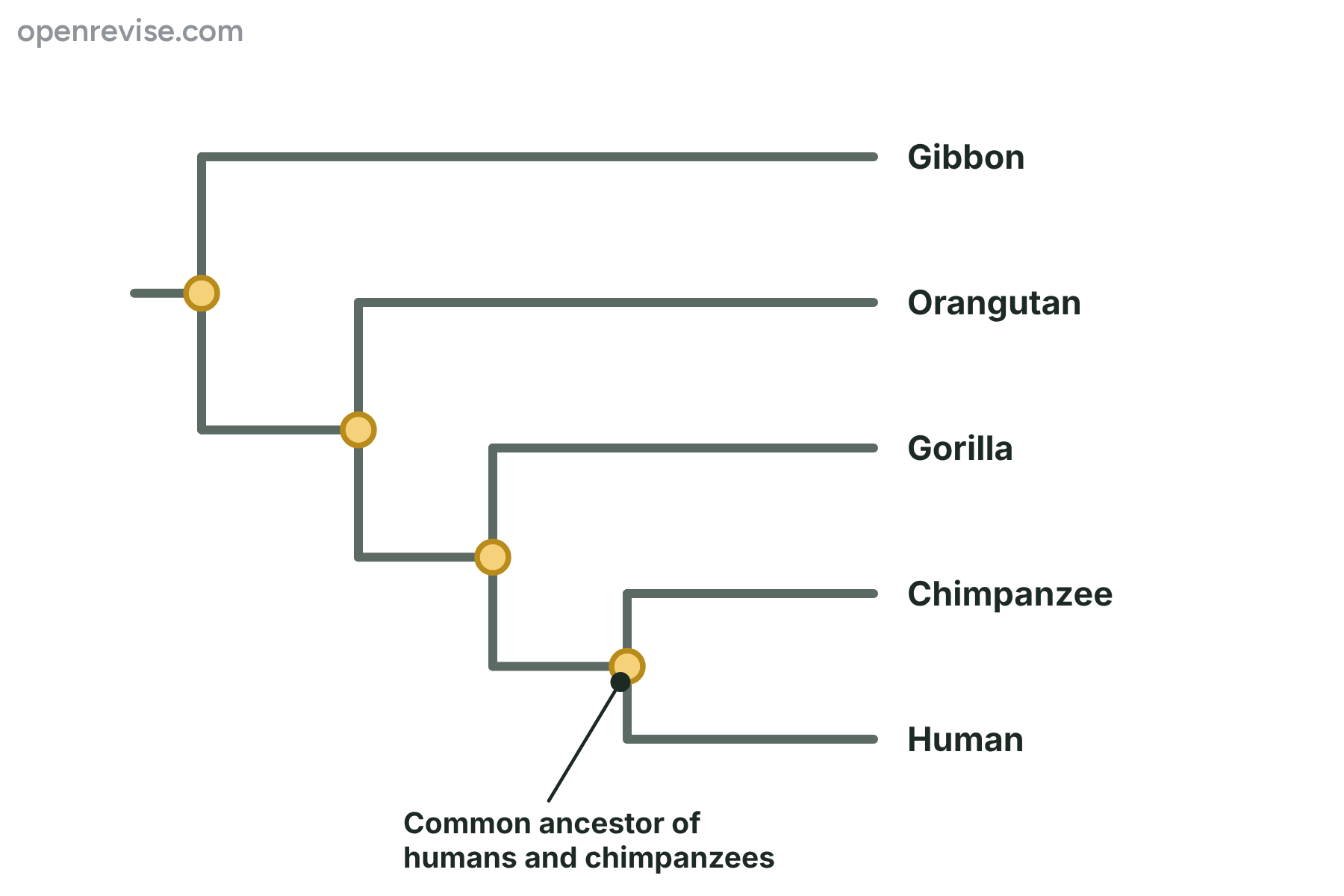
The last branch point to separate shows the closest relatives: humans and chimpanzees.
How to read an evolutionary tree
Follow these steps and you can answer most tree questions.
-
1
Find the tips
The organisms alive today, or extinct organisms known from fossils, are at the ends of the branches.
-
2
Trace back
Follow each branch back to the point where it joins another branch. That point is a common ancestor.
-
3
Compare the branch points
Two organisms that share a recent branch point are closely related, so find the pair whose branches meet closest to the tips.
-
4
Do not read across
The order of the tips along the side does not show closeness. Closeness is shown only by where the branches join.
Which two organisms are most closely related?
In the tree of the apes, the branch of the gorilla joins the branch of the chimpanzee and the human at an earlier point than the branch of the chimpanzee joins the branch of the human. Which two apes are most closely related, and which is the most distant relative of the human among the three?
Show the solutionHide the solution
- 1 Find the latest branch point The chimpanzee and human branches meet last, so closest to the tips
- 2 Compare with the gorilla The gorilla branch joined the others at an earlier point, so a more distant common ancestor
- 3 Conclude Chimpanzee and human are the closest, with the gorilla further away
AnswerThe chimpanzee and the human are the most closely related. The gorilla is more distantly related to the human than the chimpanzee is.
Case study
Archaea in a hot spring
In the 1970s Carl Woese compared the sequences in ribosomal RNA from many organisms. He found that organisms such as the methane-producing microorganisms that live in hot springs and swamps looked like bacteria but had a very different chemistry. This led him to propose that they belonged to a third domain. Archaea are now known to live in many places, including the human gut, and not only in extreme environments.
The big idea
Classification and evolutionary trees are scientific models, and they are changed whenever better evidence comes along.
Classification and trees
Classification and trees
-
Why it changed
- better microscopes
- biochemistry
- chemical analysis
-
Domains
- Archaea
- Bacteria
- Eukaryota
-
Eukaryota
- protists
- fungi
- plants
- animals
-
Evolutionary trees
- show how organisms are related
-
Data
- classification data and fossil data
-
Reading
- recent common ancestor means closely related
Summary and exam focus
- As evidence of internal structures became more developed and the understanding of biochemical processes progressed, new models of classification were proposed.
- Because of the evidence from chemical analysis there is now a three-domain system developed by Carl Woese.
- The domains are Archaea (primitive bacteria usually living in extreme environments), Bacteria (true bacteria) and Eukaryota (protists, fungi, plants and animals).
- Evolutionary trees show how scientists believe organisms are related.
- They use current classification data for living organisms and fossil data for extinct organisms.
Exam focus
Explain why the three-domain system of classification was proposed, and name the three domains. (4 marks) (4 marks)
Say that new evidence, such as chemical analysis of DNA or RNA, showed that organisms were related differently from the Linnaean groups, and credit Woese. Then name the three domains correctly and add a detail about each, such as archaea living in extreme environments.
Key terms
The words this lesson expects you to use. Each one is linked from the first place it appears above.
- Domain
- The highest level of classification, above the kingdom, in the three-domain system.
- Archaea
- Primitive bacteria, usually living in extreme environments.
- Bacteria
- The true bacteria, in one of the three domains.
- Eukaryota
- The domain of organisms with a nucleus in their cells: protists, fungi, plants and animals.
- Evolutionary tree
- A diagram that shows how scientists believe organisms are related.
- Common ancestor
- An organism from which two or more groups have evolved.
- Extremophile
- An organism that lives in extreme conditions, such as very hot or very salty places.
- Carl Woese
- The scientist who proposed the three-domain system, using chemical analysis.
You've finished the notes
Check your understanding
Test yourself while it is fresh. Start with the flashcards, then try the exam questions.
Something here looks wrong?
Tell us what and we will go and look. It goes to whoever writes these pages, nobody else, and we do not ask who you are — so there is nothing to sign and nothing comes back to you.