Biology · Homeostasis and the Nervous System
Control of Body Temperature
Humans keep their body temperature at about 37 °C however hot or cold it is outside. This lesson is for separate Biology. It covers how the thermoregulatory centre in the brain monitors the temperature of the blood, how the skin sends it information, and how sweating, the blood vessels in the skin and shivering cool or warm the body. For Higher tier students it also covers how to explain these mechanisms in a given context.
Learning Objectives
- 1Explain that body temperature is monitored and controlled by the thermoregulatory centre in the brain.
- 2Describe the roles of the temperature receptors in the thermoregulatory centre and in the skin.
- 3Describe how the body responds when it is too hot: vasodilation and sweating.
- 4Describe how the body responds when it is too cold: vasoconstriction, no sweating and shivering.
- 5(Higher tier) Explain how these mechanisms lower or raise body temperature in a given context.
Retrieval practice
-
1
What is homeostasis?
Show answerHide answer
The regulation of the internal conditions of a cell or organism to maintain optimum conditions for function.
-
2
Why must body temperature stay at about 37 °C?
Show answerHide answer
Enzymes work best at an optimum temperature, so they stop working properly if it changes too much.
-
3
What is an effector?
Show answerHide answer
A muscle or a gland that carries out a response.
-
4
What is released by respiration in the muscles?
Show answerHide answer
Energy, some of it as heat.
Hot days and cold days
On a hot day you sweat and your face goes red. On a cold day you shiver and your skin goes pale. These are not accidents. They are responses that keep your core body temperature at about 37 °C, the best temperature for your enzymes. A control centre in your brain compares your temperature with the normal level, and sends impulses to the effectors that warm you up or cool you down.
Monitoring body temperature
Body temperature is monitored and controlled by the thermoregulatory centre, a part of the brain.
-
In the brain
The thermoregulatory centre contains receptors that are sensitive to the temperature of the blood flowing through it.
-
In the skin
The skin contains temperature receptors. They detect the temperature of the surroundings and send nervous impulses to the thermoregulatory centre.
-
The coordination centre
The thermoregulatory centre processes the information and sends impulses to the effectors.
-
The effectors
The sweat glands, the muscles in the walls of the blood vessels in the skin, and the skeletal muscles.
How body temperature is controlled
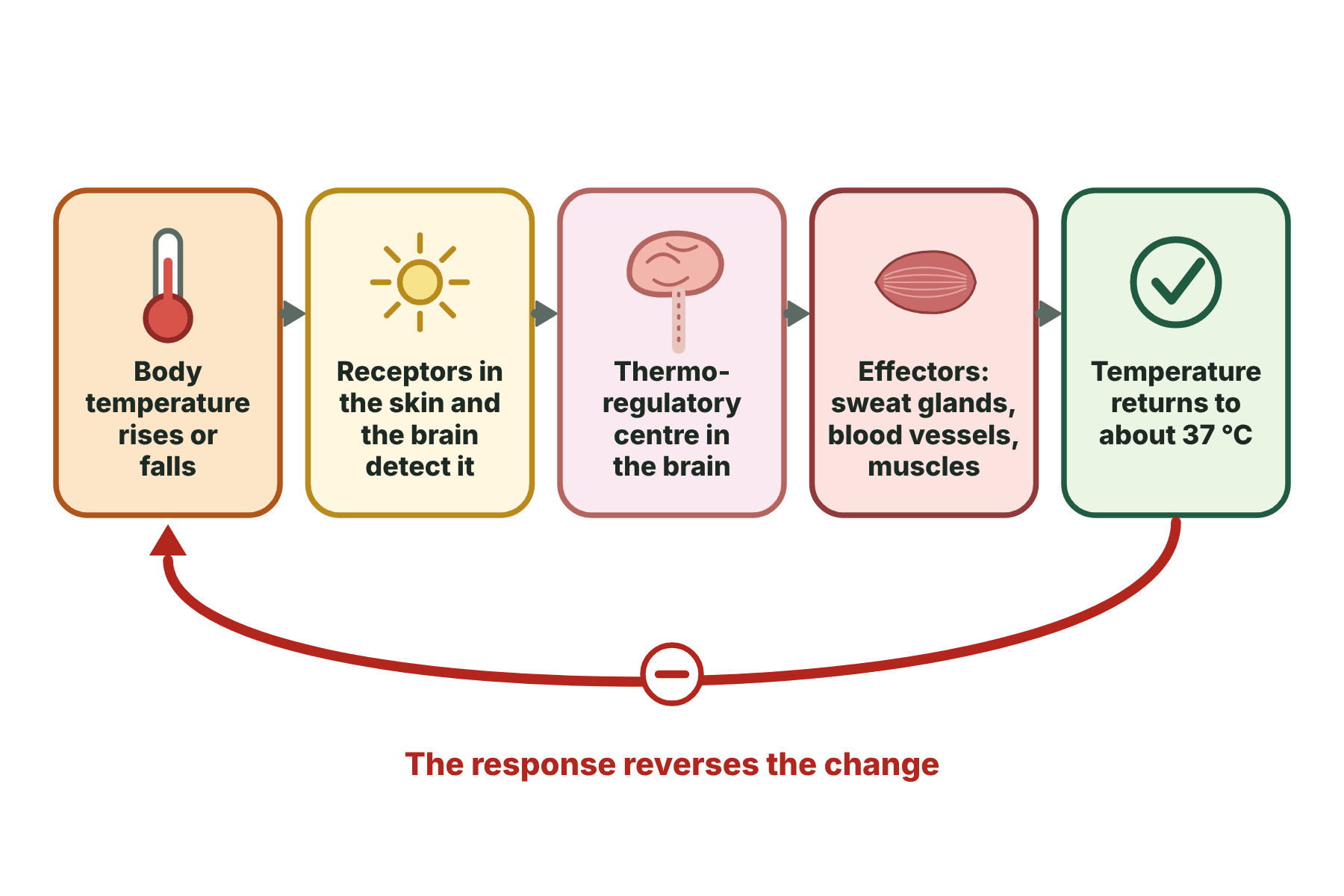
The thermoregulatory centre receives information from receptors and sends impulses to the effectors.
When the body is too hot
If the body temperature is too high, the body transfers more energy from the skin to the environment.
-
Sweating
The sweat glands produce sweat. As the sweat evaporates from the skin it takes energy from the body, which cools it down.
-
Vasodilation
The blood vessels in the skin dilate, which means they get wider. More blood flows close to the surface of the skin, so more energy is transferred from the blood to the environment. The skin looks red.
-
Both mechanisms
Both sweating and vasodilation cause a transfer of energy from the skin to the environment.
-
Result
The body temperature falls back towards 37 °C.
When the body is too cold
If the body temperature is too low, the body loses less energy to the environment and releases more energy inside.
-
Vasoconstriction
The blood vessels in the skin constrict, which means they get narrower. Less blood flows close to the surface, so less energy is transferred to the environment. The skin looks pale.
-
Sweating stops
The sweat glands stop producing sweat, so no energy is taken from the skin by evaporation.
-
Shivering
The skeletal muscles contract and relax rapidly. Respiration in the muscles releases energy, and some of this warms the body.
-
Result
The body temperature rises back towards 37 °C.
-
A common mistake
Blood vessels cannot move towards or away from the skin. They only get wider or narrower.
Responses to heat and cold
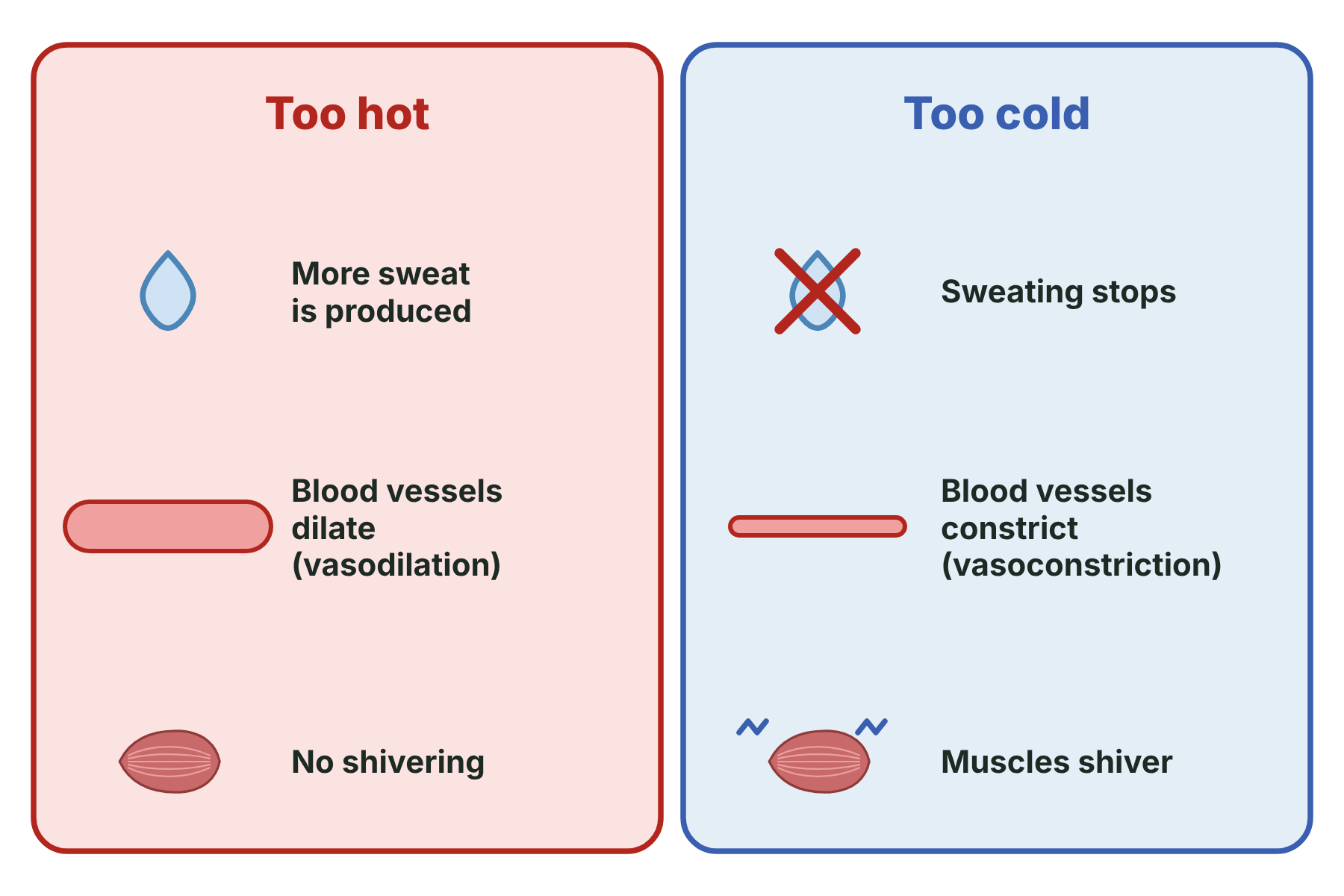
The body cools by sweating and vasodilation, and warms by vasoconstriction, no sweating and shivering.
Too hot and too cold
Too hot
- Sweat is produced
- Blood vessels dilate
- No shivering
- Energy is transferred to the environment
Too cold
- Sweating stops
- Blood vessels constrict
- Skeletal muscles shiver
- Less energy is lost and more is released
Explaining temperature control in context (Higher tier)
Higher tier questions give you a situation and ask how the mechanisms change body temperature. Link each response to what it does to energy transfer.
-
Step 1
Say what has changed and what detects it, for example the thermoregulatory centre detects that the blood temperature has risen.
-
Step 2
Name the effectors that respond, such as the sweat glands and the blood vessels in the skin.
-
Step 3
Explain how each response changes the energy transfer. Sweat evaporating takes energy from the skin. Wider vessels let more energy move from the blood to the environment. Shivering releases energy by respiration in the muscles.
-
Step 4
Say what happens to the body temperature, which returns towards 37 °C.
Case study
Why do we go red when we exercise?
When you run hard, your muscles release a lot of energy from respiration and your blood temperature rises. The thermoregulatory centre detects this and sends impulses to the effectors. The blood vessels near the surface of the skin dilate, which is why your face looks red, and the sweat glands produce sweat. The blood carries the energy to the skin, where it is transferred to the air, and the evaporation of sweat cools you down.
The big idea
The thermoregulatory centre monitors the temperature of the blood and receives impulses from the skin. When the body is too hot, sweating and vasodilation transfer energy to the environment, and when it is too cold, vasoconstriction, no sweating and shivering keep and release energy.
Control of body temperature
Control of body temperature
-
Receptors
- in the skin and in the thermoregulatory centre
-
Coordination centre
- the thermoregulatory centre in the brain
-
Too hot
- sweating and vasodilation
-
Too cold
- vasoconstriction
- no sweating
- shivering
-
Normal
- about 37 °C
Summary and exam focus
- Body temperature is monitored by the thermoregulatory centre in the brain, which contains receptors sensitive to the temperature of the blood.
- The skin contains temperature receptors that send impulses to the thermoregulatory centre.
- When the body is too hot the blood vessels dilate and sweat is produced, so energy is transferred from the skin to the environment.
- When the body is too cold the blood vessels constrict, sweating stops and the skeletal muscles shiver.
- (Higher tier) Explain how these mechanisms lower or raise body temperature in a given context.
Exam focus
Describe how the body responds when its temperature rises above 37 °C. (3 marks) (3 marks)
Start with the detection by the thermoregulatory centre. Then give the two responses: more sweat, which evaporates, and vasodilation. Say that both transfer energy from the skin to the environment. Remember that vessels dilate, they do not move.
Key terms
The words this lesson expects you to use. Each one is linked from the first place it appears above.
- Thermoregulatory centre
- The part of the brain that monitors and controls body temperature.
- Sweat gland
- A gland in the skin that produces sweat.
- Vasodilation
- The widening of the blood vessels in the skin, so that more energy is transferred to the environment.
- Vasoconstriction
- The narrowing of the blood vessels in the skin, so that less energy is transferred to the environment.
- Shivering
- Rapid contractions of the skeletal muscles, which release energy.
- Evaporation
- The change from liquid to gas, which takes energy from the surface.
- Dilate
- To get wider.
- Constrict
- To get narrower.
You've finished the notes
Check your understanding
Test yourself while it is fresh. Start with the flashcards, then try the exam questions.
Something here looks wrong?
Tell us what and we will go and look. It goes to whoever writes these pages, nobody else, and we do not ask who you are — so there is nothing to sign and nothing comes back to you.