Exam questions · Biology · Homeostasis and the Nervous System
Control of Body Temperature
- 7 exam questions
- 22 marks
- 8 quick checks
-
1 State [1 mark]
State the part of the brain that monitors and controls body temperature.
Show answerHide answer
Model answer
The thermoregulatory centre.
Mark scheme
- Thermoregulatory centre — 1 mark
-
2 Name [3 marks]
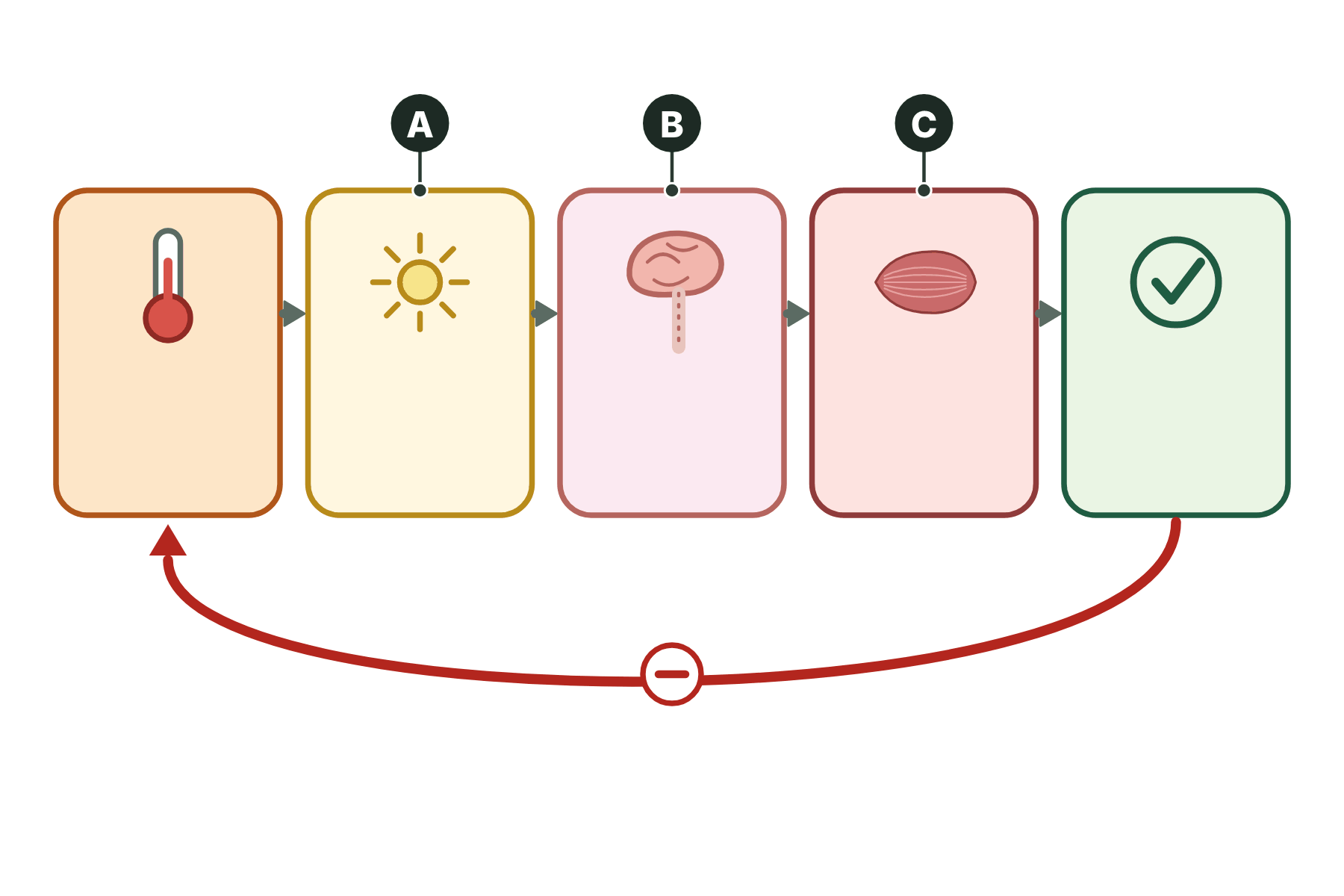
Figure 1 shows how body temperature is controlled. Name the parts shown at A, B and C.
Show answerHide answer
Model answer
A is the (temperature) receptors. B is the thermoregulatory centre. C is the effectors.
Mark scheme
- A: receptors — 1 mark
- B: thermoregulatory centre — 1 mark
- C: effectors — 1 mark
-
3 Describe [3 marks]
Describe how sweating helps to cool the body.
Show answerHide answer
Model answer
The sweat glands produce sweat on the surface of the skin. The sweat evaporates. Evaporation takes energy from the skin, so energy is transferred away from the body.
Mark scheme
- Sweat is produced on the skin — 1 mark
- The sweat evaporates — 1 mark
- Evaporation takes energy from the skin / body — 1 mark
-
4 Describe [4 marks]
Describe how the body responds when the temperature of the surroundings falls.
Show answerHide answer
Model answer
Temperature receptors in the skin send impulses to the thermoregulatory centre, which also detects the cooler blood. The blood vessels in the skin constrict, so less energy is transferred to the environment. Sweating stops. The skeletal muscles shiver, which releases energy.
Mark scheme
- Receptors detect the fall / impulses to the thermoregulatory centre — 1 mark
- Blood vessels constrict — 1 mark
- Sweating stops — 1 mark
- Muscles shiver — 1 mark
-
5 Explain [4 marks]
Explain how vasodilation helps to lower body temperature on a hot day.
Show answerHide answer
Model answer
The thermoregulatory centre detects the high temperature. The blood vessels in the skin dilate. More blood flows close to the surface of the skin, so more energy is transferred from the blood to the environment. The body temperature falls.
Mark scheme
- The thermoregulatory centre detects the rise — 1 mark
- Blood vessels in the skin dilate — 1 mark
- More blood flows close to the skin surface — 1 mark
- More energy is transferred to the environment — 1 mark
-
6 Explain [4 marks]
A runner finishes a race on a hot day. Explain how the runner's body returns its temperature to normal.
Show answerHide answer
Model answer
The runner's muscles have released a lot of energy and the blood temperature has risen. The thermoregulatory centre detects this. Sweat is produced, and as it evaporates it takes energy from the skin. The blood vessels in the skin dilate, so more energy is transferred to the environment. The body temperature falls back to about 37 °C.
Mark scheme
- Detected by the thermoregulatory centre — 1 mark
- Sweat is produced and evaporates, taking energy from the skin — 1 mark
- Blood vessels dilate and more energy is transferred to the environment — 1 mark
- Temperature returns towards 37 °C — 1 mark
-
7 Explain [3 marks]
A student says that blood vessels move closer to the surface of the skin when the body is hot. Explain why the student is wrong and what really happens.
Show answerHide answer
Model answer
Blood vessels cannot move. When the body is hot the blood vessels in the skin dilate, which means they get wider. More blood flows near the surface of the skin, so more energy is transferred to the environment.
Mark scheme
- Blood vessels cannot move — 1 mark
- They dilate / get wider — 1 mark
- More blood flows near the skin surface, so more energy is transferred — 1 mark
Quick check
-
1
Which part of the brain monitors the temperature of the blood?
Show answerHide answer
C: The thermoregulatory centre
The thermoregulatory centre contains receptors that are sensitive to the temperature of the blood.
-
2
What happens to the blood vessels in the skin when the body is too hot?
Show answerHide answer
A: They dilate
They dilate, which is vasodilation.
-
3
What does shivering do?
Show answerHide answer
D: Releases energy from the muscles
Shivering is rapid contraction of the skeletal muscles, and respiration in the muscles releases energy.
-
4
Why does sweating cool the body?
Show answerHide answer
B: Evaporation takes energy from the skin
Evaporation of the sweat takes energy from the skin.
-
5
What is vasoconstriction?
Show answerHide answer
C: The narrowing of the blood vessels
Vasoconstriction is the narrowing of the blood vessels in the skin.
-
6
What happens to sweating when the body is too cold?
Show answerHide answer
D: It stops
The sweat glands stop producing sweat.
-
7
Why does the skin look pale when the body is cold?
Show answerHide answer
A: Less blood flows near the surface
The blood vessels constrict, so less blood flows near the surface of the skin.
-
8
Which of these best explains why a runner's face goes red?
Show answerHide answer
B: The blood vessels in the skin dilate
The blood vessels in the skin dilate, so more blood flows near the surface and more energy is transferred to the environment.