Biology · Blood, Blood Vessels and the Heart
Heart Rate, Stroke Volume and Cardiac Output
How hard is your heart working, and how does it change when you run? This lesson is for both Combined Science and separate Biology, at Foundation and Higher. It defines heart rate, stroke volume and cardiac output, shows how to calculate them using cardiac output = stroke volume \(\times\) heart rate, and explains what happens to them during exercise and with training.
Learning Objectives
- 1Define heart rate, stroke volume and cardiac output, and give the units of each.
- 2Calculate cardiac output, stroke volume or heart rate using cardiac output = stroke volume \(\times\) heart rate.
- 3Explain how heart rate, stroke volume and cardiac output change during exercise and with regular training.
- 4Interpret graphs and tables of heart rate against time, and calculate changes and percentage changes.
Retrieval practice
-
1
Which chamber of the heart pumps blood into the aorta?
Show answerHide answer
The left ventricle.
-
2
Why do muscles need more blood during exercise?
Show answerHide answer
They respire faster, so they need more oxygen and glucose and must get rid of more carbon dioxide.
-
3
What is your pulse?
Show answerHide answer
The stretching and recoil of an artery wall with each heartbeat.
-
4
How do you work out a percentage change?
Show answerHide answer
Divide the change by the starting value and multiply by 100.
How hard is the heart working?
A doctor, a coach and a student with a stopwatch can all use the same three measurements to find out how well the heart is working. Heart rate says how often the heart beats, stroke volume says how much blood leaves the heart with each beat, and cardiac output says how much it pumps in a minute. The three are tied together by one equation, which makes them ideal for calculations.
Three measurements of the heart
Each one has its own unit, and you must check the units before you calculate anything.
-
Heart rate
The number of times the heart beats in one minute, in beats per minute (bpm). A resting adult has a heart rate of about 60 to 80 bpm. It can be found by counting the pulse at the wrist or neck.
-
Stroke volume
The volume of blood pumped out of one ventricle in one heartbeat, in cm\(^3\) (per beat). At rest it is about 70 cm\(^3\).
-
Cardiac output
The volume of blood pumped out of the heart in one minute, in cm\(^3\) per minute or dm\(^3\) per minute. At rest it is about 5 dm\(^3\) per minute, which is about 5000 cm\(^3\).
-
Units
One dm\(^3\) is 1000 cm\(^3\), the same as one litre. Convert everything to the same unit before calculating, and write the unit with your answer.
The equation
\(\text{cardiac output} = \text{stroke volume} \times \text{heart rate}\)
Cardiac output in cm\(^3\) per minute, stroke volume in cm\(^3\), heart rate in beats per minute.
Rearranging the equation
The equation can be used to find any one of the three quantities when the other two are known.
-
Finding the cardiac output
Multiply: \(\text{cardiac output} = \text{stroke volume} \times \text{heart rate}\).
-
Finding the stroke volume
Divide the cardiac output by the heart rate: \(\text{stroke volume} = \text{cardiac output} \div \text{heart rate}\).
-
Finding the heart rate
Divide the cardiac output by the stroke volume: \(\text{heart rate} = \text{cardiac output} \div \text{stroke volume}\).
-
Heart rate from a pulse
Count the beats in 15 seconds and multiply by 4, or count for 30 seconds and multiply by 2, to get beats per minute.
Calculating cardiac output
A person at rest has a heart rate of 72 beats per minute and a stroke volume of 70 cm\(^3\). Calculate the cardiac output in cm\(^3\) per minute, and then in dm\(^3\) per minute.
Show the solutionHide the solution
- 1 Write the equation \(\text{cardiac output} = \text{stroke volume} \times \text{heart rate}\)
- 2 Substitute the values \(\text{cardiac output} = 70 \times 72\)
- 3 Calculate \(70 \times 72 = 5040\ \text{cm}^3\) per minute
- 4 Convert to dm\(^3\) \(5040 \div 1000 = 5.04\), which is 5.0 dm\(^3\) per minute to 2 significant figures
AnswerThe cardiac output is 5040 cm\(^3\) per minute, which is about 5.0 dm\(^3\) per minute.
Calculating stroke volume
A person has a cardiac output of 5.6 dm\(^3\) per minute and a heart rate of 80 beats per minute. Calculate the stroke volume in cm\(^3\).
Show the solutionHide the solution
- 1 Convert the units \(5.6\ \text{dm}^3 = 5.6 \times 1000 = 5600\ \text{cm}^3\)
- 2 Rearrange the equation \(\text{stroke volume} = \text{cardiac output} \div \text{heart rate}\)
- 3 Substitute and calculate \(5600 \div 80 = 70\ \text{cm}^3\)
AnswerThe stroke volume is 70 cm\(^3\).
From a pulse count to cardiac output
A student counts 21 beats of her pulse in 15 seconds. Her stroke volume is 68 cm\(^3\). Calculate her heart rate and her cardiac output.
Show the solutionHide the solution
- 1 Find the heart rate 15 seconds is a quarter of a minute, so \(21 \times 4 = 84\) beats per minute
- 2 Substitute into the equation \(\text{cardiac output} = 68 \times 84\)
- 3 Calculate \(68 \times 84 = 5712\ \text{cm}^3\) per minute, which is about 5.7 dm\(^3\) per minute
AnswerHer heart rate is 84 beats per minute and her cardiac output is 5712 cm\(^3\) per minute.
What happens during exercise
Exercising muscles need much more oxygen and glucose and produce more carbon dioxide, so the circulation has to speed up.
-
Heart rate rises
The brain and the hormone adrenaline make the heart beat faster. Within seconds of starting to run the rate can double.
-
Stroke volume rises
The heart muscle contracts more strongly, so each beat pushes out more blood. A resting stroke volume of 70 cm\(^3\) may increase to 100 cm\(^3\) or more.
-
Cardiac output rises
Because both factors increase, cardiac output can rise to three or four times the resting value. More blood, carrying more oxygen and glucose, reaches the muscles each minute.
-
Recovery
When the exercise stops, the heart rate falls back slowly towards its resting value, because the muscles still need extra oxygen to recover. The time this takes is the recovery time. The fitter the person, the shorter it is.
Heart rate before, during and after exercise
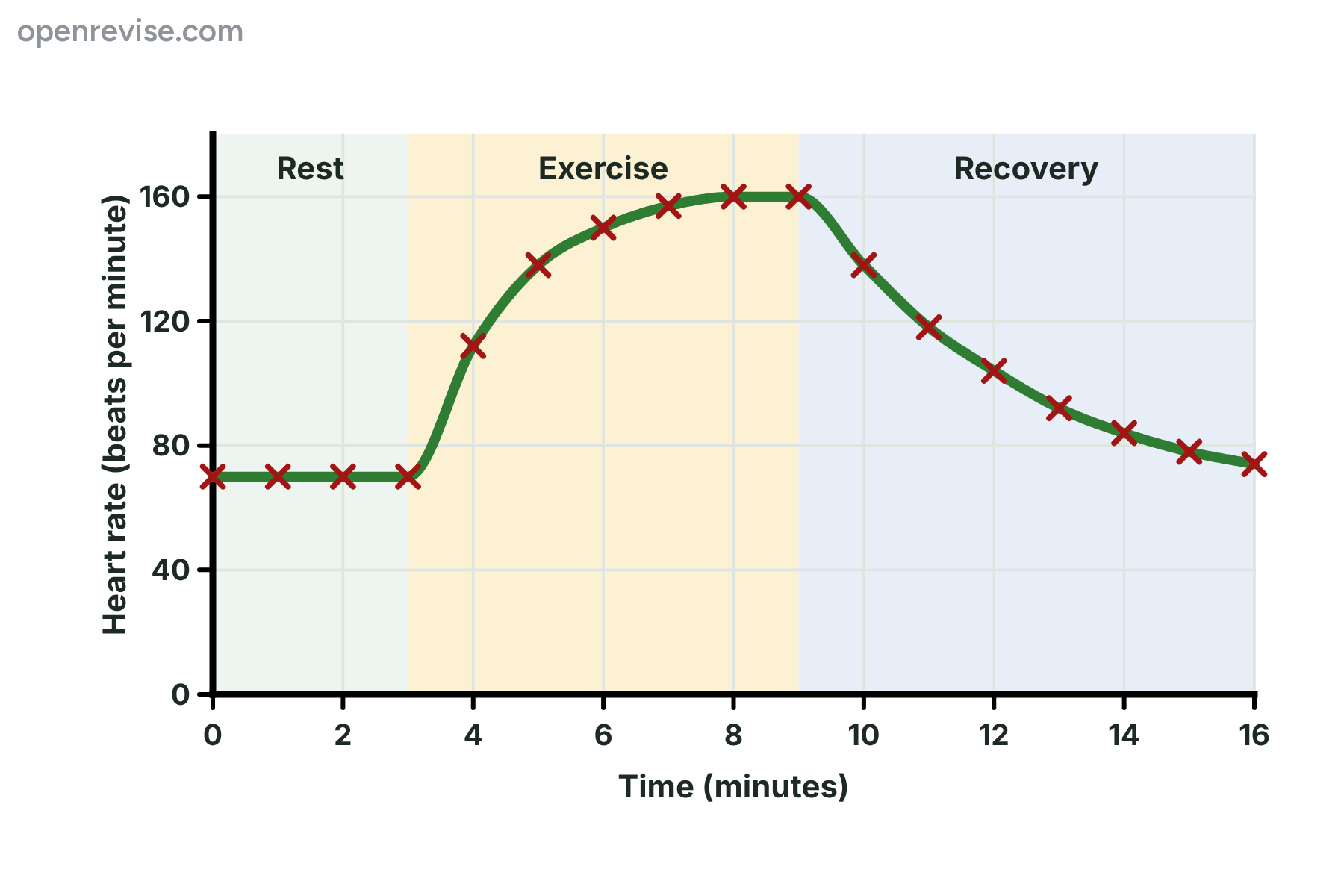
The heart rate rises quickly when exercise starts, levels off, and falls slowly during recovery.
The percentage increase in cardiac output
Before exercise a person has a heart rate of 70 beats per minute and a stroke volume of 75 cm\(^3\). During exercise their heart rate is 150 beats per minute and their stroke volume is 100 cm\(^3\). Calculate the percentage increase in cardiac output.
Show the solutionHide the solution
- 1 Cardiac output at rest \(75 \times 70 = 5250\ \text{cm}^3\) per minute
- 2 Cardiac output during exercise \(100 \times 150 = 15\,000\ \text{cm}^3\) per minute
- 3 Find the increase \(15\,000 - 5250 = 9750\ \text{cm}^3\) per minute
- 4 Percentage increase \(9750 \div 5250 \times 100 = 185.7\), which is 186 percent to the nearest whole number
AnswerThe cardiac output rises by about 186 percent.
Fitness and training
Regular aerobic exercise changes the heart, and the changes show up in all three measurements.
-
A stronger heart
Training makes the heart muscle bigger and stronger, so each contraction pushes out more blood and the stroke volume is larger.
-
A lower resting heart rate
At rest the body needs the same cardiac output, so a heart with a larger stroke volume needs fewer beats. An athlete with a stroke volume of 100 cm\(^3\) needs only 50 beats per minute to deliver 5000 cm\(^3\).
-
A higher maximum output
During hard exercise a trained heart can reach a much higher cardiac output, so more oxygen reaches the muscles and the athlete can work harder for longer.
-
Faster recovery
The heart rate of a fit person falls back to its resting value more quickly after exercise.
An untrained person and an athlete at rest
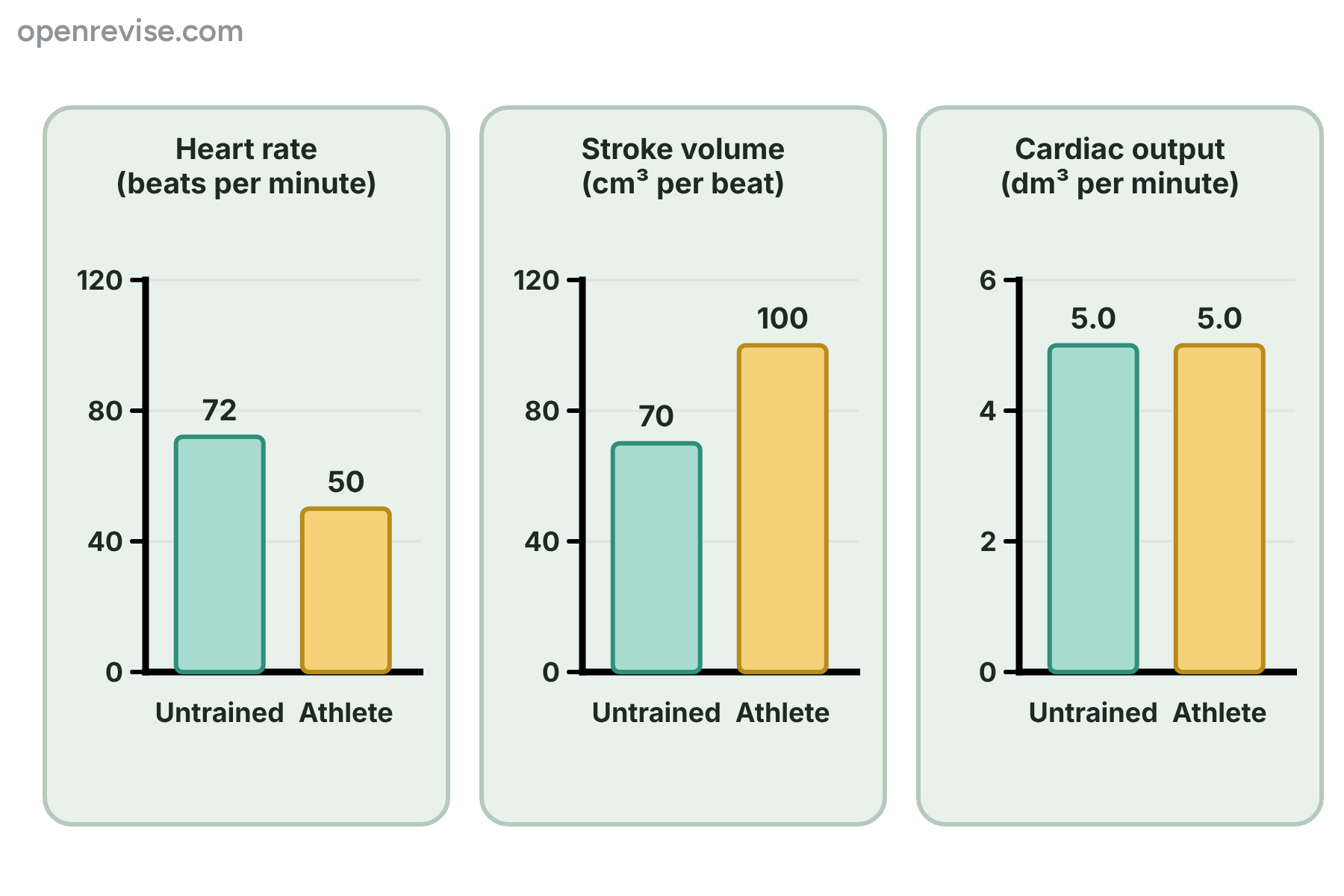
The athlete's bigger stroke volume means a lower heart rate gives the same cardiac output.
Investigating the effect of exercise on heart rate
A suggested practical to find how a short period of exercise changes the pulse.
-
1
Rest
The volunteer sits quietly for five minutes. Count their pulse for 30 seconds, double it, and repeat to find a mean resting heart rate.
-
2
Exercise
The volunteer steps up and down on a step, or jogs on the spot, for two minutes. Keep the step height and the speed the same each time.
-
3
Measure straight away
Immediately find the pulse again, counting for 15 seconds and multiplying by 4, and record it.
-
4
Recovery
Measure the pulse every minute until it returns to the resting value, and record the recovery time.
-
5
Control and repeat
Use the same person and the same method each time, repeat with different exercise times or intensities, and plot a graph of heart rate against time.
Case study
The athlete's heart
Elite endurance athletes such as marathon runners and cyclists can have resting heart rates below 40 beats per minute, far lower than the average of about 70. Their training has enlarged the heart muscle, so each beat pumps out a large volume of blood. Their resting cardiac output is much the same as anyone else's, but their maximum output during a race is far higher. A rough way to estimate the highest heart rate a person can reach is 220 minus their age in years.
Cardiac output
Cardiac output
-
Heart rate
- beats per minute
- counted from the pulse
- about 70 at rest
-
Stroke volume
- \(\text{cm}^3\) per beat
- about 70 \(\text{cm}^3\) at rest
- larger in athletes
-
Cardiac output
- \(\text{cm}^3\) per minute
- stroke volume times heart rate
- about 5 \(\text{dm}^3\) at rest
-
Exercise
- heart rate and stroke volume rise
- cardiac output rises
- slow recovery
-
Training
- stronger heart
- lower resting heart rate
- higher maximum output
Summary and exam focus
- Heart rate is the number of beats per minute, stroke volume is the volume of blood pumped out in one beat, and cardiac output is the volume pumped out in one minute.
- Cardiac output = stroke volume \(\times\) heart rate, and the equation can be rearranged to find the stroke volume or the heart rate.
- 1 dm\(^3\) = 1000 cm\(^3\), so convert before calculating and write the unit with the answer.
- During exercise heart rate and stroke volume both rise, so cardiac output rises and more oxygen and glucose reach the muscles.
- Training gives a stronger heart with a larger stroke volume, a lower resting heart rate and a higher maximum cardiac output.
Exam focus
A person has a heart rate of 75 beats per minute and a stroke volume of 68 cm\(^3\). Calculate the cardiac output in cm\(^3\) per minute. (2 marks) (2 marks)
Write the equation first, substitute the numbers, then give the answer with its unit. If the question gives the cardiac output in dm\(^3\), convert it to cm\(^3\) by multiplying by 1000 before you divide. Show the working, because a wrong answer with correct working still earns a mark.
Key terms
The words this lesson expects you to use. Each one is linked from the first place it appears above.
- Heart rate
- The number of times the heart beats in one minute, measured in beats per minute.
- Stroke volume
- The volume of blood pumped out of a ventricle in one heartbeat.
- Cardiac output
- The volume of blood pumped out of the heart in one minute, equal to stroke volume times heart rate.
- Beats per minute
- The unit of heart rate, written bpm.
- Pulse
- The stretching and recoil of an artery wall with each heartbeat, which can be counted to find the heart rate.
- Resting heart rate
- The heart rate of a person who has been sitting quietly, usually about 60 to 80 beats per minute.
- Recovery time
- The time that it takes the heart rate to return to its resting value after exercise.
- Cardiac muscle
- The special muscle of the heart wall, which contracts without tiring.
- Adrenaline
- A hormone that makes the heart beat faster and prepares the body for action.
- Aerobic exercise
- Exercise that is fuelled by respiration with oxygen, such as running or cycling, and which trains the heart.
You've finished the notes
Check your understanding
Test yourself while it is fresh. Start with the flashcards, then try the exam questions.
Something here looks wrong?
Tell us what and we will go and look. It goes to whoever writes these pages, nobody else, and we do not ask who you are — so there is nothing to sign and nothing comes back to you.