Flashcards · Biology · Blood, Blood Vessels and the Heart
Heart Rate, Stroke Volume and Cardiac Output
-
What is heart rate?
The number of times the heart beats in one minute.
-
What is the unit of heart rate?
Beats per minute (bpm).
-
What is stroke volume?
The volume of blood pumped out of a ventricle in one beat.
-
What is the unit of stroke volume?
cm\(^3\) (per beat).
-
What is cardiac output?
The volume of blood pumped out of the heart in one minute.
-
What are the units of cardiac output?
cm\(^3\) per minute or dm\(^3\) per minute.
-
What is the equation for cardiac output?
Cardiac output = stroke volume \(\times\) heart rate.
-
How do you find the stroke volume?
Divide the cardiac output by the heart rate.
-
How do you find the heart rate?
Divide the cardiac output by the stroke volume.
-
How many cm\(^3\) are there in 1 dm\(^3\)?
1000.
-
What is a typical resting cardiac output?
About 5 dm\(^3\) per minute, or 5000 cm\(^3\) per minute.
-
A person has a stroke volume of 60 cm\(^3\) and a heart rate of 80 bpm. What is the cardiac output?
\(60 \times 80 = 4800\ \text{cm}^3\) per minute.
-
You count 18 beats in 15 seconds. What is the heart rate?
\(18 \times 4 = 72\) beats per minute.
-
Why does heart rate increase during exercise?
The muscles need more oxygen and glucose, and the nervous system and adrenaline make the heart beat faster.
-
Why does stroke volume increase during exercise?
The heart muscle contracts more strongly.
-
What happens to cardiac output during exercise?
It increases, because both heart rate and stroke volume increase.
-
What is the recovery time?
How long the heart rate takes to return to its resting value after exercise.
-
Why do athletes have a lower resting heart rate?
Their larger stroke volume means that fewer beats give the same cardiac output.
-
How does training change the heart?
The heart muscle becomes stronger, so the stroke volume is larger.
-
What is the usual mistake in cardiac output calculations?
Mixing units, such as multiplying cm\(^3\) by beats per minute and then writing the answer in dm\(^3\).
-
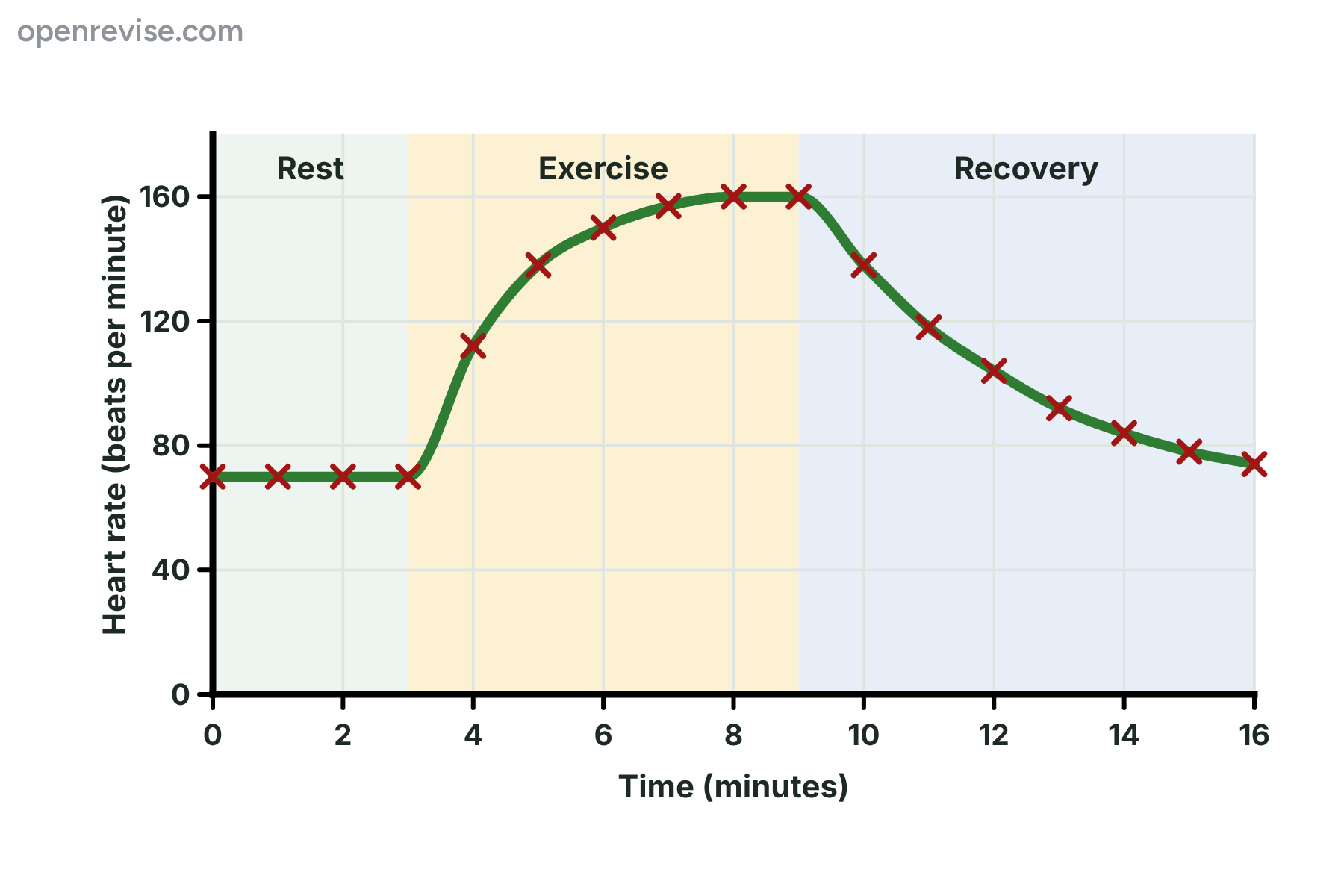 Describe what happens to the heart rate in each part of this graph.
 At rest the heart rate is steady at about 70 beats per minute. During exercise it rises quickly and then levels off at about 160. During recovery it falls slowly and takes several minutes to return to the resting rate.
-
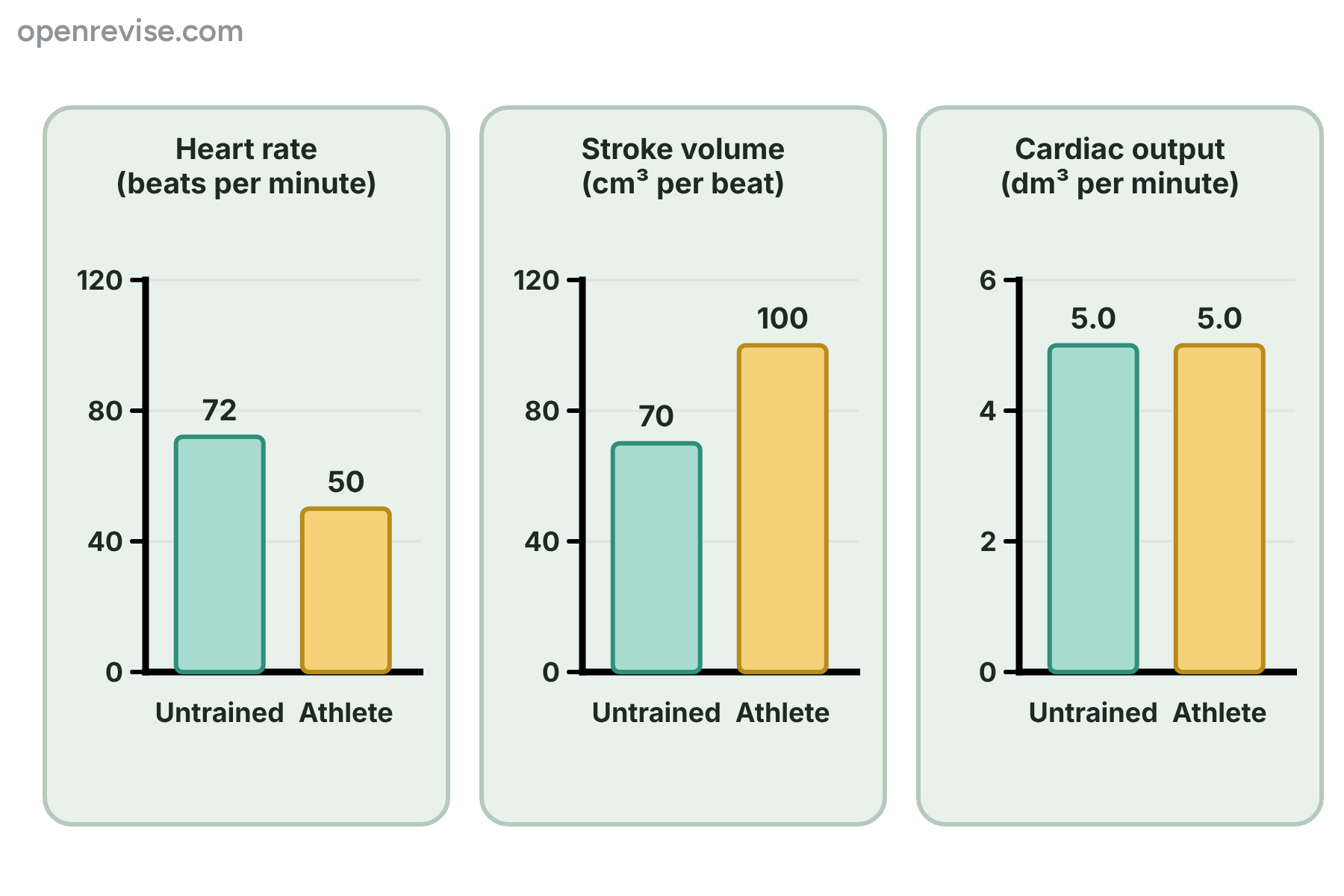 Why does the athlete have a lower heart rate but the same cardiac output?
 The athlete has a larger stroke volume, so each beat pumps out more blood. Cardiac output is stroke volume times heart rate, so fewer beats give the same cardiac output.