Exam questions · Biology · Blood, Blood Vessels and the Heart
Heart Rate, Stroke Volume and Cardiac Output
- 8 exam questions
- 26 marks
- 8 quick checks
-
1 State [1 mark]
Write down the equation that links cardiac output, stroke volume and heart rate.
Show answerHide answer
Model answer
Cardiac output = stroke volume \(\times\) heart rate.
Mark scheme
- Cardiac output = stroke volume \(\times\) heart rate — 1 mark
-
2 Calculate [2 marks]
A person has a heart rate of 75 beats per minute and a stroke volume of 68 cm\(^3\). Calculate the cardiac output in cm\(^3\) per minute.
Show answerHide answer
Model answer
Cardiac output \(= 68 \times 75 = 5100\ \text{cm}^3\) per minute.
Mark scheme
- \(68 \times 75\) — 1 mark
- 5100 cm\(^3\) per minute — 1 mark
-
3 Calculate [3 marks]
A person has a cardiac output of 4.8 dm\(^3\) per minute and a heart rate of 80 beats per minute. Calculate the stroke volume of the person in cm\(^3\).
Show answerHide answer
Model answer
Convert the cardiac output: \(4.8 \times 1000 = 4800\ \text{cm}^3\) per minute. Stroke volume \(= 4800 \div 80 = 60\ \text{cm}^3\).
Mark scheme
- Converts 4.8 dm\(^3\) to 4800 cm\(^3\) — 1 mark
- \(4800 \div 80\) — 1 mark
- 60 cm\(^3\) — 1 mark
-
4 Calculate [3 marks]
A student counts 18 pulse beats in 15 seconds. Her stroke volume is 65 cm\(^3\). Calculate her heart rate in beats per minute and her cardiac output in cm\(^3\) per minute.
Show answerHide answer
Model answer
Heart rate \(= 18 \times 4 = 72\) beats per minute. Cardiac output \(= 65 \times 72 = 4680\ \text{cm}^3\) per minute.
Mark scheme
- \(18 \times 4\) — 1 mark
- Heart rate 72 beats per minute — 1 mark
- Cardiac output 4680 cm\(^3\) per minute — 1 mark
-
5 Describe [4 marks]
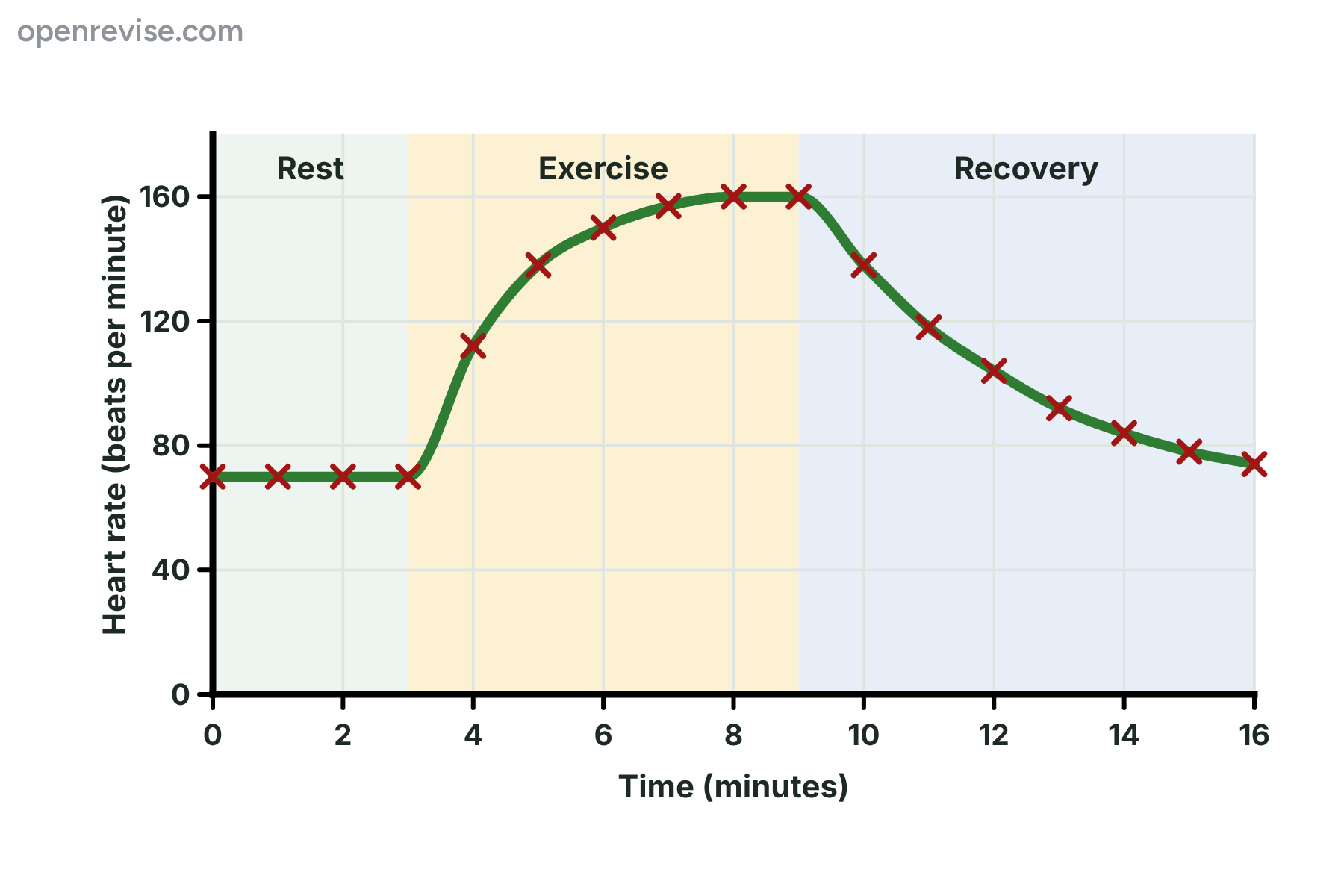
The graph shows the heart rate of a person before, during and after exercise. Describe the change in heart rate during the exercise period, and calculate the percentage increase in heart rate from the resting rate to the highest rate.
Show answerHide answer
Model answer
During exercise the heart rate rises quickly from 70 to about 138 beats per minute in the first two minutes, then more slowly, and levels off at 160 beats per minute. The increase is \(160 - 70 = 90\) beats per minute, so the percentage increase is \(90 \div 70 \times 100 = 128.6\), which is 129 percent.
Mark scheme
- Rises quickly at first, then more slowly — 1 mark
- Levels off at 160 beats per minute — 1 mark
- \(90 \div 70 \times 100\) — 1 mark
- 129 percent — 1 mark
-
6 Explain [3 marks]
Explain why the heart rate and the stroke volume of a person increase during exercise.
Show answerHide answer
Model answer
The muscles respire faster, so they need more oxygen and glucose and produce more carbon dioxide. The nervous system and adrenaline make the heart beat faster, so the heart rate rises. The heart muscle also contracts more strongly, so the stroke volume rises. Both changes increase the cardiac output, so more blood reaches the muscles.
Mark scheme
- Muscles need more oxygen and glucose, and have more carbon dioxide to remove — 1 mark
- Heart rate rises so the heart beats faster — 1 mark
- Stroke volume rises because the heart muscle contracts more strongly — 1 mark
-
7 Calculate [4 marks]
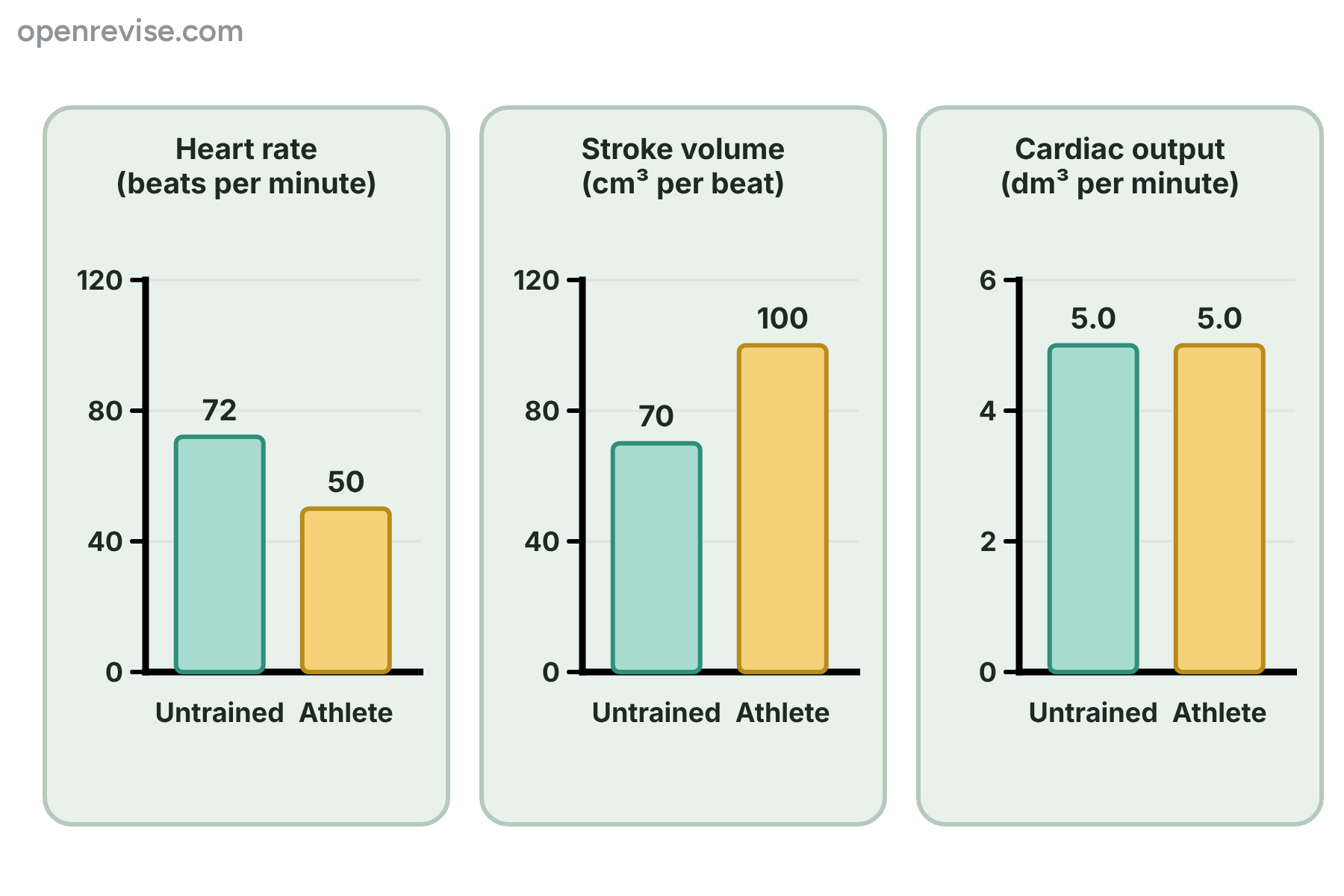
The charts show the heart rate, stroke volume and cardiac output of an untrained person and an athlete at rest. Calculate the cardiac output of the athlete in cm\(^3\) per minute, and explain why the athlete has a lower heart rate than the untrained person although the cardiac output is the same.
Show answerHide answer
Model answer
Cardiac output of the athlete \(= 100 \times 50 = 5000\ \text{cm}^3\) per minute. The athlete has a larger stroke volume, because training has made the heart muscle stronger. Each beat pumps out more blood, so fewer beats per minute are needed to give the same cardiac output.
Mark scheme
- \(100 \times 50\) — 1 mark
- 5000 cm\(^3\) per minute — 1 mark
- The athlete has a larger stroke volume — 1 mark
- So fewer beats are needed to pump the same volume of blood per minute — 1 mark
-
8 Evaluate [6 marks]
Source: A volunteer trained on a bicycle for six months. Before training: at rest the heart rate was 75 beats per minute and the stroke volume was 64 cm\(^3\). During hard exercise the heart rate was 170 beats per minute and the stroke volume was 105 cm\(^3\). After training: at rest the heart rate was 60 beats per minute and the stroke volume was 80 cm\(^3\). During hard exercise the heart rate was 172 beats per minute and the stroke volume was 130 cm\(^3\). Use the data to evaluate the effect of six months of training on the heart of the volunteer. Include calculations of cardiac output in your answer.
Show answerHide answer
Model answer
At rest, before training the cardiac output was \(64 \times 75 = 4800\ \text{cm}^3\) per minute and after training it was \(80 \times 60 = 4800\ \text{cm}^3\) per minute, so it was unchanged. The resting heart rate fell because the stroke volume rose, so fewer beats were needed. During hard exercise the cardiac output rose from \(105 \times 170 = 17\,850\ \text{cm}^3\) per minute to \(130 \times 172 = 22\,360\ \text{cm}^3\) per minute, an increase of 4510 cm\(^3\) per minute, which is about 25 percent. Training has made the heart muscle stronger, so the stroke volume is larger. This means that more oxygen and glucose are delivered to the muscles during exercise, so the volunteer can exercise harder for longer. The effect on the heart is beneficial.
Mark scheme
- Resting cardiac output is 4800 before and after training — 1 mark
- Resting heart rate falls because the stroke volume increases — 1 mark
- Exercise cardiac output rises from 17 850 to 22 360 cm\(^3\) per minute — 1 mark
- An increase of about 25 percent — 1 mark
- Training strengthens the heart muscle, giving a larger stroke volume — 1 mark
- More oxygen is delivered to the muscles, so performance improves (a conclusion that the training is beneficial) — 1 mark
Quick check
-
1
What is the unit of heart rate?
Show answerHide answer
C: Beats per minute
Heart rate is the number of beats in one minute, so it is measured in beats per minute.
-
2
Which equation is correct?
Show answerHide answer
A: Cardiac output = stroke volume \(\times\) heart rate
Cardiac output is the stroke volume multiplied by the heart rate.
-
3
A person has a stroke volume of 70 cm\(^3\) and a heart rate of 60 beats per minute. What is the cardiac output?
Show answerHide answer
D: 4200 cm\(^3\) per minute
\(70 \times 60 = 4200\ \text{cm}^3\) per minute.
-
4
A person's cardiac output is 6000 cm\(^3\) per minute and their heart rate is 75 beats per minute. What is the stroke volume?
Show answerHide answer
B: 80 cm\(^3\)
Stroke volume is cardiac output divided by heart rate, so \(6000 \div 75 = 80\ \text{cm}^3\).
-
5
A pulse is counted for 30 seconds and there are 36 beats. What is the heart rate?
Show answerHide answer
C: 72 beats per minute
30 seconds is half a minute, so double the count: \(36 \times 2 = 72\) beats per minute.
-
6
What happens to the cardiac output during exercise?
Show answerHide answer
A: It increases
Both the heart rate and the stroke volume increase, so the cardiac output increases.
-
7
Why does a trained athlete have a lower resting heart rate than an untrained person?
Show answerHide answer
D: The athlete has a larger stroke volume
Training gives a stronger heart with a larger stroke volume, so fewer beats are needed to give the same cardiac output.
-
8
What does the recovery time measure?
Show answerHide answer
B: The time for the heart rate to return to normal after exercise
The recovery time is how long the heart rate takes to return to its resting value after exercise stops.