Biology · Blood, Blood Vessels and the Heart
The Structure and Functions of Blood
Blood is a tissue made of a liquid and three kinds of cell, and each part has a structure that suits its job. This lesson is for both Combined Science and separate Biology, at Foundation and Higher. It explains how the structure of red blood cells, white blood cells, plasma and platelets is related to their functions.
Learning Objectives
- 1Describe the components of blood: plasma, red blood cells, white blood cells and platelets.
- 2Explain how the structure of a red blood cell is related to its function of carrying oxygen.
- 3Explain how phagocytes and lymphocytes protect the body, and how platelets help blood to clot.
- 4Calculate the actual size of a cell from a magnified image and use standard form to find the number of cells in a volume of blood.
Retrieval practice
-
1
Why do large animals need a transport system?
Show answerHide answer
Their surface area to volume ratio is small and their cells are far from the surface, so diffusion alone cannot supply them.
-
2
Name two substances carried by the blood to the cells.
Show answerHide answer
Any two of: oxygen, glucose, amino acids, mineral ions, water.
-
3
Name two waste substances carried away from the cells by the blood.
Show answerHide answer
Carbon dioxide and urea.
-
4
What is the formula for magnification?
Show answerHide answer
Magnification equals the size of the image divided by the size of the real object.
A tissue in a liquid
Blood is a tissue that flows round the body in the blood vessels, pumped by the heart. An adult has about five litres of it. If a blood sample is left to settle or is spun in a centrifuge, it separates into a pale yellow liquid, the plasma, with a thin white layer and a red layer of cells beneath. Each component has its own structure and its own job, and the structure of each one is what lets it do that job.
What blood is made of
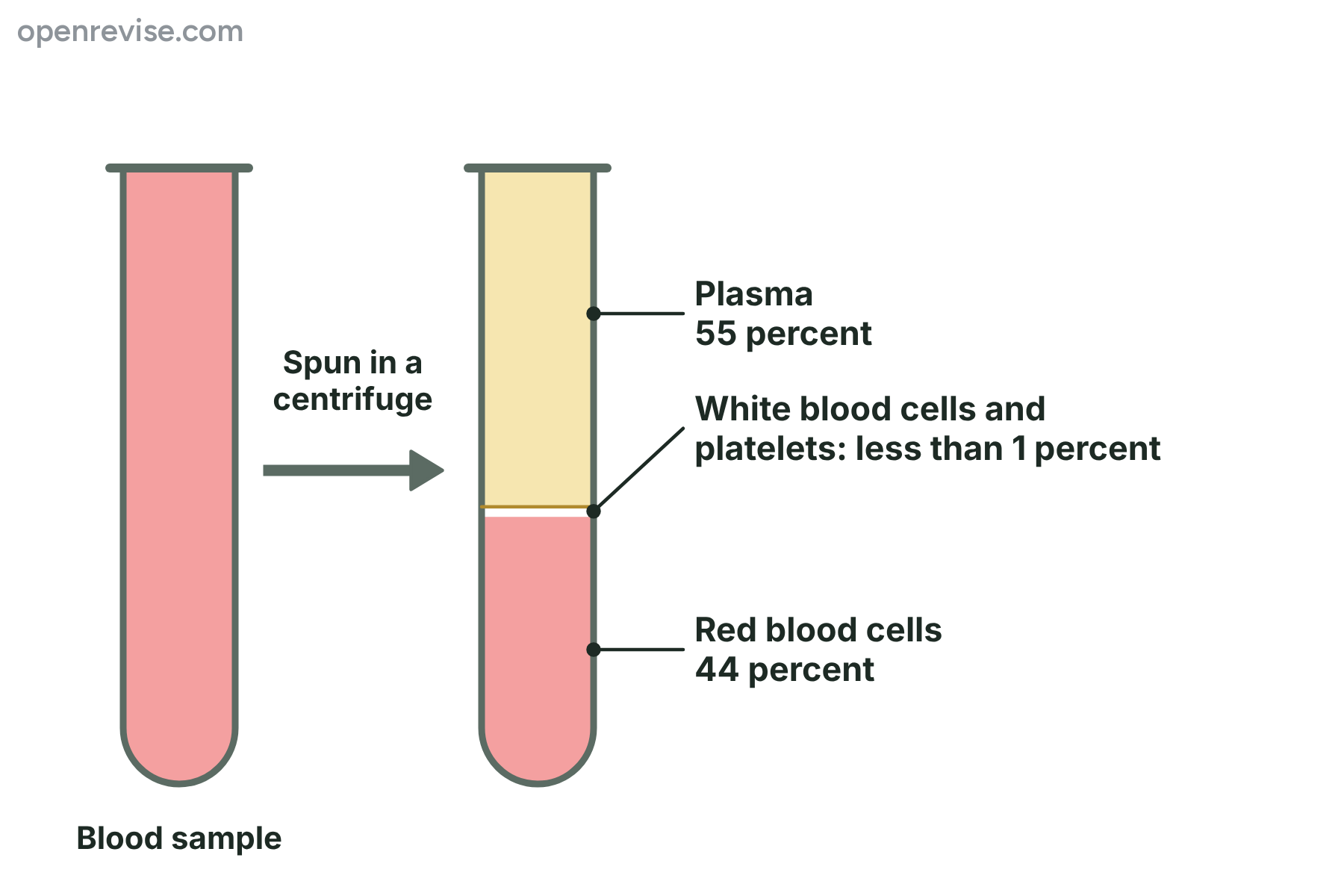
Plasma is a little over half of the blood, the red blood cells are most of the rest and the white cells and platelets are less than 1 percent.
Plasma
Plasma is a straw-coloured liquid that is mostly water. It carries other substances in solution or suspension.
-
A transport liquid
Plasma carries dissolved carbon dioxide from the cells to the lungs, dissolved food molecules such as glucose and amino acids from the small intestine to the cells, and urea from the liver to the kidneys.
-
Hormones and ions
Hormones travel from the glands that make them to their target organs in the plasma, and mineral ions are carried in it too.
-
Heat
Plasma carries heat from the organs that make it, such as the liver and the muscles, so that it is spread round the body.
-
Mostly water
Water is a good solvent, so many substances dissolve in it, and it flows easily. About 55 percent of the blood by volume is plasma.
Red blood cells (erythrocytes)
Red blood cells are the most numerous cells in blood, about 5 million in every cubic millimetre. Their job is to carry oxygen from the lungs to every cell in the body.
-
Haemoglobin
Each cell is packed with the red pigment haemoglobin, a protein that contains iron. In the lungs, where the oxygen concentration is high, haemoglobin combines with oxygen to form oxyhaemoglobin. In the tissues, where it is low, the oxyhaemoglobin releases the oxygen.
-
No nucleus
A mature red blood cell has no nucleus, so there is more room inside for haemoglobin and the cell can carry more oxygen.
-
A biconcave disc
The cell is a flattened disc that is pushed in on both sides. This gives a large surface area for its volume, so oxygen can diffuse in and out quickly across a short distance.
-
Small and flexible
The cell is about 7 micrometres across, which is small enough, and flexible enough, to squeeze through the narrowest capillaries so that oxygen reaches every tissue.
White blood cells (phagocytes and lymphocytes)
White blood cells defend the body against pathogens. There are fewer of them, about 7000 in every cubic millimetre, and unlike red blood cells they have a nucleus.
-
Phagocytes
A phagocyte can change shape, so it can flow round a pathogen and engulf it. It then digests the pathogen with enzymes. This is called phagocytosis. Its nucleus has lobes, and it can leave the blood and move through the tissues.
-
Lymphocytes
A lymphocyte has a large round nucleus that fills most of the cell. It makes antibodies, which stick to a particular pathogen and help to destroy it. Some lymphocytes make antitoxins.
-
Different attacks
Phagocytes attack any pathogen that they meet. Lymphocytes make antibodies that are specific to one type of pathogen.
Platelets
Platelets are small fragments of cells, with no nucleus, and there are about 250 000 of them in every cubic millimetre of blood. They are made in the bone marrow.
-
Clotting
When a blood vessel is damaged, platelets collect at the cut and help to make the blood clot. The clot seals the wound.
-
Stopping blood loss
A clot stops the body losing too much blood and keeps the blood pressure up.
-
Stopping infection
The clot dries into a scab that stops pathogens getting into the blood through the wound. Without platelets, even a small cut could bleed for a long time.
The cells in blood
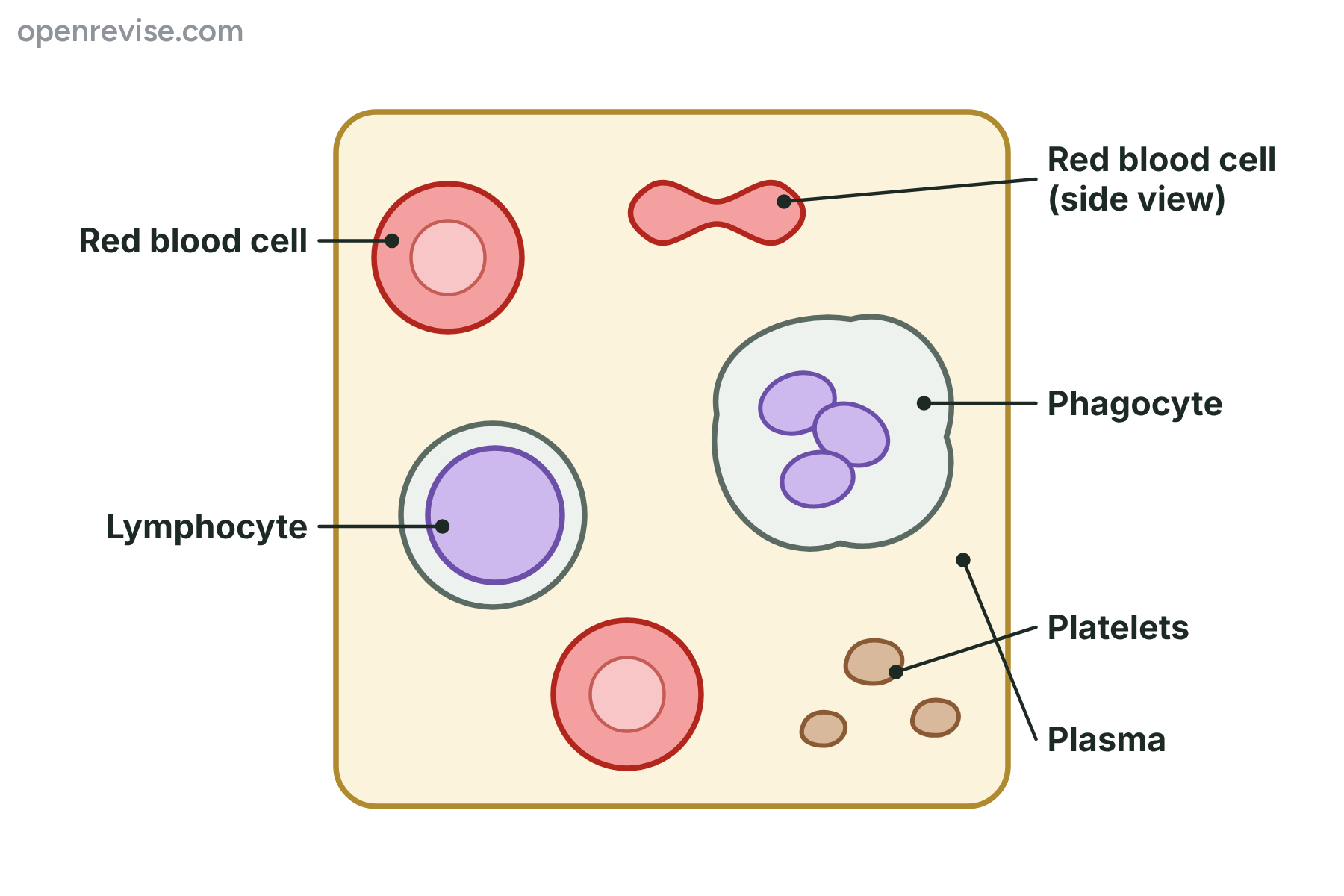
Red blood cells have no nucleus. White blood cells have a nucleus. Platelets are cell fragments.
Red blood cells and white blood cells
Red blood cells
- No nucleus
- Packed with haemoglobin
- A biconcave disc about 7 micrometres across
- About 5 million in each cubic millimetre
- Carry oxygen
White blood cells
- A nucleus, which may have lobes
- No haemoglobin
- Round or irregular, and larger than red cells
- About 7000 in each cubic millimetre
- Defend against pathogens
How a blood clot forms
A clot seals a damaged vessel in a few minutes.
-
1
The vessel is cut
Blood leaks out and the damaged wall is exposed.
-
2
Platelets collect
Platelets stick to the damaged area and release chemicals.
-
3
A mesh forms
The chemicals change the soluble protein fibrinogen into insoluble threads of fibrin, which make a mesh.
-
4
The mesh traps cells
Red blood cells and platelets are trapped in the mesh, which forms a clot.
-
5
A scab
The clot dries to form a scab, which protects the wound while the skin repairs itself.
Calculating the actual size of a red blood cell
A drawing of a red blood cell is 56 mm across. The magnification of the drawing is \(\times 8000\). Calculate the actual diameter of the cell in micrometres (\(\mu\)m).
Show the solutionHide the solution
- 1 Rearrange the formula \(\text{magnification} = \dfrac{\text{image size}}{\text{actual size}}\), so \(\text{actual size} = \dfrac{\text{image size}}{\text{magnification}}\)
- 2 Substitute \(\text{actual size} = 56 \div 8000 = 0.007\ \text{mm}\)
- 3 Convert mm to \(\mu\)m 1 mm is 1000 \(\mu\)m, so \(0.007 \times 1000 = 7\ \mu\text{m}\)
AnswerThe actual diameter is 7 \(\mu\)m.
How many red blood cells are there in a body?
There are \(5.0 \times 10^6\) red blood cells in each cubic millimetre of blood. A person has \(5.0 \times 10^6\) cubic millimetres of blood (5 litres). Calculate the number of red blood cells in the person. Give your answer in standard form.
Show the solutionHide the solution
- 1 Multiply the number per mm\(^3\) by the volume \((5.0 \times 10^6) \times (5.0 \times 10^6)\)
- 2 Multiply the numbers \(5.0 \times 5.0 = 25\)
- 3 Add the powers of ten \(10^6 \times 10^6 = 10^{12}\), so the answer is \(25 \times 10^{12}\)
- 4 Write in standard form \(25 \times 10^{12} = 2.5 \times 10^{13}\)
AnswerThere are \(2.5 \times 10^{13}\) red blood cells.
Case study
Anaemia: too little haemoglobin
Haemoglobin contains iron, so a diet that is short of iron means that the body makes fewer healthy red blood cells and less haemoglobin. The blood then carries less oxygen. A person with this iron-deficiency anaemia looks pale, feels tired and gets short of breath easily. The bone marrow has to replace the red blood cells that wear out, so it needs a steady supply of iron from foods such as red meat and green vegetables.
The big idea
Every part of the blood has a structure that suits its job: red blood cells carry oxygen, white blood cells defend, platelets clot and plasma transports.
Blood
Blood
-
Plasma
- mostly water
- carries carbon dioxide, food, urea, hormones and heat
-
Red blood cells
- haemoglobin
- no nucleus
- biconcave disc
- carry oxygen
-
Phagocytes
- change shape
- engulf and digest pathogens
-
Lymphocytes
- large nucleus
- make antibodies
-
Platelets
- cell fragments
- help the blood to clot
- scab
Summary and exam focus
- Blood is made of plasma, red blood cells, white blood cells and platelets.
- Plasma is mostly water and carries carbon dioxide, dissolved food, urea, hormones, mineral ions and heat.
- Red blood cells carry oxygen. They contain haemoglobin, have no nucleus and are biconcave discs with a large surface area.
- Phagocytes engulf and digest pathogens, and lymphocytes make antibodies against them.
- Platelets are cell fragments that help blood to clot, which seals a wound and keeps pathogens out.
Exam focus
Explain how the structure of a red blood cell is related to its function. (4 marks) (4 marks)
Pair every feature with its effect. Write that the cell has no nucleus, so there is more room for haemoglobin, and that it is a biconcave disc, so it has a large surface area for oxygen to diffuse. Say what haemoglobin does: it combines with oxygen. Do not just list the features.
Key terms
The words this lesson expects you to use. Each one is linked from the first place it appears above.
- Plasma
- The pale yellow liquid part of the blood, which carries dissolved substances, hormones, heat and blood cells.
- Red blood cell
- A blood cell with no nucleus that is full of haemoglobin and carries oxygen (an erythrocyte).
- Haemoglobin
- The red protein in red blood cells that contains iron and combines with oxygen.
- Oxyhaemoglobin
- The bright red compound formed when haemoglobin combines with oxygen in the lungs.
- Biconcave disc
- The flattened shape of a red blood cell, curved in on both sides, which gives a large surface area.
- White blood cell
- A blood cell with a nucleus that defends the body against pathogens (a leucocyte).
- Phagocyte
- A white blood cell that engulfs and digests pathogens by phagocytosis.
- Lymphocyte
- A white blood cell with a large round nucleus that makes antibodies.
- Antibody
- A protein made by a lymphocyte that sticks to a particular pathogen and helps to destroy it.
- Platelet
- A small fragment of a cell with no nucleus that helps blood to clot.
You've finished the notes
Check your understanding
Test yourself while it is fresh. Start with the flashcards, then try the exam questions.
Something here looks wrong?
Tell us what and we will go and look. It goes to whoever writes these pages, nobody else, and we do not ask who you are — so there is nothing to sign and nothing comes back to you.