Biology · Blood, Blood Vessels and the Heart
Arteries, Veins and Capillaries
Blood travels round the body in three types of vessel, and each one is built for the job it does. This lesson is for both Combined Science and separate Biology, at Foundation and Higher. It explains how the structure of arteries, veins and capillaries is related to their functions, and shows how to calculate magnification and blood flow from diagrams and data.
Learning Objectives
- 1Describe the direction of blood flow and the function of arteries, veins and capillaries.
- 2Explain how the wall thickness, the lumen, elastic fibres, muscle and valves of each vessel are related to its function.
- 3Compare the pressure and speed of the blood in arteries, capillaries and veins.
- 4Calculate magnification, wall thickness and the rate of blood flow from diagrams and data.
Retrieval practice
-
1
What does the heart do?
Show answerHide answer
It pumps blood round the body.
-
2
Which blood cells carry oxygen?
Show answerHide answer
Red blood cells.
-
3
Why do cells need a supply of blood?
Show answerHide answer
It brings oxygen and glucose and carries away carbon dioxide and urea.
-
4
What is the formula for magnification?
Show answerHide answer
\(\text{magnification} = \text{image size} \div \text{actual size}\).
A closed system of tubes
Blood never leaves its vessels. The heart pumps it into arteries, which branch into smaller and smaller vessels until they reach the capillaries that run between the cells. The capillaries join up into veins, which carry the blood back to the heart. Three kinds of vessel, with three different structures, make this one-way system work.
Arteries
Arteries carry blood away from the heart. The blood leaves the ventricles at high pressure in surges, one with each heartbeat.
-
A thick wall of muscle
The thick, muscular wall can withstand the high pressure of the blood without bursting. The muscle can also contract to narrow the artery and change how much blood goes to an organ.
-
Elastic fibres
The wall contains elastic fibres that stretch as each surge of blood arrives and recoil afterwards. This smooths the flow of blood and keeps the pressure up between heartbeats. The recoil is what you can feel as your pulse.
-
A narrow lumen
The lumen is the space in the middle of the vessel. In an artery it is small compared with the thickness of the wall, which helps to keep the pressure high.
-
Which blood they carry
Most arteries carry oxygenated blood. The pulmonary artery is the exception, because it carries deoxygenated blood from the heart to the lungs.
Veins
Veins carry blood back to the heart. By the time the blood has been through the capillaries its pressure is low and it flows smoothly.
-
A thin wall
The pressure is low, so the wall does not need to be thick. It has less muscle and fewer elastic fibres than an artery.
-
A wide lumen
The wide lumen gives the blood little resistance, so it can flow easily even though the pressure is low.
-
Valves
Valves are flaps that close if the blood tries to flow backwards. In the legs and arms the blood is squeezed along by the contraction of the surrounding muscles, and the valves make sure that it only moves towards the heart.
-
Which blood they carry
Most veins carry deoxygenated blood. The pulmonary vein is the exception, because it carries oxygenated blood from the lungs to the heart.
Capillaries
Capillaries are the exchange vessels. They bring the blood close to every cell so that substances can move between the blood and the cells.
-
A wall one cell thick
The wall is only one cell thick, so the diffusion distance is as short as it can be. Oxygen and glucose diffuse out of the blood into the cells, and carbon dioxide and urea diffuse in.
-
Very narrow
A capillary is about as wide as a single red blood cell, so the cells pass through in single file and are pressed close to the wall, which speeds up exchange.
-
A dense network
Capillaries branch into huge networks, so there is a very large total surface area for diffusion, and every cell is close to a capillary.
-
Slow flow
The total space in all the capillaries is so large that the blood slows down. This gives more time for substances to be exchanged.
The three kinds of blood vessel
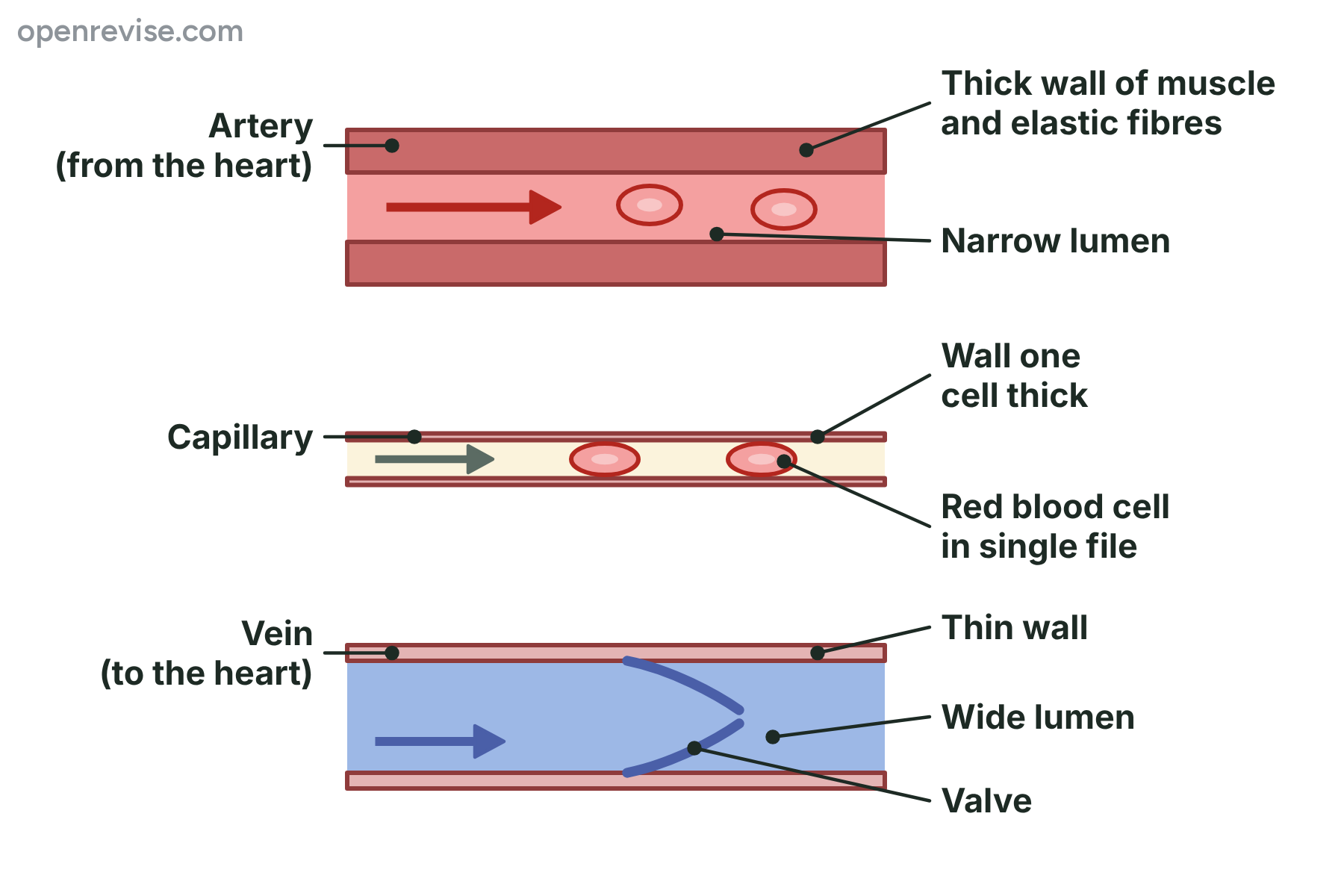
Each vessel has a structure that suits its job: strong, thin or one-way.
Arteries and veins
Arteries
- Carry blood away from the heart
- High pressure
- Thick wall with muscle and elastic fibres
- Narrow lumen
- No valves, and the blood moves in pulses
Veins
- Carry blood towards the heart
- Low pressure
- Thin wall with little muscle
- Wide lumen
- Valves stop blood flowing backwards
The route of blood around the body
The vessels get smaller and then larger again.
-
1
Artery
The heart pumps blood at high pressure into the arteries, which carry it away from the heart.
-
2
Smaller arteries
The arteries branch into smaller vessels that take the blood to each organ.
-
3
Capillaries
The smallest vessels run between the cells, where substances are exchanged with the blood.
-
4
Small veins
The capillaries join up to form small veins, and the pressure is now low.
-
5
Vein
The small veins join up into larger veins, which carry the blood back to the heart.
Vessels seen in cross-section
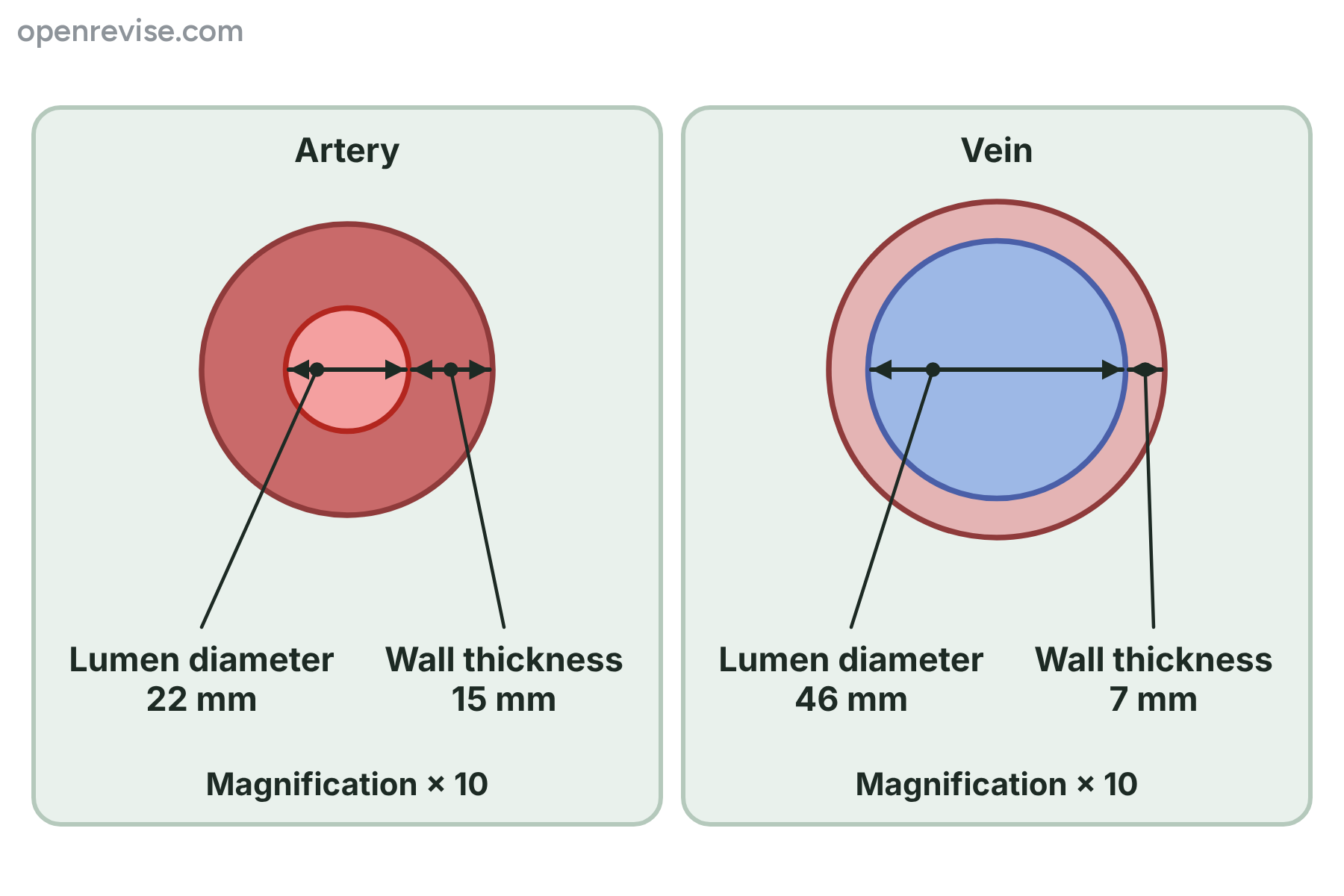
The artery has a thick wall and a small lumen. The vein has a thin wall and a large lumen.
Finding the actual size from a magnified diagram
The diagram shows the artery magnified \(\times 10\). The lumen is 22 mm across in the diagram and the wall is 15 mm thick. Calculate the actual diameter of the lumen and the actual thickness of the wall.
Show the solutionHide the solution
- 1 Rearrange the formula \(\text{actual size} = \text{image size} \div \text{magnification}\)
- 2 Lumen \(22 \div 10 = 2.2\ \text{mm}\)
- 3 Wall \(15 \div 10 = 1.5\ \text{mm}\)
AnswerThe actual lumen diameter is 2.2 mm and the actual wall thickness is 1.5 mm.
Comparing wall thickness with lumen width
Use the measurements in the diagram to compare the artery and the vein. Calculate the ratio of wall thickness to lumen diameter for each vessel, giving each answer to 2 significant figures.
Show the solutionHide the solution
- 1 Artery \(15 \div 22 = 0.68\)
- 2 Vein \(7 \div 46 = 0.15\)
- 3 Compare \(0.68 \div 0.15 \approx 4.5\)
- 4 Conclude In proportion to its lumen the artery has a much thicker wall, which suits its job of withstanding high pressure
AnswerThe artery's ratio is 0.68 and the vein's is 0.15, so the artery's wall is about 4.5 times thicker relative to its lumen.
Calculating the rate of blood flow
In an artery, 450 cm\(^3\) of blood flows past a point in 90 seconds. Calculate the rate of blood flow in cm\(^3\) per minute.
Show the solutionHide the solution
- 1 Write the formula \(\text{rate of blood flow} = \text{volume of blood} \div \text{time}\)
- 2 Find the rate per second \(450 \div 90 = 5\ \text{cm}^3\) per second
- 3 Convert to minutes \(5 \times 60 = 300\ \text{cm}^3\) per minute
AnswerThe rate of blood flow is 300 cm\(^3\) per minute.
Case study
A cut artery or a cut vein?
First-aiders can tell the two apart by the way that the blood escapes. Blood from a cut artery spurts out in time with the heartbeat, because it is under high pressure and the elastic wall pulses with each beat. Blood from a cut vein wells out steadily, because the pressure is low. An arterial bleed is more dangerous because the blood is lost much faster, and pressure on the wound is needed straight away.
The big idea
Arteries are strong, veins are wide with valves, and capillaries are thin and tiny, because the structure of each vessel suits its job.
Blood vessels
Blood vessels
-
Arteries
- away from the heart
- thick muscular wall
- elastic fibres
- narrow lumen
- high pressure
-
Veins
- towards the heart
- thin wall
- wide lumen
- valves
- low pressure
-
Capillaries
- wall one cell thick
- one red cell at a time
- huge network
- exchange
-
Route
- artery
- capillary
- vein
-
Calculations
- actual size equals image size divided by magnification
- flow equals volume divided by time
Summary and exam focus
- Arteries carry blood away from the heart at high pressure. They have a thick wall of muscle and elastic fibres and a narrow lumen.
- Veins carry blood to the heart at low pressure. They have a thin wall, a wide lumen and valves that stop the blood flowing backwards.
- Capillaries have walls one cell thick, are one red blood cell wide and form dense networks, so substances are exchanged quickly.
- The pulmonary artery carries deoxygenated blood and the pulmonary vein carries oxygenated blood, so the rule is based on the direction of flow and not on the oxygen content.
- The actual size equals the image size divided by the magnification, and the rate of blood flow equals the volume divided by the time.
Exam focus
Explain how the structure of an artery, a vein and a capillary is related to the function of each vessel. (6 marks) (6 marks)
Give each vessel two features and link each feature to the job. For an artery write thick, elastic wall and narrow lumen because the pressure is high. For a vein write wide lumen and valves because the pressure is low and the blood must not flow backwards. For a capillary write wall one cell thick because the diffusion distance is short.
Key terms
The words this lesson expects you to use. Each one is linked from the first place it appears above.
- Artery
- A blood vessel that carries blood away from the heart at high pressure.
- Vein
- A blood vessel that carries blood towards the heart at low pressure.
- Capillary
- A tiny blood vessel with a wall one cell thick, where substances are exchanged with the cells.
- Lumen
- The space inside a blood vessel through which the blood flows.
- Elastic fibres
- Fibres in the wall of an artery that stretch and recoil to smooth the flow and keep up the pressure.
- Valve
- A flap in a vein or in the heart that stops the blood flowing backwards.
- Blood pressure
- The force that the blood puts on the walls of the vessels.
- Pulse
- The stretching and recoil of an artery wall with each beat of the heart.
- Rate of blood flow
- The volume of blood that flows past a point in a given time.
- Magnification
- How many times larger an image is than the real object.
You've finished the notes
Check your understanding
Test yourself while it is fresh. Start with the flashcards, then try the exam questions.
Something here looks wrong?
Tell us what and we will go and look. It goes to whoever writes these pages, nobody else, and we do not ask who you are — so there is nothing to sign and nothing comes back to you.