Exam questions · Biology · Blood, Blood Vessels and the Heart
The Structure and Functions of Blood
- 8 exam questions
- 26 marks
- 8 quick checks
-
1 Name [1 mark]
Name the blood cells that contain haemoglobin.
Show answerHide answer
Model answer
Red blood cells (erythrocytes).
Mark scheme
- Red blood cells — 1 mark
-
2 Name [3 marks]
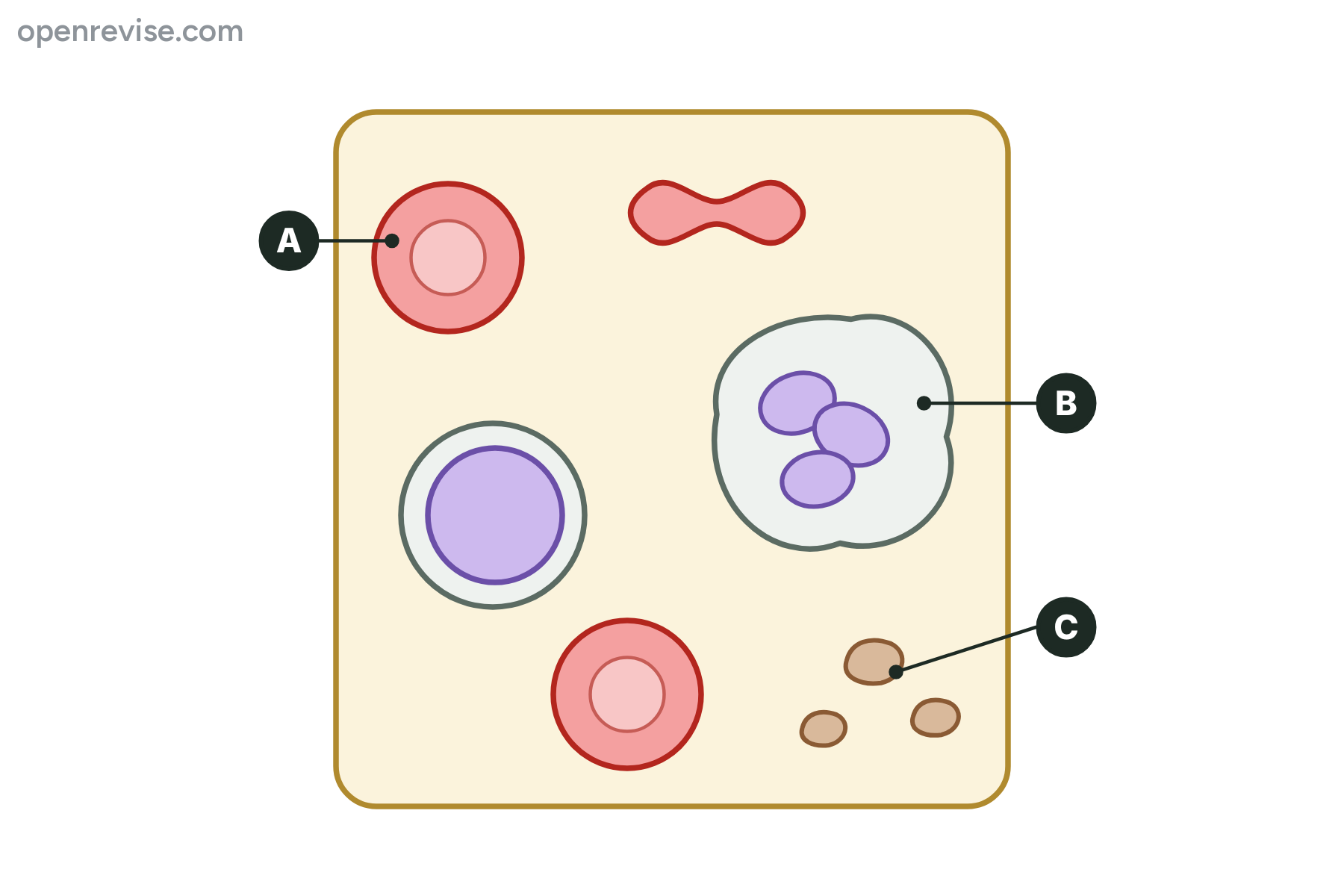
The diagram shows some of the components of blood. Name the parts labelled A, B and C.
Show answerHide answer
Model answer
A is a red blood cell. B is a phagocyte (a white blood cell). C is a platelet.
Mark scheme
- A: red blood cell — 1 mark
- B: phagocyte (white blood cell) — 1 mark
- C: platelet — 1 mark
-
3 Describe [3 marks]
Describe how platelets help to protect the body after a cut.
Show answerHide answer
Model answer
Platelets collect at the damaged blood vessel and help the blood to clot. The clot seals the wound, so the body does not lose too much blood. The clot dries to form a scab, which stops pathogens from entering the body.
Mark scheme
- Platelets help the blood to clot at the wound — 1 mark
- This stops blood loss — 1 mark
- The scab prevents pathogens from entering — 1 mark
-
4 Explain [4 marks]
Explain how the structure of a red blood cell is related to its function.
Show answerHide answer
Model answer
A red blood cell contains haemoglobin, which combines with oxygen so that the cell can carry it. It has no nucleus, so there is more space inside for haemoglobin. It is a biconcave disc, which gives it a large surface area for its volume, so oxygen can diffuse in and out quickly. It is small and flexible, so it can squeeze through the narrow capillaries to reach the tissues.
Mark scheme
- Contains haemoglobin, which combines with oxygen — 1 mark
- No nucleus, so more room for haemoglobin — 1 mark
- Biconcave disc gives a large surface area for diffusion — 1 mark
- Small and flexible to pass through capillaries — 1 mark
-
5 Explain [4 marks]
Explain how phagocytes and lymphocytes help to protect the body against pathogens.
Show answerHide answer
Model answer
A phagocyte can change its shape to flow round a pathogen and engulf it. It then digests the pathogen with enzymes. A lymphocyte makes antibodies that are specific to a pathogen. The antibodies stick to the pathogen and help to destroy it.
Mark scheme
- Phagocytes engulf pathogens — 1 mark
- They digest the pathogen — 1 mark
- Lymphocytes produce antibodies — 1 mark
- Antibodies bind to the pathogen and help to destroy it — 1 mark
-
6 Calculate [3 marks]
A student draws a white blood cell from a photomicrograph. The cell in the drawing is 48 mm across. The actual diameter of the cell is 12 \(\mu\)m. Calculate the magnification of the drawing.
Show answerHide answer
Model answer
Convert the image size to micrometres: \(48\ \text{mm} = 48 \times 1000 = 48\,000\ \mu\text{m}\). Then magnification \(= 48\,000 \div 12 = 4000\), so the magnification is \(\times 4000\).
Mark scheme
- Convert 48 mm to 48 000 \(\mu\)m — 1 mark
- \(48\,000 \div 12\) — 1 mark
- \(\times 4000\) — 1 mark
-
7 Calculate [2 marks]
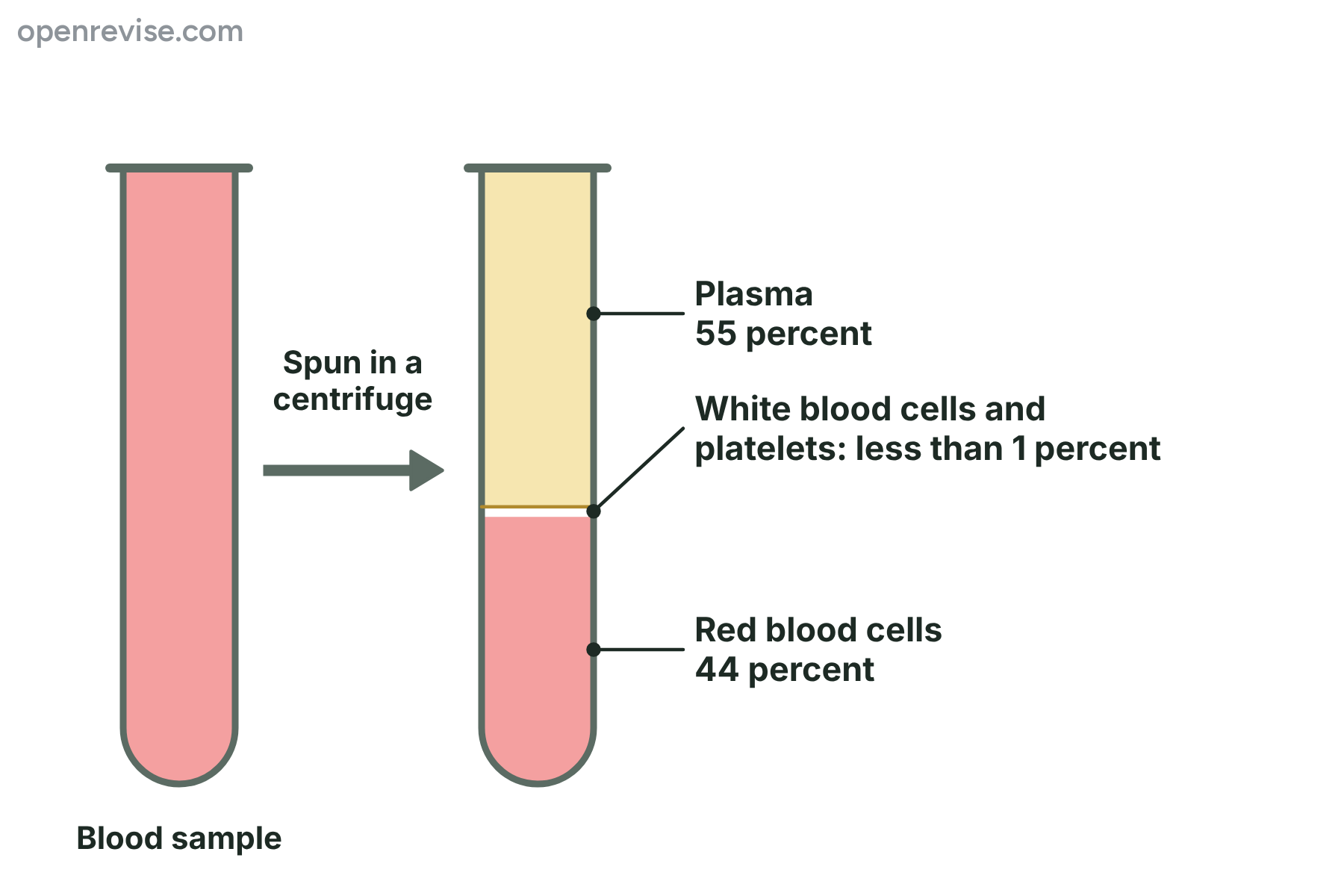
A blood sample of 600 cm\(^3\) is spun in a centrifuge and separated as shown in the diagram. Calculate the volume of plasma in the sample.
Show answerHide answer
Model answer
\(55 \div 100 \times 600 = 330\ \text{cm}^3\).
Mark scheme
- \(55 \div 100 \times 600\) — 1 mark
- 330 cm\(^3\) — 1 mark
-
8 Explain [6 marks]
Explain how the structure of the blood is related to its functions. In your answer refer to plasma, red blood cells, white blood cells and platelets.
Show answerHide answer
Model answer
Plasma is mostly water, so it dissolves and carries substances such as carbon dioxide, glucose, urea and hormones around the body. Red blood cells contain haemoglobin to carry oxygen, have no nucleus so there is more room for haemoglobin, and are biconcave discs with a large surface area for oxygen to diffuse. White blood cells have a nucleus and defend the body: phagocytes change shape to engulf and digest pathogens, and lymphocytes make antibodies to destroy them. Platelets are cell fragments that help the blood to clot, which seals wounds and stops pathogens getting in.
Mark scheme
- Plasma is mostly water, a solvent that carries dissolved substances — 1 mark
- Red blood cells contain haemoglobin to carry oxygen — 1 mark
- No nucleus and a biconcave shape suit the red cell for carrying oxygen — 1 mark
- Phagocytes change shape to engulf pathogens — 1 mark
- Lymphocytes make antibodies — 1 mark
- Platelets help blood to clot, sealing wounds and keeping pathogens out — 1 mark
Quick check
-
1
Which part of the blood carries most of the oxygen?
Show answerHide answer
C: Red blood cells
Red blood cells contain haemoglobin, which combines with oxygen.
-
2
What is haemoglobin?
Show answerHide answer
A: A red protein containing iron that combines with oxygen
Haemoglobin is a red protein that contains iron and combines with oxygen in the lungs.
-
3
Why does a red blood cell have no nucleus?
Show answerHide answer
D: So there is more room for haemoglobin
Without a nucleus there is more room for haemoglobin, so the cell carries more oxygen.
-
4
What is the job of a phagocyte?
Show answerHide answer
B: To engulf and digest pathogens
Phagocytes engulf pathogens and digest them.
-
5
Which blood component is a fragment of a cell and has no nucleus?
Show answerHide answer
A: Platelets
Platelets are fragments of cells. They have no nucleus and help the blood to clot.
-
6
Which of these is not carried in the plasma?
Show answerHide answer
D: Most of the oxygen
Oxygen is carried mainly by haemoglobin inside the red blood cells, while the other three are carried dissolved in the plasma.
-
7
A drawing of a cell is 30 mm across and the cell is 10 \(\mu\)m across in real life. What is the magnification?
Show answerHide answer
C: \(\times 3000\)
Convert 30 mm to 30 000 \(\mu\)m, then \(30\,000 \div 10 = 3000\).
-
8
Which cell makes antibodies?
Show answerHide answer
B: Lymphocyte
Lymphocytes produce antibodies that are specific to a pathogen.