Biology · Exchange Surfaces and Gas Exchange
Factors Affecting the Rate of Diffusion and Fick's Law
Why is diffusion fast in the alveoli and slow through thick skin? This lesson is for separate Biology only, so Combined Science students do not need it. It describes the factors that affect the rate of diffusion and shows how to use Fick's law to calculate and compare rates, at Foundation and Higher.
Learning Objectives
- 1Describe how surface area, concentration gradient and diffusion distance affect the rate of diffusion.
- 2Explain how exchange surfaces such as the alveoli and the villi are adapted to make diffusion fast.
- 3State Fick's law and use it to calculate and compare rates of diffusion.
- 4Interpret graphs that show how the rate of diffusion changes with the concentration difference and with the thickness of a membrane.
Retrieval practice
-
1
What is a concentration gradient?
Show answerHide answer
The difference in concentration between two places.
-
2
Name three adaptations of the alveoli for gas exchange.
Show answerHide answer
A large surface area, thin walls (a short diffusion distance), a rich blood supply and ventilation, which keep the concentration gradient steep.
-
3
What does it mean if y is directly proportional to x?
Show answerHide answer
If x doubles, y doubles. The graph is a straight line through the origin.
-
4
What is the surface area to volume ratio of a 2 cm cube?
Show answerHide answer
3 : 1.
Fast or slow?
Oxygen crosses from the air into your blood in a fraction of a second, yet the same gas would take far longer to cross a thick layer of skin. Diffusion is not always the same speed. Its rate depends on the size of the surface, the difference in concentration and the distance the particles must travel. Knowing this explains why exchange surfaces look the way they do, and Fick's law lets us put numbers on it.
The factors that affect the rate of diffusion
Three factors matter for the exchange surfaces of the body. Each one changes the rate in a predictable way.
-
Surface area
The larger the area of the membrane, the more particles can cross at the same time, so the faster the rate. If the area doubles, the rate of diffusion doubles.
-
Concentration gradient
The bigger the difference in concentration between the two sides, the more particles move from the high side than from the low side, so the net movement is faster. If the concentration difference doubles, the rate doubles.
-
Diffusion distance
This is the thickness of the membrane or layer that the particles have to cross. The thicker it is, the longer the journey, so the slower the rate. If the thickness doubles, the rate halves.
-
Temperature
At a higher temperature the particles have more energy and move faster, so diffusion is faster. This is not part of Fick's law, but it matters in experiments.
Three factors, slower and faster
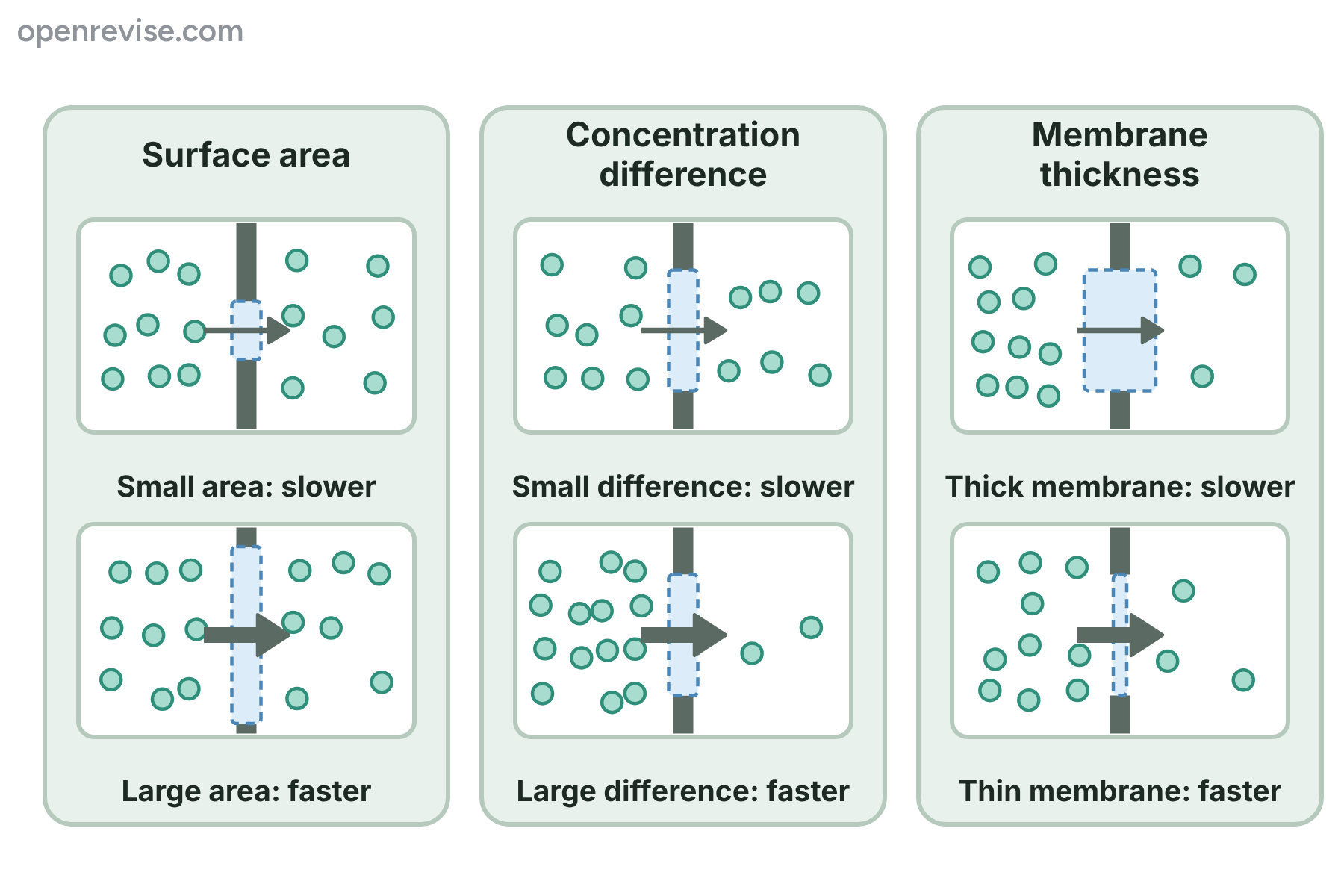
A bigger area, a bigger concentration difference and a thinner membrane all speed up diffusion.
Keeping the concentration gradient steep
In a living thing the gradient is not left to fade away. The body keeps removing the substance on the low side, so diffusion carries on.
-
In the lungs
Blood flowing past the alveoli carries oxygen away, and breathing brings in fresh air with plenty of oxygen. Both keep the oxygen gradient steep.
-
In the small intestine
Blood flowing through the villi carries the absorbed food molecules away, so there is always a bigger concentration in the gut than in the blood.
-
In respiring cells
The cells keep using up oxygen in respiration, so the oxygen concentration inside the cell stays low and more oxygen keeps diffusing in.
-
In fish gills
Water keeps flowing over the gills and blood keeps flowing through them. This replaces the oxygen that has diffused out of the water and takes it away from the gills.
Exchange surfaces use all three factors
Look at any good exchange surface and you will find a large area, a thin barrier and a steep gradient.
-
Alveoli
Hundreds of millions of alveoli give a very large surface area. Their walls and the capillary walls are one cell thick, and blood flow and ventilation keep the gradients steep.
-
Villi in the small intestine
Each villus has a folded surface that increases the area for absorbing food. The wall is one cell thick and a rich blood supply carries the food away.
-
Gills
Each gill has many thin filaments covered in folds, which give a large area with a thin surface. Water flowing past and blood flowing through keep the gradient steep.
-
Root hair cells
The long, thin extension of a root hair cell increases the surface area for taking up water and mineral ions from the soil.
Fick's law
Fick's law puts the three factors into one relationship. It tells us how many times faster or slower diffusion will be, not an exact figure.
-
The law
The rate of diffusion is proportional to the surface area multiplied by the concentration difference, divided by the thickness of the membrane.
-
Proportional
The symbol \(\propto\) means is proportional to. The rate is directly proportional to the surface area and to the concentration difference, and inversely proportional to the thickness.
-
Relative rates
The law does not give the actual number of particles per second, so a calculation gives a relative rate in arbitrary units. It is used to compare two situations.
-
Changes by a factor
If the area or the concentration difference is multiplied by a number, the rate is multiplied by it too. If the thickness is multiplied by a number, the rate is divided by it.
Fick's law
\(\text{rate of diffusion} \propto \dfrac{\text{surface area} \times \text{concentration difference}}{\text{thickness of membrane}}\)
Calculating a relative rate of diffusion
A membrane has a surface area of 12 cm\(^2\). The difference in concentration between the two sides is 30 units and the membrane is 3 \(\mu\)m thick. Use Fick's law to calculate the relative rate of diffusion.
Show the solutionHide the solution
- 1 Write down the values surface area = 12, concentration difference = 30, thickness = 3
- 2 Multiply the surface area by the concentration difference \(12 \times 30 = 360\)
- 3 Divide by the thickness \(360 \div 3 = 120\)
- 4 Give the units The answer is a relative rate, so write 120 arbitrary units
AnswerThe relative rate of diffusion is 120 arbitrary units.
What happens when the factors change?
A membrane has a relative rate of diffusion of 40 units. The surface area then doubles, the concentration difference halves and the thickness doubles. Calculate the new rate.
Show the solutionHide the solution
- 1 Surface area doubles The rate is multiplied by 2, so \(40 \times 2 = 80\)
- 2 Concentration difference halves The rate is multiplied by \(\frac{1}{2}\), so \(80 \times \frac{1}{2} = 40\)
- 3 Thickness doubles The rate is divided by 2, so \(40 \div 2 = 20\)
- 4 Check The overall change is \(2 \times \frac{1}{2} \div 2 = \frac{1}{2}\), so the rate halves from 40 to 20
AnswerThe new rate is 20 units.
A healthy lung compared with a diseased lung
In a healthy lung the relative values are surface area 70, concentration difference 60 and thickness 0.5. In a person with pulmonary fibrosis the walls are thicker, so the thickness is 1.5, and the other values are unchanged. Calculate the percentage decrease in the rate of diffusion.
Show the solutionHide the solution
- 1 Healthy lung \((70 \times 60) \div 0.5 = 4200 \div 0.5 = 8400\)
- 2 Fibrosis \((70 \times 60) \div 1.5 = 4200 \div 1.5 = 2800\)
- 3 Find the decrease \(8400 - 2800 = 5600\)
- 4 Percentage decrease \(5600 \div 8400 \times 100 = 66.7\) percent
- 5 Shortcut The thickness tripled, so the rate fell to one third, which is a decrease of two thirds
AnswerThe rate falls by 66.7 percent, which is about 67 percent.
How the rate changes with each factor
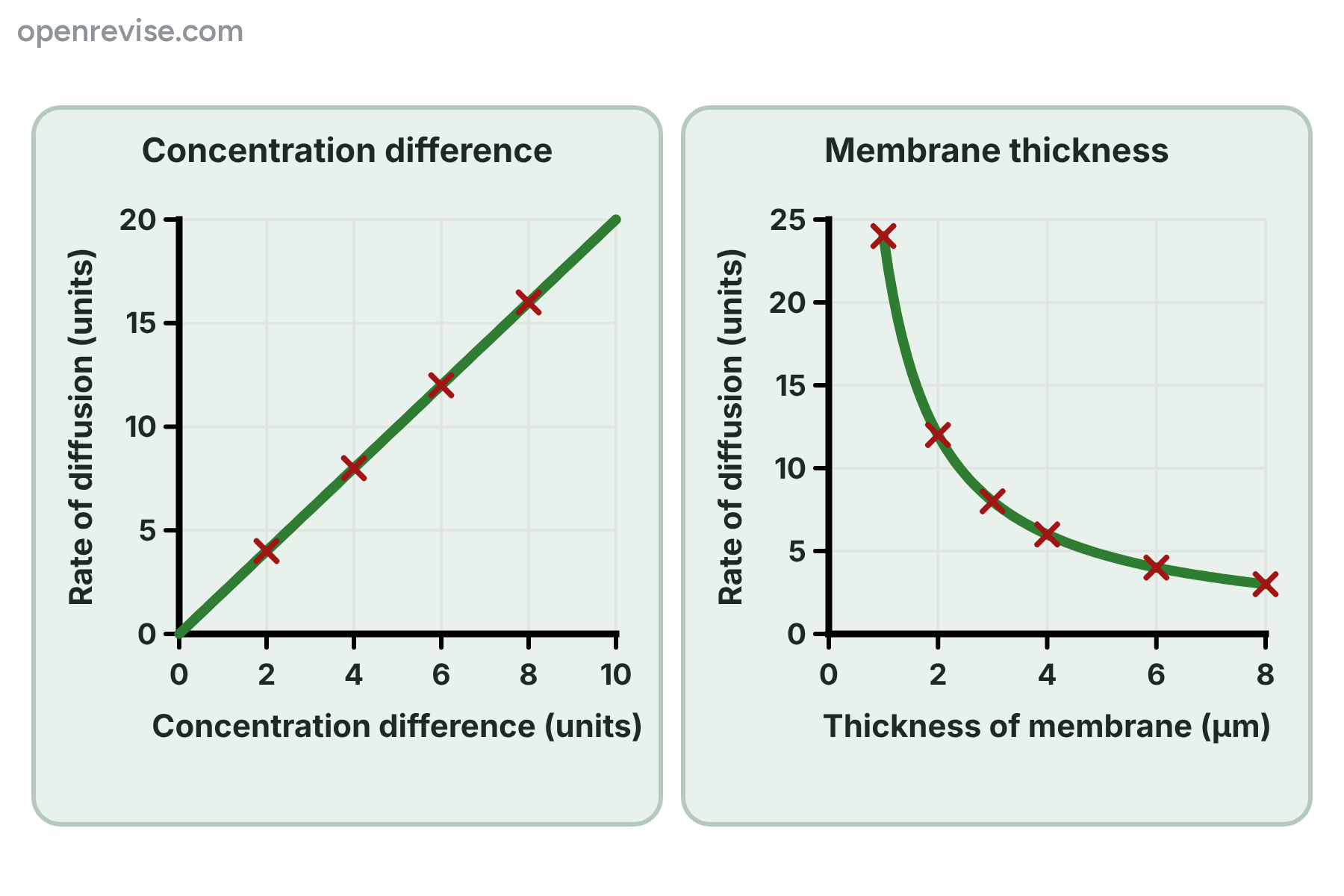
Rate is directly proportional to concentration difference (a straight line) and inversely proportional to thickness (a falling curve).
Faster or slower diffusion
Makes diffusion faster
- A larger surface area
- A bigger concentration difference
- A thinner membrane, so a shorter diffusion distance
- A higher temperature
Makes diffusion slower
- A smaller surface area
- A smaller concentration difference
- A thicker membrane, so a longer diffusion distance
- A lower temperature
Case study
The alveoli by numbers
Fick's law explains the remarkable dimensions of the alveoli. The total surface area is about 70 square metres, so the area term is huge. The barrier between the air and the blood is only about half a micrometre thick, so the thickness term is tiny. A human hair is about 140 times thicker than this barrier. A huge area divided by a tiny thickness, with blood and breathing keeping the concentration difference high, gives a very large rate of diffusion.
Rate of diffusion
Rate of diffusion
-
Surface area
- larger is faster
- directly proportional
- folds, villi and many alveoli
-
Concentration difference
- larger is faster
- directly proportional
- blood flow and ventilation keep it steep
-
Thickness
- thinner is faster
- inversely proportional
- walls one cell thick
-
Fick's law
- area times difference divided by thickness
- relative rate in arbitrary units
-
Graphs
- straight line through the origin
- falling curve
Summary and exam focus
- The rate of diffusion increases with a larger surface area, a bigger concentration difference and a thinner membrane.
- Fick's law says that the rate of diffusion is proportional to the surface area multiplied by the concentration difference, divided by the thickness of the membrane.
- A calculation using Fick's law gives a relative rate in arbitrary units, which is used to compare two situations.
- Doubling the area or the concentration difference doubles the rate, but doubling the thickness halves it.
- Exchange surfaces such as the alveoli and villi have a large area and a thin barrier, and the blood supply keeps the concentration gradient steep.
Exam focus
The rate of diffusion across an exchange surface depends on three factors. Describe how each of these factors affects the rate of diffusion across a membrane. (3 marks) (3 marks)
Give one statement for each of the surface area, the concentration gradient and the thickness, and use a direction word every time: larger, bigger, thinner. Do not say that a factor speeds it up without saying which way the factor changes.
Key terms
The words this lesson expects you to use. Each one is linked from the first place it appears above.
- Rate of diffusion
- How quickly particles move from a region of higher concentration to a region of lower concentration.
- Fick's law
- The rate of diffusion is proportional to the surface area multiplied by the concentration difference, divided by the thickness of the membrane.
- Concentration difference
- The difference in concentration between the two sides of a membrane. It makes the concentration gradient.
- Surface area
- The size of the area of membrane across which particles can diffuse.
- Thickness of membrane
- The distance that particles have to travel across the membrane, also called the diffusion distance.
- Directly proportional
- Changing together by the same factor, so that doubling one doubles the other.
- Inversely proportional
- Changing in opposite directions by the same factor, so that doubling one halves the other.
- Arbitrary units
- Units used to compare values without measuring an actual quantity.
- Net movement
- The overall movement of particles in one direction after the movement in the other direction is taken into account.
- Steep concentration gradient
- A large difference in concentration between two places, which gives fast diffusion.
You've finished the notes
Check your understanding
Test yourself while it is fresh. Start with the flashcards, then try the exam questions.
Something here looks wrong?
Tell us what and we will go and look. It goes to whoever writes these pages, nobody else, and we do not ask who you are — so there is nothing to sign and nothing comes back to you.