Exam questions · Biology · Exchange Surfaces and Gas Exchange
Factors Affecting the Rate of Diffusion and Fick's Law
- 8 exam questions
- 26 marks
- 8 quick checks
-
1 Name [3 marks]
Name the three factors that are included in Fick's law and that affect the rate of diffusion across a membrane.
Show answerHide answer
Model answer
The surface area of the membrane, the concentration difference (gradient) and the thickness of the membrane (the diffusion distance).
Mark scheme
- Surface area — 1 mark
- Concentration difference (gradient) — 1 mark
- Thickness of the membrane (diffusion distance) — 1 mark
-
2 Describe [2 marks]
Describe what happens to the rate of diffusion across a membrane when the membrane becomes twice as thick. All other factors stay the same.
Show answerHide answer
Model answer
The rate of diffusion decreases. It is halved, because the rate is inversely proportional to the thickness.
Mark scheme
- The rate decreases — 1 mark
- It halves (or is half as fast) — 1 mark
-
3 Calculate [2 marks]
A membrane has a surface area of 8 cm\(^2\), a concentration difference of 15 units and a thickness of 4 \(\mu\)m. Use Fick's law to calculate the relative rate of diffusion.
Show answerHide answer
Model answer
Rate \(= (8 \times 15) \div 4 = 120 \div 4 = 30\) arbitrary units.
Mark scheme
- \(8 \times 15 \div 4\) — 1 mark
- 30 (arbitrary units) — 1 mark
-
4 Calculate [3 marks]
A membrane has a rate of diffusion of 60 units. The surface area of the membrane then triples, the concentration difference doubles and the thickness triples. Calculate the new rate of diffusion.
Show answerHide answer
Model answer
Surface area tripling multiplies the rate by 3 and the concentration difference doubling multiplies it by 2. The thickness tripling divides it by 3. So the new rate is \(60 \times 3 \times 2 \div 3 = 120\) units.
Mark scheme
- Area and concentration difference multiply the rate (\(\times 3\) and \(\times 2\)) — 1 mark
- Thickness divides the rate (\(\div 3\)) — 1 mark
- 120 units — 1 mark
-
5 Explain [3 marks]
Explain how blood flow keeps the rate of diffusion of oxygen into the blood high in the lungs.
Show answerHide answer
Model answer
The blood flowing through the capillaries carries the oxygen away from the alveoli. This keeps the concentration of oxygen in the blood lower than in the alveolus. This maintains a steep concentration gradient, and the rate of diffusion is proportional to the concentration difference.
Mark scheme
- Blood carries oxygen away from the alveoli — 1 mark
- This keeps the oxygen concentration in the blood low, so the concentration gradient stays steep — 1 mark
- A steep gradient gives a faster rate of diffusion — 1 mark
-
6 Calculate [3 marks]
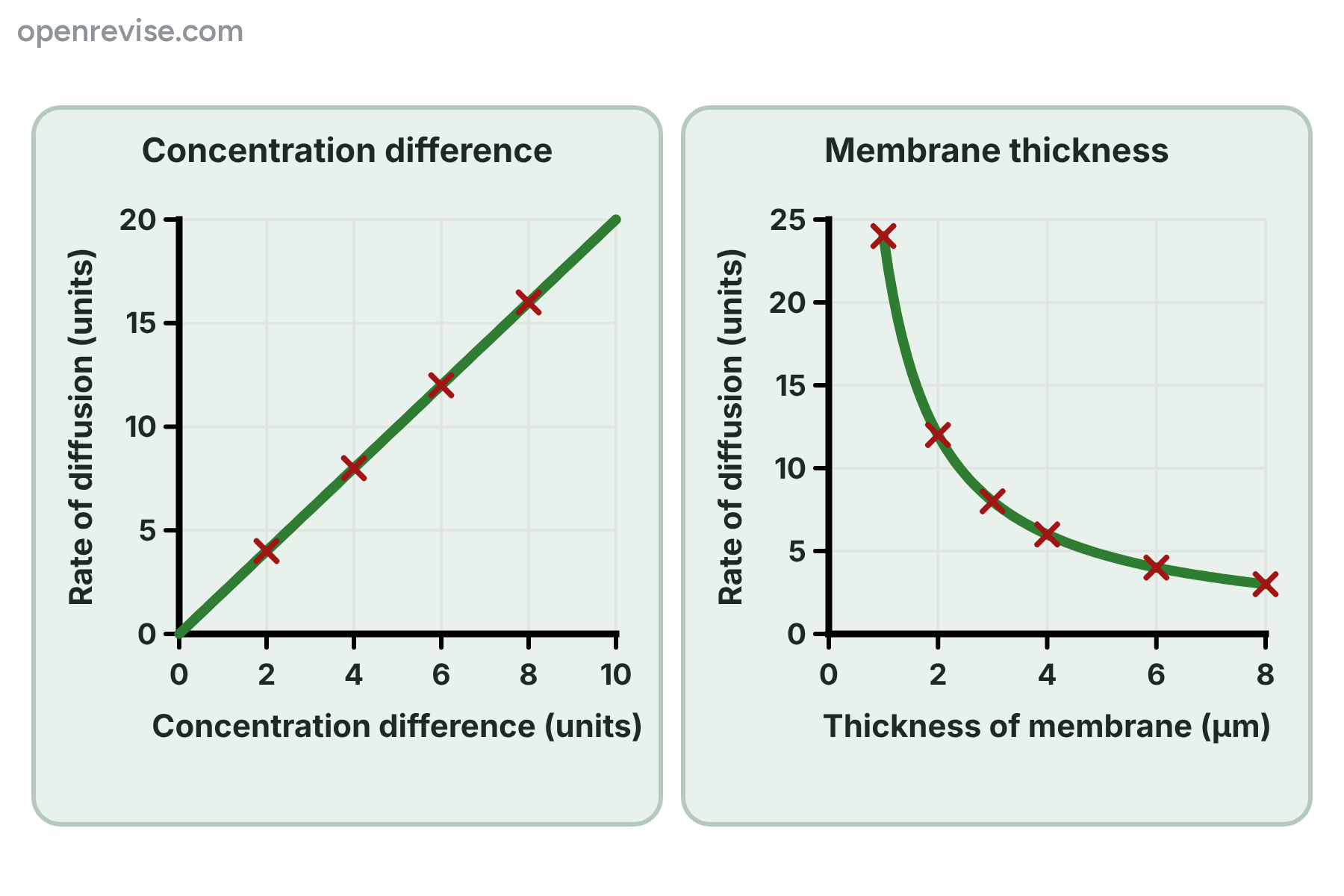
The graphs show the rate of diffusion across a membrane. In the right-hand graph the surface area and the concentration difference are kept constant. Use the right-hand graph to find the rate of diffusion when the thickness is 3 micrometres, and to find how the rate changes when the thickness doubles from 2 micrometres to 4 micrometres.
Show answerHide answer
Model answer
At a thickness of 3 micrometres the rate is 8 units. At 2 micrometres the rate is 12 units and at 4 micrometres it is 6 units, so doubling the thickness halves the rate, from 12 to 6 units.
Mark scheme
- 8 units at 3 micrometres — 1 mark
- 12 units at 2 micrometres and 6 units at 4 micrometres — 1 mark
- The rate halves when the thickness doubles — 1 mark
-
7 Calculate [4 marks]
In a healthy alveolus the relative values are surface area 70, concentration difference 60 and thickness 0.5. In a person with emphysema the alveolar walls have broken down, so the surface area is 42. The other values are unchanged. Calculate the percentage decrease in the rate of diffusion.
Show answerHide answer
Model answer
Healthy rate \(= 70 \times 60 \div 0.5 = 8400\). Emphysema rate \(= 42 \times 60 \div 0.5 = 5040\). The decrease is \(8400 - 5040 = 3360\), so the percentage decrease is \(3360 \div 8400 \times 100 = 40\) percent.
Mark scheme
- Healthy rate 8400 — 1 mark
- Emphysema rate 5040 — 1 mark
- Decrease of 3360 — 1 mark
- 40 percent — 1 mark
-
8 Explain [6 marks]
Use Fick's law to explain how the lungs are adapted for efficient gas exchange, and explain why a person with a lung disease that thickens the alveolus walls has less oxygen in their blood.
Show answerHide answer
Model answer
Fick's law says that the rate of diffusion is proportional to the surface area multiplied by the concentration difference, divided by the thickness. The lungs have hundreds of millions of alveoli, which give a very large surface area. The walls of the alveoli and capillaries are one cell thick, so the thickness is very small. A rich blood supply and ventilation keep the concentration difference large, because they carry oxygen away and bring in fresh air. All three make the rate of diffusion high. When the walls thicken, the thickness in the law increases, so the rate of diffusion falls and less oxygen diffuses into the blood in the same time.
Mark scheme
- Large surface area from many alveoli — 1 mark
- Thin walls give a small thickness — 1 mark
- Blood supply and ventilation keep a large concentration difference — 1 mark
- Rate is proportional to surface area times concentration difference divided by thickness — 1 mark
- Thicker walls increase the thickness, so the rate decreases — 1 mark
- So less oxygen diffuses into the blood — 1 mark
Quick check
-
1
Which change would make diffusion across a membrane faster?
Show answerHide answer
B: A larger surface area
A larger surface area lets more particles cross at the same time, so the rate of diffusion is faster.
-
2
The membrane thickness doubles and nothing else changes. What happens to the rate of diffusion?
Show answerHide answer
D: It halves
The rate is inversely proportional to the thickness, so doubling the thickness halves the rate.
-
3
Which expression is the correct form of Fick's law?
Show answerHide answer
A: Area times concentration difference, divided by thickness
The rate of diffusion is proportional to the surface area times the concentration difference, divided by the thickness of the membrane.
-
4
A membrane has surface area 6, concentration difference 20 and thickness 2. What is its relative rate of diffusion?
Show answerHide answer
C: 60
\(6 \times 20 \div 2 = 120 \div 2 = 60\).
-
5
What shape is the graph of rate of diffusion against concentration difference, if the other factors stay the same?
Show answerHide answer
B: A straight line through the origin
The rate is directly proportional to the concentration difference, so the graph is a straight line through the origin.
-
6
How does blood flow help gas exchange in the lungs?
Show answerHide answer
D: It keeps the concentration gradient steep
Blood carries away the oxygen that has diffused in, so the concentration of oxygen in the blood stays low and the gradient stays steep.
-
7
A cell membrane has a relative rate of 30. Its area doubles and its thickness doubles. What is the new rate?
Show answerHide answer
A: 30
Doubling the area doubles the rate and doubling the thickness halves it, so the rate does not change.
-
8
Which feature of a villus does not help to make diffusion faster?
Show answerHide answer
C: A wall many cells thick
A thick wall would increase the diffusion distance. Villi have a thin wall, a large surface area and a rich blood supply.