Biology · Exchange Surfaces and Gas Exchange
Alveoli and Gas Exchange
Oxygen has to get from the air into the blood, and carbon dioxide has to go the other way, every second of your life. This lesson is for both Combined Science and separate Biology, at Foundation and Higher. It follows the airways to the lungs and then explains how the alveoli are adapted for gas exchange by diffusion.
Learning Objectives
- 1Describe the route that air takes through the airways to the alveoli in the lungs.
- 2Describe how oxygen and carbon dioxide are exchanged by diffusion between the air in the alveoli and the blood in the capillaries.
- 3Explain how the alveoli are adapted for gas exchange: a large surface area, thin walls, a rich blood supply and ventilation.
- 4Calculate the change in the percentage of oxygen between inhaled and exhaled air.
Retrieval practice
-
1
What is diffusion?
Show answerHide answer
The net movement of particles from a region of higher concentration to a region of lower concentration.
-
2
Why do large animals need an exchange surface?
Show answerHide answer
They have a small surface area to volume ratio and a long diffusion distance, so the skin alone cannot supply the cells.
-
3
Which gas do cells need for aerobic respiration, and which is made?
Show answerHide answer
Oxygen is needed and carbon dioxide is made.
-
4
What is the name of the blood vessels with walls one cell thick?
Show answerHide answer
Capillaries.
The lungs are the human exchange surface for gases
A human has a small surface area compared with its volume and a lot of cells to supply, so the skin could never take in enough oxygen. The lungs solve this. They are packed into the chest, protected by the ribs, and they contain hundreds of millions of tiny air sacs called alveoli. Each alveolus is a place where the air and the blood come very close together, and that is where oxygen moves into the blood and carbon dioxide moves out.
The airways to the lungs
Air reaches the alveoli through a series of tubes that divide again and again.
-
Trachea
The windpipe, a tube that carries air from the nose and mouth down to the chest. It is held open by rings of cartilage so that it does not collapse when you breathe in.
-
Bronchi
The trachea divides into two bronchi (one is a bronchus), one going to each lung. They divide into smaller tubes inside the lungs.
-
Bronchioles
The bronchi branch into many narrower tubes called bronchioles, which spread through the lung like the twigs of a tree.
-
Alveoli
Each bronchiole ends in a cluster of tiny air sacs called alveoli. This is where gas exchange happens.
From the trachea to the alveoli
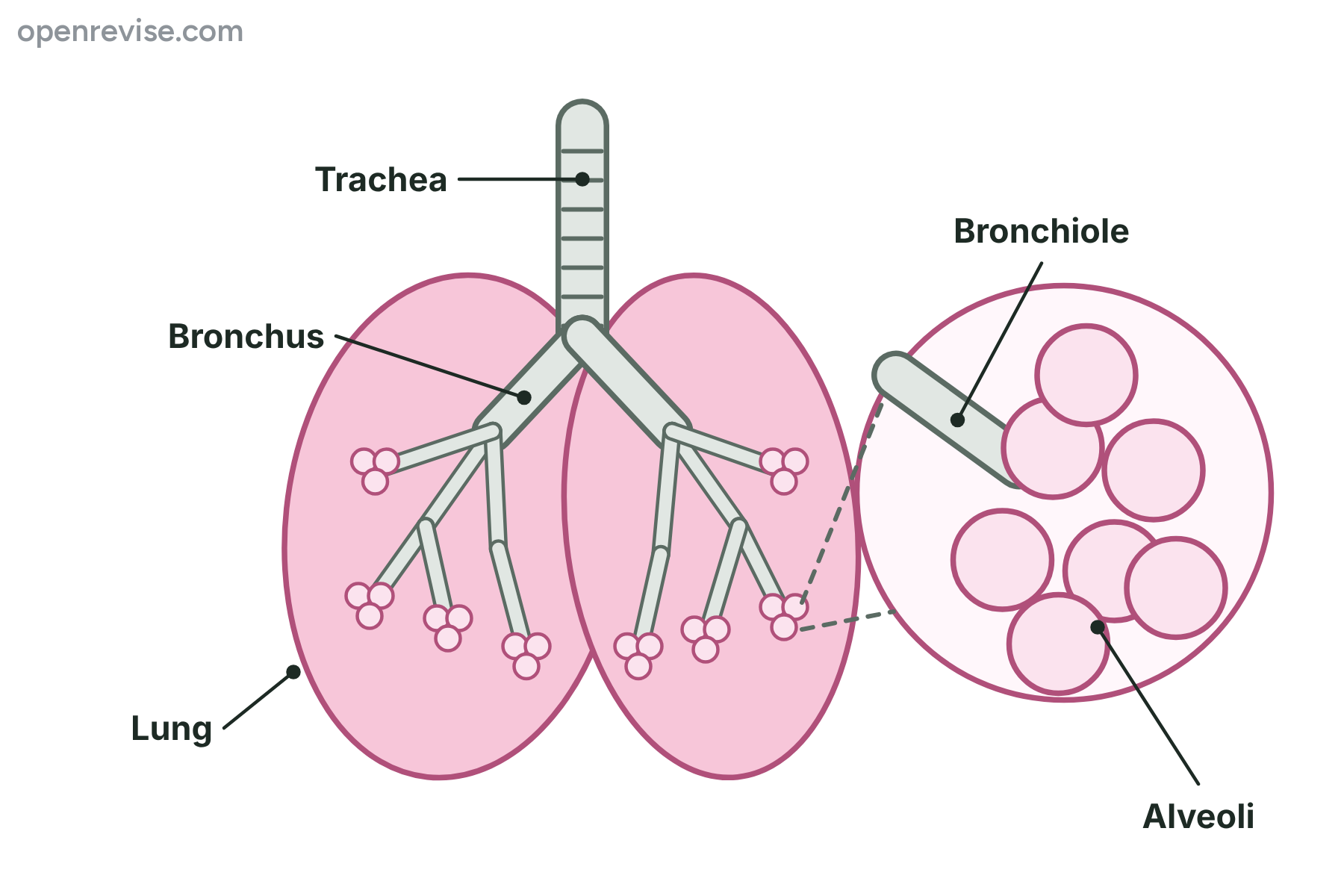
Air passes from the trachea through the bronchi and bronchioles to the alveoli.
What happens in an alveolus
Each alveolus is wrapped in a net of capillaries. Gases cross between the air and the blood by diffusion, so no energy is needed.
-
Oxygen moves into the blood
The air in the alveolus has a higher concentration of oxygen than the blood arriving from the body. Oxygen diffuses through the wall of the alveolus and the wall of the capillary into the blood, where it combines with haemoglobin in the red blood cells.
-
Carbon dioxide moves out
The blood arriving from the body has a higher concentration of carbon dioxide than the air in the alveolus. Carbon dioxide diffuses from the blood into the alveolus and is breathed out.
-
Both at once
The two gases move in opposite directions across the same surface at the same time. Each one moves down its own concentration gradient.
-
Blood changes
The blood arriving at the lungs is deoxygenated blood from the body. The blood leaving is oxygenated blood, ready to be pumped round the body.
Gas exchange in an alveolus
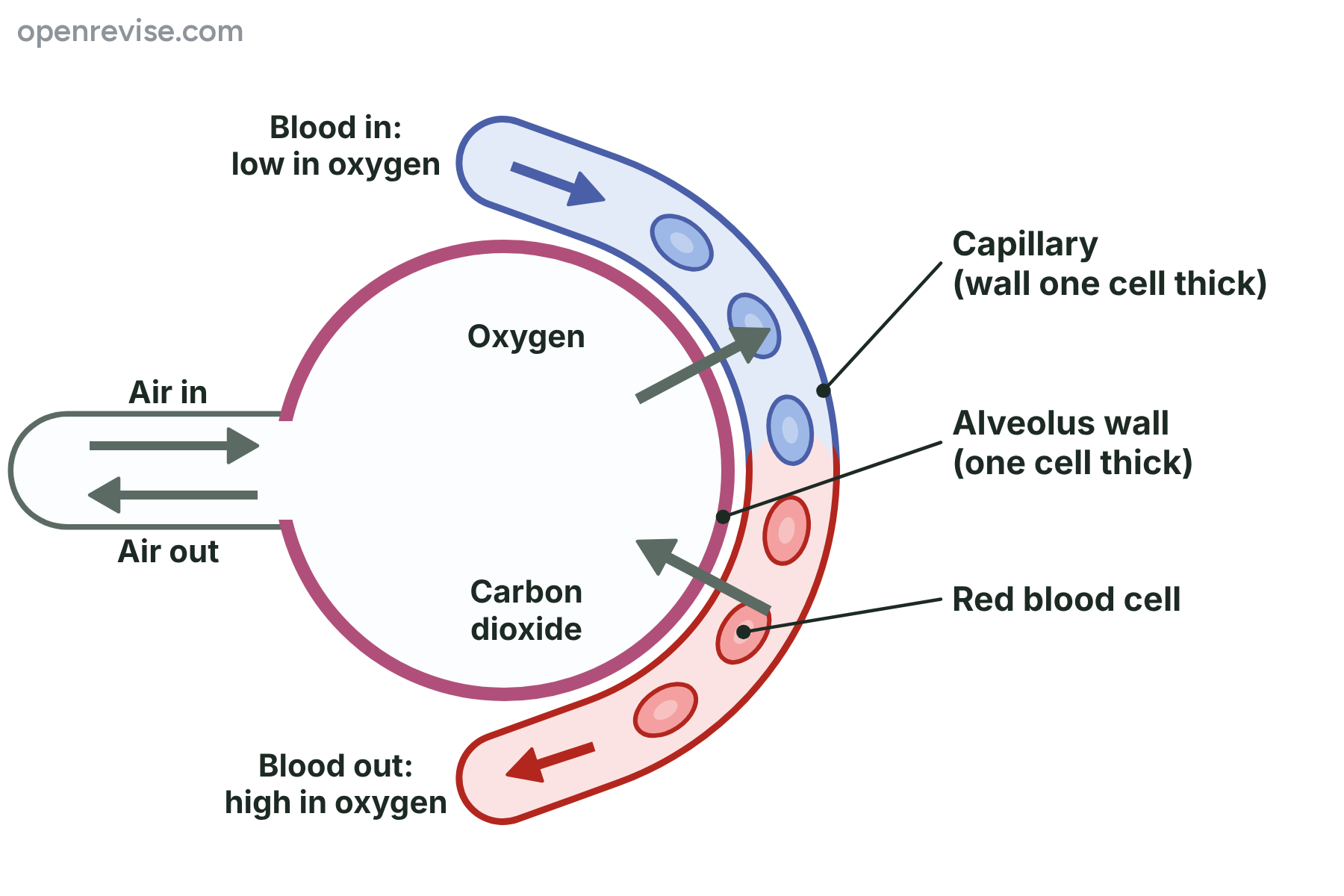
Oxygen diffuses into the blood and carbon dioxide diffuses out, across two very thin walls.
The journey of an oxygen molecule
Follow one molecule of oxygen from the air outside to the haemoglobin in a red blood cell.
-
1
Breathed in
The oxygen enters through the nose or mouth and passes down the trachea.
-
2
Down the airways
It passes through a bronchus and then a bronchiole into an alveolus.
-
3
Across the walls
It dissolves in the moist lining and diffuses across the wall of the alveolus and the wall of the capillary, each only one cell thick.
-
4
Into the blood
It diffuses into a red blood cell and combines with haemoglobin.
-
5
Carried away
The blood carries it to the heart, which pumps it round the body to the cells that need it.
How the alveoli are adapted for gas exchange
Every feature makes diffusion faster, either by giving more room for it to happen or by keeping the concentration gradient steep.
-
A very large surface area
There are hundreds of millions of alveoli in the lungs. Together they have an area of about 70 square metres, so a huge number of oxygen and carbon dioxide molecules can cross at the same time.
-
Thin walls
The wall of an alveolus is one cell thick and so is the wall of a capillary. The gases have only about half a micrometre to travel, so the diffusion distance is very short.
-
A rich blood supply
A dense network of capillaries surrounds every alveolus. The flowing blood carries oxygen away and brings more carbon dioxide, which keeps the concentration gradients steep.
-
Ventilation
Breathing in and out replaces the air in the alveoli. Fresh air brings in more oxygen and carries carbon dioxide away, so the concentration gradients stay steep too.
-
A moist lining
A thin film of water lines each alveolus. Gases dissolve in it before they diffuse through the wall.
Inhaled air and exhaled air
Inhaled air
- About 21 percent oxygen
- About 0.04 percent carbon dioxide
- Fresh air that has just entered the airways
- Ventilation keeps this gradient steep
Exhaled air
- About 16 percent oxygen
- About 4 percent carbon dioxide
- Some oxygen has diffused into the blood
- Carbon dioxide has diffused out of the blood
How much oxygen is taken from the air?
Inhaled air contains 21 percent oxygen and exhaled air contains 16 percent oxygen. Calculate the percentage of the oxygen in the inhaled air that has been taken into the blood. Give your answer to the nearest whole number.
Show the solutionHide the solution
- 1 Find the oxygen that has been removed \(21 - 16 = 5\) percentage points
- 2 Divide by the starting value \(5 \div 21 = 0.238\)
- 3 Multiply by 100 \(0.238 \times 100 = 23.8\) percent
- 4 Round 24 percent, to the nearest whole number
AnswerAbout 24 percent of the oxygen is taken into the blood.
Case study
When the exchange surface is damaged
Diseases that damage the alveoli show why each adaptation matters. In emphysema, often caused by smoking, the walls between alveoli break down, so there are fewer and larger air spaces and the surface area falls. In pulmonary fibrosis the walls become thick and scarred, so the diffusion distance rises. In both, less oxygen reaches the blood, so the person is short of breath, tires easily and cannot exercise much.
The big idea
The alveoli are adapted for gas exchange because they have a large surface area, thin walls, a rich blood supply and ventilation, which make diffusion fast and keep the concentration gradient steep.
Alveoli and gas exchange
Alveoli and gas exchange
-
Airways
- trachea
- bronchi
- bronchioles
- alveoli
-
Oxygen
- air to blood
- combines with haemoglobin
- carried to the cells
-
Carbon dioxide
- blood to air
- breathed out
-
Surface
- hundreds of millions of alveoli
- about 70 square metres
-
Short distance
- walls one cell thick
- moist lining
-
Steep gradient
- rich blood supply
- ventilation
Summary and exam focus
- Air passes down the trachea, through the bronchi and bronchioles to the alveoli, where gas exchange happens.
- Oxygen diffuses from the air in the alveoli into the blood, and carbon dioxide diffuses from the blood into the air to be breathed out.
- The very large number of alveoli gives a large surface area, and the walls of the alveoli and capillaries are one cell thick, so the diffusion distance is short.
- A rich blood supply and ventilation keep the concentration gradients of both gases steep.
- Damage to the alveoli reduces the surface area or thickens the walls, so less oxygen reaches the blood.
Exam focus
Explain how the alveoli are adapted for gas exchange by diffusion between the air in the lungs and the blood in the capillaries. (4 marks) (4 marks)
Name each adaptation and then say what it does to the rate of diffusion. A feature with no effect, such as thin walls on their own, scores less than thin walls giving a short diffusion distance. Aim for four different features, each linked to oxygen or carbon dioxide diffusing.
Key terms
The words this lesson expects you to use. Each one is linked from the first place it appears above.
- Alveolus
- One of millions of tiny air sacs at the ends of the bronchioles, where oxygen and carbon dioxide are exchanged (plural alveoli).
- Trachea
- The windpipe, a tube held open by rings of cartilage that carries air to the bronchi.
- Bronchus
- One of the two tubes that branch from the trachea, one into each lung (plural bronchi).
- Bronchiole
- A narrow tube that branches from a bronchus and ends in a cluster of alveoli.
- Gas exchange
- The diffusion of oxygen into the blood and carbon dioxide out of the blood across the walls of the alveoli.
- Ventilation
- Breathing in and out, which keeps replacing the air in the alveoli.
- Capillary
- A tiny blood vessel with a wall one cell thick, where substances are exchanged with the surroundings.
- Haemoglobin
- The red substance in red blood cells that combines with oxygen to carry it round the body.
- Concentration gradient
- The difference in concentration between two places, which makes particles diffuse from the higher to the lower.
- Diffusion distance
- The distance particles have to travel by diffusion, which in the alveoli is the thickness of the two walls.
You've finished the notes
Check your understanding
Test yourself while it is fresh. Start with the flashcards, then try the exam questions.
Something here looks wrong?
Tell us what and we will go and look. It goes to whoever writes these pages, nobody else, and we do not ask who you are — so there is nothing to sign and nothing comes back to you.