Flashcards · Biology · Exchange Surfaces and Gas Exchange
Factors Affecting the Rate of Diffusion and Fick's Law
-
Name three factors that affect the rate of diffusion.
The surface area, the concentration gradient and the diffusion distance (thickness).
-
What happens to the rate of diffusion if the surface area is bigger?
It increases, because more particles can cross at once.
-
What happens to the rate of diffusion if the concentration difference is bigger?
It increases, because the net movement is greater.
-
What happens to the rate of diffusion if the membrane is thicker?
It decreases, because the particles have further to go.
-
What is Fick's law in words?
The rate of diffusion is proportional to the surface area times the concentration difference, divided by the thickness of the membrane.
-
What does the symbol \(\propto\) mean?
Is proportional to.
-
If the surface area doubles, what happens to the rate?
It doubles.
-
If the thickness doubles, what happens to the rate?
It halves.
-
If the concentration difference triples, what happens to the rate?
It triples.
-
What shape is the graph of rate against concentration difference?
A straight line through the origin.
-
What shape is the graph of rate against thickness?
A curve that falls steeply and then levels off.
-
What are arbitrary units?
Units used for comparing values, such as the answer to a Fick's law calculation.
-
Calculate the relative rate for area 8, difference 15 and thickness 4.
\(8 \times 15 \div 4 = 30\) arbitrary units.
-
Why does a thin barrier suit an exchange surface?
The diffusion distance is short, so the rate is high.
-
How do blood and breathing keep the gradient steep in the lungs?
The blood carries oxygen away and breathing brings in fresh air.
-
How are villi adapted for absorbing food?
A large surface area, a wall one cell thick and a rich blood supply.
-
Why does temperature affect diffusion?
Particles have more energy at a higher temperature, so they move and diffuse faster.
-
What is the common mistake with Fick's law?
Multiplying by the thickness instead of dividing by it.
-
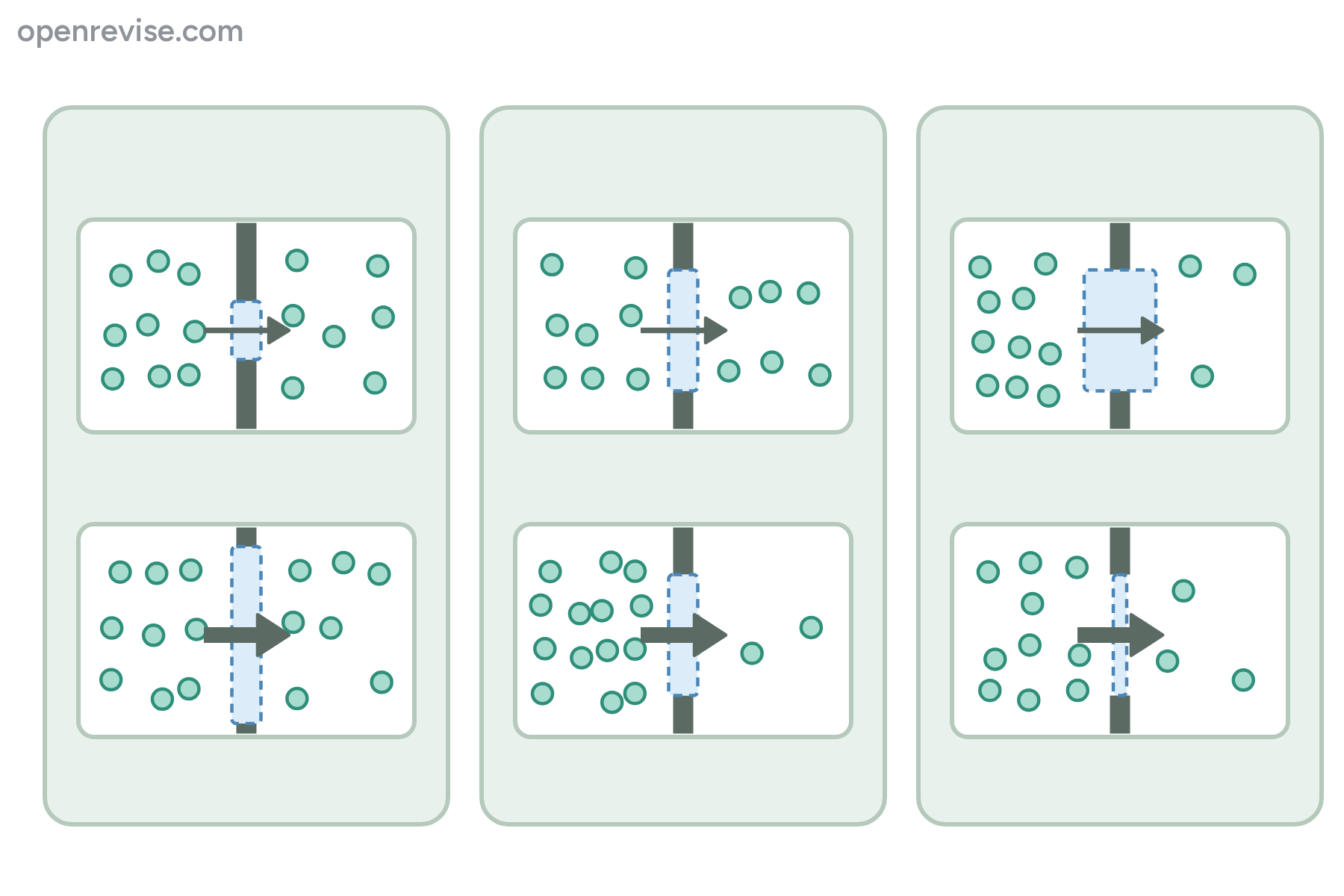 Describe what each pair of boxes shows about the rate of diffusion.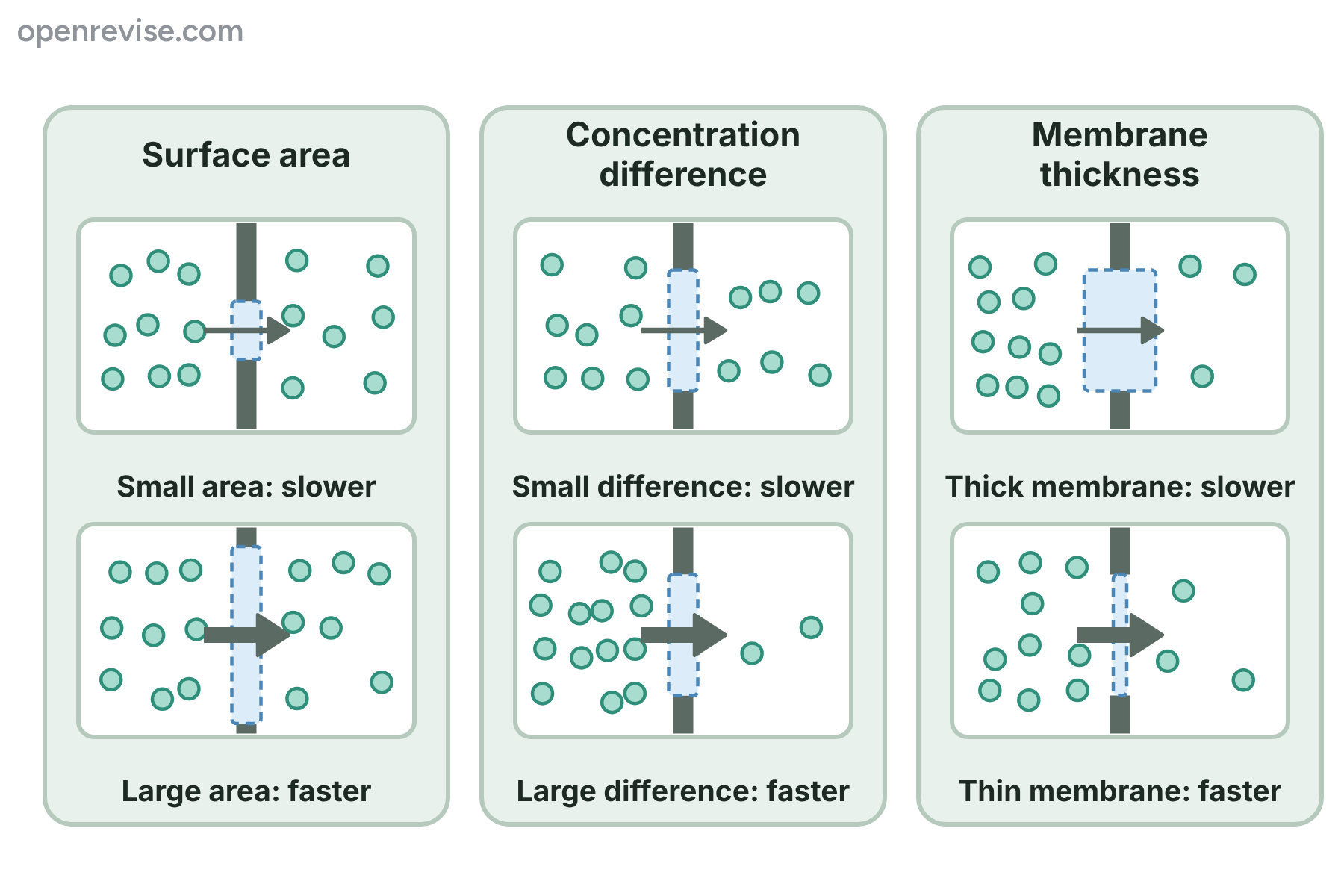
Left: a larger area makes diffusion faster. Middle: a bigger concentration difference makes diffusion faster. Right: a thinner membrane makes diffusion faster.
-
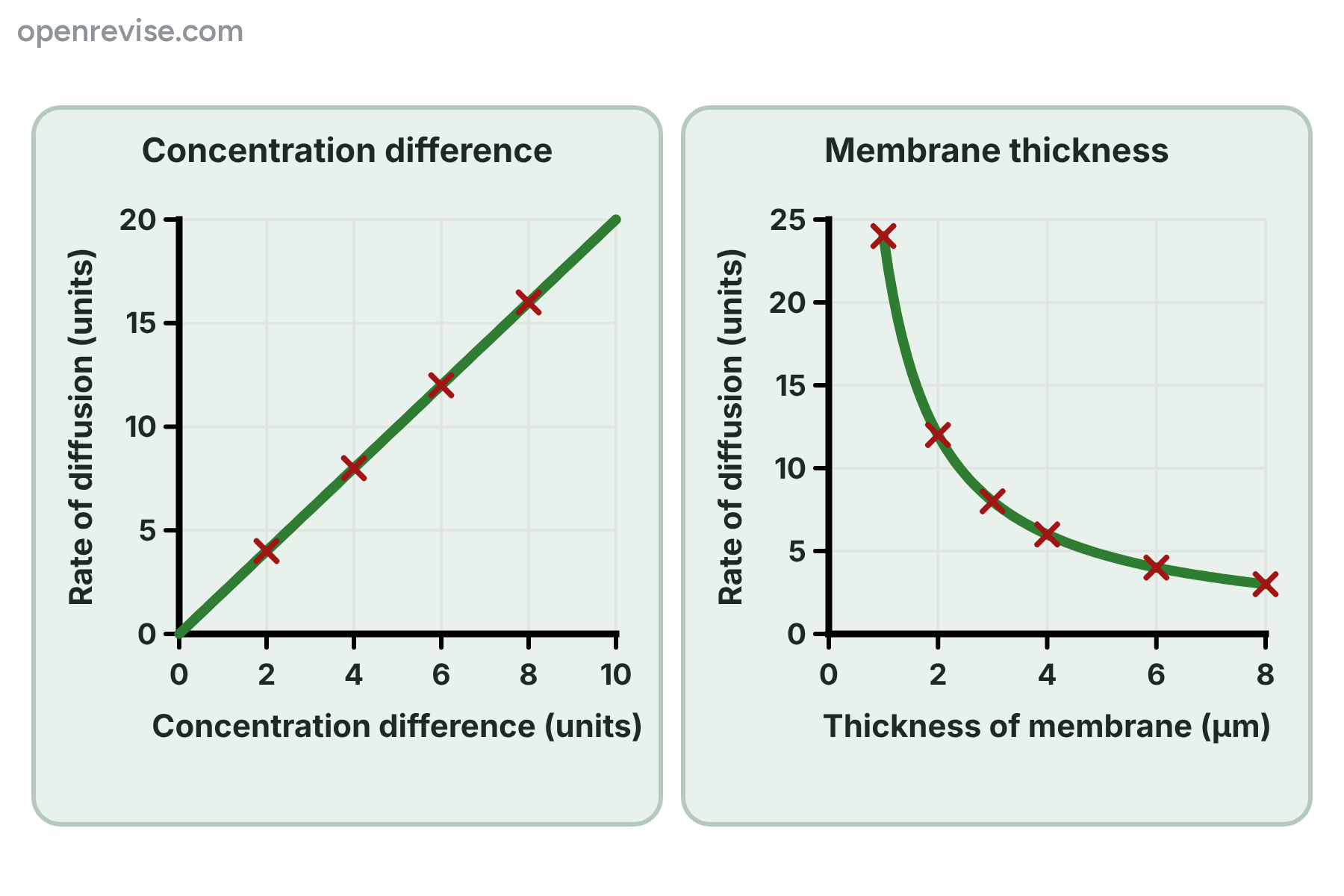 Describe the relationship shown by each graph.
 Rate of diffusion is directly proportional to the concentration difference: a straight line through the origin. Rate of diffusion is inversely proportional to thickness: doubling the thickness halves the rate.