Biology · Exchange Surfaces and Gas Exchange
Why Organisms Need Exchange Surfaces and Transport Systems
Every cell has to take in what it needs and get rid of what it makes, but a big animal cannot do that through its skin. This lesson is for both Combined Science and separate Biology, at Foundation and Higher. It covers the substances that are moved into and out of organisms, how to calculate a surface area to volume ratio, and why large organisms need exchange surfaces and a transport system.
Learning Objectives
- 1Describe the need to transport oxygen, carbon dioxide, water, dissolved food molecules, mineral ions and urea into and out of a range of organisms.
- 2Calculate the surface area to volume ratio of cubes and of simple models of organisms, and compare two ratios.
- 3Explain why a single-celled organism needs neither an exchange surface nor a transport system, but a large multicellular organism needs both.
- 4Explain how an exchange surface and a transport system work together to supply a cell deep inside the body.
Retrieval practice
-
1
What is diffusion?
Show answerHide answer
The net movement of particles from a region of higher concentration to a region of lower concentration, down a concentration gradient.
-
2
What do cells use oxygen and glucose for?
Show answerHide answer
Aerobic respiration, which releases the energy the cell needs.
-
3
What is the surface area of a cube with sides of 2 cm?
Show answerHide answer
\(6 \times 2 \times 2 = 24\ \text{cm}^2\).
-
4
What is the name of the waste substance made in the liver from excess amino acids?
Show answerHide answer
Urea.
Everything a cell needs has to arrive from somewhere
A living cell is never idle. It uses oxygen and glucose to release energy, it builds proteins from amino acids, and it makes waste that would harm it if the waste stayed put. So substances must be moved into and out of every cell, and in a large organism into and out of the whole body. This lesson looks at what has to move, at why size makes the job hard, and at the two solutions that large organisms have evolved: exchange surfaces and a transport system.
Substances that have to be taken in
Cells cannot make these for themselves, so they must come from the air, the water or the food.
-
Oxygen
Needed for aerobic respiration, which releases energy from glucose. It is taken in from the air, or from the water in a fish, at an exchange surface such as the lungs or gills, and then reaches every cell.
-
Dissolved food molecules
Glucose, amino acids, fatty acids and glycerol are the small soluble molecules that are left after digestion. They are absorbed through the wall of the small intestine into the blood and used for respiration, growth and repair.
-
Water
Needed for the chemical reactions in cells and to keep the cytoplasm and the blood plasma liquid. Animals take it in by drinking and in their food, and plants take it in through their root hairs.
-
Mineral ions
Examples are iron for making haemoglobin, calcium for bones and teeth, and sodium and potassium for nerve impulses. Plants need nitrate and magnesium ions. They are absorbed from food or from the soil as dissolved ions.
Substances that have to be removed
Cells make waste, and some of it would damage them if it built up.
-
Carbon dioxide
A waste product of respiration in every cell. It diffuses out of the cells into the blood, is carried to the lungs or gills and leaves the body in the breath. Plants are the other way round: they take carbon dioxide in for photosynthesis.
-
Urea
A waste substance made in the liver when excess amino acids are broken down. It is carried in the blood plasma to the kidneys and removed from the body in the urine.
-
Water
Lost as water vapour in the breath, in sweat and in the urine. The body has to balance the water it takes in against the water it loses.
-
Excess mineral ions
Extra salts are lost in sweat and in the urine, which keeps the level of ions in the body fluids steady.
Moving substances in a range of organisms
The same substances move in every living thing, but the organs that do the job depend on the size and type of organism.
-
Amoeba, a single-celled organism
Oxygen diffuses in across the cell membrane and carbon dioxide diffuses out. No part of the cell is far from the surface, so it needs no transport system.
-
Earthworm
Its thin, moist skin is the exchange surface, and oxygen diffuses through it into the blood. Blood in vessels then carries the oxygen to the tissues deeper in the body.
-
Fish
Oxygen from the water diffuses into the blood across the gills and carbon dioxide diffuses out. Food is absorbed in the gut, and the blood carries all of it round the body.
-
Humans
The lungs exchange oxygen and carbon dioxide, the small intestine absorbs dissolved food, mineral ions and water, and the kidneys remove urea and the excess water and ions. The blood connects them all.
-
Plants
The leaves exchange carbon dioxide and oxygen through the stomata, the roots take in water and mineral ions, and the xylem and phloem are the transport system.
Surface area to volume ratio
To compare how well organisms of different sizes can exchange substances, biologists compare the surface area of the body with its volume.
-
Surface area
The total area of the outside of the object. Substances can only enter or leave across this surface. For a cube with sides of length \(L\), it is \(6 \times L \times L\).
-
Volume
The space inside the object, which is the amount of living material that has to be supplied. For a cube it is \(L \times L \times L\).
-
The ratio
The surface area to volume ratio is the surface area divided by the volume. It is usually written with 1 on the right, so a surface area of 54 cm\(^2\) and a volume of 27 cm\(^3\) give \(54 \div 27 = 2\), written 2 : 1.
-
Bigger means a smaller ratio
Doubling the length of each side of a cube makes the surface area 4 times bigger but the volume 8 times bigger, so the ratio halves. A large organism has a small ratio and a small organism has a large one.
Bigger cubes have a smaller ratio
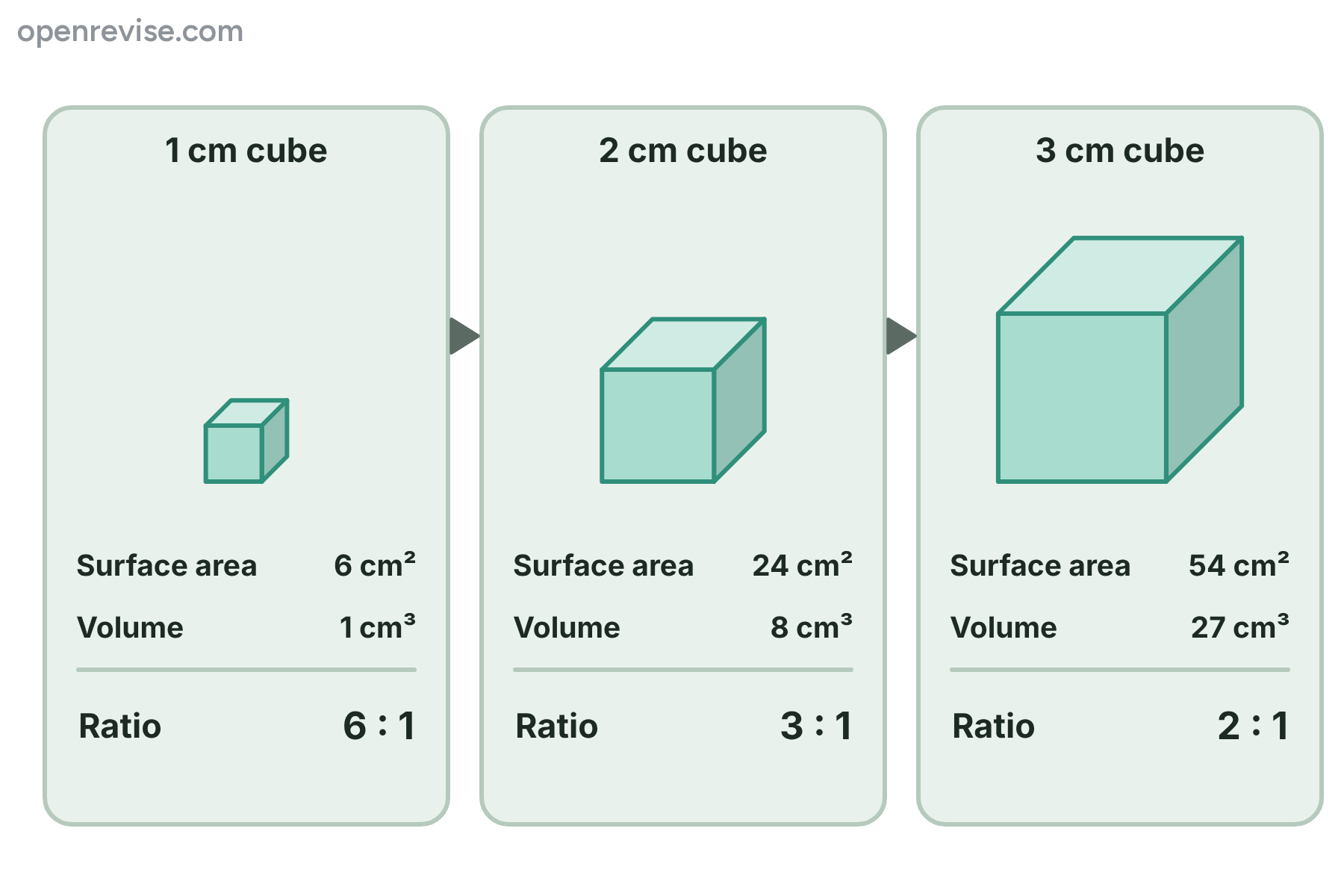
As a cube gets bigger its surface area to volume ratio gets smaller.
Surface area to volume ratio of a cube
Calculate the surface area to volume ratio of a cube with sides of 5 cm. Give your answer in the form X : 1.
Show the solutionHide the solution
- 1 Area of one face \(5 \times 5 = 25\ \text{cm}^2\)
- 2 Surface area of the cube A cube has 6 faces, so \(6 \times 25 = 150\ \text{cm}^2\)
- 3 Volume \(5 \times 5 \times 5 = 125\ \text{cm}^3\)
- 4 Divide the surface area by the volume \(150 \div 125 = 1.2\), so the ratio is 1.2 : 1
AnswerThe ratio is 1.2 : 1.
A small animal and a large animal
A pond animal can be modelled as a cube with sides of 0.5 cm and a cat as a cube with sides of 20 cm. Calculate the surface area to volume ratio of each, and work out how many times bigger the ratio is for the pond animal.
Show the solutionHide the solution
- 1 Pond animal: surface area \(6 \times 0.5 \times 0.5 = 1.5\ \text{cm}^2\)
- 2 Pond animal: volume \(0.5 \times 0.5 \times 0.5 = 0.125\ \text{cm}^3\), so the ratio is \(1.5 \div 0.125 = 12\), written 12 : 1
- 3 Cat: surface area \(6 \times 20 \times 20 = 2400\ \text{cm}^2\)
- 4 Cat: volume \(20 \times 20 \times 20 = 8000\ \text{cm}^3\), so the ratio is \(2400 \div 8000 = 0.3\), written 0.3 : 1
- 5 Compare the two ratios \(12 \div 0.3 = 40\), so the small animal has a ratio 40 times bigger
AnswerThe ratios are 12 : 1 and 0.3 : 1, so the pond animal's ratio is 40 times bigger.
Does shape matter?
Two models of an animal both have a volume of 64 cm\(^3\). Model A is a cube of 4 cm by 4 cm by 4 cm. Model B is a flat cuboid of 16 cm by 4 cm by 1 cm. Calculate the surface area to volume ratio of each model and say which shape is better for exchanging substances.
Show the solutionHide the solution
- 1 Model A: surface area \(6 \times 4 \times 4 = 96\ \text{cm}^2\), so the ratio is \(96 \div 64 = 1.5\), written 1.5 : 1
- 2 Model B: area of each pair of faces \(2 \times (16 \times 4) = 128\), \(2 \times (16 \times 1) = 32\) and \(2 \times (4 \times 1) = 8\)
- 3 Model B: surface area \(128 + 32 + 8 = 168\ \text{cm}^2\)
- 4 Model B: volume \(16 \times 4 \times 1 = 64\ \text{cm}^3\), which is the same as model A
- 5 Model B: ratio \(168 \div 64 = 2.625\), which is 2.6 : 1 to two significant figures
- 6 Conclusion Model B has the bigger ratio, so more surface is available for each unit of volume. This is why flatworms and leaves are flat.
AnswerModel A is 1.5 : 1 and model B is 2.6 : 1, so the flat shape is better for exchange.
Single-celled and multicellular organisms
Single-celled organism
- Large surface area to volume ratio
- Every part of the cell is close to the outside
- Substances diffuse across the cell membrane fast enough to meet all its needs
- No exchange organs or transport system needed
Large multicellular organism
- Small surface area to volume ratio
- Most cells are deep inside, far from the outside
- Diffusion through the skin alone would be far too slow
- Needs exchange surfaces and a transport system
Why a large organism needs more than its skin
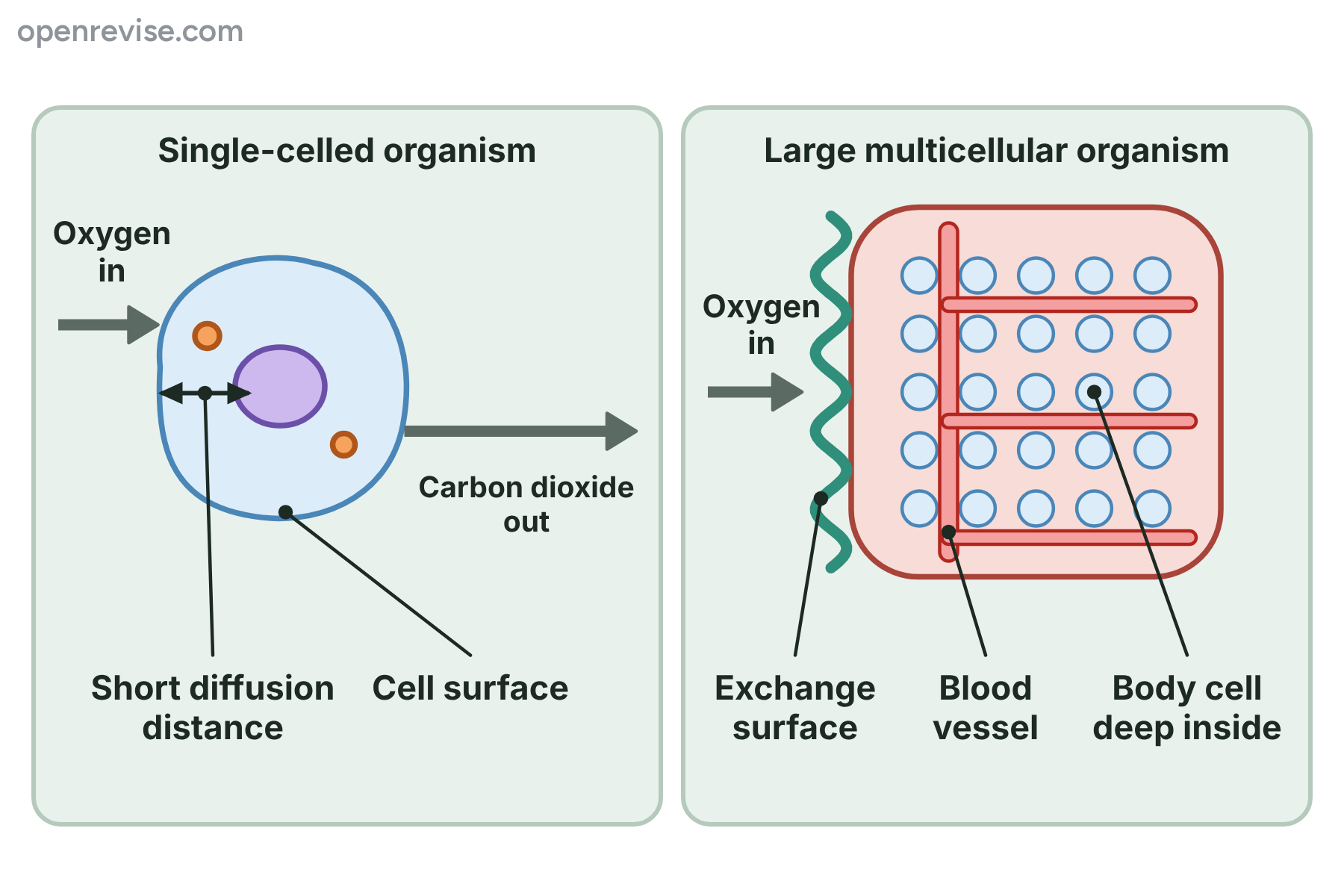
A single cell can exchange substances across its surface, but a large body needs an exchange surface and blood vessels.
Why large organisms need an exchange surface and a transport system
Three things go wrong as an organism gets bigger, and the two adaptations put them right.
-
A smaller ratio
A large animal has a small surface area compared with its volume. Its outer surface is far too small to take in enough oxygen and food for all the cells inside.
-
A longer diffusion distance
Cells deep inside are a long way from the surface, and diffusion is only fast over very short distances. Oxygen would arrive too slowly, so these cells would run out of oxygen and be poisoned by their own waste.
-
A higher demand
A large animal has millions of cells respiring, and active animals respire faster, so the total demand for oxygen and glucose, and the amount of waste to remove, is large.
-
Two solutions
An exchange surface such as the lungs, gills or small intestine gives a large surface area for substances to cross. A transport system, the heart, blood vessels and blood, carries them quickly between the exchange surfaces and every cell.
Case study
How slow is diffusion over a distance?
Diffusion is quick over tiny distances and painfully slow over large ones, because the time it takes grows with the square of the distance. Ten times the distance takes about a hundred times as long. As a rough guide, oxygen needs only a few minutes to diffuse 1 mm through water but would need about a month to diffuse 10 cm. A mammal's heart or brain cells are centimetres from the nearest air, so they could never be supplied by diffusion from the skin alone.
From the air to a cell deep inside the body
The exchange surface and the transport system do different jobs, and both are needed.
-
1
Exchange at the surface
Oxygen diffuses from the air across the exchange surface, for example the wall of an alveolus, into the blood.
-
2
Transport
The heart pumps the blood round the body, so the oxygen is carried quickly to the tissues, far further than diffusion could take it.
-
3
Exchange at the cell
Oxygen diffuses from the blood into the cells, and carbon dioxide and urea diffuse out of the cells into the blood.
-
4
Transport of the waste
The blood carries carbon dioxide to the lungs and urea to the kidneys.
-
5
Removal
The carbon dioxide leaves in the breath and the urea leaves in the urine.
The big idea
As an organism gets bigger its surface area to volume ratio falls, so it needs exchange surfaces to take in and remove substances and a transport system to carry them to every cell.
Exchange surfaces and transport
Exchange surfaces and transport
-
Substances
- oxygen and carbon dioxide
- water
- dissolved food molecules
- mineral ions
- urea
-
Ratio
- surface area divided by volume
- written as X : 1
- bigger organism means smaller ratio
-
Small organisms
- large ratio
- short diffusion distance
- diffusion across the cell surface is enough
-
Large organisms
- small ratio
- long diffusion distance
- high demand for oxygen and food
-
Solutions
- exchange surfaces with a large area
- transport system of heart, vessels and blood
Summary and exam focus
- Cells need oxygen, dissolved food molecules, water and mineral ions to be taken in, and carbon dioxide, urea and excess water and ions to be removed.
- The surface area to volume ratio is the surface area divided by the volume, so a 2 cm cube has a ratio of \(24 \div 8 = 3\), written 3 : 1.
- As an organism gets bigger its ratio falls, because the volume grows faster than the surface area.
- A single-celled organism has a large ratio and a short diffusion distance, so diffusion across its surface is enough.
- A large organism has a small ratio and a long diffusion distance, so it needs exchange surfaces with a large area and a transport system to carry substances to every cell.
Exam focus
Explain why a human needs both an exchange surface and a transport system, but an amoeba needs neither. (4 marks) (4 marks)
Compare the two organisms. For the amoeba, give the large surface area to volume ratio and the short diffusion distance. For the human, give the small ratio and the long distance to cells deep inside, then name both solutions. Use the words ratio and diffusion distance, because they carry the marks.
Key terms
The words this lesson expects you to use. Each one is linked from the first place it appears above.
- Exchange surface
- A specialised surface, such as the alveoli, the gills or the villi, where substances pass into and out of an organism.
- Transport system
- The organs that carry substances around a large organism, such as the heart, blood vessels and blood in an animal.
- Surface area
- The total area of the outside of an object, across which substances can enter or leave.
- Volume
- The amount of space inside an object, which is the amount of living material that has to be supplied.
- Surface area to volume ratio
- The surface area of an organism divided by its volume.
- Diffusion distance
- The distance that particles have to move by diffusion, for example from the surface to a cell deep inside.
- Multicellular organism
- An organism made of many cells, often with specialised organs.
- Urea
- A waste substance made in the liver from excess amino acids and carried in the blood to the kidneys.
- Mineral ions
- Dissolved substances such as iron, calcium and sodium that the body needs in small amounts.
- Aerobic respiration
- The reaction in cells that uses oxygen to release energy from glucose, making carbon dioxide and water.
You've finished the notes
Check your understanding
Test yourself while it is fresh. Start with the flashcards, then try the exam questions.
Something here looks wrong?
Tell us what and we will go and look. It goes to whoever writes these pages, nobody else, and we do not ask who you are — so there is nothing to sign and nothing comes back to you.