Exam questions · Biology · Exchange Surfaces and Gas Exchange
Why Organisms Need Exchange Surfaces and Transport Systems
- 8 exam questions
- 24 marks
- 8 quick checks
-
1 State [1 mark]
Name the waste substance that is made in the liver and carried in the blood to the kidneys.
Show answerHide answer
Model answer
Urea.
Mark scheme
- Urea — 1 mark
-
2 Name [2 marks]
Name two waste substances that have to be removed from the body of a mammal.
Show answerHide answer
Model answer
Carbon dioxide and urea. Excess water or excess mineral ions are also accepted.
Mark scheme
- Carbon dioxide — 1 mark
- Urea (or excess water or excess ions) — 1 mark
-
3 Calculate [2 marks]
A cube has sides of 4 cm. Calculate its surface area to volume ratio. Give your answer in the form X : 1.
Show answerHide answer
Model answer
Surface area is \(6 \times 4 \times 4 = 96\ \text{cm}^2\). Volume is \(4 \times 4 \times 4 = 64\ \text{cm}^3\). The ratio is \(96 \div 64 = 1.5\), so 1.5 : 1.
Mark scheme
- Surface area 96 and volume 64 — 1 mark
- 1.5 : 1 — 1 mark
-
4 Name [3 marks]
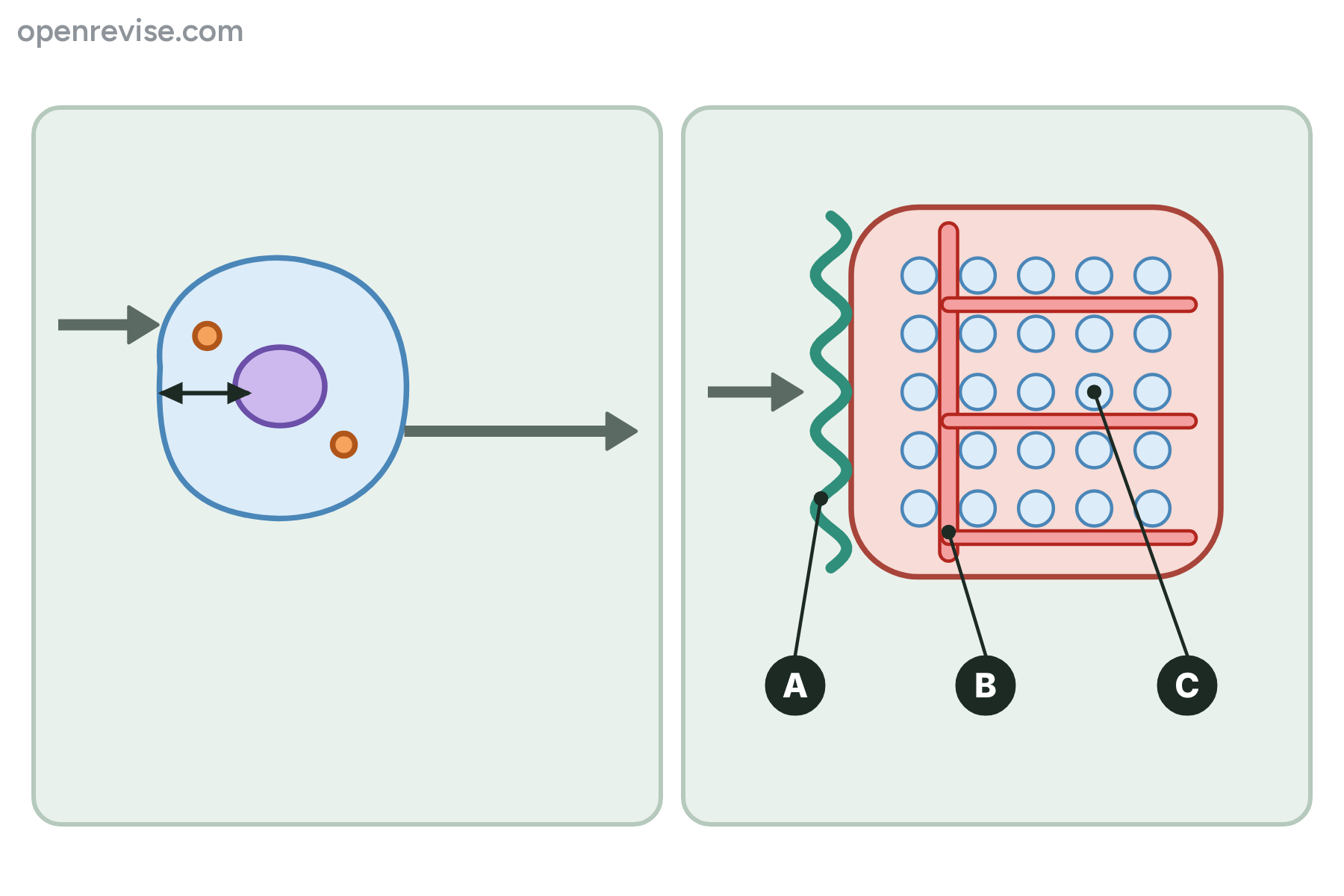
The diagram shows a single-celled organism and a large multicellular organism. Name the parts of the large organism labelled A, B and C.
Show answerHide answer
Model answer
A is the exchange surface. B is a blood vessel, which is part of the transport system. C is a body cell, deep inside the organism.
Mark scheme
- A: exchange surface — 1 mark
- B: blood vessel (or transport system) — 1 mark
- C: body cell (or cell) — 1 mark
-
5 Calculate [3 marks]
Organism P can be modelled as a cube with sides of 0.2 cm. Organism Q can be modelled as a cube with sides of 3 cm. Calculate the surface area to volume ratio of each organism and work out how many times bigger the ratio is for P than for Q.
Show answerHide answer
Model answer
P has a surface area of \(6 \times 0.2 \times 0.2 = 0.24\ \text{cm}^2\) and a volume of \(0.2 \times 0.2 \times 0.2 = 0.008\ \text{cm}^3\), so its ratio is \(0.24 \div 0.008 = 30\), which is 30 : 1. Q has a surface area of \(6 \times 3 \times 3 = 54\ \text{cm}^2\) and a volume of \(27\ \text{cm}^3\), so its ratio is \(54 \div 27 = 2\), which is 2 : 1. P's ratio is \(30 \div 2 = 15\) times bigger.
Mark scheme
- P: 30 : 1 — 1 mark
- Q: 2 : 1 — 1 mark
- 15 times bigger — 1 mark
-
6 Explain [3 marks]
Explain why a single-celled organism does not need a transport system.
Show answerHide answer
Model answer
A single-celled organism has a large surface area compared with its volume. No part of the cell is far from the surface, so the diffusion distance is short. Oxygen and other substances can therefore diffuse across the cell membrane fast enough to reach every part of the cell.
Mark scheme
- It has a large surface area to volume ratio — 1 mark
- The diffusion distance is short — 1 mark
- Substances diffuse in and out fast enough across the surface — 1 mark
-
7 Explain [4 marks]
A blue whale is a very large animal. Explain why it needs both an exchange surface and a transport system.
Show answerHide answer
Model answer
A whale has a very small surface area compared with its volume, so its skin could not take in enough oxygen for all of its cells. Most of its cells are a long way from the surface, and diffusion over a long distance is far too slow. The lungs are an exchange surface that provides a large surface area for taking in oxygen and removing carbon dioxide. The transport system, the blood pumped by the heart, then carries the oxygen quickly to all of the cells and carries the carbon dioxide back.
Mark scheme
- Small surface area to volume ratio — 1 mark
- Long diffusion distance, so diffusion alone is too slow — 1 mark
- Exchange surface gives a large area for oxygen and carbon dioxide to cross — 1 mark
- Transport system carries substances quickly to and from all the cells — 1 mark
-
8 Explain [6 marks]
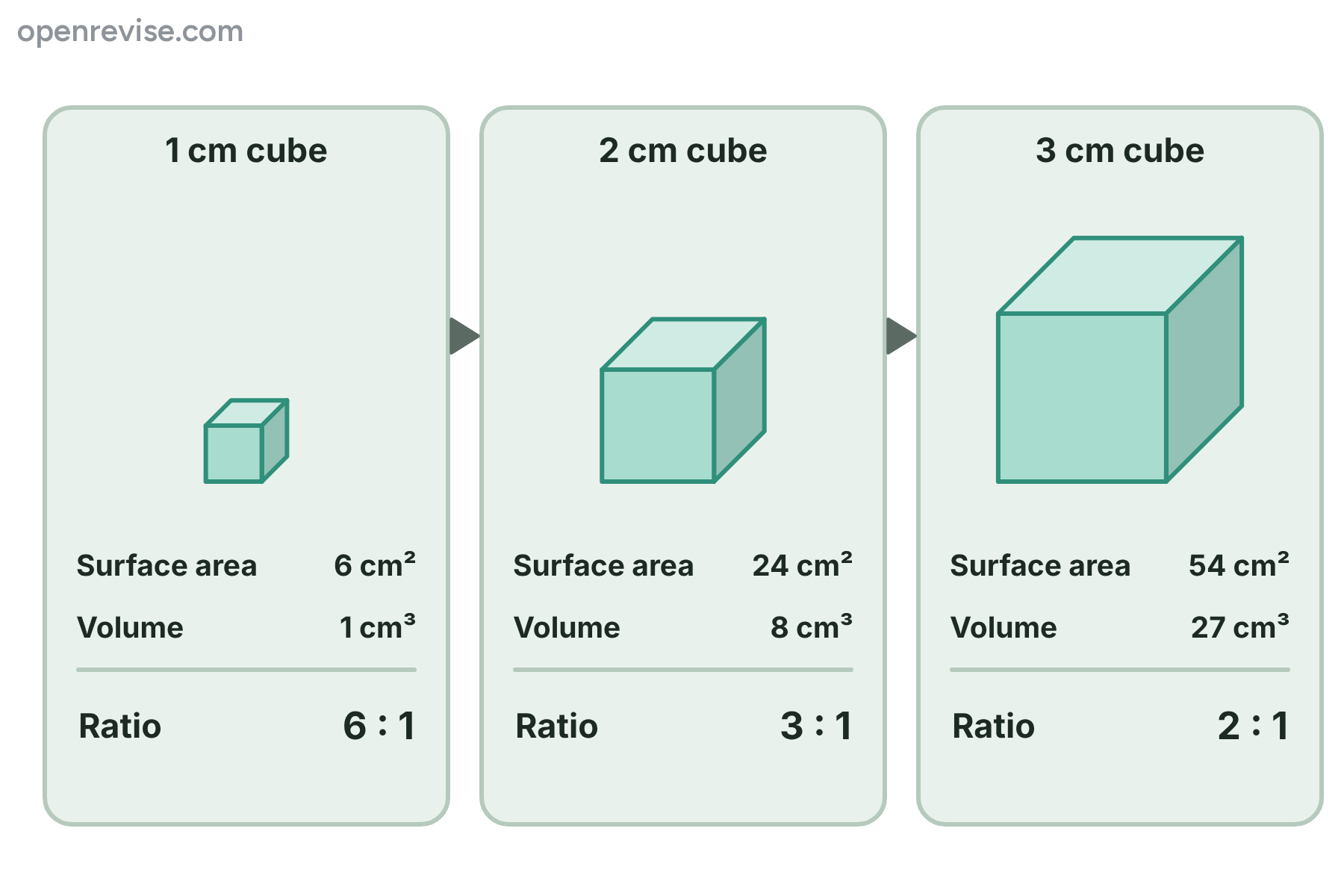
The diagram shows three cubes that are used as models of organisms of different sizes. Use the diagram and your own knowledge to explain why a large multicellular animal needs specialised exchange surfaces and a transport system, but a very small organism does not.
Show answerHide answer
Model answer
The diagram shows that as the cube gets bigger the surface area to volume ratio falls, from 6 : 1 to 2 : 1. A large animal is like the large cube, so it has a small surface area compared with its volume, and its outer surface is too small to take in enough oxygen for all its cells. Its cells are also deep inside the body, so the diffusion distance is long and diffusion alone is too slow. It therefore needs an exchange surface, such as the lungs, which has a large surface area, to take in oxygen and remove carbon dioxide. It also needs a transport system, the blood pumped by the heart, to carry oxygen and other substances quickly to every cell. A very small organism is like the small cube. Its large ratio and short diffusion distance mean that diffusion across its surface is fast enough, so it needs neither.
Mark scheme
- Ratio falls as size increases (6 : 1 to 2 : 1) — 1 mark
- A large animal has a small surface area compared with its volume — 1 mark
- Cells deep inside, so a long diffusion distance and diffusion alone is too slow — 1 mark
- Exchange surface with a large surface area, such as the lungs — 1 mark
- Transport system (blood and heart) carries substances to and from all cells — 1 mark
- A small organism has a large ratio and short distance, so diffusion across its surface is enough — 1 mark
Quick check
-
1
Which of these is a waste substance that is made in the liver?
Show answerHide answer
B: Urea
Urea is made in the liver from excess amino acids and is removed by the kidneys in the urine.
-
2
What is the surface area to volume ratio of a cube with sides of 2 cm?
Show answerHide answer
D: 3 : 1
The surface area is \(6 \times 4 = 24\ \text{cm}^2\) and the volume is \(8\ \text{cm}^3\), so the ratio is \(24 \div 8 = 3\), which is 3 : 1.
-
3
What happens to the surface area to volume ratio of an organism as it gets bigger?
Show answerHide answer
A: It gets smaller
The volume increases faster than the surface area, so the ratio gets smaller.
-
4
Why does a single-celled organism not need a transport system?
Show answerHide answer
C: Its diffusion distance is short
It has a large surface area to volume ratio and a short diffusion distance, so diffusion across the surface is fast enough.
-
5
A cube has a surface area of 150 cm\(^2\) and a volume of 125 cm\(^3\). What is its surface area to volume ratio?
Show answerHide answer
B: 1.2 : 1
Surface area divided by volume is \(150 \div 125 = 1.2\), so the ratio is 1.2 : 1.
-
6
Which pair of substances is taken into the body from the small intestine?
Show answerHide answer
A: Glucose and amino acids
Digestion leaves small soluble molecules such as glucose and amino acids, which are absorbed into the blood, together with mineral ions and water.
-
7
Which statement best explains why a large animal needs a transport system?
Show answerHide answer
D: Diffusion is too slow over long distances
Cells deep inside a large body are too far from the surface for diffusion to supply them, so the blood carries substances to and from them.
-
8
When the length of each side of a cube doubles, what happens to its volume?
Show answerHide answer
C: It is 8 times bigger
Volume depends on the side cubed, and \(2^3 = 8\), so the volume is 8 times bigger. The surface area is only 4 times bigger.