Flashcards · Biology · Exchange Surfaces and Gas Exchange
Why Organisms Need Exchange Surfaces and Transport Systems
-
Name two substances that cells need to take in.
Any two of: oxygen, dissolved food molecules, water, mineral ions.
-
Name two waste substances that have to be removed from the body.
Any two of: carbon dioxide, urea, excess water, excess mineral ions.
-
Where is urea made, and where is it removed from the body?
It is made in the liver and removed by the kidneys in the urine.
-
Why do cells need oxygen?
For aerobic respiration, which releases energy from glucose.
-
How does carbon dioxide leave the body of a human?
It diffuses from the cells into the blood, is carried to the lungs and is breathed out.
-
Which dissolved food molecules are absorbed in the small intestine?
Glucose, amino acids, fatty acids and glycerol.
-
What is the formula for the surface area of a cube?
\(6 \times \text{side} \times \text{side}\).
-
What is the formula for the volume of a cube?
\(\text{side} \times \text{side} \times \text{side}\).
-
How do you calculate a surface area to volume ratio?
Divide the surface area by the volume.
-
What is the surface area to volume ratio of a 2 cm cube?
3 : 1, because \(24 \div 8 = 3\).
-
What happens to the ratio when an organism gets bigger?
It gets smaller, because the volume increases faster than the surface area.
-
What happens to the surface area and the volume of a cube when its sides double?
The surface area is 4 times bigger and the volume is 8 times bigger.
-
Why does a single-celled organism not need a transport system?
It has a large ratio and a short diffusion distance, so diffusion across the cell surface is fast enough.
-
Why can diffusion alone not supply a large animal?
The ratio is small and the diffusion distance to cells deep inside is long, so diffusion is far too slow.
-
Name the two adaptations that large organisms have.
Exchange surfaces and a transport system.
-
What is the job of the transport system?
To carry substances quickly between the exchange surfaces and every cell.
-
Why are flatworms and leaves flat?
A flat shape has a large ratio, so exchange across the surface is fast enough.
-
What is the usual mistake with ratio questions?
Dividing the volume by the surface area, instead of the surface area by the volume.
-
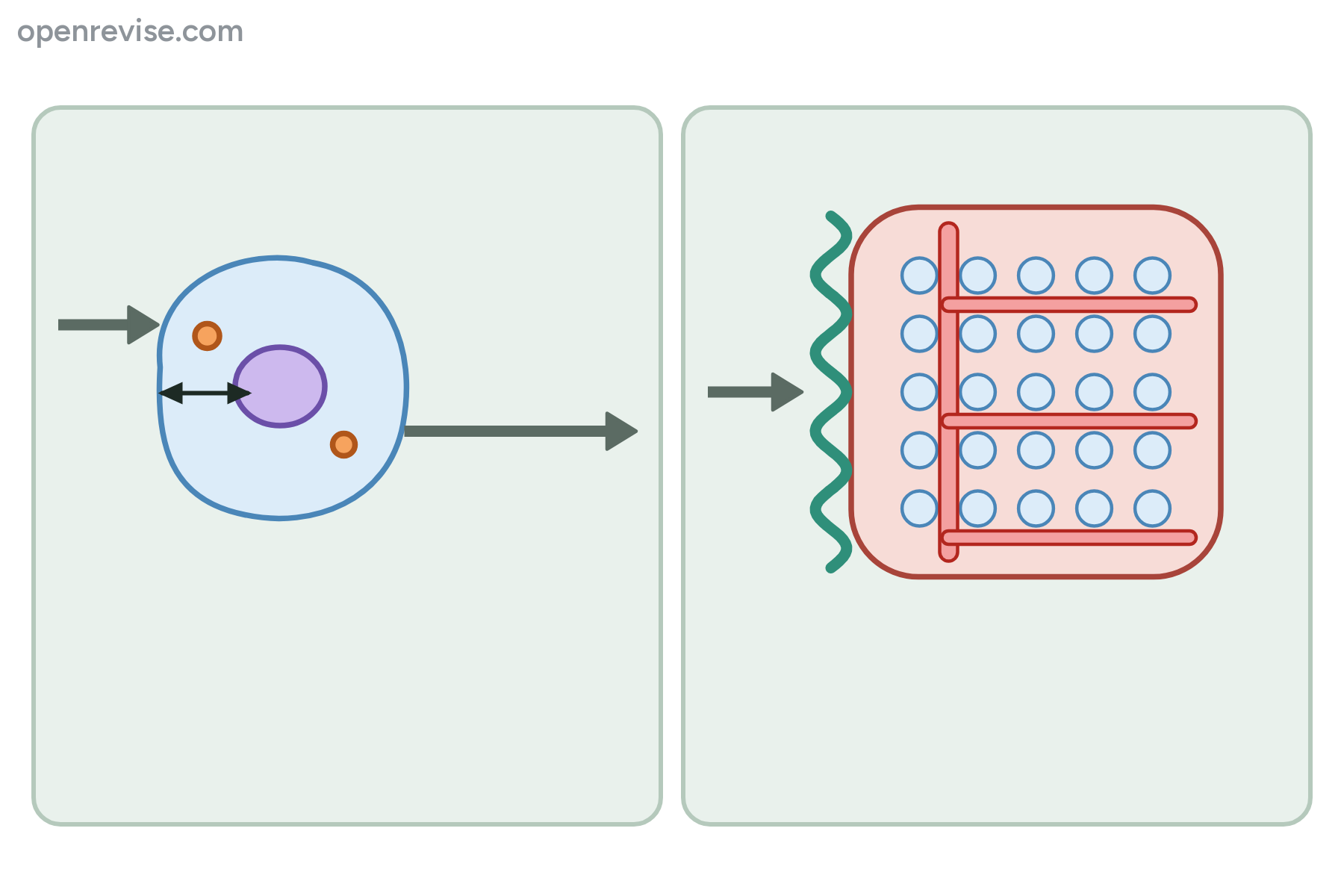 Label the exchange surface, the blood vessel and the cell deep inside the body, and say why this organism needs them.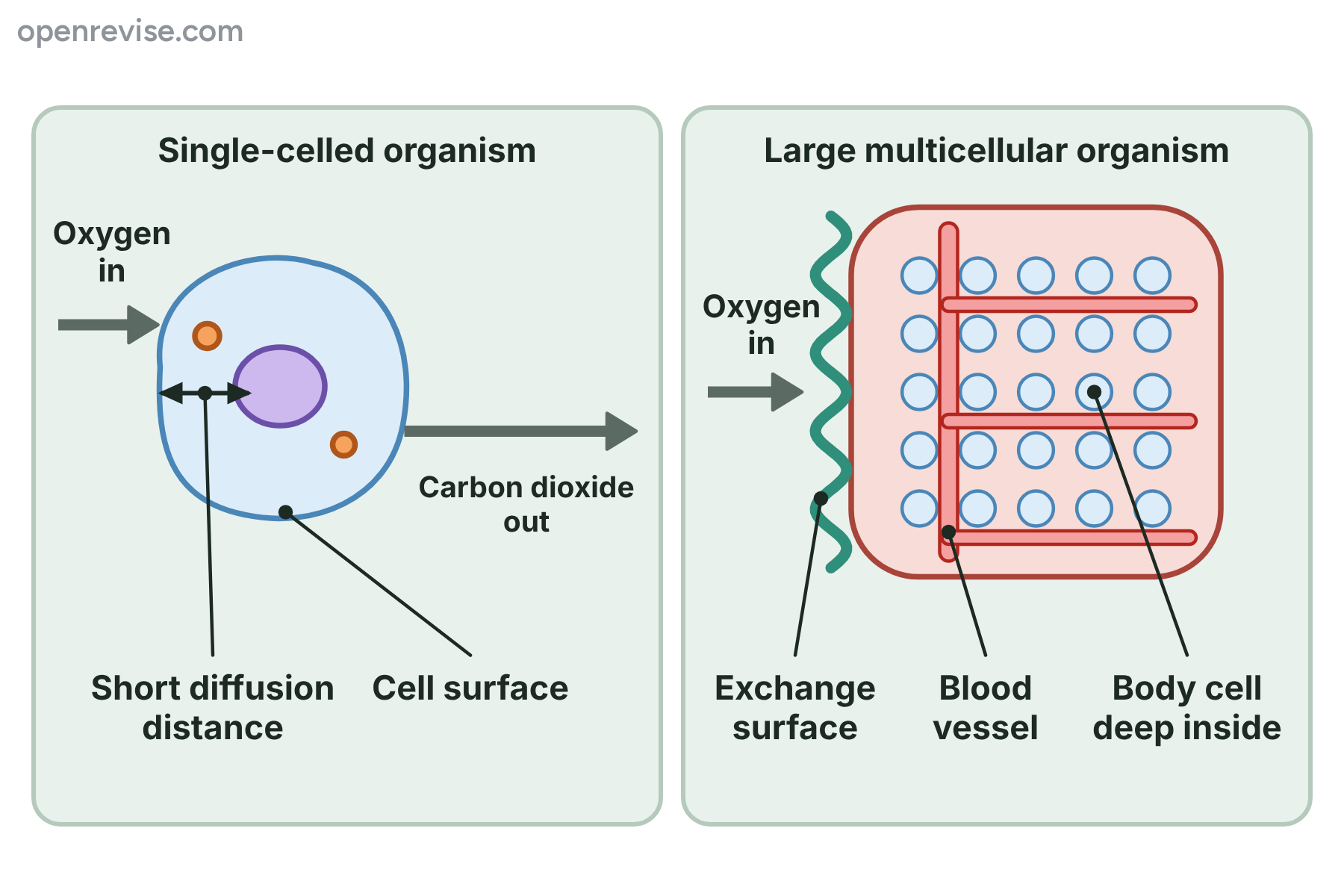
The wavy line is the exchange surface, the red tube is a blood vessel in the transport system and the circle in the middle is a body cell deep inside. A large organism has a small surface area to volume ratio and a long diffusion distance, so it needs both.
-
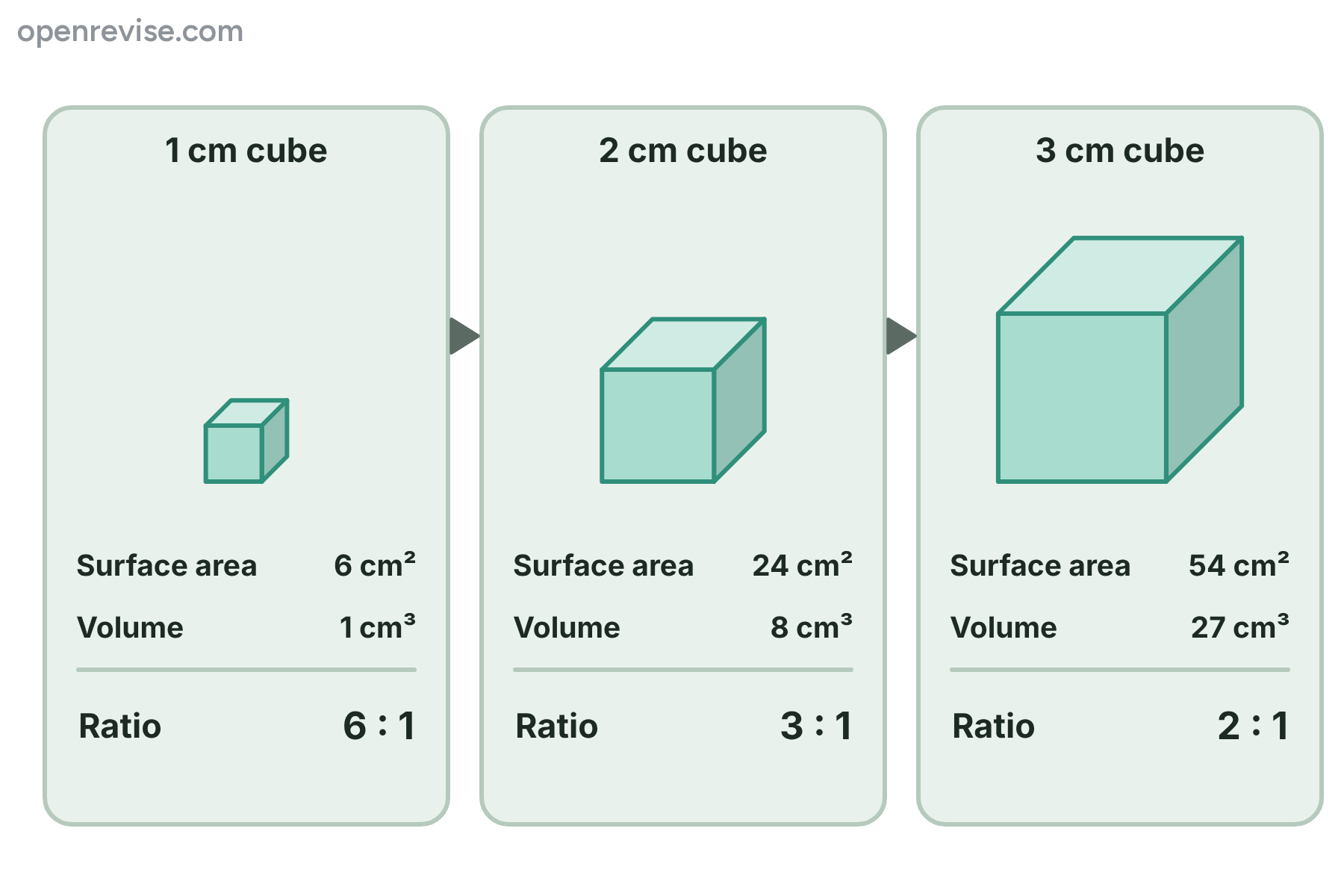 What pattern do the surface area to volume ratios show as the cube gets bigger, and why?
 The ratio falls from 6 : 1 to 3 : 1 to 2 : 1. The volume grows faster than the surface area, so bigger organisms have a smaller ratio.