Biology · Respiration
Cellular Respiration and Aerobic Respiration
Every living cell, in animals, plants and microorganisms alike, needs a constant supply of energy. This lesson is for both Combined Science and separate Biology. It covers respiration as an exothermic reaction, the equations for aerobic respiration, where it happens, what the energy is used for, and how breathing and the circulatory system keep it going.
Learning Objectives
- 1Describe cellular respiration as an exothermic reaction that occurs continuously in living cells to release energy for metabolic processes.
- 2State the word equation and the balanced symbol equation for aerobic respiration.
- 3Describe where aerobic respiration takes place in a cell and what the energy it releases is used for.
- 4Explain how the breathing system and the circulatory system supply the reactants for respiration and remove the carbon dioxide.
Retrieval practice
-
1
Which sugar do plants make in photosynthesis?
Show answerHide answer
-
2
What is an enzyme?
Show answerHide answer
A biological catalyst that speeds up a chemical reaction without being used up.
-
3
What are the air sacs in the lungs called?
Show answerHide answer
Alveoli.
-
4
Which blood cells carry oxygen, and which substance in them binds to it?
Show answerHide answer
Red blood cells, using haemoglobin.
Why every cell needs energy
Living things never stop using energy. A muscle contracts, a nerve cell sends an impulse, a root hair cell pumps in mineral ions and every cell builds new proteins, and all of these jobs need energy. The energy comes from glucose, which animals get from digested food and plants make by photosynthesis. Respiration is the chemical process that transfers the energy stored in glucose into a form the cell can use. It is not the same thing as breathing: breathing moves air in and out of the lungs, while respiration is a reaction that happens inside the cells.
What cellular respiration is
Respiration is a series of chemical reactions in living cells that release energy from nutrient molecules such as glucose.
-
Continuous
Respiration occurs continuously in living cells, day and night, in animals, plants, fungi and bacteria. A cell that stops respiring soon runs out of energy and dies.
-
Exothermic
Respiration is an exothermic reaction, which means that it transfers energy to the surroundings. Some of this energy is released as heat, which is why your body is warm and why a compost heap or a pile of germinating seeds heats up.
-
Metabolic processes
The rest of the energy is used by the cell for metabolic processes. Metabolism is the sum of all the chemical reactions that take place in a living organism.
-
Two types
Aerobic respiration uses oxygen. Anaerobic respiration happens without oxygen and releases much less energy per glucose molecule. This lesson covers aerobic respiration and the next lesson covers anaerobic respiration.
Aerobic respiration
Aerobic respiration uses oxygen to break glucose down completely, which makes it the main way that most organisms release energy.
-
Word equation
glucose + oxygen \(\rightarrow\) carbon dioxide + water, with energy released.
-
Symbol equation
\(C_6H_{12}O_6 + 6O_2 \rightarrow 6CO_2 + 6H_2O\) with energy released. You must recognise the symbols for glucose, oxygen, carbon dioxide and water, and be able to balance the equation.
-
A complete breakdown
Oxygen lets the glucose be broken down completely into the waste products carbon dioxide and water, so a large amount of energy is released from every glucose molecule.
-
Where it happens
Most of the reactions of aerobic respiration take place in the mitochondria, which are found in the cytoplasm of animal and plant cells.
Aerobic respiration in a cell
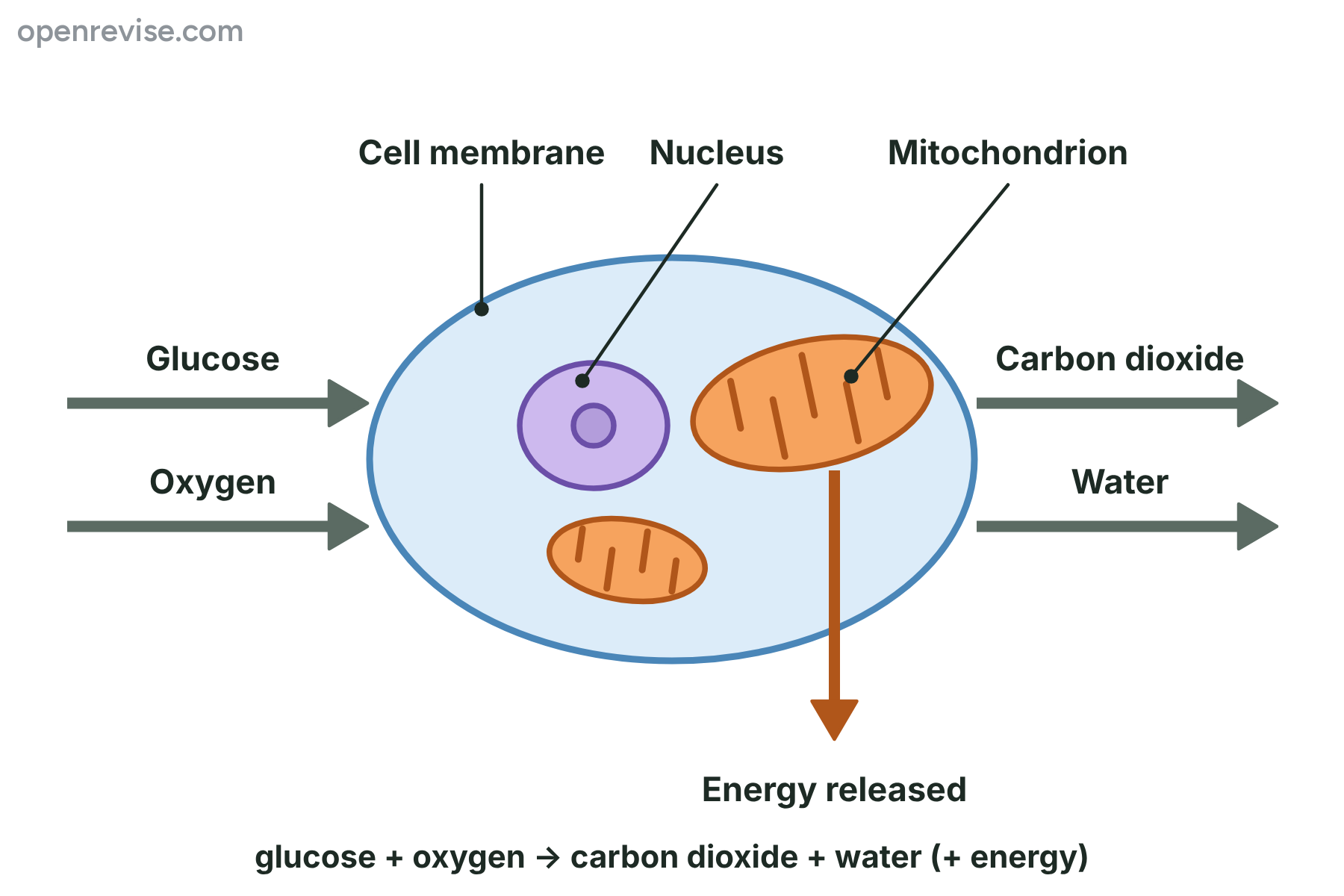
Glucose and oxygen go in; carbon dioxide, water and energy come out.
Where respiration happens
The reactions of aerobic respiration are packed into mitochondria, so the number of mitochondria in a cell shows how much energy it uses.
-
Mitochondria
These tiny structures, with a folded inner membrane that gives a large surface area, are where most of the reactions of aerobic respiration take place.
-
Cells with many mitochondria
Muscle cells, sperm cells, liver cells and the cells of a root hair all need a lot of energy, so each contains many mitochondria. A cell that uses little energy has fewer.
-
Plant cells respire too
Plant cells contain mitochondria as well as chloroplasts. They respire all the time, in the dark as well as in the light, but they photosynthesise only when there is light.
-
The supply of glucose
Animal cells get glucose from digested food carried in the blood plasma. Plant cells get it from photosynthesis, or from stores such as starch that are broken down to glucose.
What the energy is used for
Cells use the energy from respiration for all of their metabolic processes. Four uses matter most for the exam.
-
Building molecules
Energy is used to build larger molecules from smaller ones, for example proteins from amino acids, DNA, and starch or cellulose from glucose.
-
Movement
Muscle cells use energy to contract. This lets animals move, the heart pump blood and the diaphragm and rib muscles ventilate the lungs.
-
Keeping warm
Mammals and birds use energy released by respiration to maintain a steady body temperature. The heat that respiration releases is the heat that keeps them warm.
-
Active transport
Cells use energy to move substances against a concentration gradient, as root hair cells do when they take mineral ions in from the soil.
Breathing and the circulatory system
Respiration needs a steady supply of oxygen and glucose and a way to remove carbon dioxide, which is the job of the breathing system and the circulatory system.
-
Breathing
Ventilation of the lungs brings oxygen into the alveoli, where it diffuses into the blood. Carbon dioxide diffuses from the blood into the alveoli and is breathed out.
-
Blood
Red blood cells carry the oxygen to every respiring cell. The plasma carries dissolved glucose from the gut and carries carbon dioxide back to the lungs.
-
The heart
The heart pumps the blood around the body so that every cell receives a steady supply. Without it the oxygen could not reach the cells quickly enough by diffusion alone.
-
Exercise
During exercise muscle cells respire faster, so they use more oxygen and make more carbon dioxide. Breathing rate and heart rate both increase to keep up.
How oxygen reaches the respiring cells
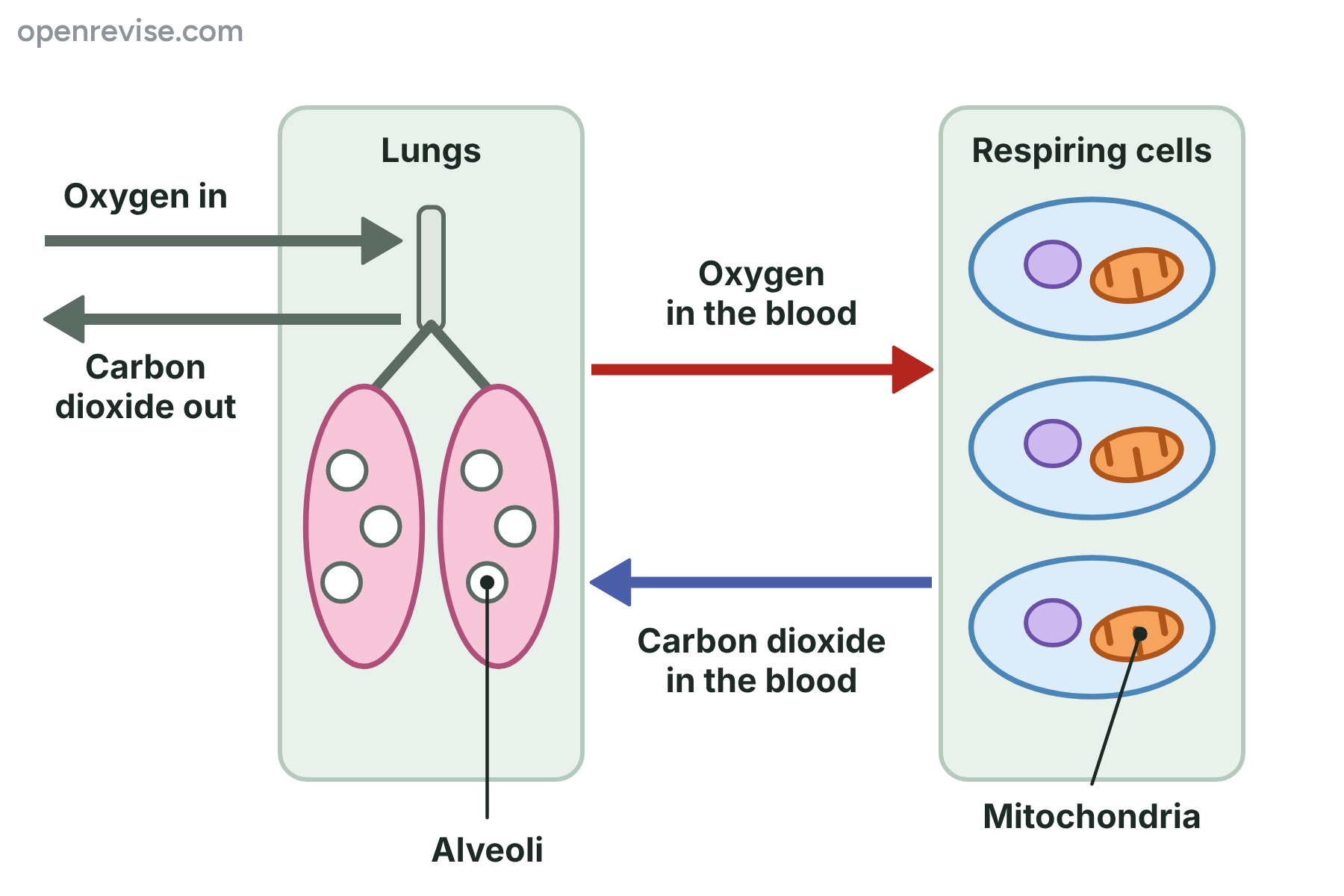
The blood carries oxygen to the cells and carbon dioxide back to the lungs.
From the air to the energy in a cell
Follow one molecule of oxygen to see how breathing, the circulatory system and respiration link together.
-
1
Breathing in
Air containing oxygen is drawn into the lungs as you inhale.
-
2
Gas exchange
Oxygen diffuses from the alveoli into the blood in the capillaries, and carbon dioxide diffuses the other way.
-
3
Transport
Red blood cells carry the oxygen, and the heart pumps the blood to the muscles and other tissues, where the plasma also delivers glucose.
-
4
Respiration
In the mitochondria, glucose and oxygen react to release energy, with carbon dioxide and water as the products.
-
5
Removal
The carbon dioxide diffuses into the blood, is carried to the lungs and is breathed out.
Respiration and photosynthesis compared
Respiration
- An exothermic reaction that releases energy
- Uses glucose and oxygen
- Makes carbon dioxide and water
- Happens all the time in every living cell
- Takes place in the mitochondria
Photosynthesis
- An endothermic reaction that takes in light energy
- Uses carbon dioxide and water
- Makes glucose and oxygen
- Happens only in the light, in cells with chlorophyll
- Takes place in the chloroplasts
Case study
Peas that warm up in a flask
In a classic investigation, soaked and germinating peas are put in a vacuum flask with a thermometer, and boiled peas are put in a second flask as a control. After a day or two the thermometer in the live peas reads several degrees higher than the one in the boiled peas, which stays at room temperature. The living peas are respiring, so they transfer energy to their surroundings as heat. The vacuum flask stops the heat escaping, and the boiled peas show that the warming is caused by living cells and not by the room.
The big idea
Respiration is the exothermic reaction in every living cell that releases the energy in glucose for metabolic processes.
Aerobic respiration
Aerobic respiration
-
What it is
- exothermic
- continuous
- releases energy
-
Equation
- glucose + oxygen gives carbon dioxide + water
-
Where
- mitochondria
- animal and plant cells
-
Uses of energy
- building molecules
- movement
- keeping warm
- active transport
-
Supply
- breathing brings oxygen
- blood carries oxygen and glucose
Summary and exam focus
- Respiration is a series of chemical reactions in living cells that release energy, and it occurs continuously in every living cell.
- Respiration is exothermic: it transfers energy to the surroundings, and the rest of the energy is used for metabolic processes.
- Aerobic respiration is glucose + oxygen to carbon dioxide + water, \(C_6H_{12}O_6 + 6O_2 \rightarrow 6CO_2 + 6H_2O\), and it takes place mainly in the mitochondria.
- The energy is used to build molecules, to contract muscles, to keep warm and for active transport.
- Breathing brings oxygen to the blood and removes carbon dioxide, and the circulatory system carries oxygen and glucose to the cells.
Exam focus
Explain why respiration is described as an exothermic reaction and give two uses of the energy that it releases in the body. (3 marks) (3 marks)
Start with the meaning of exothermic: energy is transferred to the surroundings, often as heat. Then give two different uses, one for each remaining mark, such as muscle contraction, keeping warm, building proteins or active transport. Do not write that respiration is breathing, because that is a different process.
Key terms
The words this lesson expects you to use. Each one is linked from the first place it appears above.
- Respiration
- A series of chemical reactions in living cells that releases energy from nutrient molecules such as glucose.
- Aerobic respiration
- Respiration that uses oxygen to break glucose down completely into carbon dioxide and water, releasing energy.
- Exothermic reaction
- A reaction that transfers energy to the surroundings, usually as heat.
- Metabolic processes
- The chemical reactions that take place in a living organism, which use the energy released by respiration.
- Mitochondria
- The structures in a cell where most of the reactions of aerobic respiration take place.
- Glucose
- A sugar that is the main fuel for respiration, made in photosynthesis or from digested food.
- Active transport
- The movement of substances against a concentration gradient, using energy from respiration.
- Ventilation
- Breathing: the movement of air into and out of the lungs.
- Red blood cell
- A blood cell packed with haemoglobin that carries oxygen from the lungs to the respiring cells.
You've finished the notes
Check your understanding
Test yourself while it is fresh. Start with the flashcards, then try the exam questions.
Something here looks wrong?
Tell us what and we will go and look. It goes to whoever writes these pages, nobody else, and we do not ask who you are — so there is nothing to sign and nothing comes back to you.