Exam questions · Biology · Respiration
Cellular Respiration and Aerobic Respiration
- 8 exam questions
- 21 marks
- 8 quick checks
-
1 State [1 mark]
State where most of the reactions of aerobic respiration take place in a cell.
Show answerHide answer
Model answer
In the mitochondria.
Mark scheme
- Mitochondria (mitochondrion) — 1 mark
-
2 Write [2 marks]
Write the word equation for aerobic respiration.
Show answerHide answer
Model answer
glucose + oxygen → carbon dioxide + water
Mark scheme
- Glucose and oxygen on the left as the reactants — 1 mark
- Carbon dioxide and water on the right as the products — 1 mark
-
3 Name [3 marks]
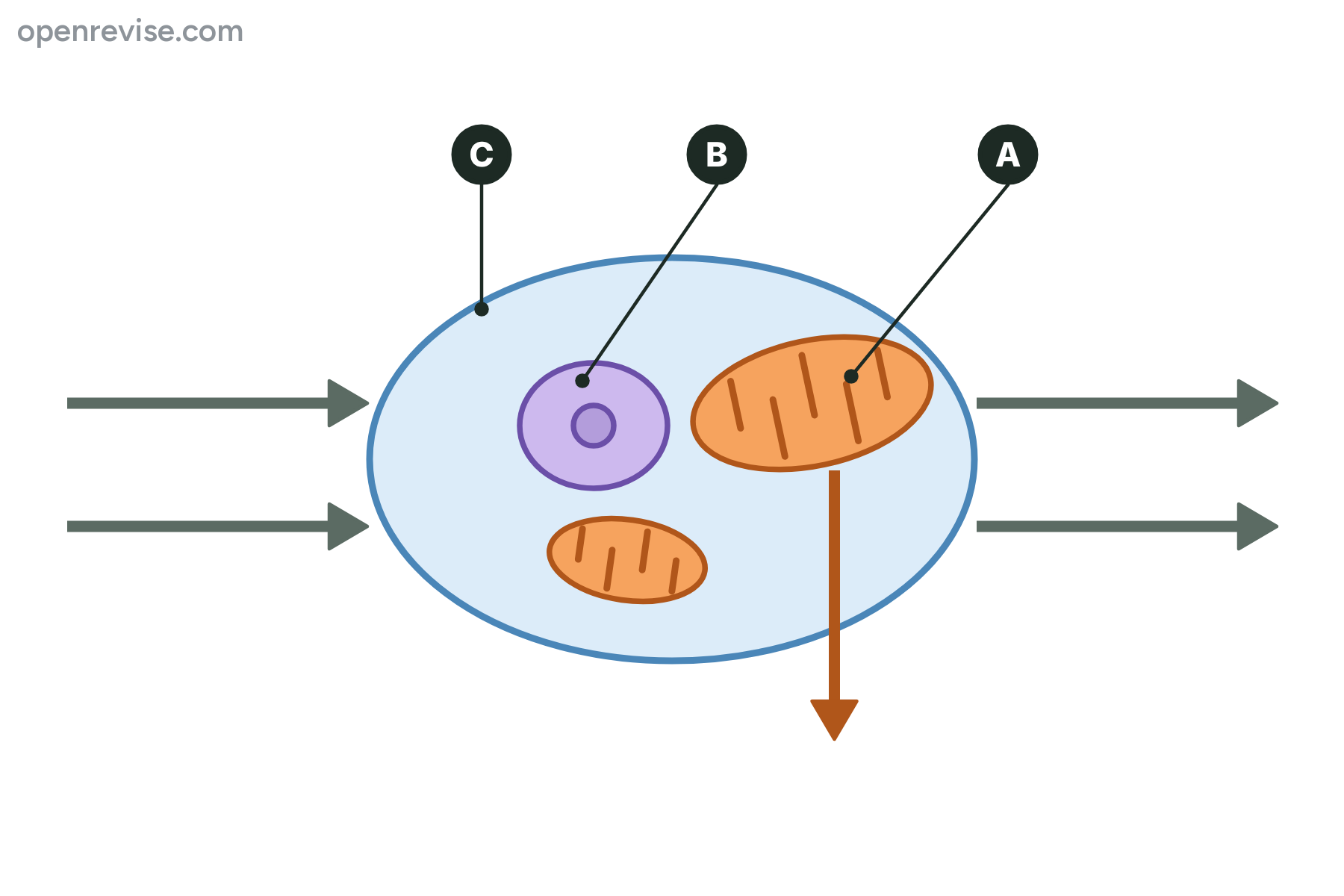
The diagram shows a cell. Name the parts labelled A, B and C.
Show answerHide answer
Model answer
A is a mitochondrion. B is the nucleus. C is the cell membrane.
Mark scheme
- A: mitochondrion — 1 mark
- B: nucleus — 1 mark
- C: cell membrane — 1 mark
-
4 Explain [2 marks]
Respiration is an exothermic reaction. Explain what this means and give one piece of evidence from living things that shows it.
Show answerHide answer
Model answer
An exothermic reaction transfers energy to the surroundings. For example, the body temperature of a mammal stays warm, and a pile of germinating seeds or a compost heap becomes warmer than the air around it, because the respiring cells release heat.
Mark scheme
- Energy is transferred to the surroundings (as heat) — 1 mark
- A suitable example such as a warm body, a compost heap or germinating seeds — 1 mark
-
5 Give [3 marks]
Give three ways in which the energy released by respiration is used in the human body.
Show answerHide answer
Model answer
Any three of: building larger molecules such as proteins from amino acids; muscle contraction for movement; keeping the body at a constant temperature; active transport of substances against a concentration gradient; cell division and growth.
Mark scheme
- First correct use — 1 mark
- Second correct use — 1 mark
- Third correct use — 1 mark
-
6 Explain [3 marks]
Muscle cells contain many more mitochondria than skin cells. Explain why.
Show answerHide answer
Model answer
Muscle cells need a lot of energy to contract. Most of the reactions of aerobic respiration take place in the mitochondria. Having many mitochondria means that more energy can be released every second to supply the muscle.
Mark scheme
- Muscle cells use a lot of energy (to contract) — 1 mark
- Mitochondria are where aerobic respiration takes place — 1 mark
- More mitochondria release more energy — 1 mark
-
7 Explain [4 marks]
Explain how the breathing system and the circulatory system work together to supply the cells with what they need for aerobic respiration.
Show answerHide answer
Model answer
Ventilation brings air into the lungs, and oxygen diffuses from the alveoli into the blood. Red blood cells carry the oxygen, and the heart pumps the blood around the body to the cells. The plasma carries glucose from digested food to the cells. The cells use the glucose and oxygen in the mitochondria, and the carbon dioxide they make diffuses into the blood and is carried back to the lungs to be breathed out.
Mark scheme
- Oxygen diffuses from the alveoli into the blood — 1 mark
- Red blood cells carry oxygen, and the heart pumps the blood to the cells — 1 mark
- Plasma carries glucose to the cells — 1 mark
- Carbon dioxide is carried back to the lungs and breathed out — 1 mark
-
8 Explain [3 marks]
A student put germinating peas in one vacuum flask and boiled peas in a second flask. Each flask had a thermometer. After two days the temperature in the flask with the germinating peas had risen by 4 degrees Celsius and the temperature in the flask with the boiled peas had not changed. Explain these results.
Show answerHide answer
Model answer
The germinating peas are alive, so they respire. Respiration is exothermic and transfers energy to the surroundings as heat, so the temperature rose. The boiled peas are dead and cannot respire, so no energy was released and the temperature did not change. The boiled peas are a control that shows the warming is caused by respiration.
Mark scheme
- Germinating peas respire — 1 mark
- Respiration is exothermic, so heat is released and the temperature rises — 1 mark
- Boiled peas are dead, so there is no respiration and no temperature change — 1 mark
Quick check
-
1
Which of these is the word equation for aerobic respiration?
Show answerHide answer
C: Glucose + oxygen → carbon dioxide + water
Aerobic respiration uses glucose and oxygen and makes carbon dioxide and water, releasing energy.
-
2
What does it mean to say that respiration is an exothermic reaction?
Show answerHide answer
B: It transfers energy to the surroundings
An exothermic reaction transfers energy to the surroundings, often as heat.
-
3
Which part of a cell contains most of the reactions of aerobic respiration?
Show answerHide answer
D: The mitochondrion
The mitochondria are the site of most of the reactions of aerobic respiration.
-
4
How often does respiration take place in a plant cell?
Show answerHide answer
A: All the time, day and night
Respiration occurs continuously in all living cells, so a plant cell respires in the dark as well as in the light.
-
5
Which of these is NOT a use of the energy released by respiration?
Show answerHide answer
B: Making glucose from carbon dioxide
Glucose is made by photosynthesis, which uses light energy. Respiration releases energy from glucose, it does not make it.
-
6
Why do the cells of a root hair contain many mitochondria?
Show answerHide answer
C: They use a lot of energy for active transport
Root hair cells use active transport to take in mineral ions, which needs energy released by respiration in the mitochondria.
-
7
What carries oxygen from the lungs to the respiring cells?
Show answerHide answer
A: Red blood cells
Red blood cells contain haemoglobin, which carries oxygen from the lungs to the cells.
-
8
During exercise a person breathes faster and their heart beats faster. What is the reason?
Show answerHide answer
D: The muscle cells need more oxygen and make more carbon dioxide
Muscle cells respire faster during exercise, so they need more oxygen and make more carbon dioxide.