Exam questions · Biology · Homeostasis
The Kidneys and Water Balance
- 8 exam questions
- 24 marks
- 8 quick checks
-
1 State [2 marks]
State two substances that are removed from the blood by the kidneys.
Show answerHide answer
Model answer
Any two of: urea, excess water, excess mineral ions.
Mark scheme
- Substance 1 — 1 mark
- Substance 2 — 1 mark
-
2 Name [3 marks]
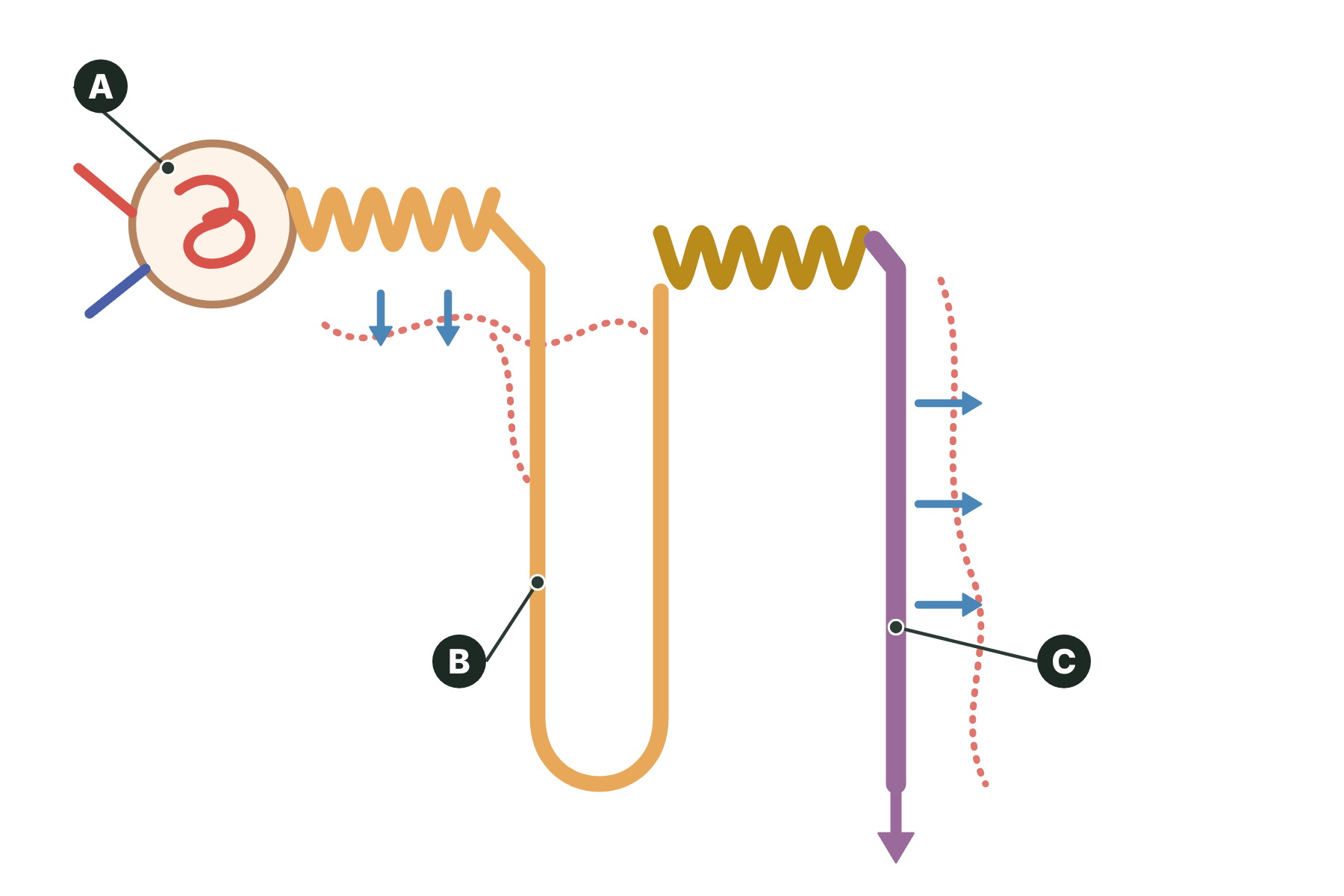
Figure 1 shows a nephron. Name the parts shown at A, B and C.
Show answerHide answer
Model answer
A is the Bowman's capsule. B is the loop of Henle. C is the collecting duct.
Mark scheme
- A: Bowman's capsule — 1 mark
- B: loop of Henle — 1 mark
- C: collecting duct — 1 mark
-
3 Name [3 marks]
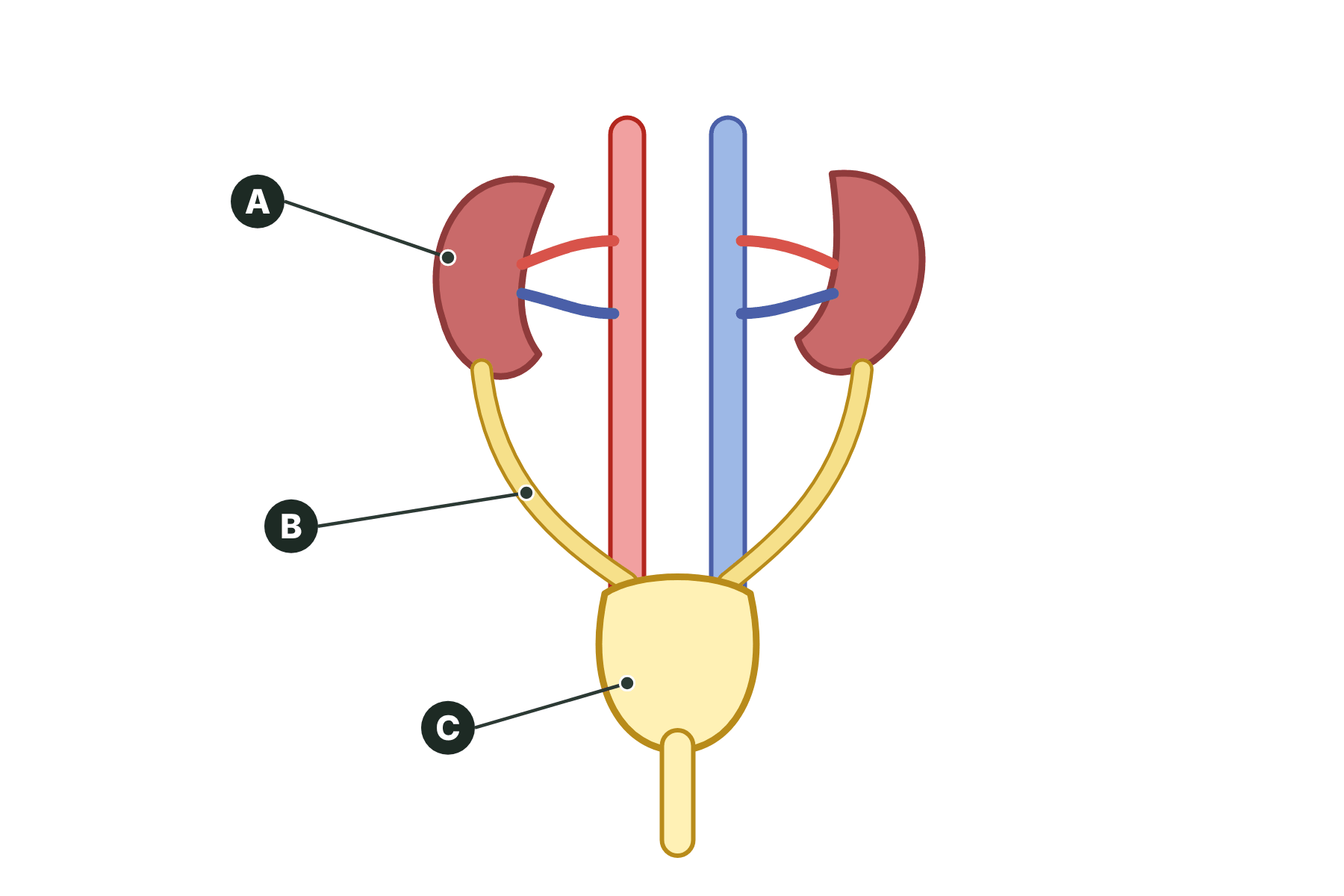
Figure 2 shows the urinary system. Name the parts shown at A, B and C.
Show answerHide answer
Model answer
A is a kidney. B is a ureter. C is the bladder.
Mark scheme
- A: kidney — 1 mark
- B: ureter — 1 mark
- C: bladder — 1 mark
-
4 Explain [3 marks]
Explain why the water content of the blood must be controlled.
Show answerHide answer
Model answer
If the blood is too dilute, water enters the cells by osmosis and they may swell and burst. If it is too concentrated, water leaves the cells by osmosis and they shrink. The cells can only work normally if the water content is right.
Mark scheme
- Too dilute: cells gain water and may burst — 1 mark
- Too concentrated: cells lose water and shrink — 1 mark
- Cells only work normally with the right water content — 1 mark
-
5 Describe [4 marks]
Describe how urine is made in a nephron.
Show answerHide answer
Model answer
Blood is filtered under high pressure in the glomerulus, and water, glucose, urea and ions pass into the Bowman's capsule. Blood cells and proteins stay in the blood. In the tubule all the glucose and some water and ions are reabsorbed into the blood. The urea, excess water and excess ions are left and form the urine.
Mark scheme
- Filtration under high pressure — 1 mark
- Blood cells and proteins are not filtered — 1 mark
- All glucose and some water and ions reabsorbed — 1 mark
- Urea and excess water and ions leave as urine — 1 mark
-
6 Explain [2 marks]
Explain why there is no glucose in the urine of a healthy person.
Show answerHide answer
Model answer
All of the glucose is reabsorbed into the blood from the tubule by active transport, so none is left in the urine.
Mark scheme
- All glucose is reabsorbed — 1 mark
- By active transport — 1 mark
-
7 Explain [4 marks]
Explain how ADH changes the volume of urine produced when a person has not had a drink for many hours.
Show answerHide answer
Model answer
The blood becomes more concentrated, and the hypothalamus detects this. The pituitary gland releases more ADH. ADH makes the walls of the collecting ducts more permeable to water, so more water is reabsorbed into the blood. A small volume of concentrated urine is produced.
Mark scheme
- Blood more concentrated, detected — 1 mark
- More ADH released from the pituitary — 1 mark
- Collecting duct more permeable, more water reabsorbed — 1 mark
- Small volume of concentrated urine — 1 mark
-
8 Explain [3 marks]
A person eats a very salty meal. Explain how their body responds to bring the blood back to normal.
Show answerHide answer
Model answer
The blood becomes more concentrated. More ADH is released, so more water is reabsorbed and a small volume of concentrated urine is made. The person feels thirsty and drinks, which dilutes the blood.
Mark scheme
- Blood becomes more concentrated — 1 mark
- More ADH, more water reabsorbed, concentrated urine — 1 mark
- Thirst makes the person drink — 1 mark
Quick check
-
1
What substance is removed from the blood by the kidneys?
Show answerHide answer
C: Urea
The kidneys remove urea, excess water and excess ions.
-
2
What carries urine from the kidney to the bladder?
Show answerHide answer
A: The ureter
The ureter carries urine from the kidney to the bladder.
-
3
In which structure is blood filtered?
Show answerHide answer
D: The glomerulus and Bowman's capsule
Filtration takes place in the glomerulus and the Bowman's capsule.
-
4
Which substance is all reabsorbed into the blood in the tubule?
Show answerHide answer
B: Glucose
All the glucose is reabsorbed.
-
5
What happens to an animal cell in a dilute solution?
Show answerHide answer
A: It swells and may burst
Water enters by osmosis and the cell swells, and may burst.
-
6
Where is urea made?
Show answerHide answer
C: In the liver
Urea is made in the liver from excess amino acids.
-
7
What does ADH do to the collecting duct?
Show answerHide answer
B: Makes it more permeable to water
ADH makes the collecting duct more permeable to water.
-
8
When is more ADH released?
Show answerHide answer
D: When the blood is too concentrated
More ADH is released when the blood is too concentrated.