Biology · Respiration and Biological Molecules
Monomers and Polymers
Large biological molecules are built from small ones. This lesson uses the terms monomer and polymer to explain the importance of sugars, amino acids, fatty acids and glycerol in the synthesis and breakdown of carbohydrates, proteins and lipids.
Learning Objectives
- 1Use the terms monomer and polymer to describe how carbohydrates and proteins are built.
- 2Explain the importance of sugars in the synthesis and breakdown of carbohydrates.
- 3Explain the importance of amino acids in the synthesis and breakdown of proteins.
- 4Explain the importance of fatty acids and glycerol in the synthesis and breakdown of lipids.
- 5Describe the tests for sugars, starch, protein and lipids.
Retrieval practice
-
1
What is an enzyme?
Show answerHide answer
A biological catalyst that speeds up a reaction.
-
2
What does respiration use as its fuel?
Show answerHide answer
Glucose.
-
3
What is made from glucose in plants for storage?
Show answerHide answer
Starch.
-
4
What colour does iodine solution turn when starch is present?
Show answerHide answer
Blue-black.
Small units, big molecules
Your body is built from three main kinds of large molecule: carbohydrates, proteins and lipids. None of them is made in one step. Each is built from smaller molecules that are joined together, and each can be broken down into those smaller molecules again. This building and breaking down is happening in every cell all the time, controlled by enzymes, with the energy supplied by respiration.
Monomers and polymers
Two words describe how many large biological molecules are built.
-
Monomer
A small molecule that can join to many others of the same kind. Sugars and amino acids are monomers.
-
Polymer
A large molecule made of many monomers joined together in a chain. Starch, glycogen, cellulose and proteins are polymers.
-
Synthesis
Building a polymer by joining monomers. It is controlled by enzymes and needs energy from respiration.
-
Breakdown
Splitting a polymer into its monomers. Enzymes do this, for example in digestion.
Building large molecules from small ones
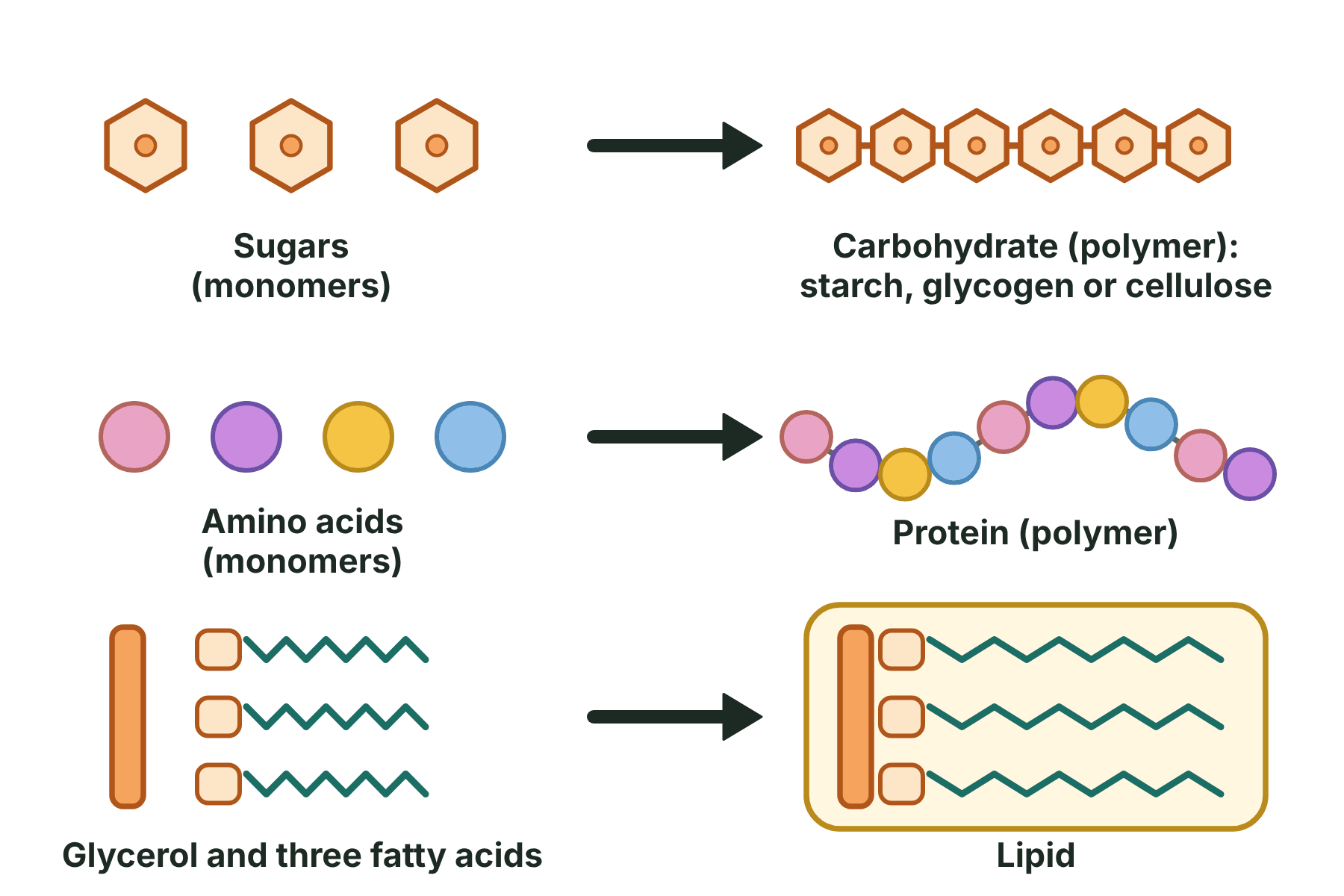
Monomers are joined to make polymers, and lipids are made from glycerol and fatty acids.
Carbohydrates are made from sugars
Sugars are the monomers of carbohydrates.
-
Synthesis
Sugar molecules, such as glucose, are joined in long chains to make starch, glycogen and cellulose.
-
Starch
Plants store glucose as starch.
-
Glycogen
Animals store glucose as glycogen, in the liver and the muscles.
-
Cellulose
Plants use cellulose to make strong cell walls.
-
Breakdown
Carbohydrase enzymes, such as amylase, break starch down into sugars. The sugars can be used in respiration or to make new carbohydrates.
Proteins are made from amino acids
Amino acids are the monomers of proteins.
-
Synthesis
Many amino acids are joined in a chain. There are about twenty different amino acids, and the order they are joined in decides the shape and the job of the protein.
-
What proteins do
They make enzymes, antibodies, many hormones, haemoglobin and the structure of muscle.
-
Breakdown
Protease enzymes break proteins down into amino acids.
-
Why it matters
The amino acids from the proteins you eat are joined again in a different order to make the proteins your own body needs.
Lipids are made from fatty acids and glycerol
A lipid is made from smaller molecules, though it is not a long chain of repeating monomers like a polymer.
-
Synthesis
One molecule of glycerol is joined to three molecules of fatty acids to make a lipid.
-
What lipids do
They store energy, insulate the body, and are part of cell membranes.
-
Breakdown
Lipase enzymes break lipids down into fatty acids and glycerol.
-
Why it matters
The fatty acids and glycerol can be released as an energy source, or joined again to make the lipids the body needs.
Building up and breaking down
Synthesis
- Small molecules are joined together
- Sugars make carbohydrates, amino acids make proteins, glycerol and fatty acids make lipids
- Controlled by enzymes
- Uses energy from respiration
Breakdown
- Large molecules are split into small ones
- Carbohydrates make sugars, proteins make amino acids, lipids make glycerol and fatty acids
- Controlled by enzymes, such as carbohydrase, protease and lipase
- Happens in digestion and inside cells
Testing for biological molecules
Simple chemical tests show which biological molecules are in a sample.
-
Sugars
Heat the sample with Benedict's reagent. It changes from blue to green, yellow, orange or brick-red.
-
Starch
Add iodine solution. It changes from orange-brown to blue-black.
-
Protein
Add biuret reagent. It changes from blue to purple.
-
Lipids
Shake the sample with ethanol, then pour it into water. A cloudy white emulsion shows lipid is present.
Case study
Digesting a slice of bread
Bread is rich in starch, and it also contains some protein. In the mouth, the enzyme amylase in saliva starts to break the starch polymer down into sugars. Later, protease enzymes in the stomach and small intestine break the protein down into amino acids. The sugars and the amino acids are small enough to be absorbed into the blood, and the cells then join them in new combinations to make the carbohydrates and proteins the body needs.
The big idea
Sugars, amino acids, fatty acids and glycerol are the small molecules that cells join together to make carbohydrates, proteins and lipids, and that enzymes release again when these molecules are broken down.
Biological molecules
Biological molecules
-
Carbohydrates
- polymers of sugars: starch
- glycogen
- cellulose
-
Proteins
- polymers of amino acids
-
Lipids
- one glycerol and three fatty acids
-
Synthesis
- joining small molecules
- using energy from respiration
-
Breakdown
- enzymes split the large molecules into small ones
Summary and exam focus
- A monomer is a small molecule that joins with others. A polymer is a large molecule made of many monomers.
- Sugars are the monomers that make carbohydrates such as starch, glycogen and cellulose.
- Amino acids are the monomers that make proteins.
- One glycerol and three fatty acids make a lipid.
- Enzymes break the large molecules down again, and enzyme-controlled synthesis uses energy from respiration.
- Benedict's reagent, iodine, biuret and the ethanol emulsion test show sugars, starch, protein and lipids.
Exam focus
Explain the importance of sugars, amino acids, fatty acids and glycerol in the body. (4 marks) (4 marks)
Pair each small molecule with the large one it makes: sugars with carbohydrates, amino acids with proteins, fatty acids and glycerol with lipids. Then say the same molecules are released when the large molecules are broken down.
Key terms
The words this lesson expects you to use. Each one is linked from the first place it appears above.
- Monomer
- A small molecule that can join with many others to make a polymer.
- Polymer
- A large molecule made of many monomers joined in a chain.
- Synthesis
- Building a larger molecule from smaller ones.
- Carbohydrate
- A molecule such as starch, glycogen or cellulose, made of sugar units.
- Protein
- A polymer made of amino acids.
- Lipid
- A molecule made of one glycerol and three fatty acids.
- Amino acid
- The monomer that is joined with others to make proteins.
- Glycogen
- The carbohydrate that animals use to store glucose.
You've finished the notes
Check your understanding
Test yourself while it is fresh. Start with the flashcards, then try the exam questions.
Something here looks wrong?
Tell us what and we will go and look. It goes to whoever writes these pages, nobody else, and we do not ask who you are — so there is nothing to sign and nothing comes back to you.