Exam questions · Biology · Respiration and Biological Molecules
Monomers and Polymers
- 7 exam questions
- 22 marks
- 8 quick checks
-
1 State [2 marks]
State what is meant by the terms monomer and polymer.
Show answerHide answer
Model answer
A monomer is a small molecule that can join with others. A polymer is a large molecule made of many monomers joined together.
Mark scheme
- Monomer: small molecule that joins with others — 1 mark
- Polymer: large molecule made of many monomers — 1 mark
-
2 Name [3 marks]
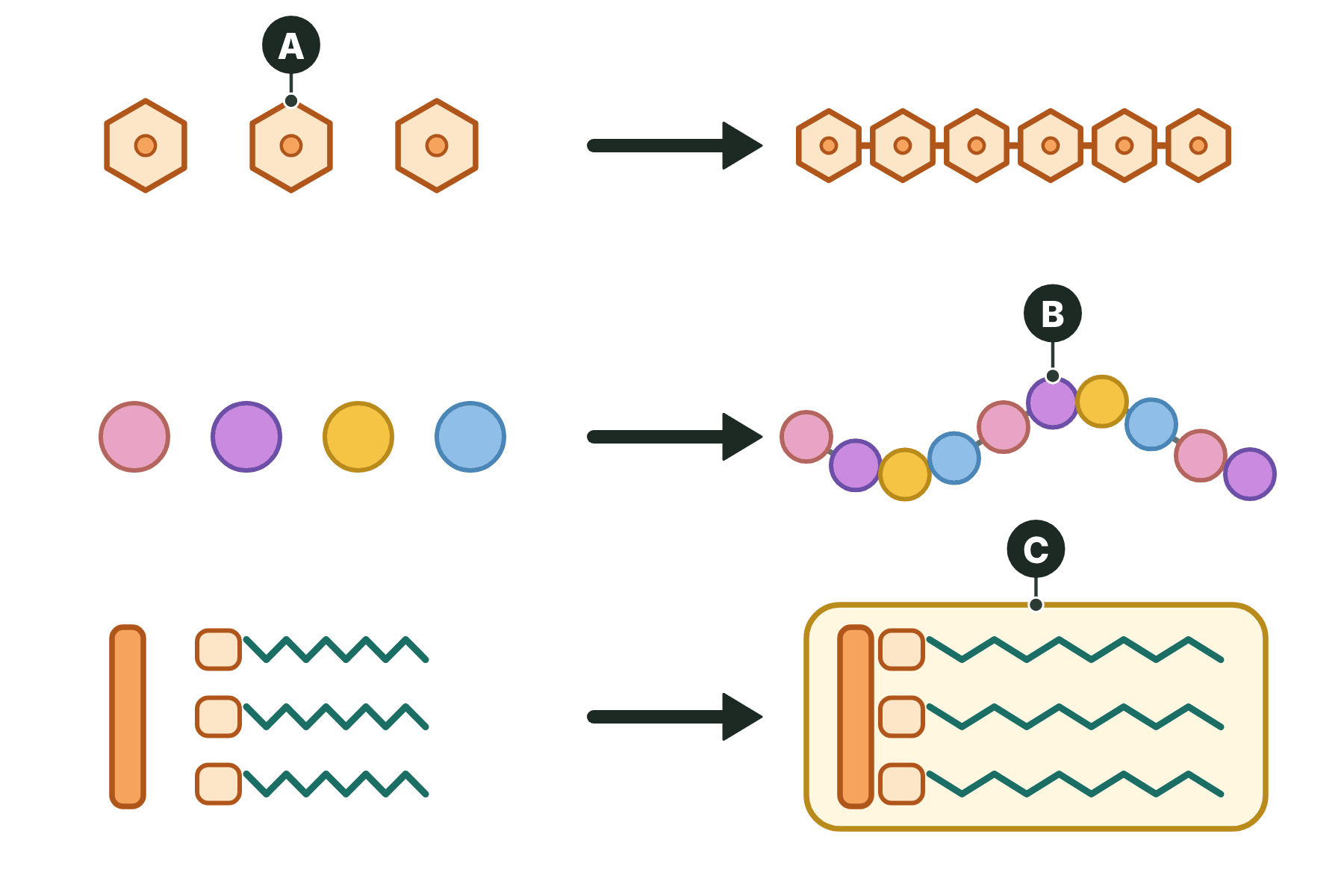
Figure 1 shows how large molecules are made from small ones. Name the molecules shown at A, B and C.
Show answerHide answer
Model answer
A is sugars (glucose). B is a protein. C is a lipid.
Mark scheme
- A: sugars / glucose — 1 mark
- B: protein — 1 mark
- C: lipid — 1 mark
-
3 State [3 marks]
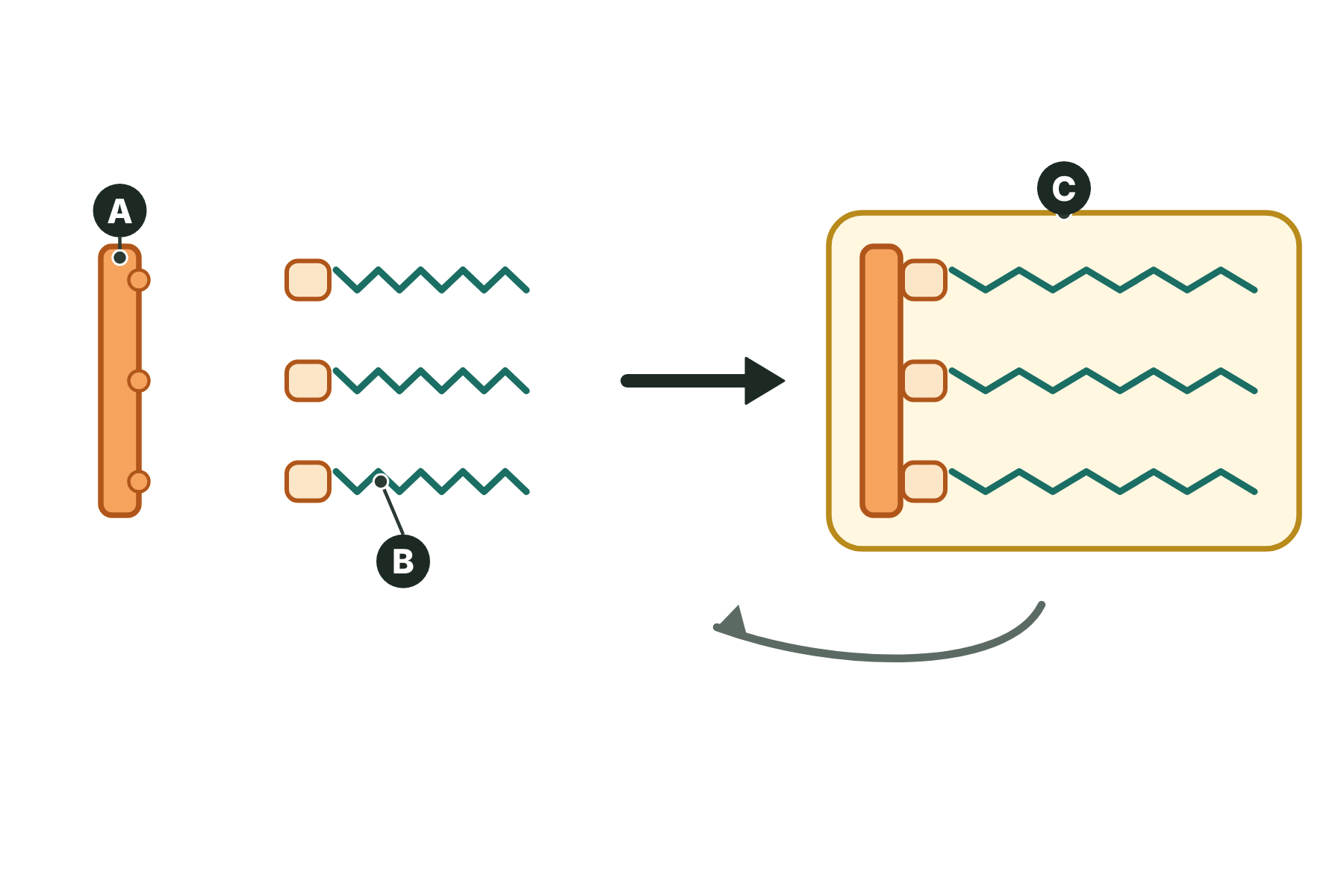
Figure 2 shows how a lipid molecule is made. Name the parts shown at A, B and C.
Show answerHide answer
Model answer
A is glycerol. B is a fatty acid. C is a lipid (molecule).
Mark scheme
- A: glycerol — 1 mark
- B: fatty acid — 1 mark
- C: lipid — 1 mark
-
4 Describe [3 marks]
Describe how proteins are made in a cell and how they are broken down.
Show answerHide answer
Model answer
Amino acids are joined together in a chain to make a protein. This needs energy from respiration and is controlled by enzymes. Protease enzymes break proteins down into amino acids.
Mark scheme
- Amino acids are joined to make proteins — 1 mark
- Uses energy / controlled by enzymes — 1 mark
- Protease breaks proteins down into amino acids — 1 mark
-
5 Explain [3 marks]
Explain why the starch in a slice of bread is broken down before the body can use it.
Show answerHide answer
Model answer
Starch is a polymer, a large molecule made of many sugars. It is too large to be absorbed. Amylase, a carbohydrase, breaks it down into sugars, which can be absorbed and used in respiration.
Mark scheme
- Starch is a large molecule / polymer — 1 mark
- Amylase breaks it down into sugars — 1 mark
- Sugars can be absorbed and used in respiration — 1 mark
-
6 Describe [4 marks]
Describe how you would test a food sample for starch, sugars, protein and lipids.
Show answerHide answer
Model answer
Starch: add iodine solution, which turns blue-black. Sugars: heat with Benedict's reagent, which turns green, yellow, orange or brick-red. Protein: add biuret reagent, which turns purple. Lipids: shake with ethanol, then add water, and a cloudy white emulsion forms.
Mark scheme
- Starch with iodine, blue-black — 1 mark
- Sugars with Benedict's reagent and heat — 1 mark
- Protein with biuret, purple — 1 mark
- Lipids with ethanol then water, cloudy emulsion — 1 mark
-
7 Explain [4 marks]
Explain the importance of sugars, amino acids, fatty acids and glycerol in the body.
Show answerHide answer
Model answer
Sugars are joined to make carbohydrates such as glycogen and starch. Amino acids are joined to make proteins. Fatty acids and glycerol are joined to make lipids. They are also released when the large molecules are broken down, so they can be used again or in respiration.
Mark scheme
- Sugars make carbohydrates — 1 mark
- Amino acids make proteins — 1 mark
- Fatty acids and glycerol make lipids — 1 mark
- They are released again when the molecules are broken down — 1 mark
Quick check
-
1
What are the monomers that make a protein?
Show answerHide answer
C: Amino acids
Proteins are polymers made of amino acids.
-
2
Which of these is a carbohydrate polymer used by plants to strengthen cell walls?
Show answerHide answer
B: Cellulose
Cellulose is made from sugars and strengthens plant cell walls.
-
3
What is a lipid made from?
Show answerHide answer
D: One glycerol and three fatty acids
A lipid is made from one molecule of glycerol and three molecules of fatty acids.
-
4
Which enzyme breaks down proteins?
Show answerHide answer
A: Protease
Protease breaks proteins down into amino acids.
-
5
What do animals use to store glucose?
Show answerHide answer
C: Glycogen
Animals store glucose as glycogen in the liver and muscles.
-
6
What is the colour change in the biuret test when protein is present?
Show answerHide answer
B: Blue to purple
Biuret reagent changes from blue to purple when protein is present.
-
7
What does the synthesis of polymers need?
Show answerHide answer
D: Enzymes and energy from respiration
Joining monomers is controlled by enzymes and uses energy from respiration.
-
8
Which pair of molecules is made when a lipid is broken down?
Show answerHide answer
A: Fatty acids and glycerol
Lipase breaks a lipid down into fatty acids and glycerol.