Biology · Communities in Ecosystems
Trophic Levels, Pyramids of Biomass and Efficiency
Energy and biomass flow through a community along food chains. This lesson is for separate Biology. It describes the trophic levels in a food chain, shows how pyramids of biomass are drawn, explains how biomass is lost between the levels, and shows how to calculate the efficiency of biomass transfers.
Learning Objectives
- 1Describe the differences between the trophic levels of organisms in an ecosystem, using the terms producer and consumer.
- 2Describe pyramids of biomass and explain, with examples, how biomass is lost between the trophic levels.
- 3Calculate the efficiency of biomass transfers between trophic levels.
- 4Explain how the efficiency of biomass transfers affects the number of trophic levels in a food chain.
Retrieval practice
-
1
What does an arrow in a food chain show?
Show answerHide answer
The direction in which biomass, and energy, is transferred, from the organism that is eaten to the one that eats it.
-
2
What is a producer?
Show answerHide answer
An organism, such as a plant, that makes its own food by photosynthesis.
-
3
What is respiration?
Show answerHide answer
The reaction that releases energy from glucose in all living cells.
-
4
What is biomass?
Show answerHide answer
The mass of living material.
Why are there so few lions?
A hectare of grassland can hold millions of blades of grass, thousands of insects, a few dozen rabbits and just one or two foxes. There is never a herd of lions for every herd of zebras. Each time one animal eats another, most of the biomass in the food is not passed on. This is why food chains are short, and why the numbers and the mass of living things fall at each step up a food chain.
Trophic levels
The feeding position of an organism in a food chain is called its trophic level.
-
Producers
Trophic level 1. Plants and algae make their own biomass by photosynthesis. They are the start of every food chain.
-
Primary consumers
Trophic level 2. Animals that eat the producers, such as caterpillars and rabbits. They are herbivores.
-
Secondary consumers
Trophic level 3. Animals that eat the primary consumers, such as a thrush that eats caterpillars. They are carnivores.
-
Tertiary consumers
Trophic level 4. Animals that eat the secondary consumers, such as a sparrowhawk that eats thrushes. The last consumer in a food chain is the top predator.
-
Decomposers
They break down the dead remains and waste at every level, and so return the materials to the soil.
A food chain with four trophic levels
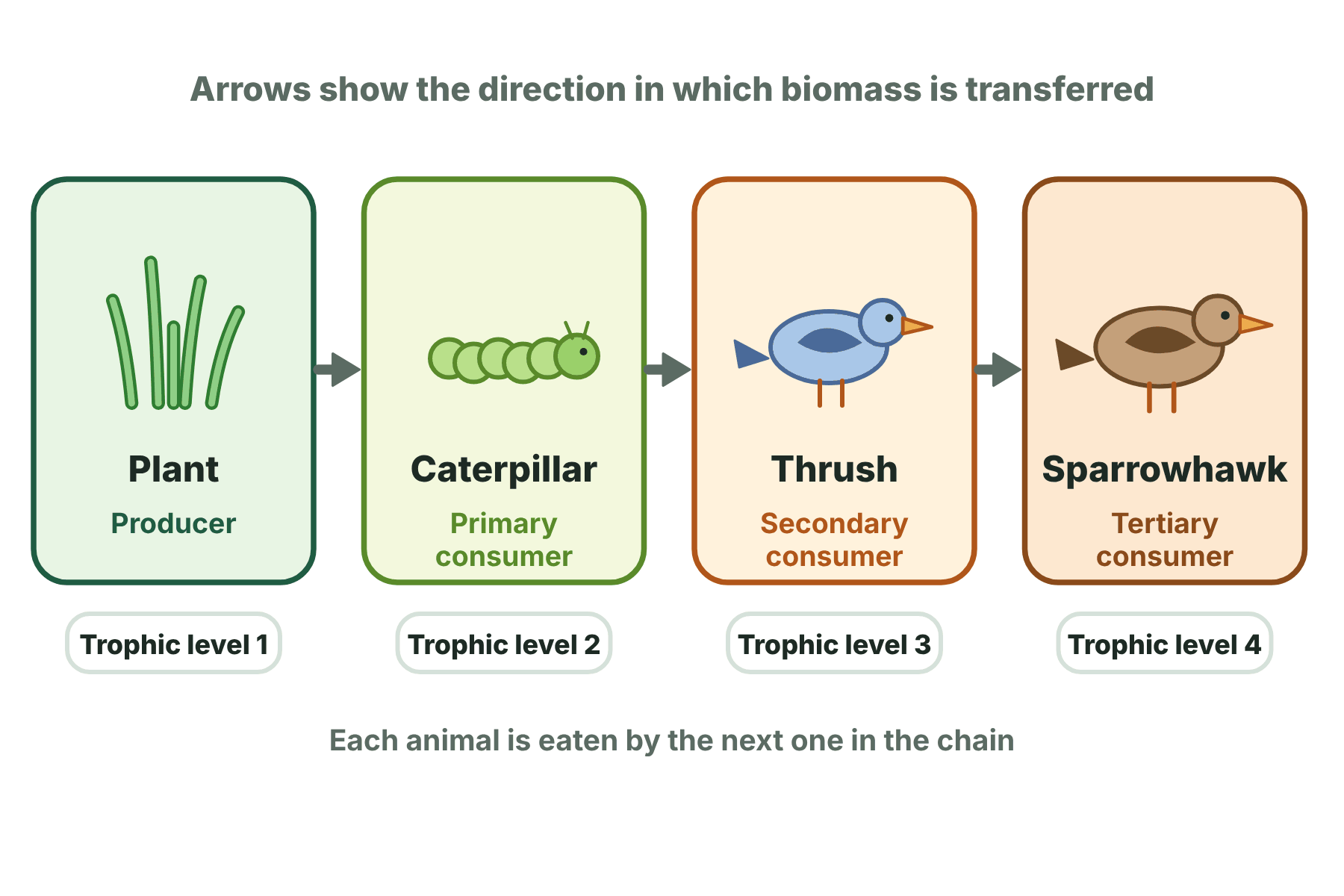
The arrows show the direction in which biomass is transferred.
Pyramids of biomass
A pyramid of biomass shows the mass of living material at each trophic level.
-
Drawing it
Each trophic level is a bar, with the producers at the bottom. The width of each bar is scaled to the dry mass of all the organisms at that level.
-
Biomass not numbers
Mass is used instead of numbers, because one oak tree is a single organism but has far more biomass than one aphid.
-
The shape
The pyramid gets narrower at each level, because there is less biomass at each step up the food chain.
-
Measuring
Samples of the organisms are dried and weighed, and the mass is given in units such as kilograms per hectare.
A pyramid of biomass
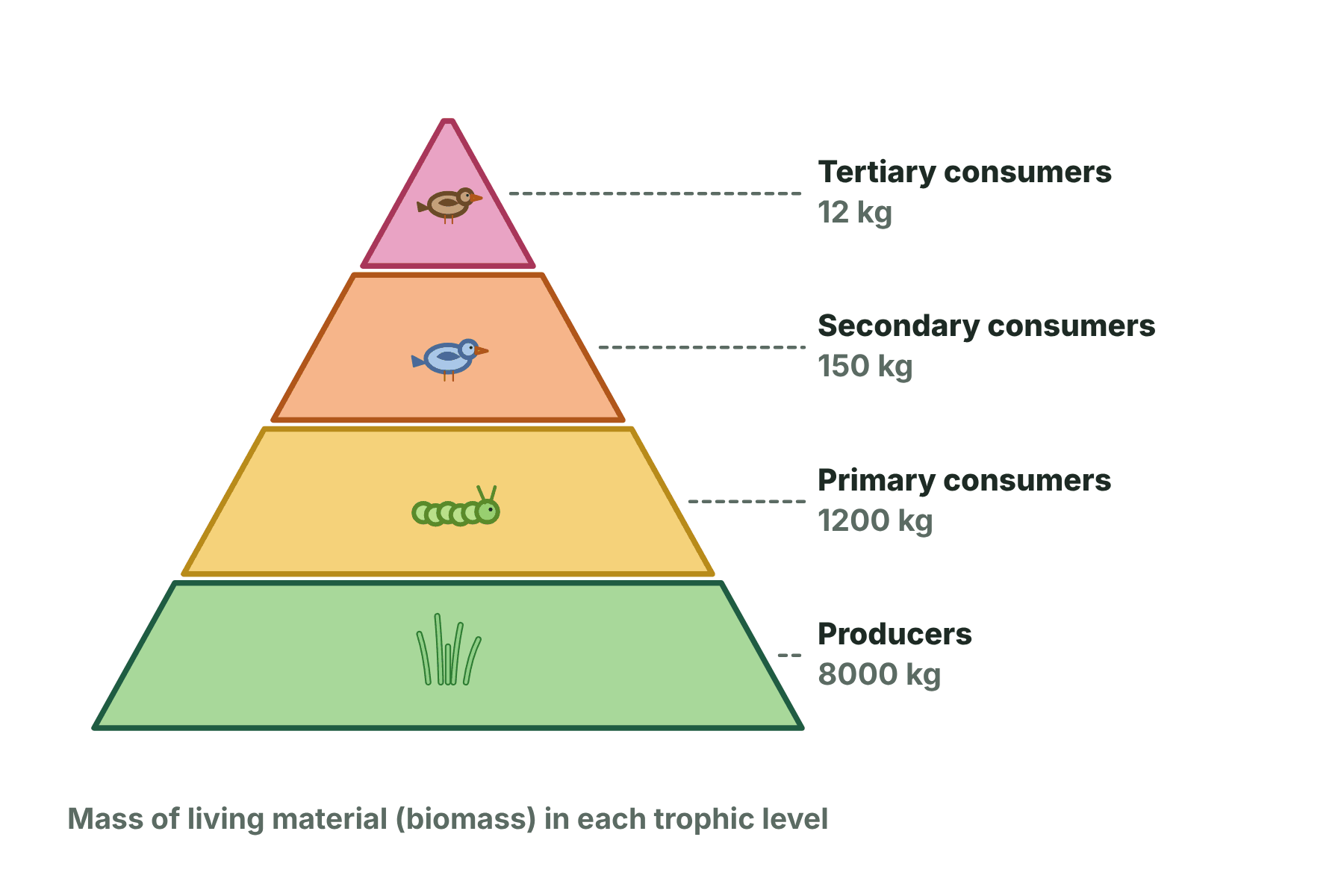
The biomass falls at each trophic level.
Why biomass is lost
Only a small part of the biomass at one level ends up in the next one. The rest is lost.
-
Not all is eaten
Some parts of the organism are not eaten, such as roots, bones, shells and fur, and some organisms are not eaten at all.
-
Egestion
Some of what is eaten is not digested, and is lost as faeces.
-
Excretion
Waste substances such as urea are lost in urine.
-
Respiration
Much of the glucose in food is used in respiration, to release energy for movement, keeping warm and growth. The carbon is lost as carbon dioxide, and some of the energy as heat.
-
Growth
Only the part that is used for growth becomes new biomass, and it is the only part that the next consumer can eat.
Where the biomass goes
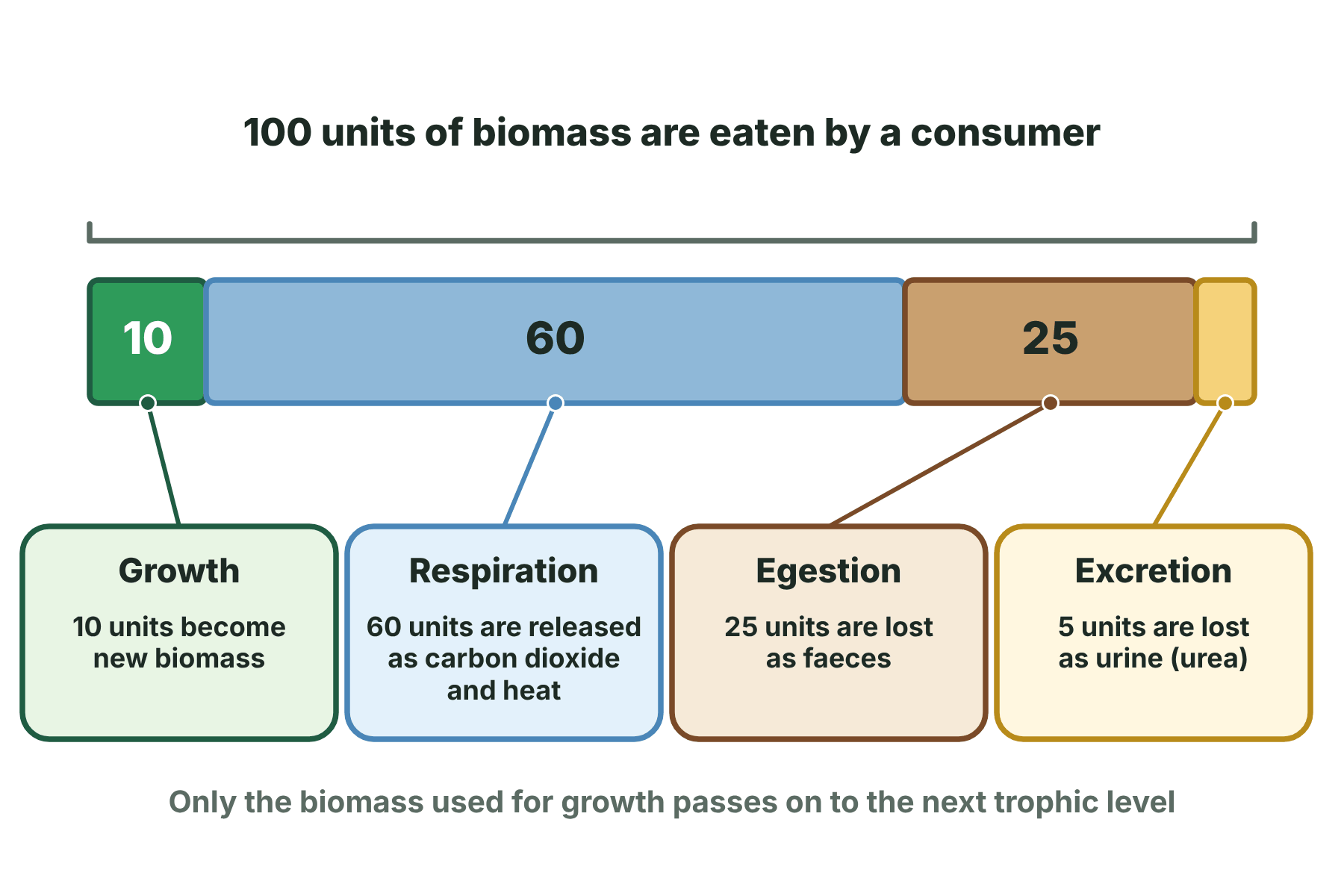
Most of the biomass that is eaten is lost, mainly by respiration.
Efficiency of biomass transfers
The efficiency of a biomass transfer shows how much of the biomass at one trophic level is passed on to the next.
-
The calculation
Efficiency = (biomass transferred to the next level ÷ biomass available at the previous level) × 100.
-
Typical values
The efficiency is usually only about 10 per cent, but varies between food chains.
-
Units
Use the same units for both masses. The efficiency is a percentage, so it has no units.
-
The number of trophic levels
Because so much biomass is lost at each step, there is very little left after four or five levels, so food chains are short.
-
People
Eating plants rather than animals uses fewer trophic levels, so more of the original biomass is used by people. That is why a field of wheat can feed more people than a field of cattle.
Calculating the efficiency of a biomass transfer
In a food chain there are 8000 kg of producers and 1200 kg of primary consumers. Calculate the efficiency of the biomass transfer from the producers to the primary consumers.
Show the solutionHide the solution
- 1 Write the formula \(\text{efficiency} = \frac{\text{biomass transferred}}{\text{biomass available}} \times 100\)
- 2 Put in the values \(\frac{1200}{8000} \times 100\)
- 3 Calculate \(= 15\%\)
AnswerThe efficiency is 15 per cent.
Eating plants and eating meat
Eating plants
- Short food chain
- Fewer trophic levels
- Less biomass lost
- More people can be fed from a field
Eating meat
- Longer food chain
- An extra trophic level
- More biomass lost by the animal
- Fewer people can be fed from a field
Case study
Wheat or beef?
A farmer has a field that can grow 10 tonnes of wheat. People can eat the wheat directly, so they are at the second trophic level. If the farmer feeds the wheat to cattle, and people eat the beef, the cattle use most of the biomass for respiration, movement and keeping warm, and only about 10 per cent becomes new cattle biomass. The field produces much less food for people as beef, so it feeds fewer people.
The big idea
Biomass falls at each trophic level because much of it is lost by respiration, egestion, excretion and parts that are not eaten, so the efficiency of each transfer is low, which is why food chains have only a few trophic levels.
Trophic levels and biomass
Trophic levels and biomass
-
Trophic levels
- producer
- primary
- secondary
- tertiary consumers
-
Pyramid of biomass
- mass of living material at each level
-
Biomass lost
- not eaten
- egestion
- excretion
- respiration
-
Efficiency
- biomass transferred divided by biomass available times 100
-
Result
- food chains are short
Summary and exam focus
- Producers are trophic level 1, and consumers are in the higher levels.
- A pyramid of biomass shows the mass of living material at each trophic level.
- Biomass is lost by parts not eaten, egestion, excretion and respiration.
- Efficiency = biomass transferred ÷ biomass available × 100, and is usually about 10 per cent.
- The loss of biomass limits the number of trophic levels in a food chain.
Exam focus
Explain why a food chain rarely has more than five trophic levels. (3 marks) (3 marks)
Say that biomass is lost at each trophic level, and give the ways that it is lost, such as respiration and egestion. Say that the efficiency of each transfer is low, so there is too little biomass left to support more animals.
Key terms
The words this lesson expects you to use. Each one is linked from the first place it appears above.
- Trophic level
- The position of an organism in a food chain.
- Producer
- An organism that makes its own food, such as a plant.
- Primary consumer
- An animal that eats producers.
- Secondary consumer
- An animal that eats primary consumers.
- Tertiary consumer
- An animal that eats secondary consumers.
- Pyramid of biomass
- A diagram that shows the mass of living material at each trophic level.
- Egestion
- The loss of undigested food as faeces.
- Efficiency
- The percentage of the biomass at one level that is transferred to the next.
You've finished the notes
Check your understanding
Test yourself while it is fresh. Start with the flashcards, then try the exam questions.
Something here looks wrong?
Tell us what and we will go and look. It goes to whoever writes these pages, nobody else, and we do not ask who you are — so there is nothing to sign and nothing comes back to you.