Exam questions · Biology · Communities in Ecosystems
Trophic Levels, Pyramids of Biomass and Efficiency
- 7 exam questions
- 21 marks
- 8 quick checks
-
1 Name [3 marks]
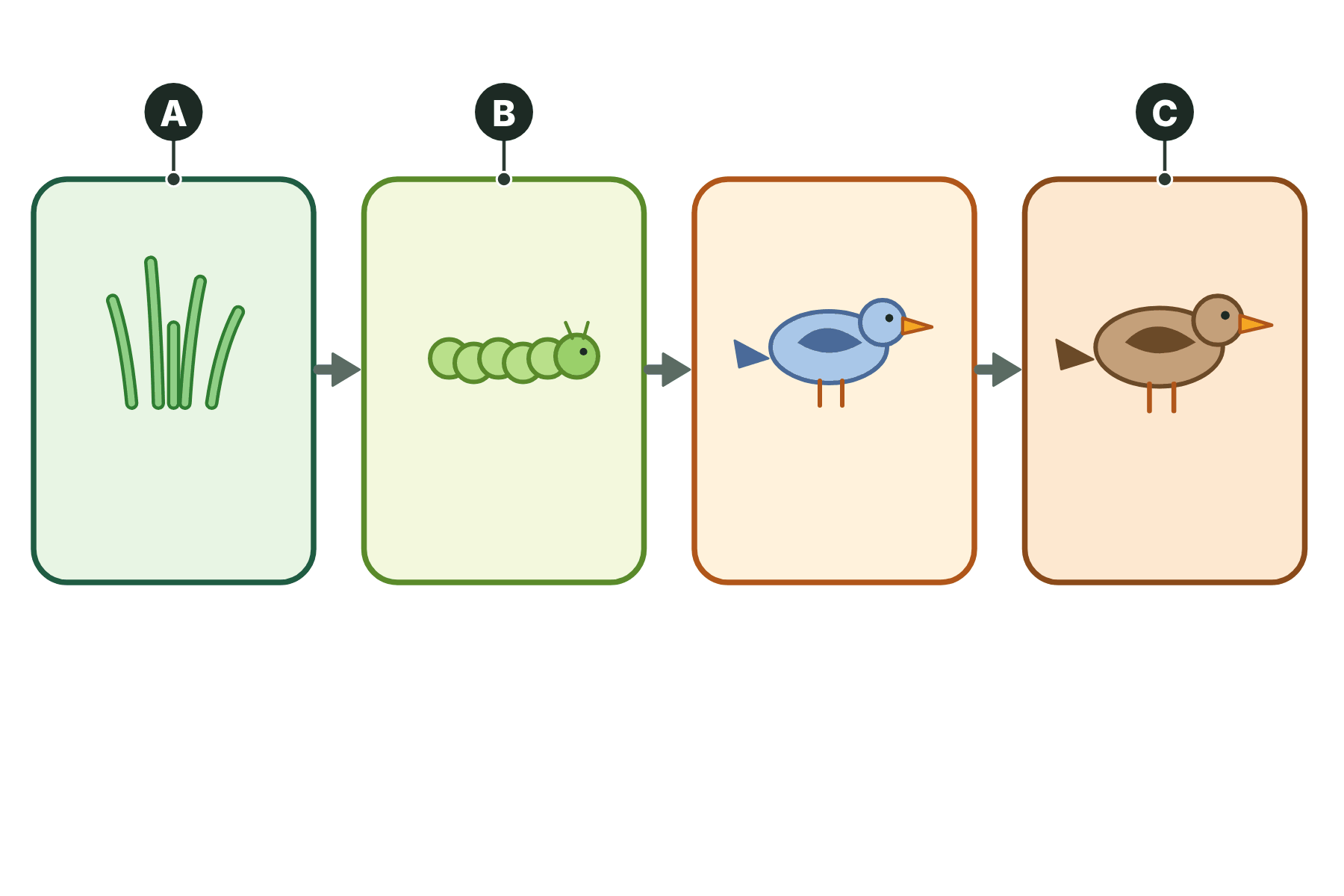
Figure 1 shows a food chain. Name the trophic levels shown at A, B and C.
Show answerHide answer
Model answer
A is the producer (trophic level 1). B is the primary consumer (trophic level 2). C is the tertiary consumer (trophic level 4).
Mark scheme
- A: producer — 1 mark
- B: primary consumer — 1 mark
- C: tertiary consumer — 1 mark
-
2 State [2 marks]
State what a pyramid of biomass shows, and why biomass is used instead of numbers.
Show answerHide answer
Model answer
A pyramid of biomass shows the mass of living material at each trophic level. Biomass is used because the numbers do not show the size of the organisms, as one large organism counts the same as one small one.
Mark scheme
- It shows the mass of living material at each trophic level — 1 mark
- Numbers do not show the size of the organisms — 1 mark
-
3 Explain [4 marks]
Explain why only about 10 per cent of the biomass at one trophic level is passed on to the next.
Show answerHide answer
Model answer
Some parts of the organism, such as bones and roots, are not eaten. Some of the food is not digested and is lost as faeces. Some biomass is lost as urea in urine. A lot of the glucose is used in respiration, which releases energy and carbon dioxide.
Mark scheme
- Some parts are not eaten — 1 mark
- Egestion as faeces — 1 mark
- Excretion of urea — 1 mark
- Respiration — 1 mark
-
4 Calculate [3 marks]
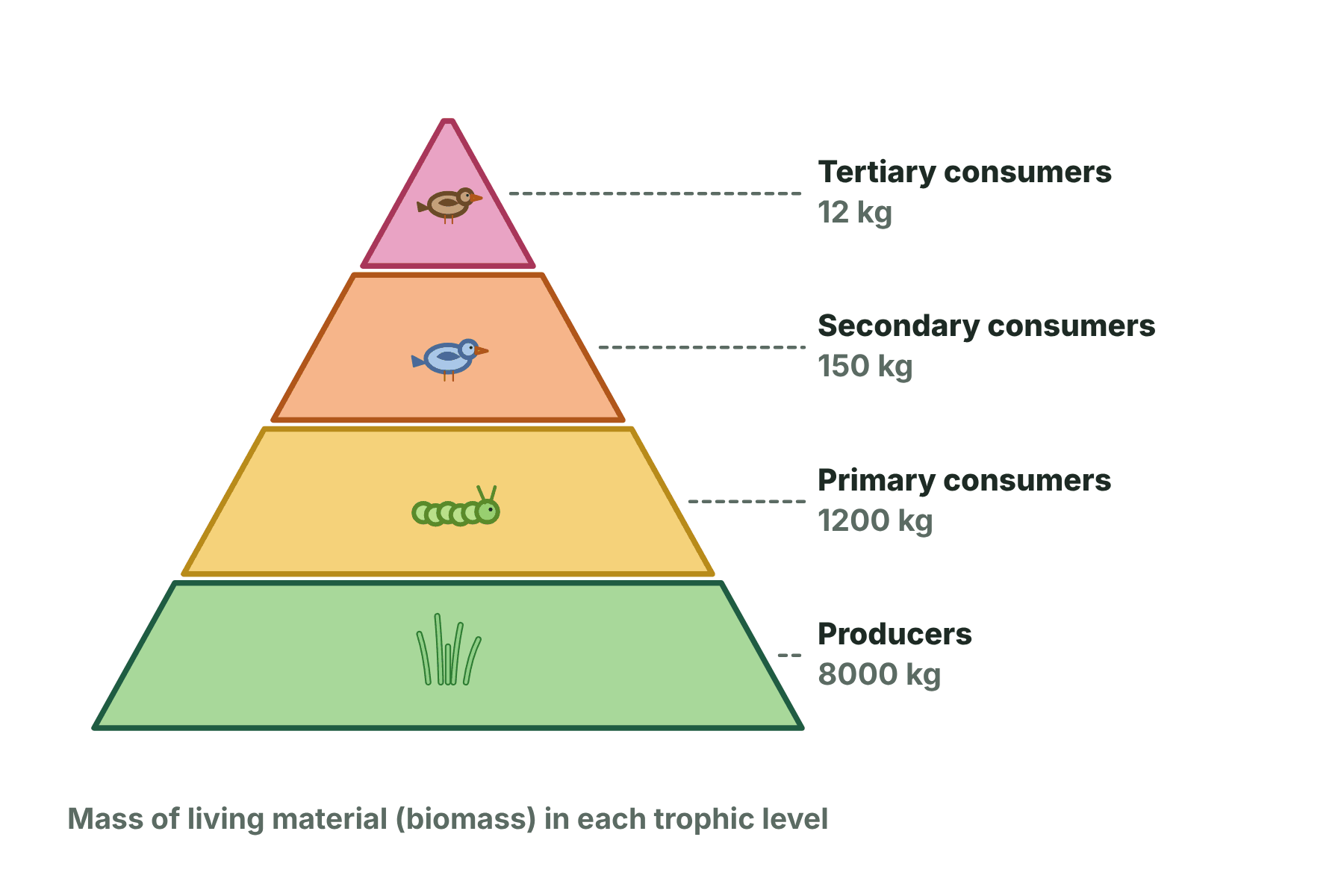
Use Figure 2 to calculate the efficiency of the biomass transfer from the primary consumers to the secondary consumers. Give your answer as a percentage.
Show answerHide answer
Model answer
The efficiency is 12.5 per cent.
Mark scheme
- \(\frac{150}{1200}\) — 1 mark
- \(\times 100\) — 1 mark
- 12.5% — 1 mark
-
5 Calculate [3 marks]
A herbivore eats 400 kg of grass. The herbivore gains 36 kg of biomass. Calculate the efficiency of the biomass transfer, and suggest where the rest of the biomass went.
Show answerHide answer
Model answer
The efficiency is 9 per cent. The rest was lost by egestion, excretion and respiration, and parts of the grass that were not eaten.
Mark scheme
- \(36 \div 400 \times 100\) — 1 mark
- 9% — 1 mark
- Lost by egestion, excretion, respiration — 1 mark
-
6 Explain [3 marks]
Explain why food chains rarely have more than five trophic levels.
Show answerHide answer
Model answer
Biomass is lost at each step, because of respiration, egestion and excretion. The efficiency of each transfer is low, about 10 per cent. After a few steps there is too little biomass left to support another trophic level.
Mark scheme
- Biomass is lost at each transfer — 1 mark
- The efficiency is low — 1 mark
- Too little biomass left to support another level — 1 mark
-
7 Explain [3 marks]
Explain why a field of wheat can provide food for more people than the same field used to raise cattle.
Show answerHide answer
Model answer
If people eat the wheat, there is one transfer from producer to consumer. If the wheat is fed to cattle first, there is another transfer, and a lot of biomass is lost by the cattle in respiration and in other ways. So less of the original biomass reaches people as beef.
Mark scheme
- Wheat has one transfer to people — 1 mark
- Cattle add another trophic level — 1 mark
- Cattle lose much biomass, so less reaches people — 1 mark
Quick check
-
1
Which organisms are at the first trophic level?
Show answerHide answer
A: Producers
Producers, such as plants, are at the first trophic level.
-
2
What is a secondary consumer?
Show answerHide answer
C: An animal that eats primary consumers
A secondary consumer eats primary consumers.
-
3
What does a pyramid of biomass show?
Show answerHide answer
B: The mass of living material at each trophic level
It shows the mass of living material at each trophic level.
-
4
Which of these is NOT a way that biomass is lost between trophic levels?
Show answerHide answer
D: Photosynthesis
Photosynthesis makes biomass; it does not lose it.
-
5
What is egestion?
Show answerHide answer
A: Loss of faeces
Egestion is the loss of undigested food as faeces.
-
6
A level has 500 kg of biomass and the next has 50 kg. What is the efficiency of the transfer?
Show answerHide answer
C: 10%
50 divided by 500 times 100 is 10 per cent.
-
7
Why are food chains short?
Show answerHide answer
B: Biomass is lost at each transfer
A lot of biomass is lost at each transfer, so there is too little at the top.
-
8
Why is eating plants more efficient than eating animals?
Show answerHide answer
D: There are fewer trophic levels, so less biomass is lost
Fewer trophic levels means less biomass is lost.