Biology · Communities in Ecosystems
Interdependence and Competition
No species lives alone. This lesson explains how living things depend on each other, through predation, mutualism and parasitism, how they compete for resources, and why interdependence matters for the stability of a community.
Learning Objectives
- 1Describe the importance of interdependence in a community, relating it to predation, mutualism and parasitism.
- 2Describe what living things compete for, and the importance of competition in a community.
- 3Explain how a change in one population can affect others in a community.
- 4Interpret graphs of predator and prey populations.
Retrieval practice
-
1
What is a community?
Show answerHide answer
All the populations of different species living in an area.
-
2
What is a food chain?
Show answerHide answer
A diagram that shows what eats what in a community.
-
3
What do plants compete for?
Show answerHide answer
Light, water, mineral ions and space.
-
4
What is a parasite?
Show answerHide answer
An organism that lives on or in another organism and feeds on it.
Living things need each other
A bee gets nectar from a flower and the flower gets pollinated. A fox eats a rabbit, and the rabbit eats grass. A tick feeds on the blood of a deer. In every ecosystem, species depend on each other for food, shelter, pollination and seed dispersal. This is interdependence, and it means that a change in one species can affect many others.
Interdependence
Species in a community are interdependent, which means each one depends on others.
-
Food
Animals depend on plants or other animals for food, and plants depend on animals for pollination and seed dispersal.
-
Shelter
Many animals use plants for shelter, such as birds nesting in trees.
-
Stable community
When all the species are present, the populations stay fairly steady. This is a stable community.
-
Removing a species
If one species is removed, the species that depend on it are affected, which can change the whole community.
Ways in which species depend on each other
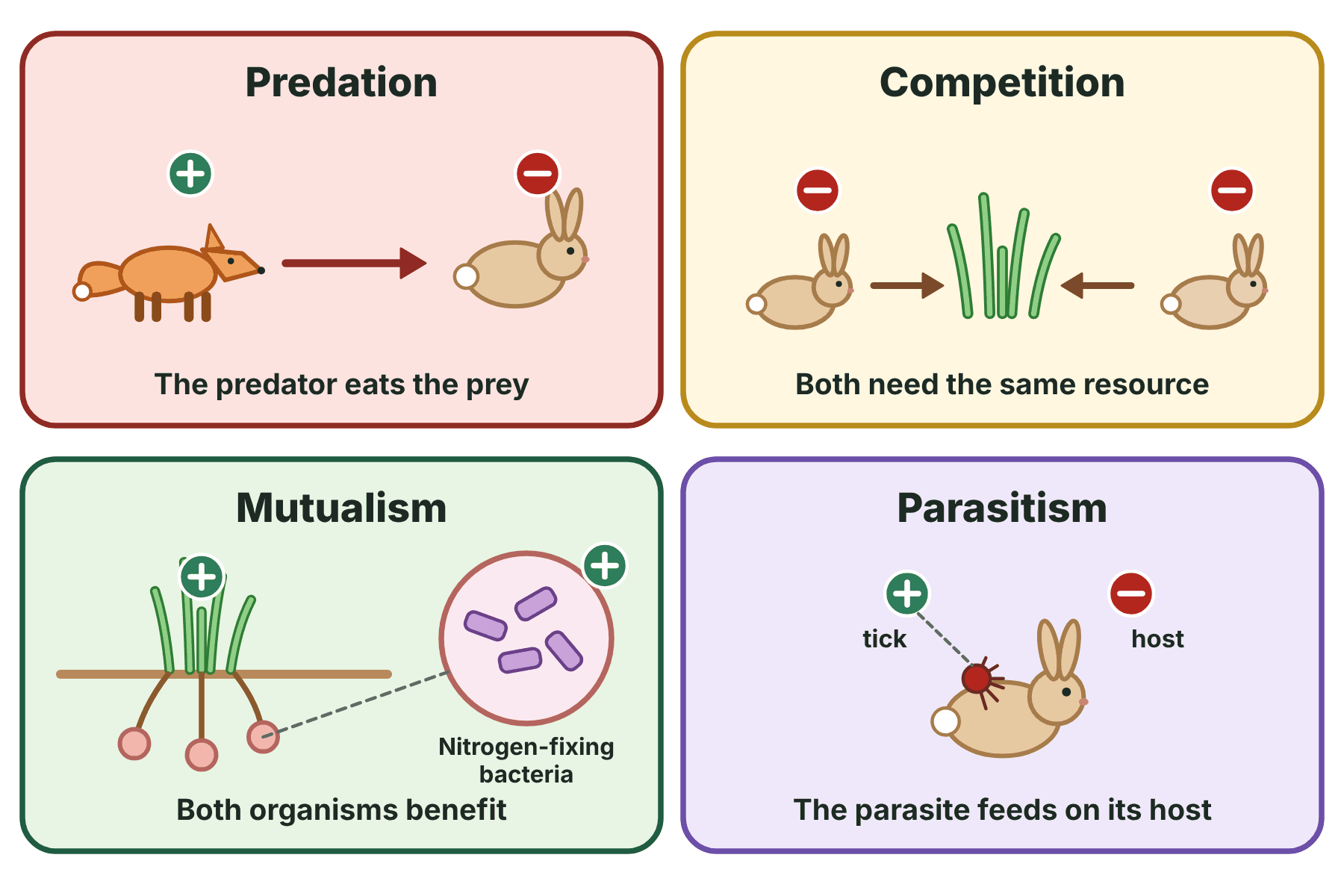
In predation and parasitism one species benefits and one is harmed, in mutualism both benefit, and in competition both are harmed.
Predation, mutualism and parasitism
There are three main ways in which two species can depend on each other.
-
Predation
A predator hunts and eats its prey. The predator benefits and the prey is harmed. Predators also help to keep the number of prey in balance.
-
Mutualism
Both organisms benefit. Nitrogen-fixing bacteria live in the root nodules of clover, peas and beans. The plant gives them sugars, and they give the plant nitrogen compounds. Another example is a cleaner fish that eats parasites from a larger fish.
-
Parasitism
A parasite lives on or in a host and feeds on it. The parasite benefits and the host is harmed. Examples are a tapeworm in a gut, a tick or a flea on an animal, and a mistletoe on a tree.
-
Pollination
Insects get food from flowers, and the flowers get pollinated, which is another example of mutualism.
Competition
Competition happens when two or more organisms need the same limited resource.
-
Plants compete for
Light, water, mineral ions and space.
-
Animals compete for
Food, water, mates, shelter and territory.
-
Within a species
Individuals of the same species compete with each other, because they need exactly the same things.
-
Between species
Different species compete if they need the same resource, such as red and grey squirrels.
-
The result
The organisms that are best adapted get more of the resource, so they survive and reproduce more. Competition limits the size of a population.
Interactions between two species
Predation and parasitism
- One species benefits
- The other is harmed
- A predator kills its prey
- A parasite usually keeps its host alive
Mutualism and competition
- Mutualism: both benefit
- Competition: both are harmed
- Mutualism helps both species to survive
- Competition limits the numbers of both
Predator and prey numbers
The populations of a predator and its prey often rise and fall together.
-
Prey increases
There is more food for the predators.
-
Predators increase
They eat more prey, so the prey population falls.
-
Prey decreases
Now there is less food, so the predators starve and their population falls.
-
The cycle repeats
With fewer predators, the prey can increase again. The predator peak comes after the prey peak.
A predator-prey graph
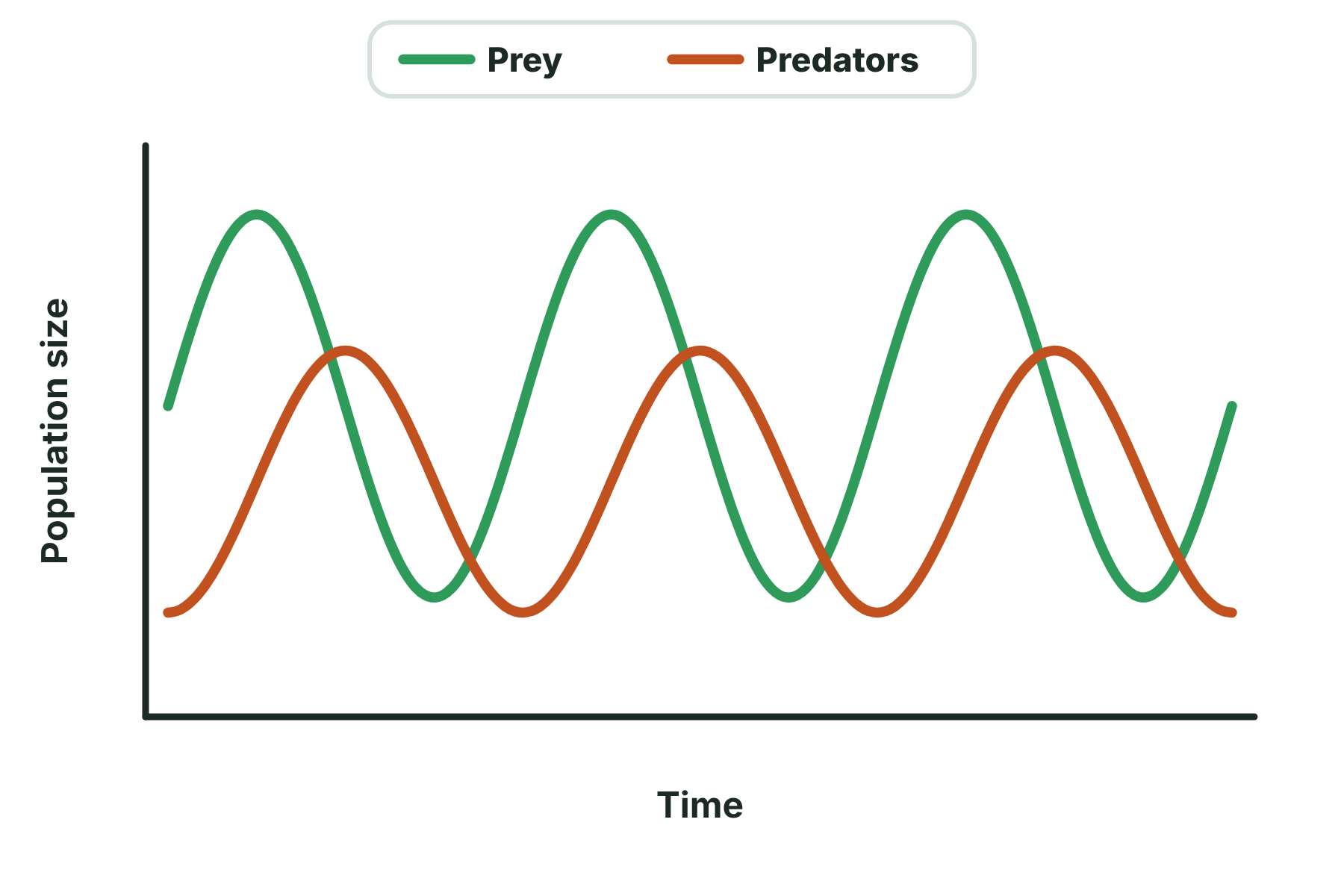
The predator peak follows the prey peak, because the predators need the prey for food.
Case study
Losing the wolves
In some places wolves were removed from a national park. The deer, which were no longer hunted, increased in number, and they ate so many young trees and shrubs along the rivers that other species lost their food and shelter. When the wolves were brought back, the number of deer fell and the plants recovered. The case shows how species depend on each other, and how removing one species can change the whole community.
The big idea
Species in a community are interdependent through predation, mutualism and parasitism, and they compete for limited resources, so a change in the population of one species can change the others.
Interdependence and competition
Interdependence and competition
-
Predation
- predator benefits
- prey harmed
-
Mutualism
- both organisms benefit
-
Parasitism
- parasite benefits
- host harmed
-
Competition
- both harmed
- for food, light, water, space
-
Stable community
- all the species keep the populations steady
Summary and exam focus
- Species depend on each other, which is called interdependence.
- In predation the predator benefits and the prey is harmed.
- In mutualism both species benefit, and in parasitism the parasite benefits and the host is harmed.
- Organisms compete for light, water, minerals and space, or food, mates and territory.
- Predator and prey populations rise and fall in cycles.
Exam focus
Describe what happens to the population of prey, and the population of predators, when a disease kills many of the predators. (3 marks) (3 marks)
Start with the immediate effect and then follow it through. Fewer predators means fewer prey are eaten, so the prey population increases. Then the extra food allows the predators to recover.
Key terms
The words this lesson expects you to use. Each one is linked from the first place it appears above.
- Interdependence
- The way in which species in a community depend on each other.
- Predation
- The hunting and eating of one animal by another.
- Mutualism
- An interaction in which both organisms benefit.
- Parasitism
- An interaction in which a parasite lives on or in a host and harms it.
- Competition
- The struggle between organisms for the same limited resource.
- Predator
- An animal that hunts and eats other animals.
- Prey
- An animal that is eaten by a predator.
- Stable community
- A community in which the populations stay fairly constant.
You've finished the notes
Check your understanding
Test yourself while it is fresh. Start with the flashcards, then try the exam questions.
Something here looks wrong?
Tell us what and we will go and look. It goes to whoever writes these pages, nobody else, and we do not ask who you are — so there is nothing to sign and nothing comes back to you.