Biology · Feeding the Human Race
Selective Breeding of Plants and Animals
Almost every plant and animal that we eat has been shaped by people choosing which individuals should breed. This lesson is for both Combined Science and separate Biology. It covers how selective breeding works generation by generation, the changes it has made to crops and farm animals, the problems of inbreeding and how to answer data questions about it.
Learning Objectives
- 1Describe the process of selective breeding, generation by generation.
- 2Explain how selective breeding has changed food plants and domesticated animals, using examples.
- 3Explain why inbreeding reduces variation and why this can harm a crop or a breed.
- 4Interpret and calculate from data on yields, using percentage change and rates.
Retrieval practice
-
1
What is variation?
Show answerHide answer
The differences between individuals of the same species.
-
2
What is an allele?
Show answerHide answer
A different version of the same gene.
-
3
Which process in nature selects the individuals best suited to their environment?
Show answerHide answer
Natural selection.
-
4
What is a domesticated animal?
Show answerHide answer
An animal that people keep and breed for a purpose, such as food, work or company.
People choose the parents
In nature the environment decides which individuals survive and breed. In selective breeding, which is also called artificial selection, people decide. They pick the plants or animals with the characteristics that they want, breed them together and then do the same with their offspring, generation after generation. Wheat, cows, hens and cabbages look nothing like their wild ancestors because of thousands of years of this process, and it is still how most new crop varieties and farm breeds are made.
The steps of selective breeding
The same five steps are repeated for many generations.
-
1
Decide on the characteristic
The breeder chooses a feature that is wanted, for example a high milk yield, large fruit or resistance to a disease.
-
2
Select the parents
From the population, the breeder chooses the individuals that show the characteristic most strongly.
-
3
Breed them
The selected parents are bred together, so that their offspring may inherit the alleles for the characteristic.
-
4
Select the best offspring
From the offspring, the breeder again chooses the individuals with the characteristic, and rejects the rest.
-
5
Repeat
Breeding and selecting are repeated over many generations, until the characteristic is very strong in the whole population.
Selective breeding over three generations
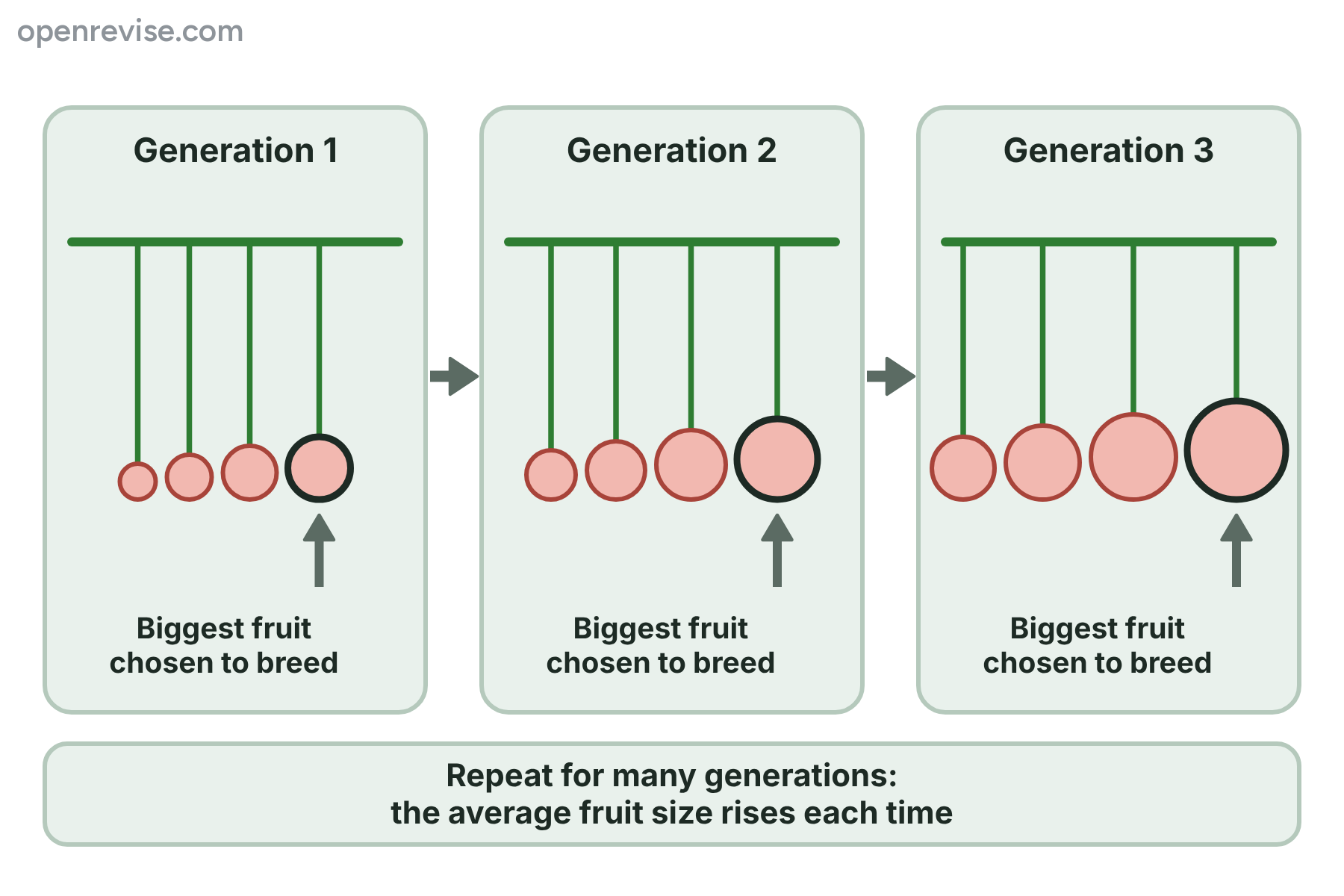
Choosing the biggest fruit to breed from each time makes the whole population produce larger fruit.
Selective breeding in plants
Plants are bred for features that raise the yield, improve the quality or help the crop to survive.
-
Higher yield
Wheat has been bred to produce more and bigger grains on each plant. Modern varieties also have short stems, so the plants do not fall over in the wind and rain and more of the energy goes into the grain.
-
Disease resistance
Breeders cross crops with plants that resist a disease and select the offspring that do not become infected, such as wheat that resists rust fungus or potatoes that resist blight.
-
Quality
Fruits have been bred to be larger, sweeter, seedless or longer lasting on the shelf, and crops are bred to have a uniform size so that they are easy to harvest.
-
Wild mustard
All of cabbage, broccoli, cauliflower, kale and kohlrabi come from one wild plant, the wild cabbage, because people selected different features: large leaves, flower heads, buds or swollen stems.
Selective breeding in animals
Farm animals are chosen for the products that people want and for features that make them easier to keep.
-
Dairy cattle
Cows that give a large volume of milk are bred together. The average milk yield of dairy cows has more than doubled in 60 years in some countries.
-
Beef cattle and sheep
Animals with more muscle and fast growth are chosen for meat, and sheep are chosen for the quality of their wool.
-
Chickens
Hens that lay many eggs have been bred for egg production, and different breeds have been selected for fast growth to produce meat.
-
Other features
Breeders also choose for resistance to disease, for fertility and for a calm temperament, because these reduce the cost of keeping the animals.
Case study
The Broadbalk wheat experiment
The Broadbalk experiment at Rothamsted in Hertfordshire has grown winter wheat on the same field since 1843, with different fertiliser treatments on different strips. The yields have risen a great deal, because of better fertilisers and because the wheat varieties planted have been selectively bred for high yield and short stems. It is the longest running field experiment in the world, and its records help scientists to separate the effect of the plant breeding from the effect of fertilisers and the weather.
Inbreeding and loss of variation
Selective breeding uses only a few of the available individuals, and that has a cost.
-
Inbreeding
This is the breeding of closely related individuals. In selective breeding a breeder often uses the same few best parents again and again, so the animals or plants in the population become closely related.
-
Less variation
The population ends up with fewer different alleles, so the individuals are very similar genetically. If the environment changes or a new disease arrives, there may be no individual with an allele that gives resistance.
-
Harmful alleles
Inbreeding makes it more likely that offspring inherit two copies of a harmful recessive allele, so inherited disorders become common. Many pedigree dogs suffer from joint, heart or breathing problems for this reason.
-
All at risk
A single variety of a crop grown over a large area is all equally open to the same pest or disease. Potato blight in Ireland in the 1840s destroyed most of the crop, because most farmers grew one type of potato from tubers, so almost all of the plants were equally open to the disease.
Selective breeding and natural selection
Selective breeding
- People choose the parents
- Chosen for the characteristics that people want
- Individuals that do not have them are not allowed to breed
- Does not always help the organism to survive
Natural selection
- The environment decides who survives and breeds
- Chosen because the characteristic helps survival
- Individuals that are less well adapted breed less
- Leads to adaptation to the environment
Impact: advantages and disadvantages
Questions often ask you to weigh up the effects of selective breeding.
-
Advantages
A higher yield of better quality food from the same land, faster growth, fewer losses to disease, and cheaper food, so it contributes to food security.
-
Disadvantages
It takes many generations and can only use alleles that are already present. A loss of variation makes the whole crop or breed vulnerable, and some features that were chosen are harmful to the animal.
-
Welfare
Fast growth in chickens can leave their legs unable to carry their weight, and very high milk yields can cause painful udder infections and lameness in cows.
-
Biodiversity
Farmers grow fewer varieties and breeds, and the older varieties that carry useful alleles may be lost.
Milk yield of a selectively bred herd
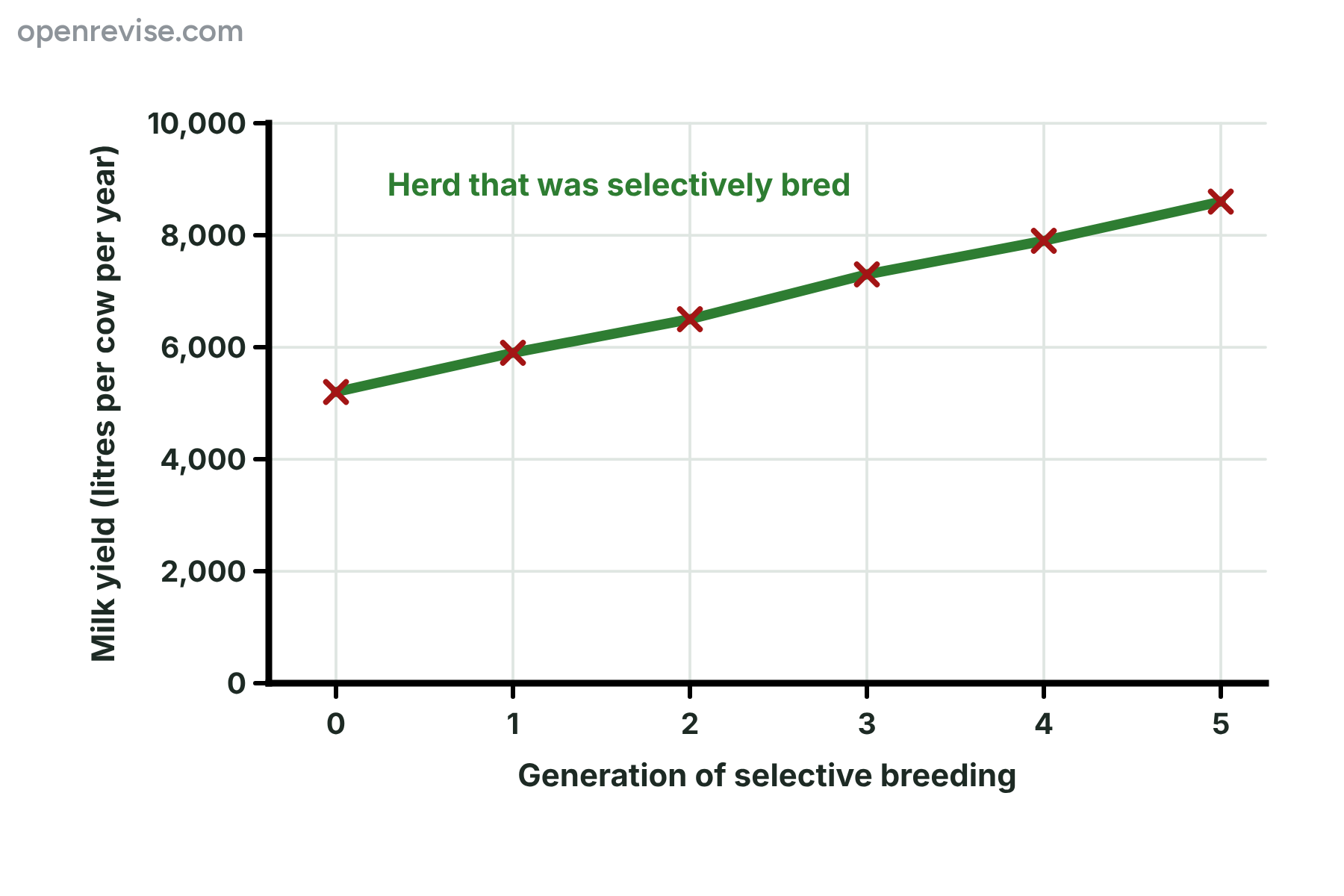
The mean milk yield rises every generation, because the highest yielding cows are chosen as parents.
Percentage increase in milk yield
Use the graph to calculate the percentage increase in the mean milk yield between generation 0 and generation 5.
Show the solutionHide the solution
- 1 Read the two values Generation 0: 5 200 litres; generation 5: 8 600 litres
- 2 Work out the increase \(8600 - 5200 = 3400\) litres
- 3 Divide by the starting value and multiply by 100 \(\frac{3400}{5200} \times 100 = 65.4\%\)
- 4 Round sensibly 65%
AnswerThe mean milk yield rose by about 65%.
The average rate of increase
Calculate the mean increase in milk yield per generation between generation 0 and generation 5.
Show the solutionHide the solution
- 1 Find the total change \(8600 - 5200 = 3400\) litres
- 2 Divide by the number of generations \(3400 \div 5 = 680\)
- 3 Give the unit 680 litres per cow per year, for each generation
AnswerThe mean milk yield rose by 680 litres per cow per year in each generation.
The big idea
Selective breeding changes a population in the direction that people choose, but every generation that uses only the best few individuals takes away some of the variation that the population needs to stay healthy.
Selective breeding
Selective breeding
-
Process
- choose parents
- breed
- select offspring
- repeat
-
Plants
- yield
- short stems
- disease resistance
- wild cabbage
-
Animals
- milk yield
- meat
- eggs
- temperament
-
Inbreeding
- less variation
- harmful alleles
- all vulnerable
-
Impact
- more food
- slow
- welfare
- fewer varieties
-
Data
- percentage change
- mean change per generation
Summary and exam focus
- Selective breeding is the process in which people choose the parents with the wanted characteristic, breed them and repeat the selection for many generations.
- It has produced crops with a higher yield and disease resistance, and animals with more milk, meat or eggs.
- Inbreeding reduces variation and makes harmful recessive alleles more likely to be inherited.
- With little variation, a new disease or a change in the environment can damage the whole crop or breed.
- Data on yields can be handled using percentage change and the mean change per generation.
Exam focus
Describe how a farmer could use selective breeding to produce a variety of wheat that is resistant to a fungal disease. (4 marks) (4 marks)
Write the steps in order and refer to the characteristic in the question: choose plants that resist the disease, breed them, select the resistant offspring and repeat for several generations. Mention that the process takes many generations, and do not say that the plants are given the gene, which is genetic engineering.
Key terms
The words this lesson expects you to use. Each one is linked from the first place it appears above.
- Selective breeding
- Choosing parents with wanted characteristics and breeding them over many generations; also called artificial selection.
- Artificial selection
- Selection by people, not by the environment, of which organisms will breed.
- Domesticated
- Kept and bred by people for food, work or company.
- Variation
- The differences between individuals of the same species.
- Allele
- A different version of the same gene.
- Inbreeding
- Breeding between closely related individuals.
- Yield
- The mass of a crop or of a product such as milk or eggs that is obtained from an area of land or an animal.
- Disease resistance
- The ability of an organism to avoid being infected by, or being harmed by, a pathogen.
- Inherited disorder
- A disease caused by an allele passed from parent to offspring.
You've finished the notes
Check your understanding
Test yourself while it is fresh. Start with the flashcards, then try the exam questions.
Something here looks wrong?
Tell us what and we will go and look. It goes to whoever writes these pages, nobody else, and we do not ask who you are — so there is nothing to sign and nothing comes back to you.