Biology · Monitoring and Maintaining the Environment
Human Interactions and Biodiversity
Humans are part of every ecosystem they live in, and what they do can destroy biodiversity or protect it. This lesson is for both Combined Science and separate Biology. It covers the negative effects of land use, deforestation, hunting, pollution and introduced species, and the positive effects of conservation, and how to interpret data on both.
Learning Objectives
- 1Describe positive and negative human interactions within ecosystems.
- 2Explain how land use, deforestation, hunting, pollution and introduced species reduce biodiversity.
- 3Describe how the conservation of individual species and of habitats helps to protect biodiversity.
- 4Interpret data on the impact of human activities on biodiversity.
Retrieval practice
-
1
What is biodiversity?
Show answerHide answer
The variety of living organisms in a habitat, or on Earth.
-
2
What is extinction?
Show answerHide answer
The permanent loss of a species, when no individuals are left alive.
-
3
What is a habitat?
Show answerHide answer
The place where an organism lives.
-
4
What does interdependence mean?
Show answerHide answer
Organisms in a community depend on each other, for example for food or shelter.
People and ecosystems
There are now more than eight billion people on Earth, and each of us needs food, water, space and energy. Almost every ecosystem has been changed by humans. Some of the changes harm living things and reduce biodiversity, and some protect and restore it. The OCR specification asks you to describe both the positive and the negative interactions, so it is not enough to learn only the damage. The important idea is that when a habitat is lost or a species is removed, other species that depend on it are lost too.
Land use and deforestation
Land is needed for housing, farming, roads and industry, and the habitat that was there is lost.
-
Habitat loss
Building on land, draining wetlands, quarrying and ploughing for crops destroy the habitats of the wild species that lived there. The species may die out, or move away and become more crowded elsewhere.
-
Farming
Hedgerows removed to make big fields, a single crop grown over a huge area (a monoculture) and the use of pesticides leave less food and shelter for wild plants and animals.
-
Deforestation
The clearing of forest, for timber and to make space for farms, plantations and roads. Tropical rainforests cover a small part of the land but hold more than half of all species, so their loss is a huge loss of biodiversity.
-
More effects of deforestation
Fewer trees take in less carbon dioxide, and burning the wood adds carbon dioxide, which contributes to climate change. Without roots the soil can be washed away, and rainfall patterns can change.
Land use and the number of species
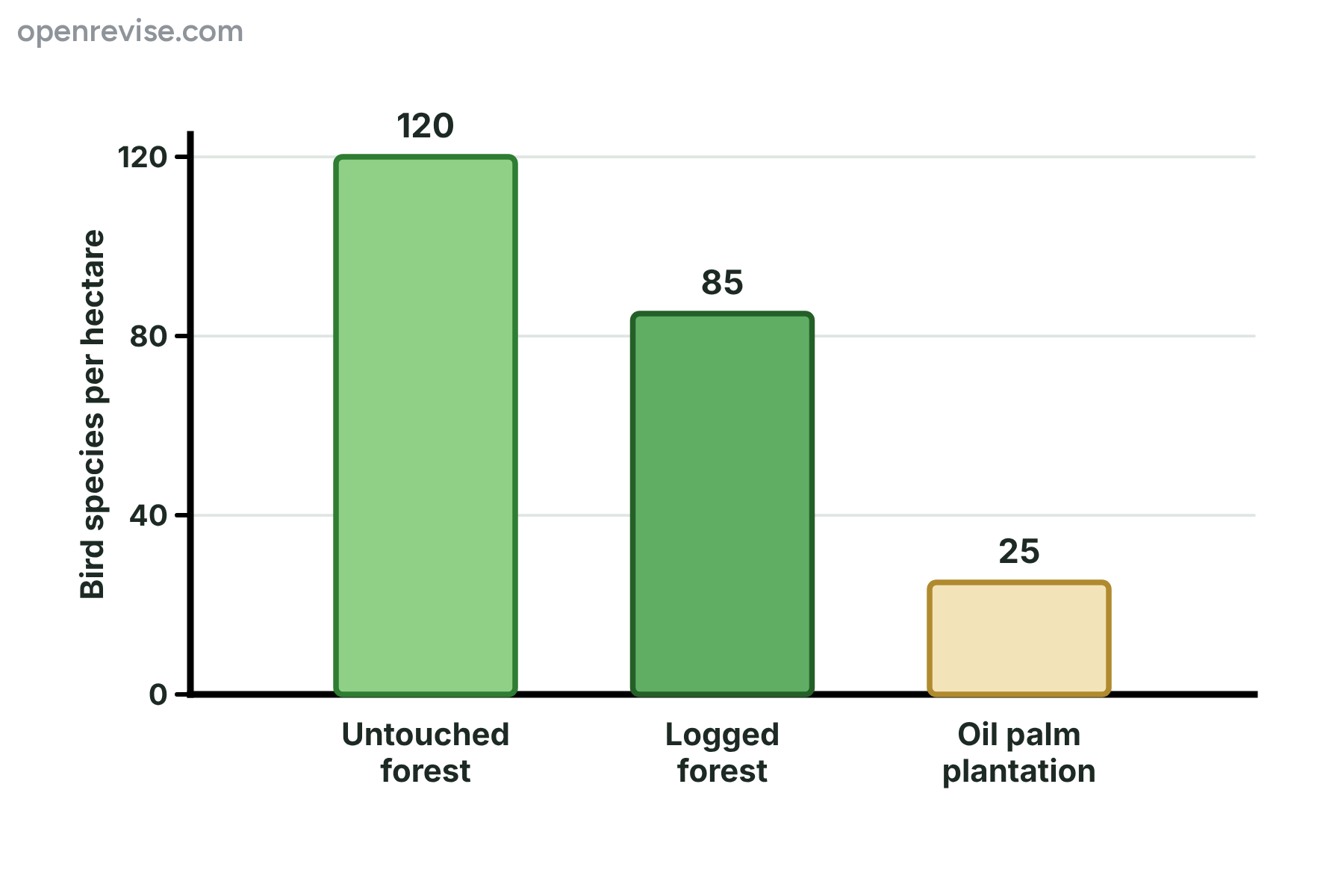
Example data: the more the forest is changed, the fewer species it supports.
A percentage decrease in biodiversity
In the bar chart, a hectare of untouched forest has 120 species of bird and a hectare of oil palm plantation has 25. Calculate the percentage decrease in the number of bird species.
Show the solutionHide the solution
- 1 Find the decrease \(120 - 25 = 95\) species
- 2 Divide by the original value \(\frac{95}{120} = 0.7917\)
- 3 Multiply by 100 \(0.7917 \times 100 = 79.2\)
- 4 Round About 79 per cent
AnswerThe number of species falls by about 79 per cent.
Hunting and overharvesting
When animals or plants are taken faster than they can reproduce, the population falls.
-
Hunting
The passenger pigeon was one of the commonest birds in North America, but it was hunted in huge numbers, and the last one died in 1914. Rhinoceroses and elephants are killed illegally for their horn and tusks.
-
Overfishing
Fish are caught faster than they can breed. The cod fishery off Newfoundland collapsed in the early 1990s, after decades of overfishing, and has still not fully recovered.
-
Collecting
Rare plants, such as orchids, and animals for the pet trade are collected from the wild.
-
Effect on communities
The loss of one species can harm others that eat it, or that it eats, because of interdependence.
Pollution
Pollution is the release of substances that harm living things into the air, the water or the land.
-
Water pollution
Fertiliser washed from fields and sewage cause eutrophication. Oil spills coat birds and mammals, and plastic is swallowed by marine animals.
-
Air pollution
Burning fossil fuels releases sulfur dioxide, which dissolves in rain to make acid rain, and which kills lichens and damages trees and the life in lakes.
-
Land pollution
Pesticides and other poisons build up along food chains. In the 1950s the insecticide DDT made the eggshells of birds of prey so thin that they broke, and the numbers of peregrine falcons fell sharply.
-
Indicator species
Some organisms are sensitive to pollution, and their presence or absence shows how polluted a place is. Lichens are sensitive to sulfur dioxide in the air.
How fertiliser pollutes a pond
Fertiliser is full of nitrates and phosphates, which plants need, and in a pond they cause a chain of events called eutrophication.
-
1
Fertiliser runs off
Rain washes fertiliser from fields into the pond, and the nutrients make algae grow very quickly, in an algal bloom.
-
2
Light is blocked
A thick layer of algae floats on the surface and blocks the light, so the pond plants below cannot photosynthesise and they die.
-
3
Decomposers multiply
Bacteria feed on the dead plants and algae, and they multiply, and use up oxygen in respiration.
-
4
Fish die
The amount of oxygen in the water falls so low that fish and other animals suffocate, and biodiversity falls.
Eutrophication in a pond
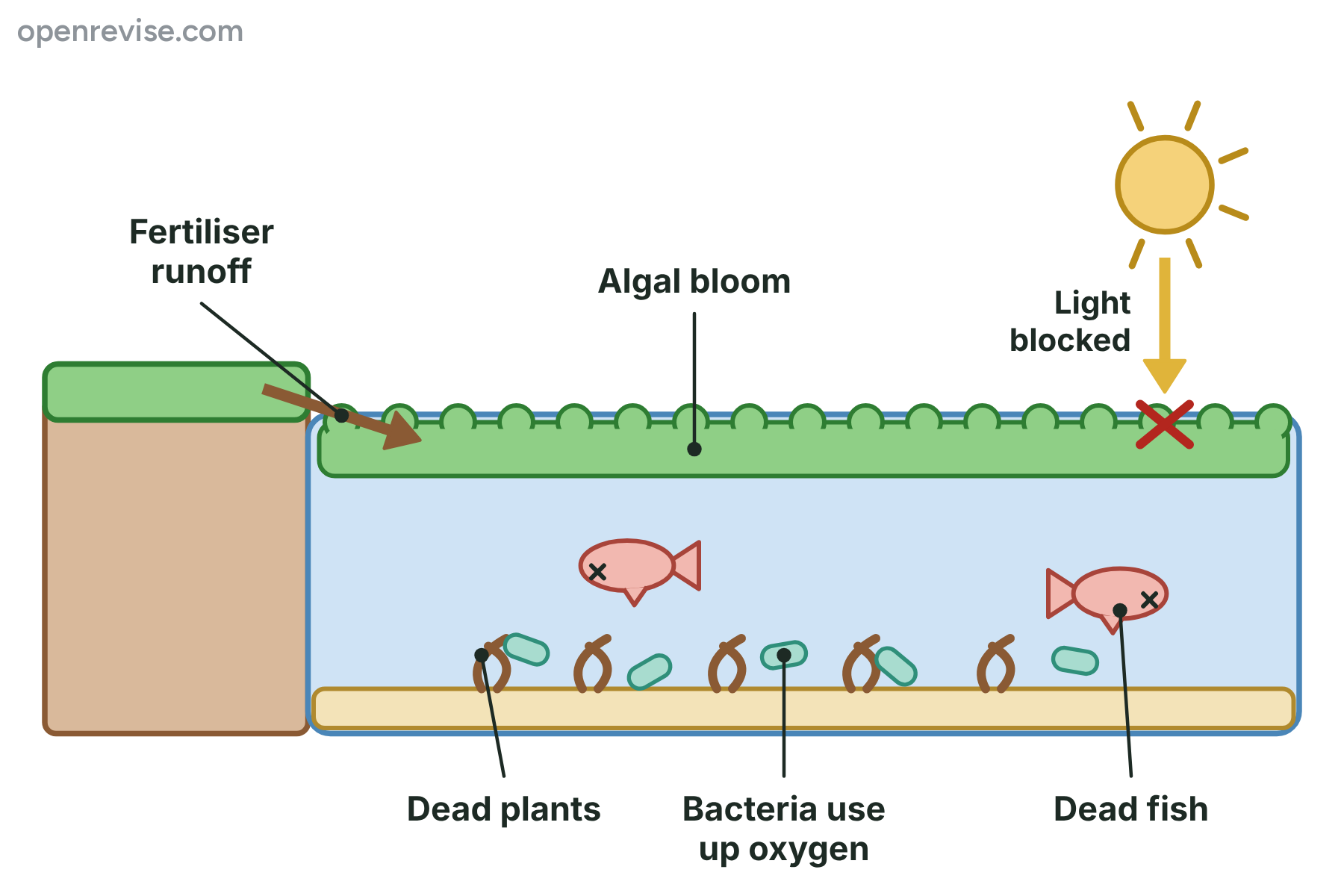
Too many nutrients lead to an algal bloom, and then to a lack of oxygen, which kills the fish.
Introduced species
A species that is brought by humans to a place where it did not live is called an introduced species. Some of them become a serious problem because they have no natural predators.
-
Predation
Rats, cats and stoats brought to islands by ships eat the eggs and young of birds that evolved without predators. The dodo on Mauritius became extinct this way.
-
Competition
The grey squirrel, brought from North America to Britain in the 1800s, eats more of the food and lives at higher densities than the red squirrel, which has declined.
-
Disease
The grey squirrel also carries the squirrelpox virus, which kills red squirrels but not greys.
-
Other examples
Himalayan balsam spreads along rivers and crowds out native plants, and the Nile perch put in Lake Victoria in the 1950s has driven many of the native fish to extinction.
Positive interactions: conservation
Conservation means protecting and managing species and habitats so that biodiversity is not lost.
-
Protected areas
National parks, nature reserves and marine protected areas are legally protected from building, hunting and fishing, so that species can live there safely.
-
Captive breeding and reintroduction
Rare animals are bred in zoos and safari parks and released back to the wild. The Arabian oryx was extinct in the wild by 1972, but it has been reintroduced to Oman and nearby countries.
-
Habitat restoration
Wetlands are restored, hedgerows and woodlands are planted, and meadows are managed for wildflowers. Wildlife corridors link fragments of habitat.
-
Laws and agreements
Laws limit hunting, fishing quotas protect fish stocks, the trade in endangered species is banned by an international agreement called CITES, and laws such as the Clean Air Acts cut pollution.
-
Sustainable use
Forests are replanted after being logged, and fish are caught with nets of a large mesh size so that the young escape. The resource is used without using it up.
Case study
The red kite in Britain
The red kite is a bird of prey that was once common across Britain, but it was shot and poisoned until by the 1930s only a few pairs were left, in Wales. It was protected by law and watched closely. From 1989 young kites from Sweden and Spain were released in England and Scotland, and the population grew from the released birds and the survivors. There are now several thousand pairs in Britain, which makes it one of the best-known conservation successes.
Negative and positive interactions
Negative interactions
- Habitat destruction by building, farming and deforestation
- Hunting and overfishing
- Pollution of water, air and land
- Introduced species that eat or out-compete native species
Positive interactions
- Nature reserves and national parks
- Captive breeding and reintroduction
- Habitat restoration and wildlife corridors
- Laws, quotas and sustainable use of resources
The big idea
Human actions can reduce biodiversity by destroying habitats, taking too many organisms, polluting and introducing species, but conservation can protect species and habitats and restore them.
Humans and biodiversity
Humans and biodiversity
-
Land use
- habitat loss
- farming
- deforestation
- fewer species
-
Hunting
- hunting
- overfishing
- extinction
- passenger pigeon
-
Pollution
- eutrophication
- acid rain
- DDT
- indicator species
-
Introduced species
- predation
- competition
- disease
- grey squirrel
-
Conservation
- reserves
- captive breeding
- restoration
- laws
- sustainable use
Summary and exam focus
- Land use, deforestation, hunting, pollution and introduced species are negative interactions that reduce biodiversity.
- Habitat loss is the main cause, because species that lose their habitat die out or must move.
- Fertiliser runoff causes eutrophication: algae, loss of light, decomposers using up oxygen and dead fish.
- Conservation includes nature reserves, captive breeding, habitat restoration, laws and sustainable use.
- Interdependence means that the loss of one species can lead to the loss of others.
Exam focus
Human activities can reduce biodiversity. Describe two ways in which humans have reduced biodiversity, and describe two ways in which humans protect it. (4 marks) (4 marks)
Make each point specific and add a short reason. For example, deforestation destroys the habitat so that species lose their food and shelter, and a nature reserve protects a habitat from building and hunting. A general statement such as "pollution is bad" earns no mark.
Key terms
The words this lesson expects you to use. Each one is linked from the first place it appears above.
- Biodiversity
- The variety of living organisms in a habitat, or on Earth.
- Deforestation
- The clearing of large areas of forest, usually to use the wood or the land.
- Overharvesting
- Taking animals or plants faster than they can reproduce.
- Pollution
- The release of substances that harm living things into the air, water or land.
- Eutrophication
- The growth of algae in water, caused by extra nutrients, which leads to a loss of oxygen and the death of animals.
- Introduced species
- A species brought by humans to a place where it did not live before.
- Conservation
- Protecting and managing species and habitats so that biodiversity is not lost.
- Captive breeding
- Breeding rare animals in zoos or reserves, so that they can be released into the wild.
- Sustainable
- Used in a way that does not use up or damage a resource, so it lasts for the future.
- Indicator species
- A species whose presence or absence shows the level of pollution or the quality of the environment.
You've finished the notes
Check your understanding
Test yourself while it is fresh. Start with the flashcards, then try the exam questions.
Something here looks wrong?
Tell us what and we will go and look. It goes to whoever writes these pages, nobody else, and we do not ask who you are — so there is nothing to sign and nothing comes back to you.