Biology · Monitoring and Maintaining the Environment
Estimating Population Size
How many woodlice live in a garden, or daisies on a playing field? Nobody can count them all, but you can estimate. This lesson is for both Combined Science and separate Biology. It covers scaling up from quadrat counts to a whole area, the capture-recapture method for animals that move, and the assumptions and errors in each.
Learning Objectives
- 1Calculate the size of a population by scaling up from the mean number of organisms in a quadrat.
- 2Describe the capture-recapture method, and use the equation to estimate the population size of a mobile animal.
- 3Explain the assumptions that are made in capture-recapture, and describe the sources of error in estimates.
- 4Evaluate how reliable an estimate of population size is, and suggest improvements.
Retrieval practice
-
1
What is a quadrat?
Show answerHide answer
A square frame that marks off a known area for sampling.
-
2
Why are quadrats placed at random?
Show answerHide answer
To avoid bias, so that the sample is representative of the area.
-
3
How do you calculate a mean?
Show answerHide answer
Add up the values and divide by the number of values.
-
4
What is abundance?
Show answerHide answer
The number of individuals of a species in an area.
An estimate, not a count
In the last lesson you found the mean number of organisms in a sample. The next step is to use that sample to estimate the whole population, which is all of the individuals of a species in the area. Plants and slow animals can be sampled with quadrats and the result scaled up. Animals that move about, such as beetles, mice or fish, cannot be caught in a quadrat, so a different method is needed, and it is called capture-recapture. Both give an estimate, and it is only as good as the sample behind it.
Scaling up from quadrat counts
The sample covers only a small fraction of the area, so the count is multiplied up by the number of times the sample area fits into the whole area.
-
Step 1: the mean
Count the organisms in each quadrat, add the counts and divide by the number of quadrats to find the mean number per quadrat.
-
Step 2: the areas
Find the area of one quadrat, such as \(0.5 \times 0.5 = 0.25\) m\(^2\), and the area of the whole habitat, such as 600 m\(^2\).
-
Step 3: how many quadrats fit
Divide the total area by the area of one quadrat to find how many quadrats would cover the whole habitat.
-
Step 4: scale up
Multiply the mean per quadrat by that number. The answer is the estimated population size.
Scaling up the number of daisies
A field has an area of 600 m\(^2\). A student placed ten 0.5 m by 0.5 m quadrats at random and found a mean of 5.0 daisies per quadrat. Estimate the number of daisies in the field.
Show the solutionHide the solution
- 1 Area of one quadrat \(0.5 \times 0.5 = 0.25\) m\(^2\)
- 2 Number of quadrats that fit in the field \(600 \div 0.25 = 2400\)
- 3 Multiply by the mean \(2400 \times 5.0 = 12\,000\)
- 4 State the estimate About 12 000 daisies in the field
AnswerThere are an estimated 12 000 daisies in the field.
Scaling up percentage cover
A student estimated that moss covered a mean of 24 per cent of the area of each quadrat on a lawn of 400 m\(^2\). Estimate the area of the lawn that is covered by moss.
Show the solutionHide the solution
- 1 Write the percentage as a fraction \(24\% = \frac{24}{100} = 0.24\)
- 2 Multiply by the total area \(0.24 \times 400 = 96\)
- 3 Give the unit 96 m\(^2\)
AnswerMoss covers about 96 m\(^2\) of the lawn.
Capture-recapture for animals that move
When animals move about, a quadrat count would be meaningless, so a sample of the animals is caught, marked and released, and a second sample is used to find out what fraction of the animals are marked.
-
Why it works
If the marked animals mix evenly with the rest, the fraction of marked animals in the second sample is the same as the fraction of marked animals in the whole population.
-
Equipment
Nets, pitfall traps or sweep nets to catch the animals, and a harmless way to mark them, such as a small dot of non-toxic paint on the underside of a snail's shell.
-
When it is used
For mobile animals such as insects, snails, fish, small mammals and birds.
-
The equation
The estimated population is the number in the first sample multiplied by the number in the second sample, divided by the number of marked animals in the second sample.
The capture-recapture method
Follow these steps in order.
-
1
First sample
Catch as many animals as you can in an area, for example with pitfall traps, and count them. Call this number M.
-
2
Mark and release
Mark each one in a way that will not harm it or make it easier to see, and release them back where they were found.
-
3
Wait
Leave enough time for the marked animals to mix with the rest of the population, for example a day.
-
4
Second sample
Catch another sample in the same way and count the total, n, and the number of those that are marked, m.
-
5
Calculate
Use the equation to estimate the size of the population.
The capture-recapture equation
Population size = (number in first sample × number in second sample) ÷ number of marked animals in the second sample.
Capture-recapture in three steps
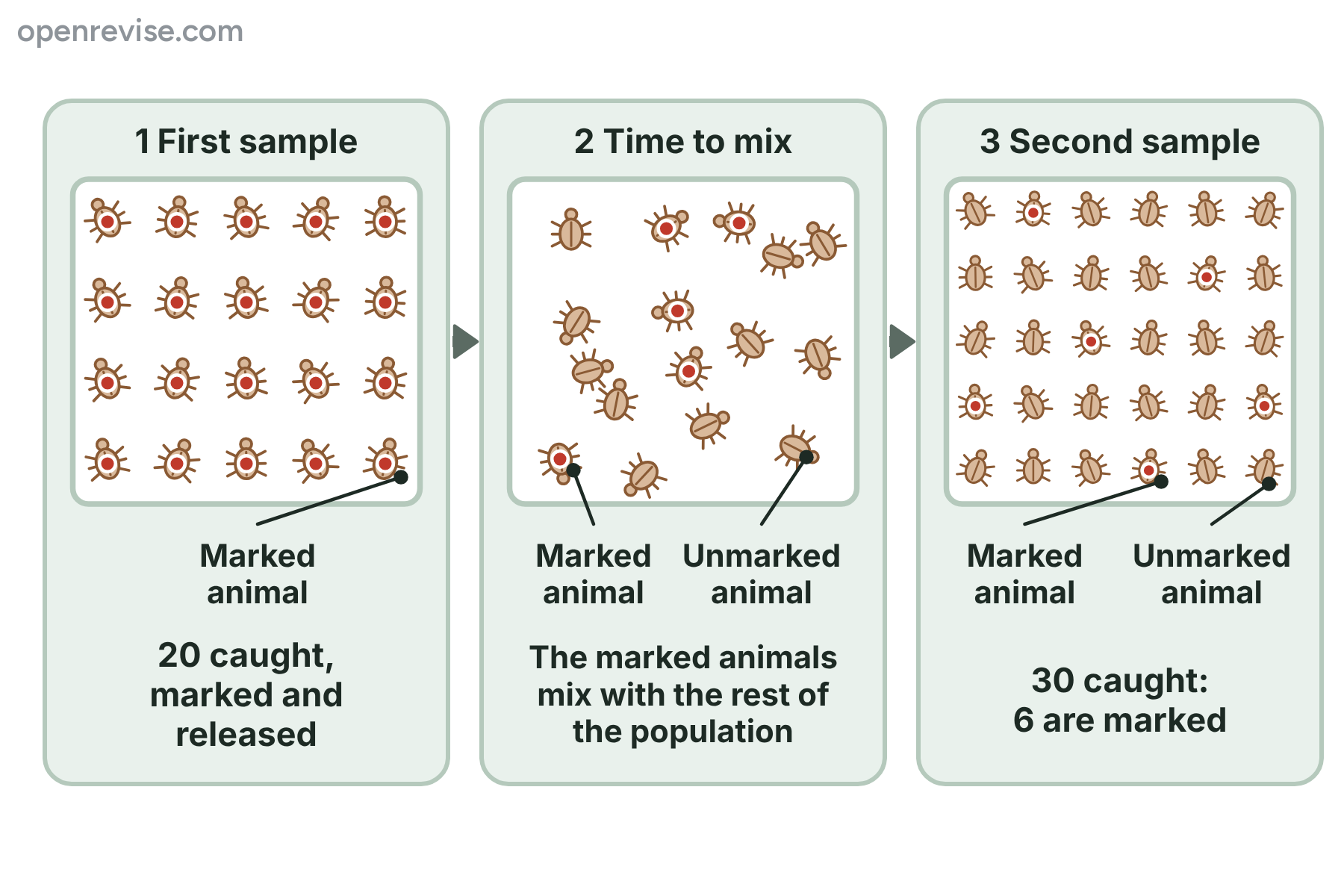
The fraction of marked animals in the second sample tells you how big the whole population is.
Estimating a population by capture-recapture
A student caught 20 beetles, marked them and released them. The next day she caught 30 beetles, of which 6 were marked. Estimate the number of beetles in the population.
Show the solutionHide the solution
- 1 Write down the values First sample \(M = 20\), second sample \(n = 30\), marked in the second sample \(m = 6\)
- 2 Write the equation \(\text{population} = \frac{M \times n}{m}\)
- 3 Substitute \(\frac{20 \times 30}{6} = \frac{600}{6}\)
- 4 Calculate \(= 100\) beetles
AnswerThe population is estimated at 100 beetles.
A second example with different numbers
Ecologists netted 45 fish in a lake, tagged them and returned them. A week later they netted 38 fish, and 9 of them had tags. Estimate the number of fish in the lake.
Show the solutionHide the solution
- 1 Values \(M = 45\), \(n = 38\), \(m = 9\)
- 2 Substitute \(\frac{45 \times 38}{9} = \frac{1710}{9}\)
- 3 Calculate \(= 190\) fish
AnswerThere are an estimated 190 fish in the lake.
Assumptions in capture-recapture
The equation gives a good estimate only if these things are true.
-
No change in numbers
No animals are born, die, move in or move out between the two samples, so the population stays the same.
-
Complete mixing
The marked animals mix evenly with the rest of the population, and the second sample is a random one.
-
The marking is harmless
The mark does not harm the animal, make it more visible to predators, or change whether it will be caught again.
-
Marks stay on
The mark does not rub or wash off between the samples.
-
Equal chance
Every animal, marked or not, has the same chance of being caught in the second sample.
Sources of error
Every estimate has uncertainty. Knowing where it comes from helps you judge it.
-
Quadrats: patchy habitat
If the organisms are patchy, the quadrats may land by chance on more patches or fewer patches than average, and scaling up magnifies the error.
-
Quadrats: counting
Different people count differently, and plants on the edge of the quadrat may be counted twice or not at all.
-
Capture-recapture: small samples
If the samples are small, one animal more or fewer in the second sample changes the estimate a lot.
-
Capture-recapture: marks
If marks rub off, fewer marked animals are found and the population is overestimated. If animals avoid traps they have been caught in, or are more easily eaten when marked, the estimate is also wrong.
-
Reducing error
Use more quadrats or larger samples, repeat the investigation and take the mean, and check that the assumptions are met.
Which method to use?
Scaling up from quadrats
- For plants and animals that do not move, such as snails or limpets
- Quadrats are placed at random
- Population = mean per quadrat × number of quadrats that fit in the area
- Error is greatest if the organisms are patchy
Capture-recapture
- For animals that move about
- Animals are caught, marked, released and caught again
- Population = first sample × second sample ÷ marked in second sample
- Error is greatest if samples are small or marks come off
Case study
Counting fish in a lake
Scientists who manage fisheries cannot count the fish in a lake, so they use capture-recapture. They catch fish in nets, attach small numbered tags and release them. Later samples show what fraction of the fish carry tags, which gives an estimate of the number of fish. The tags also show how far the fish move and how fast they grow. The estimate is used to decide how many fish can be caught each year without making the population fall, so that the fishery is sustainable.
Estimating population size
Estimating population size
-
Quadrats
- random sampling
- find the mean
- scale up by area
-
Capture-recapture
- catch, mark and release
- recapture
- M times n divided by m
-
Assumptions
- no births, deaths or movement
- marks harmless and stay on
- mixing
-
Errors
- patchy habitat
- small samples
- marks lost
- counting mistakes
-
Improve
- more samples
- repeat
- check assumptions
Summary and exam focus
- To scale up from quadrats, multiply the mean per quadrat by the number of quadrats that would fit in the whole area.
- Capture-recapture is used for mobile animals: catch, mark and release, wait, catch again, and count how many are marked.
- The population is the number in the first sample times the number in the second sample, divided by the number of marked animals in the second sample.
- It is accurate only if there are no births, deaths or movements, the marks are harmless and stay on, and the animals mix evenly.
- Larger samples and repeats reduce the error, but an estimate is never exact.
Exam focus
A student caught 40 woodlice, marked them and released them. The next day she caught 50 woodlice, and 5 were marked. Calculate an estimate of the population, and state two assumptions that she made. (4 marks) (4 marks)
Write the equation and then substitute, as the marks are for the method. The answer is 40 times 50 divided by 5, which is 400. Then give two assumptions, in a sentence each, such as that the marked woodlice mixed evenly and that none were born, died or moved in or out.
Key terms
The words this lesson expects you to use. Each one is linked from the first place it appears above.
- Population size
- The number of individuals of a species living in an area.
- Estimate
- An approximate value, found by calculation from a sample.
- Scaling up
- Using the mean of a sample to calculate the total for a whole area.
- Capture-recapture
- A method for estimating the size of an animal population by catching, marking, releasing and catching again.
- Marked
- Given a harmless mark so that the animal can be recognised if it is caught again.
- Assumption
- Something that has to be true for a method to give a valid result.
- Percentage cover
- An estimate of the percentage of the ground in a quadrat that is covered by a species.
- Reliable
- Giving similar results when repeated, so that the result can be trusted.
- Sustainable
- Used in a way that does not use up or damage the resource for the future.
You've finished the notes
Check your understanding
Test yourself while it is fresh. Start with the flashcards, then try the exam questions.
Something here looks wrong?
Tell us what and we will go and look. It goes to whoever writes these pages, nobody else, and we do not ask who you are — so there is nothing to sign and nothing comes back to you.