Exam questions · Biology · Monitoring and Maintaining the Environment
Human Interactions and Biodiversity
- 8 exam questions
- 24 marks
- 8 quick checks
-
1 State [1 mark]
State what is meant by biodiversity.
Show answerHide answer
Model answer
The variety of living organisms in a habitat, or on Earth.
Mark scheme
- The variety of living organisms (species) in an area — 1 mark
-
2 Explain [3 marks]
Explain how deforestation can reduce biodiversity.
Show answerHide answer
Model answer
Deforestation destroys the habitat of the species that live in the forest, so they lose their food and shelter and may die out. Other species that depend on them, for example as food, are also lost because of interdependence. Fewer species are left, so the biodiversity falls.
Mark scheme
- The habitat is destroyed, so organisms lose their food and shelter — 1 mark
- Species die out or move away — 1 mark
- Interdependent species are also lost, so biodiversity falls — 1 mark
-
3 Calculate [2 marks]
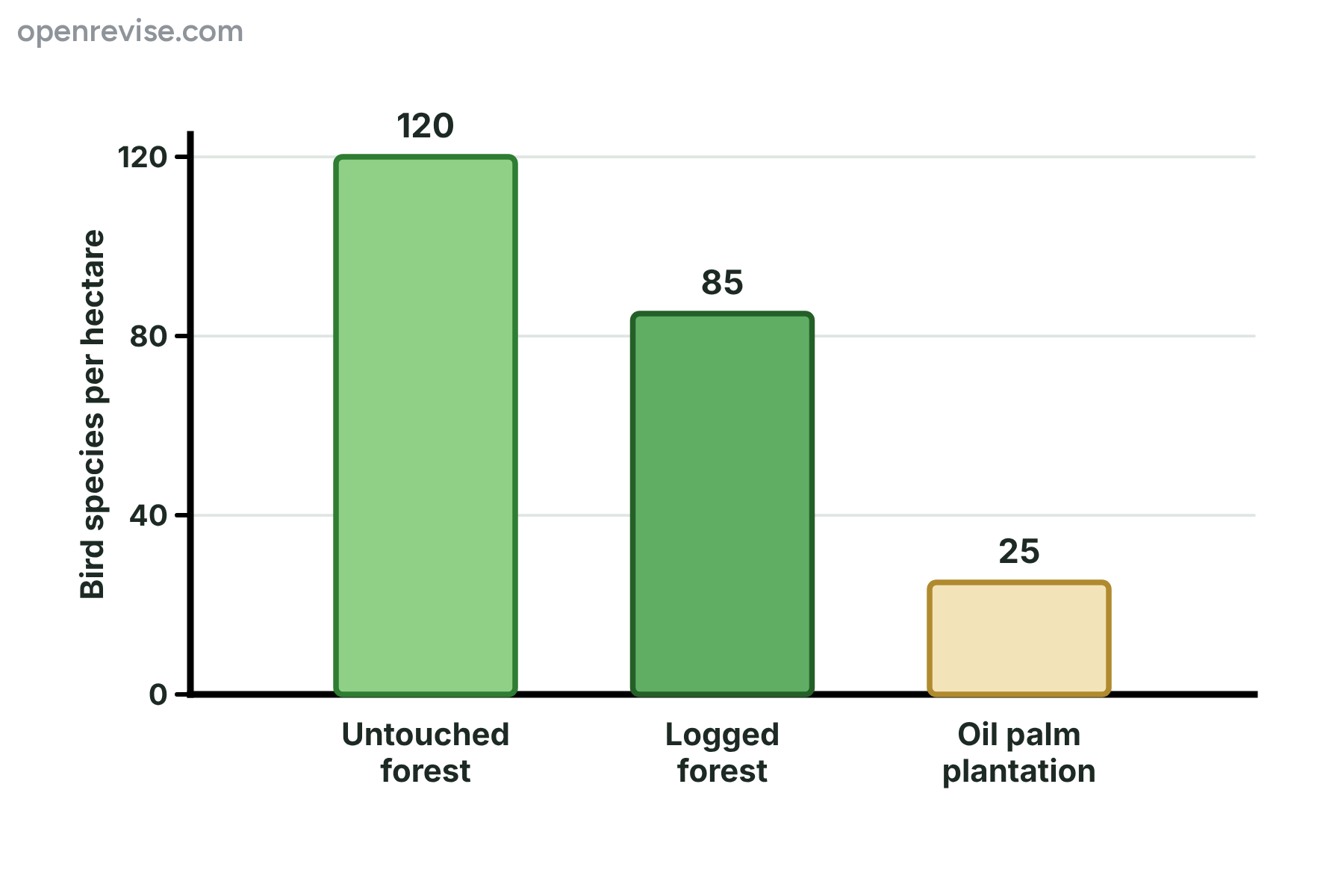
The bar chart shows the number of species of bird in a hectare of three types of land. Calculate the percentage decrease in the number of species between untouched forest and logged forest. Give your answer to the nearest whole number.
Show answerHide answer
Model answer
The decrease is \(120 - 85 = 35\), and \(\frac{35}{120} \times 100 = 29.2\), which is 29 per cent.
Mark scheme
- \(\frac{35}{120} \times 100\) — 1 mark
- 29 per cent — 1 mark
-
4 Describe [4 marks]
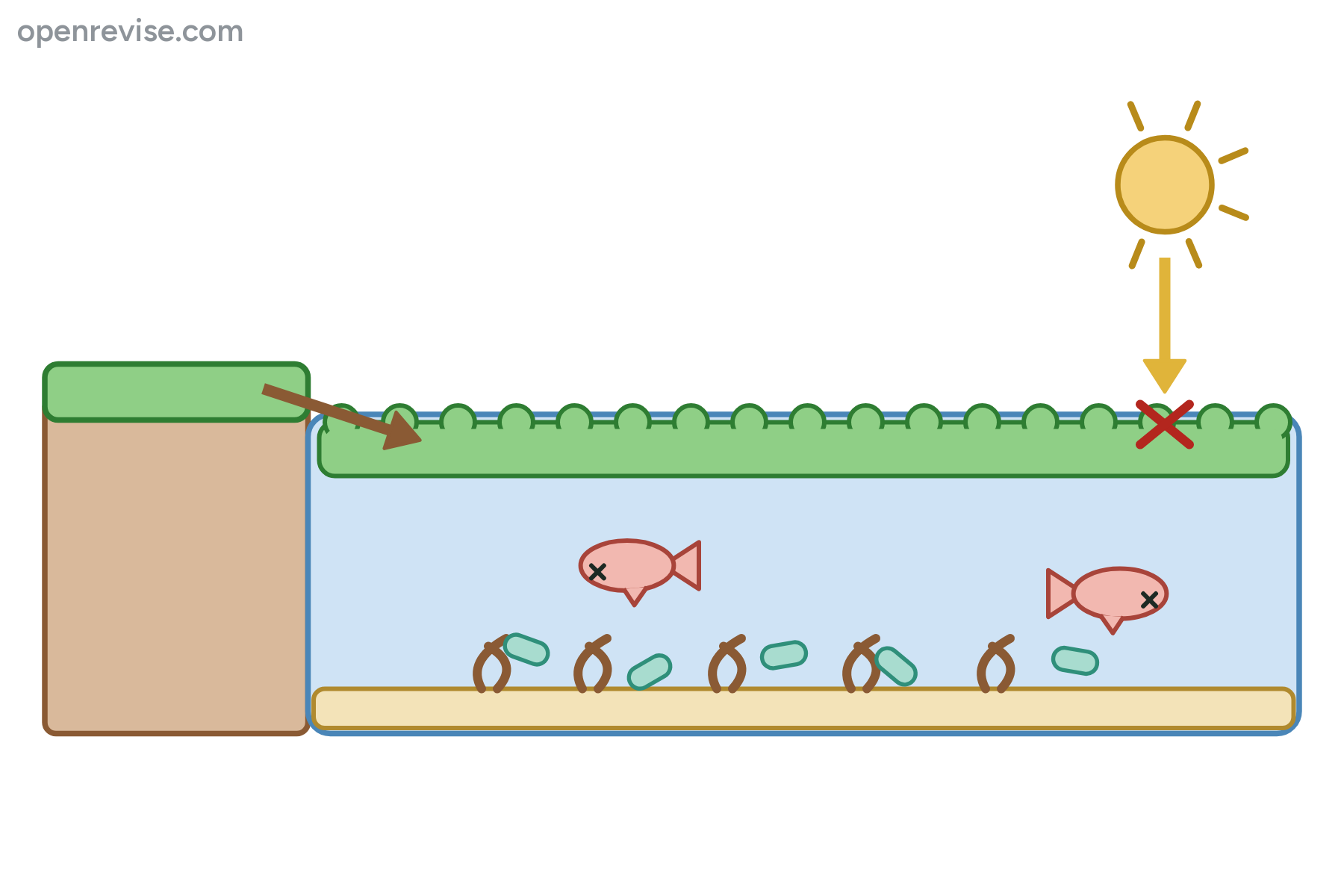
The diagram shows a pond next to a field that has been given a lot of fertiliser. Describe how the fertiliser led to the death of the fish in the pond.
Show answerHide answer
Model answer
Rain washed the fertiliser into the pond, and the nutrients made the algae grow rapidly, to form a layer on the surface. The algae blocked the light, so the plants under the water could not photosynthesise and died. Bacteria decomposed the dead plants and algae, and used up the oxygen in respiration. There was not enough oxygen for the fish, so they died.
Mark scheme
- Fertiliser runs into the pond and the algae grow rapidly — 1 mark
- Algae block the light, so the plants die — 1 mark
- Bacteria decompose the dead material and use up oxygen — 1 mark
- The fish die from a lack of oxygen — 1 mark
-
5 Explain [3 marks]
The grey squirrel was introduced to Britain from North America. The number of red squirrels has fallen since. Explain why.
Show answerHide answer
Model answer
The grey squirrel competes with the red squirrel for food and living space, and it eats the food more efficiently, so there is less for the reds. Grey squirrels also carry a virus, squirrelpox, that kills red squirrels but does not harm greys. So the red squirrels die or breed less and their numbers fall.
Mark scheme
- Competition for food and space — 1 mark
- Grey squirrels carry a disease that kills red squirrels — 1 mark
- Red squirrels die or breed less, so numbers fall — 1 mark
-
6 Describe [2 marks]
Describe two ways in which humans can conserve an endangered species.
Show answerHide answer
Model answer
Any two from: protect its habitat in a nature reserve or national park; breed it in captivity and release the young into the wild; pass laws to stop hunting or the trade in the species; restore habitats and link them with corridors.
Mark scheme
- First method — 1 mark
- Second method — 1 mark
-
7 Explain [3 marks]
The passenger pigeon was once one of the commonest birds in North America, but became extinct in 1914. Explain how hunting can cause a species to become extinct.
Show answerHide answer
Model answer
If animals are hunted faster than they can breed, the population falls. When the population is small, there are few individuals to breed, and there is little genetic variation, so it cannot recover. The last individuals are killed, so the species is extinct.
Mark scheme
- Hunted faster than they can breed, so the population falls — 1 mark
- A small population finds it hard to breed or has little variation — 1 mark
- Last individuals die, so the species is extinct — 1 mark
-
8 Discuss [6 marks]
Humans can have both positive and negative effects on biodiversity. Discuss, using examples.
Show answerHide answer
Model answer
Humans have reduced biodiversity in many ways. Clearing forests for farmland destroys the habitat of thousands of species, and a plantation of one crop has far fewer species than the forest that it replaced. Hunting and overfishing have driven species such as the passenger pigeon to extinction, and pollution, such as fertiliser running into ponds, leads to eutrophication and the death of fish. Introduced species such as the grey squirrel have out-competed native species. However, humans can also protect biodiversity. Nature reserves protect habitats from building, captive breeding and reintroduction brought back the red kite and the Arabian oryx, and laws, such as the ban on trade in endangered species, reduce hunting. Sustainable use of forests and fish stocks keeps the resource for the future. Because species are interdependent, protecting a habitat protects many species at once. Overall the damage has so far been much greater than the repair, but the successes show that conservation works when there is the political will and enough money.
Mark scheme
- A negative interaction explained, such as deforestation destroying habitats — 1 mark
- A second negative interaction with an example — 1 mark
- A third, such as pollution or an introduced species — 1 mark
- A positive interaction explained, such as a reserve or captive breeding — 1 mark
- A named example, such as the red kite — 1 mark
- A reasoned judgement or conclusion about the balance — 1 mark
Quick check
-
1
What is deforestation?
Show answerHide answer
C: The clearing of large areas of forest
Deforestation is the clearing of large areas of forest, usually for timber, farming or building.
-
2
Which of these is an example of a negative human interaction with an ecosystem?
Show answerHide answer
B: Draining a wetland to build houses
Draining a wetland destroys the habitat of the species that live there. The others are positive interactions.
-
3
What is the first effect of fertiliser running into a pond?
Show answerHide answer
A: Algae grow rapidly
The extra nutrients make the algae grow very quickly, which is an algal bloom. The loss of oxygen comes later.
-
4
Why do fish die in a pond with an algal bloom?
Show answerHide answer
D: The oxygen is used up by decomposers
Bacteria decomposing the dead plants and algae use up the oxygen, so the fish cannot get enough.
-
5
What is an introduced species?
Show answerHide answer
B: A species brought by humans to a new place
An introduced species has been brought by humans to a place where it did not live before.
-
6
Which is an example of conservation by captive breeding?
Show answerHide answer
C: Breeding Arabian oryx in a zoo and releasing them
Captive breeding is the breeding of rare animals in zoos or reserves, to release them into the wild.
-
7
Why does the loss of one species often affect others?
Show answerHide answer
A: Species depend on each other
Species are interdependent, for example one may be the food or shelter of another.
-
8
An area of forest had 80 species before it was logged, and 60 species afterwards. What is the percentage decrease?
Show answerHide answer
D: 25 per cent
The decrease is 20 species, and 20 divided by 80, times 100, is 25 per cent.