Biology · Natural Selection and Evolution
Darwin, Wallace and the Theory of Evolution
Two naturalists working thousands of miles apart came to the same idea at almost the same time, and it changed biology for ever. This lesson is for separate Biology only: Combined Science students do not need it. It covers the work of Darwin and Wallace, why the theory of evolution by natural selection was resisted, its impact on modern biology, and the use of seedbanks to store biodiversity.
Learning Objectives
- 1Describe the observations that Darwin made and how they led to his theory of evolution by natural selection.
- 2Describe the independent work of Alfred Russel Wallace, and how the two men announced the theory together.
- 3Explain why the theory was not accepted at first, and what new evidence led to its acceptance.
- 4Explain the impact of the theory on modern biology, including the use of seedbanks as a store of biodiversity.
Retrieval practice
-
1
What is natural selection?
Show answerHide answer
The process in which the individuals with the variants best suited to the environment survive and breed more, and pass on their alleles.
-
2
What is evolution?
Show answerHide answer
A change in the inherited characteristics of a population over time, through natural selection.
-
3
Who studied inheritance in pea plants in the 1860s?
Show answerHide answer
Gregor Mendel.
-
4
What is a species?
Show answerHide answer
A group of organisms that can interbreed to produce fertile offspring.
Setting the scene
In the early 1800s most people in Britain believed that every species had been created in its present form, and that species did not change. Fossils showed that some species had died out, but there was no accepted explanation of why living things were so varied, or why they fitted their environments so well. Two young naturalists, Charles Darwin and Alfred Russel Wallace, travelled to distant places and both worked out the same explanation.
- 1831 to 1836 Darwin sails round the world on HMS Beagle as the ship's naturalist
- 1838 Darwin reads an essay about human populations and food by Thomas Malthus, and sees how a struggle to survive could lead to natural selection
- 1848 to 1862 Wallace collects specimens in the Amazon, and then in the islands of what is now Indonesia
- 1858 Wallace sends Darwin an essay setting out the same idea, and the two are announced together
- 1859 Darwin publishes On the Origin of Species by Means of Natural Selection
Darwin's observations
Darwin's theory was built on a mass of observations, made on his voyage and afterwards.
-
Variation
He saw that individuals of a species differ from each other, and he studied how pigeon breeders, by choosing the birds they bred from, made new varieties in a few generations.
-
The Galapagos Islands
On the islands, which lie off the coast of Ecuador, he found birds, tortoises and mockingbirds that were similar but differed from island to island. The finches had beaks suited to the food available on each island.
-
Fossils
In South America he found the fossils of giant extinct animals that were like the living armadillos and sloths of the same continent, so the living species seemed to be related to the extinct ones.
-
Struggle to survive
Malthus's essay made him realise that animals produce more young than the food supply can support, so many must die.
Finches on the Galapagos Islands
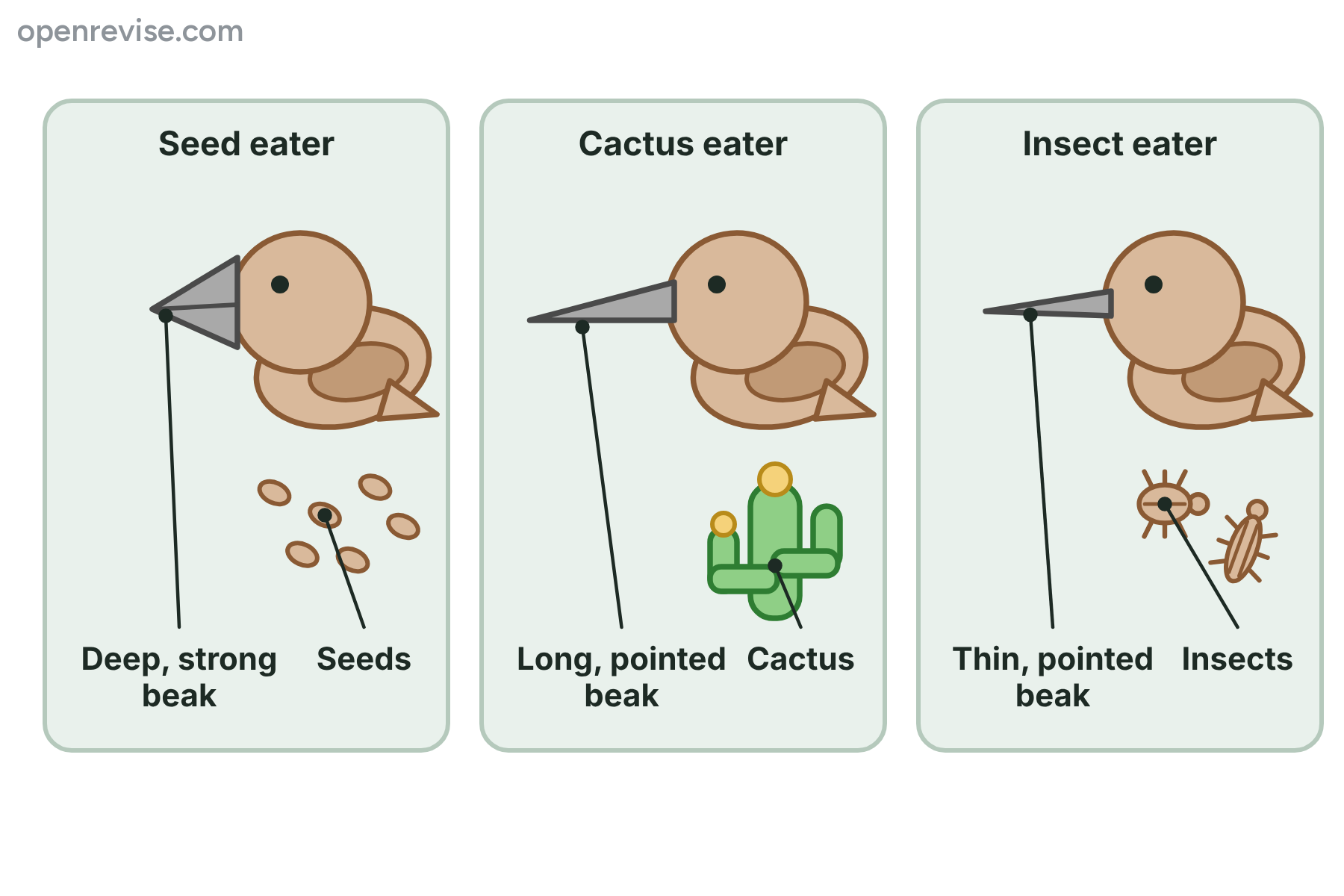
Finches of the Galapagos Islands have beaks that suit the food on each island.
Darwin's theory of natural selection
Darwin put the observations together into an explanation that could be tested.
-
Observation: more offspring than survive
Organisms produce more offspring than can survive, but the size of a population stays about the same, so there must be a struggle for food, space and mates.
-
Observation: variation
Individuals in a species vary, and some of the variation is passed on from parents to their offspring.
-
Inference: survival of the best suited
The individuals whose variations are best suited to the environment are more likely to survive and to breed, so they pass on their features to more offspring.
-
Evolution
Over many generations the features that help survival become more common, and a species can change into a new one. All species are therefore related through common ancestors.
How Darwin reasoned
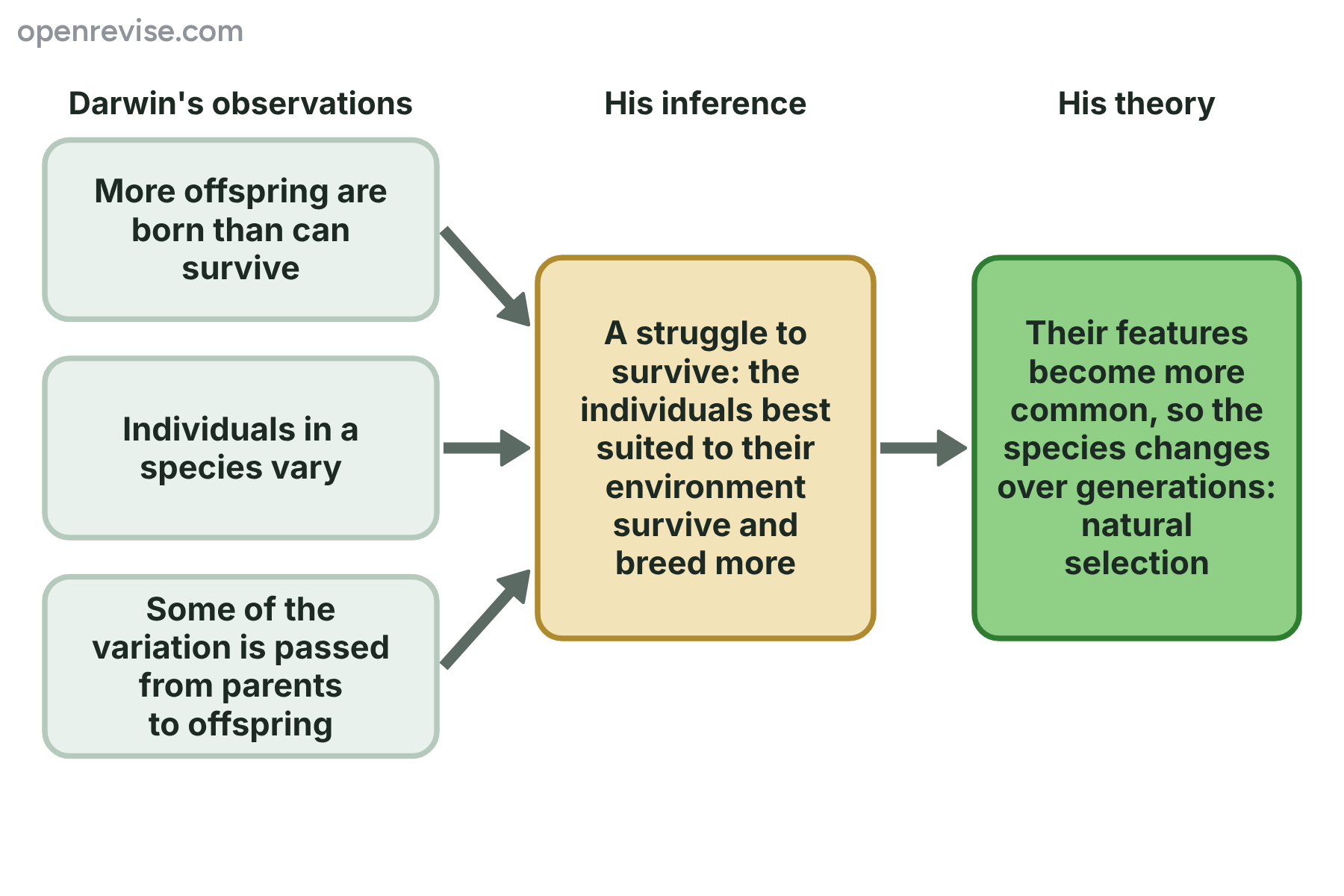
Three observations and one inference led to the theory.
Alfred Russel Wallace
Wallace was a collector of natural history specimens, and he arrived at the idea of natural selection on his own.
-
His work
Wallace collected animals and plants in the Amazon from 1848 to 1852, and in the islands of South East Asia from 1854 to 1862. He studied how species differ from one island to the next.
-
The same idea
In 1858, while ill with a fever on the island of Ternate, he thought of natural selection. He wrote it down in an essay and sent it to Darwin, whom he knew, to ask what he thought.
-
Biogeography
Wallace's studies of the distribution of species led him to draw a line between the animals of Asia and those of Australia. It is called the Wallace Line, and it is still used.
-
A joint announcement
Darwin had been working on the same idea for twenty years but had not published it. His friends arranged for the two men's papers to be read together at a meeting of the Linnean Society of London on 1 July 1858.
Case study
Why Darwin is better known
Neither Darwin nor Wallace was at the meeting in July 1858, and the papers caused little stir at the time. Darwin then worked quickly and published On the Origin of Species in 1859, with a huge amount of evidence from his own studies, from breeders and from fossils, and the first printing sold out in a day. Wallace accepted this and was generous about it, and he went on to be a great defender of natural selection and a founder of the study of the distribution of species.
Why the theory was resisted at first
Many people did not accept the idea of evolution by natural selection at first, for several reasons.
-
Religious belief
Many people, including many scientists, believed that God had created every species separately, as the Bible describes. The theory seemed to contradict this and implied that humans are related to other animals.
-
No mechanism of inheritance
Darwin could not explain how features were passed on, or where new variations came from, because genes and mutations were not known. Many thought that the features of parents blended in their offspring.
-
Too slow to observe
The changes are too slow to be seen in a lifetime, and the fossil record had gaps, so there was little direct evidence.
-
Another idea
Some scientists favoured earlier explanations, such as Lamarck's idea that features acquired in life could be inherited.
How the theory came to be accepted
Evidence accumulated over the next hundred years.
-
1
1860s
More fossils were found, including Archaeopteryx in 1861, which has features of both reptiles and birds. The study of living things in different places also supported the theory.
-
2
1900
Mendel's work on inheritance, published in 1866 but ignored, was rediscovered. It showed that features are inherited as units, which later were called genes.
-
3
1930s and 1940s
Scientists combined genetics with natural selection, showing how mutations give variation and how allele frequencies change.
-
4
1953 onwards
The structure of DNA was found, and DNA sequencing showed that species that look related are related, as the theory predicts.
-
5
Observed selection
Examples such as peppered moths and antibiotic resistance showed natural selection happening.
The impact on modern biology
The theory of evolution is the central idea of modern biology, because it explains why living things are as they are.
-
Classification
Species are now grouped by how closely they are related by evolution, and DNA sequences are used to make evolutionary trees.
-
Medicine
Understanding natural selection explains why bacteria become resistant to antibiotics, why the flu virus changes each year so that new vaccines are needed, and why cancer cells can become resistant to drugs.
-
Agriculture
Pests and weeds evolve resistance to pesticides and herbicides, so farmers rotate chemicals and crops. Selective breeding also depends on the variation that Darwin described.
-
Genetics
The theory led to a search for how variation is inherited, and so helped the development of genetics and the study of the genome.
-
Conservation
Species need genetic variation to adapt to change, so conservation aims to protect it, for example in seedbanks.
Seedbanks and biodiversity
Natural selection can work only if there is variation, so losing alleles is a loss of the raw material for future evolution.
-
What they are
A seedbank is a store of seeds, kept cold and dry. The Millennium Seed Bank in West Sussex stores wild plant seeds from tens of thousands of species, and the Svalbard Global Seed Vault in Norway keeps back-up copies of over a million samples of crop varieties.
-
How seeds are stored
The seeds are dried to a very low water content and frozen at about minus 18 to minus 20 degrees Celsius. Respiration and germination almost stop, so that many seeds stay alive for decades or even centuries.
-
Why they matter
They are an insurance. If a species or a variety of a crop is lost to disease, climate change, habitat destruction or war, the seeds can be grown again to restore it.
-
Variation for the future
A stored variety may have an allele, such as one for resistance to a disease or to drought, that breeders or genetic engineers will need in the future.
Seedbanks: benefits and limits
Benefits
- Store the genetic variation of many species in a small space
- Protect against extinction and loss of crop varieties
- Seeds can be grown to restore wild populations
- Provide alleles for plant breeding
Limits
- Some seeds, such as oak and many tropical trees, cannot be dried and frozen
- They store only plants, not animals
- Stored seeds do not evolve to meet a changing environment
- They need power, money and regular testing
Testing a seedbank sample
A seedbank tests a stored sample by sowing 200 seeds, and 164 of them germinate. Calculate the percentage that germinate. The bank grows new seeds from the sample if fewer than 85 per cent germinate. Does this sample need regenerating?
Show the solutionHide the solution
- 1 Divide the number that germinate by the number sown \(\frac{164}{200}\)
- 2 Multiply by 100 \(\frac{164}{200} \times 100 = 82\) per cent
- 3 Compare with the rule 82 per cent is less than 85 per cent
- 4 Conclude The sample needs to be regenerated, by growing plants and collecting new seeds
Answer82 per cent germinate, which is below 85 per cent, so the sample needs regenerating.
The big idea
Darwin and Wallace explained how species change through natural selection, and the idea is now the foundation of biology, from classification to the conservation of biodiversity.
Darwin, Wallace and evolution
Darwin, Wallace and evolution
-
Darwin
- Beagle voyage
- finches and tortoises
- fossils
- pigeon breeding
- Origin of Species 1859
-
Wallace
- Amazon and South East Asia
- Ternate essay 1858
- Wallace Line
-
Resistance
- religion
- no mechanism of inheritance
- slow change
- incomplete fossil record
-
Acceptance
- fossils
- Mendel and genetics
- DNA
- observed natural selection
-
Impact
- classification
- medicine
- agriculture
- conservation
- seedbanks
Summary and exam focus
- Darwin observed variation, the differences between islands and the fossils of extinct animals, and proposed natural selection.
- Wallace reached the same idea independently, and his essay in 1858 led to the joint announcement and to the publication of the Origin of Species in 1859.
- The theory was resisted because of religious belief, no known mechanism of inheritance and the lack of direct evidence of slow change.
- Fossils, the rediscovery of Mendel's work, DNA and observed natural selection led to its acceptance.
- Evolution is the basis of classification, understanding antibiotic resistance and conservation, including seedbanks that store biodiversity.
Exam focus
Describe the work of Darwin and Wallace in developing the theory of evolution by natural selection, and explain why the theory has had such an impact on modern biology. (6 marks) (6 marks)
Name both men and say what each did: Darwin's observations and twenty years of evidence, Wallace's independent work and his essay in 1858, and the joint announcement. Then give two or three impacts, each with a reason, such as classification, antibiotic resistance and the conservation of variation in seedbanks.
Key terms
The words this lesson expects you to use. Each one is linked from the first place it appears above.
- Theory
- An explanation of observations that has been tested many times and is supported by a lot of evidence.
- Natural selection
- The process in which the individuals with the variants best suited to the environment survive and breed more, so their alleles become more common.
- Origin of Species
- The book published by Darwin in 1859 that set out the theory of evolution by natural selection.
- Wallace Line
- A boundary between the animals of Asia and those of Australia, described by Alfred Russel Wallace.
- Artificial selection
- Humans choosing which individuals to breed from, as pigeon breeders did.
- Seedbank
- A store of seeds, kept dried and cold, to preserve the genetic variation of plant species.
- Biodiversity
- The variety of living organisms in a habitat or on Earth.
- Genetic variation
- Differences in the alleles carried by the individuals of a species.
- Peer review
- The checking of a scientist's work by other scientists before it is published.
- Mechanism of inheritance
- An explanation of how features are passed from parents to offspring.
You've finished the notes
Check your understanding
Test yourself while it is fresh. Start with the flashcards, then try the exam questions.
Something here looks wrong?
Tell us what and we will go and look. It goes to whoever writes these pages, nobody else, and we do not ask who you are — so there is nothing to sign and nothing comes back to you.