Biology · Natural Selection and Evolution
Classification and Molecular Phylogenetics
There are millions of species on Earth, and biologists need a way to sort them and to name them. This lesson is for both Combined Science and separate Biology. It covers natural and artificial classification, the system started by Linnaeus, binomial names, the three domains, and how DNA sequencing is now used to build evolutionary trees.
Learning Objectives
- 1Describe the difference between natural and artificial classification, and explain why natural classification is preferred.
- 2Describe the Linnaean classification system, and use the binomial naming of species.
- 3Describe how developments in biology, including DNA sequencing, have changed classification, including the three-domain system.
- 4Explain how DNA sequences are used to produce evolutionary trees (molecular phylogenetics).
Retrieval practice
-
1
What is a species?
Show answerHide answer
A group of organisms that can interbreed to produce fertile offspring.
-
2
What is a mutation?
Show answerHide answer
A random change in the base sequence of DNA.
-
3
Why are all living things related?
Show answerHide answer
They share common ancestors, because of evolution.
-
4
What do we call the order of the bases along a DNA strand?
Show answerHide answer
The base sequence.
Sorting out living things
Biologists have named about two million species and there are many millions more. To study them, they need to sort them into groups and to give each one a name that every scientist can use. How the groups are chosen has changed. At first they were based on what organisms looked like. Now the best groupings are the ones that show how organisms are related, and DNA sequencing allows us to check that.
Artificial and natural classification
There are two ways to build a classification system, and they work in very different ways.
-
Artificial classification
This groups organisms by a few features that are easy to see and useful to us, such as whether they fly, live in water or are edible. It is quick, but it can put unrelated organisms together, for example bats, birds and butterflies in a group of flying animals.
-
Natural classification
This groups organisms by many shared features, which they have inherited from a common ancestor. The groups therefore show how closely organisms are related by evolution.
-
Why natural is preferred
A natural system shows evolutionary relationships and allows predictions. If a newly discovered organism is placed in a group, we can predict many of its features from the others in the group.
-
Example
A whale and a fish are both streamlined swimmers in water, but a whale has hair, mammary glands and lungs, so it is grouped with mammals, not fish.
Artificial and natural systems
Artificial classification
- Uses one or a few easily seen features
- Groups can include unrelated organisms
- Does not show evolutionary relationships
- Example: flying animals, or trees and herbs
Natural classification
- Uses many features, now including DNA
- Groups contain organisms with a common ancestor
- Shows evolutionary relationships
- Example: the Linnaean system, now using DNA
Linnaeus and the hierarchy of ranks
Carl Linnaeus, a Swedish botanist, published a system in the 1700s which is the basis of the modern one.
-
A hierarchy
Each group sits inside a larger group, like boxes inside boxes. The groups are called ranks. From the largest to the smallest they are kingdom, phylum, class, order, family, genus and species. A phrase such as King Philip Came Over For Good Soup helps to remember them.
-
Going down the ranks
The groups get smaller. The organisms in a group have more in common with each other, and there are fewer of them.
-
Species at the bottom
A species is the smallest group, and contains organisms that can interbreed to produce fertile offspring.
-
Linnaeus
He used five ranks, kingdom, class, order, genus and species. Phylum and family were added later, as more was learned about living things.
The Linnaean ranks, with the human as an example
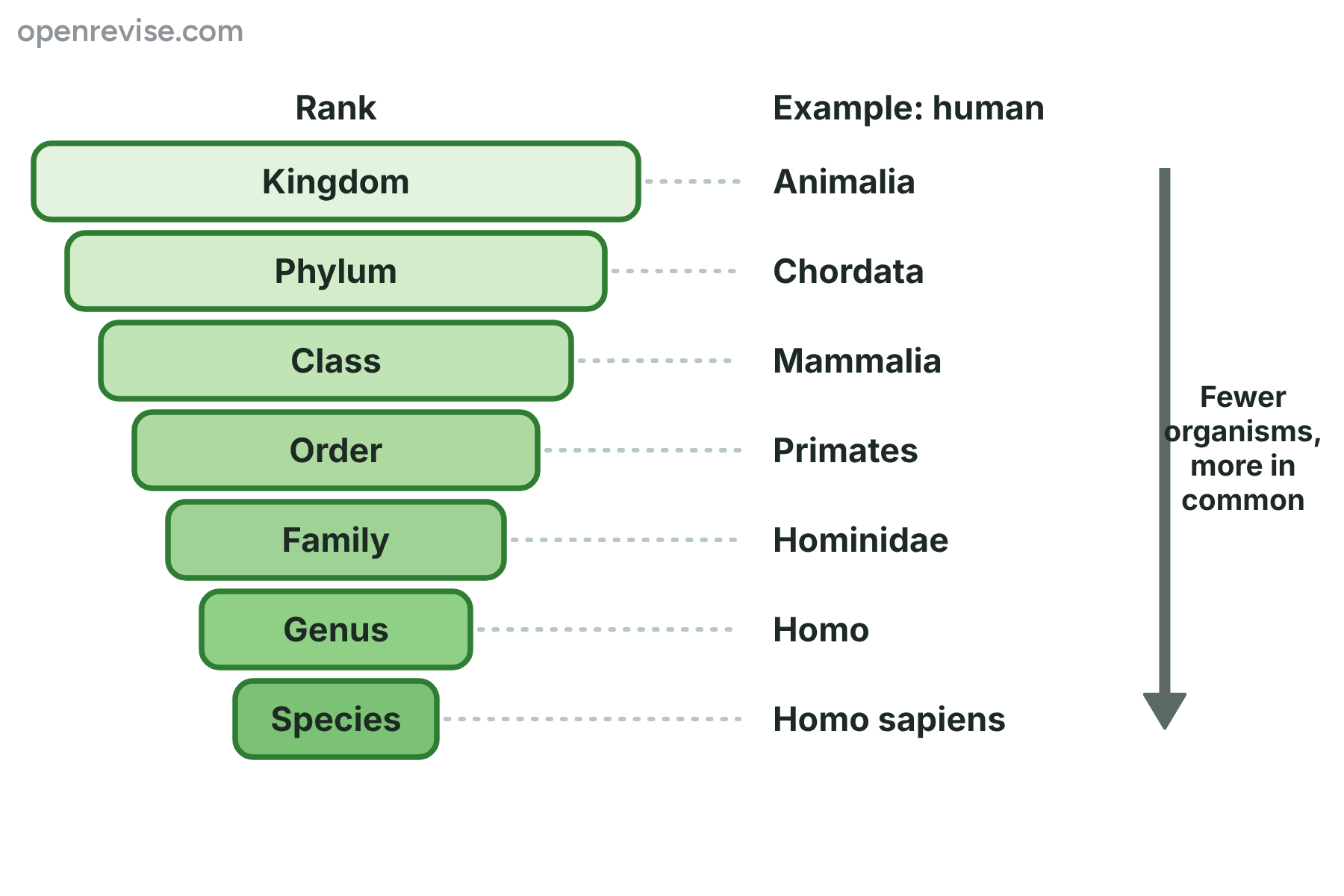
Each rank is inside the one above it. Humans are in the genus Homo and the species Homo sapiens.
Binomial names
Linnaeus also gave every species a two-part Latin name, which is called a binomial.
-
Two parts
The first part is the genus and the second is the species. The genus has a capital letter and the species has a small letter, and the name is written in italics or underlined: Homo sapiens.
-
One name worldwide
Common names change from place to place, and one name may be used for different organisms. A binomial is the same in every language, so scientists in every country know which species is meant.
-
Shows relationships
Species in the same genus are close relatives. The lion, Panthera leo, and the tiger, Panthera tigris, are in the same genus.
-
Examples
Humans are Homo sapiens, the oak is Quercus robur and the house mouse is Mus musculus.
How developments in biology changed classification
As new techniques were developed, scientists found that some groups did not reflect the relationships between organisms, and they changed them.
-
Microscopes
Better microscopes showed the structure of cells and the existence of single-celled organisms, so that scientists could group organisms by their cell structure, such as whether there is a nucleus.
-
Biochemistry
Comparing the proteins of different species showed which are closely related, even if they look different.
-
DNA sequencing
Since the 1970s scientists have been able to read the base sequence of DNA, and compare it between species. Closely related species have more similar DNA, so this gives a more reliable measure of relationship than appearance.
-
Three domains
In 1977 Carl Woese compared ribosomal RNA genes and found that the prokaryotes include two very different groups. In 1990 he proposed three domains above the kingdoms: Bacteria, Archaea and Eukaryota.
The three domains of life
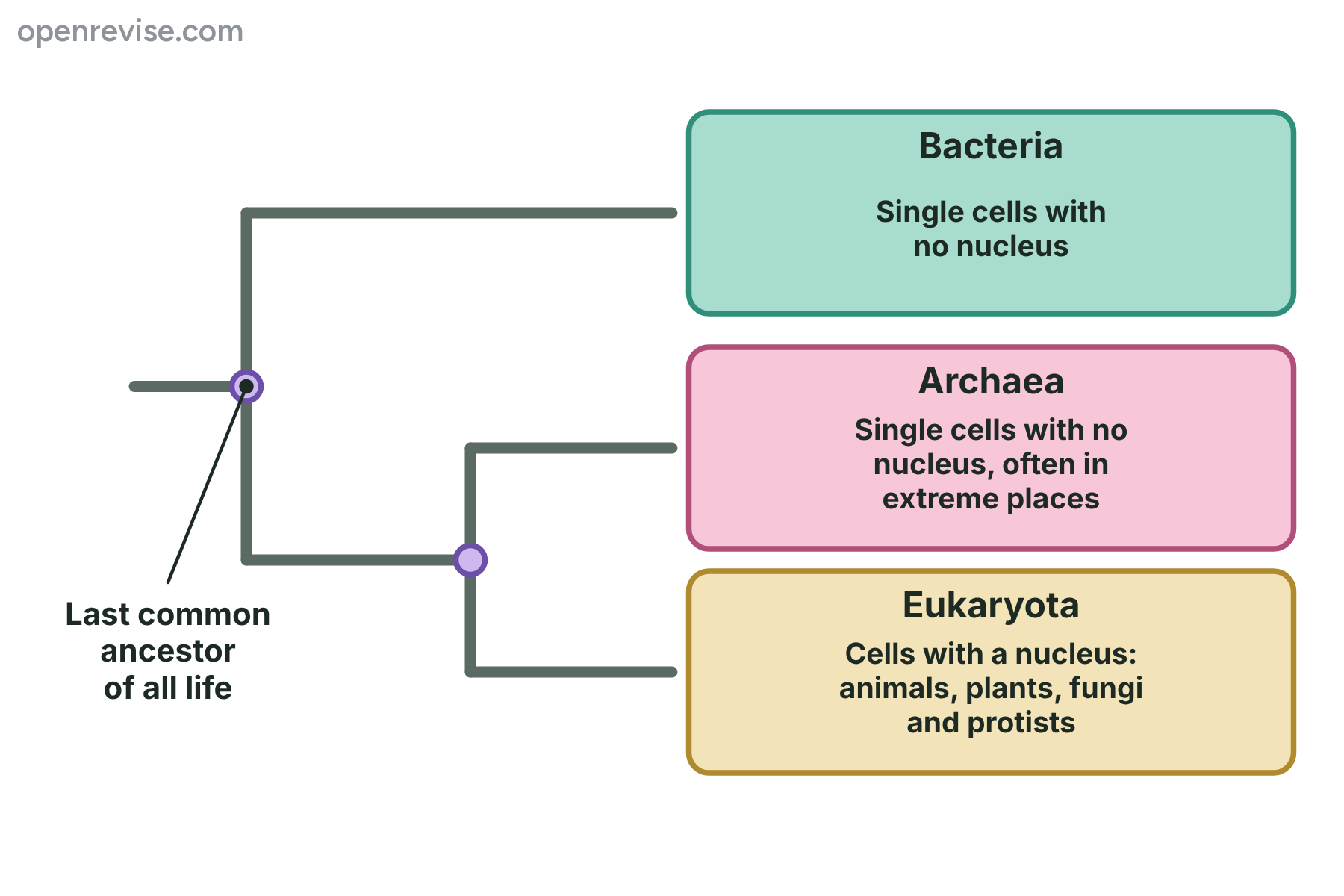
DNA showed that the Archaea are more closely related to the Eukaryota than to the Bacteria.
How DNA is used to build an evolutionary tree
Molecular phylogenetics uses differences in DNA to work out how species are related.
-
1
Choose a gene
Select a gene that all of the species have, so that its sequence can be compared.
-
2
Sequence it
Use DNA sequencing to read the order of the bases in this gene for every species.
-
3
Compare
Line up the sequences and count the bases that are different. Changes build up over time as mutations happen.
-
4
Link difference to time
The more differences there are, the longer ago the two species split from their common ancestor, so they are more distantly related.
-
5
Draw the tree
Species with the fewest differences are placed side by side, joined at a branching point, which is their most recent common ancestor.
Comparing the DNA of apes
A section of a gene has 500 bases. The human sequence differs from the chimpanzee in 6 bases, from the gorilla in 8 bases and from the orangutan in 15 bases. Calculate the percentage difference between the human and each species, and say which species is the closest relative of the human.
Show the solutionHide the solution
- 1 Chimpanzee \(\frac{6}{500} \times 100 = 1.2\) per cent
- 2 Gorilla \(\frac{8}{500} \times 100 = 1.6\) per cent
- 3 Orangutan \(\frac{15}{500} \times 100 = 3.0\) per cent
- 4 Conclude The smallest difference is with the chimpanzee, so it is the closest relative, and the orangutan is the most distant
AnswerThe differences are 1.2 per cent for the chimpanzee, 1.6 per cent for the gorilla and 3.0 per cent for the orangutan. The chimpanzee is the closest relative, because it has the fewest differences.
An evolutionary tree of the great apes
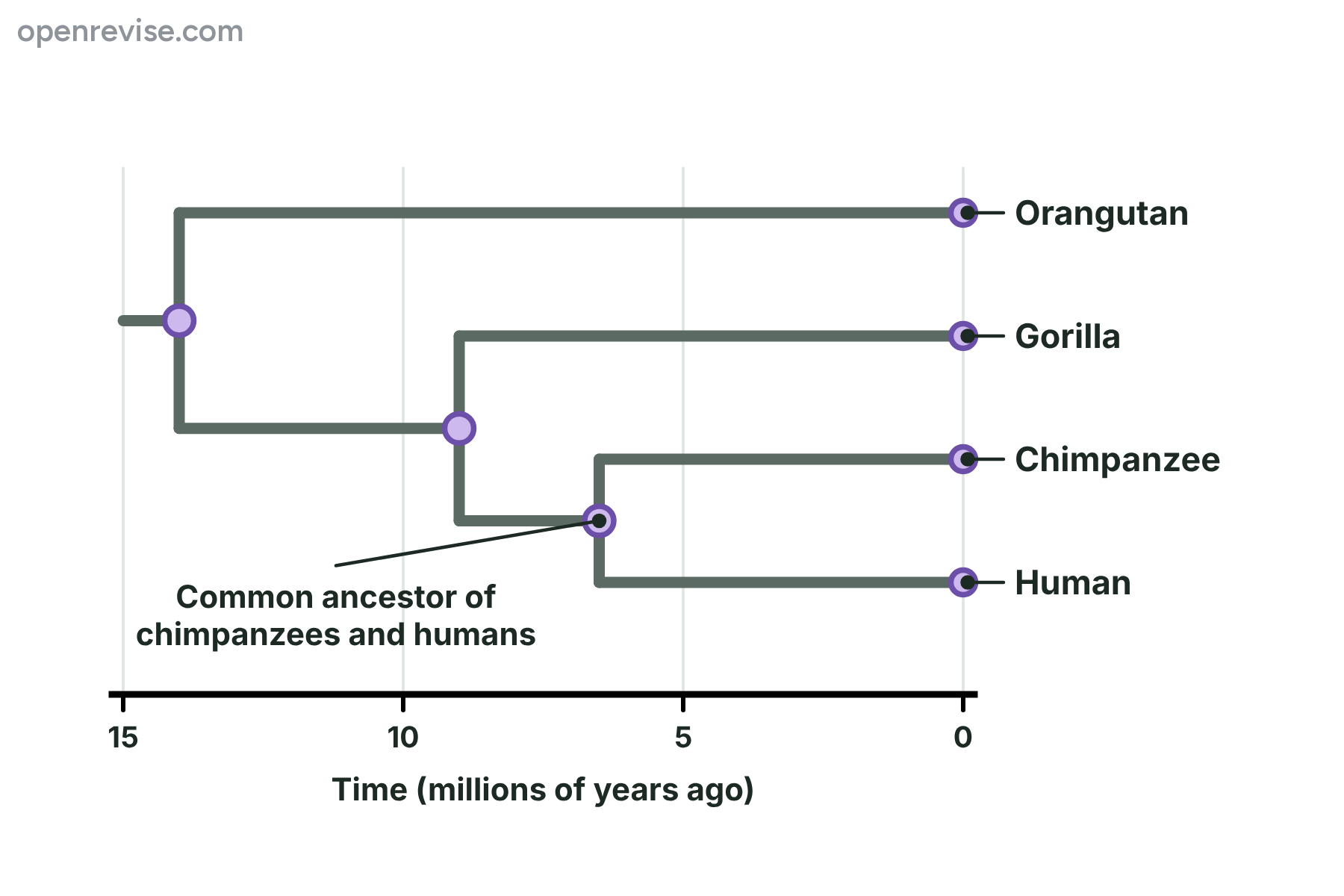
The fewer the differences in DNA, the more recent the common ancestor.
What DNA has changed
DNA sequences have confirmed some groupings and corrected others.
-
Animals that look alike
Features can look alike because of the same way of life rather than ancestry. DNA shows that the marsupial mole and the golden mole, which look alike, are not close relatives.
-
Surprising relatives
The giant panda is classed with the bears, and whales are closest to the hippopotamus among living animals.
-
Fungi
Fungi are closer to animals than to plants, although they look like plants.
-
Microorganisms
Without DNA there is not much to compare in microorganisms, and most prokaryotes could not be classified until their DNA could be sequenced.
Case study
Carl Woese and the Archaea
Until the 1970s all prokaryotes, the cells with no nucleus, were put in one group, the bacteria. Carl Woese compared the sequence of a gene for ribosomal RNA, which every living thing has, in many organisms. He found that some of the prokaryotes, which lived in places such as hot springs, were as different from the other bacteria as they were from animals and plants. In 1990 he proposed that there are three domains: Bacteria, Archaea and Eukaryota. The idea has been accepted, because it was supported by evidence from DNA.
The big idea
The best classification shows how organisms are related, and DNA sequencing gives the most reliable evidence of that.
Classification
Classification
-
Artificial
- few visible features
- unrelated organisms grouped
- does not show ancestry
-
Natural
- many shared features
- common ancestors
- shows relationships
-
Linnaeus
- kingdom, phylum, class, order, family, genus, species
- binomial names
-
Three domains
- Bacteria
- Archaea
- Eukaryota
- Woese and ribosomal RNA
-
Molecular phylogenetics
- DNA sequencing
- count differences
- build evolutionary tree
Summary and exam focus
- Artificial classification uses a few visible features, and natural classification uses many features and shows evolutionary relationships.
- The Linnaean system has seven ranks, from kingdom to species, and each species has a binomial name of genus and species.
- Microscopes, biochemistry and DNA sequencing have all changed classification, and Woese's work led to the three domains of Bacteria, Archaea and Eukaryota.
- In molecular phylogenetics, DNA sequences are compared, and species with fewer differences are more closely related.
- The results are shown in an evolutionary tree, with branches where species split from a common ancestor.
Exam focus
Describe how scientists use DNA sequencing to find out how closely related different species are, and explain how this has changed classification. (6 marks) (6 marks)
Describe the method in steps: sequencing the same gene in each species, comparing the base sequences and counting the differences. Explain that fewer differences mean a more recent common ancestor. Then give a change, such as the three domains, or the correction of groups that were based on appearance.
Key terms
The words this lesson expects you to use. Each one is linked from the first place it appears above.
- Classification
- The sorting of living things into groups.
- Artificial classification
- Grouping organisms by a few easily seen features, which may not show how they are related.
- Natural classification
- Grouping organisms by many shared features, so that the groups show evolutionary relationships.
- Binomial name
- A two-part Latin name for a species, made of its genus and species, such as Homo sapiens.
- Genus
- A group of closely related species.
- Domain
- The highest rank of classification: Bacteria, Archaea or Eukaryota.
- DNA sequencing
- Finding the order of the bases along a piece of DNA.
- Molecular phylogenetics
- Using differences in DNA or protein sequences to work out evolutionary relationships.
- Evolutionary tree
- A branching diagram that shows how species are related and when they split from common ancestors.
- Common ancestor
- The species from which two or more other species have evolved.
You've finished the notes
Check your understanding
Test yourself while it is fresh. Start with the flashcards, then try the exam questions.
Something here looks wrong?
Tell us what and we will go and look. It goes to whoever writes these pages, nobody else, and we do not ask who you are — so there is nothing to sign and nothing comes back to you.