Exam questions · Biology · Natural Selection and Evolution
Darwin, Wallace and the Theory of Evolution
- 8 exam questions
- 24 marks
- 8 quick checks
-
1 State [1 mark]
State the name of the group of islands where Darwin observed finches with beaks that differed from island to island.
Show answerHide answer
Model answer
The Galapagos Islands.
Mark scheme
- The Galapagos Islands — 1 mark
-
2 Describe [2 marks]
Describe the contribution of Alfred Russel Wallace to the theory of evolution.
Show answerHide answer
Model answer
Wallace developed the idea of natural selection independently, from his studies of animals in South East Asia. In 1858 he sent his essay to Darwin, and the work of both men was announced together at the Linnean Society.
Mark scheme
- Developed the idea of natural selection independently — 1 mark
- Sent his essay to Darwin, leading to the joint announcement in 1858 — 1 mark
-
3 Explain [4 marks]
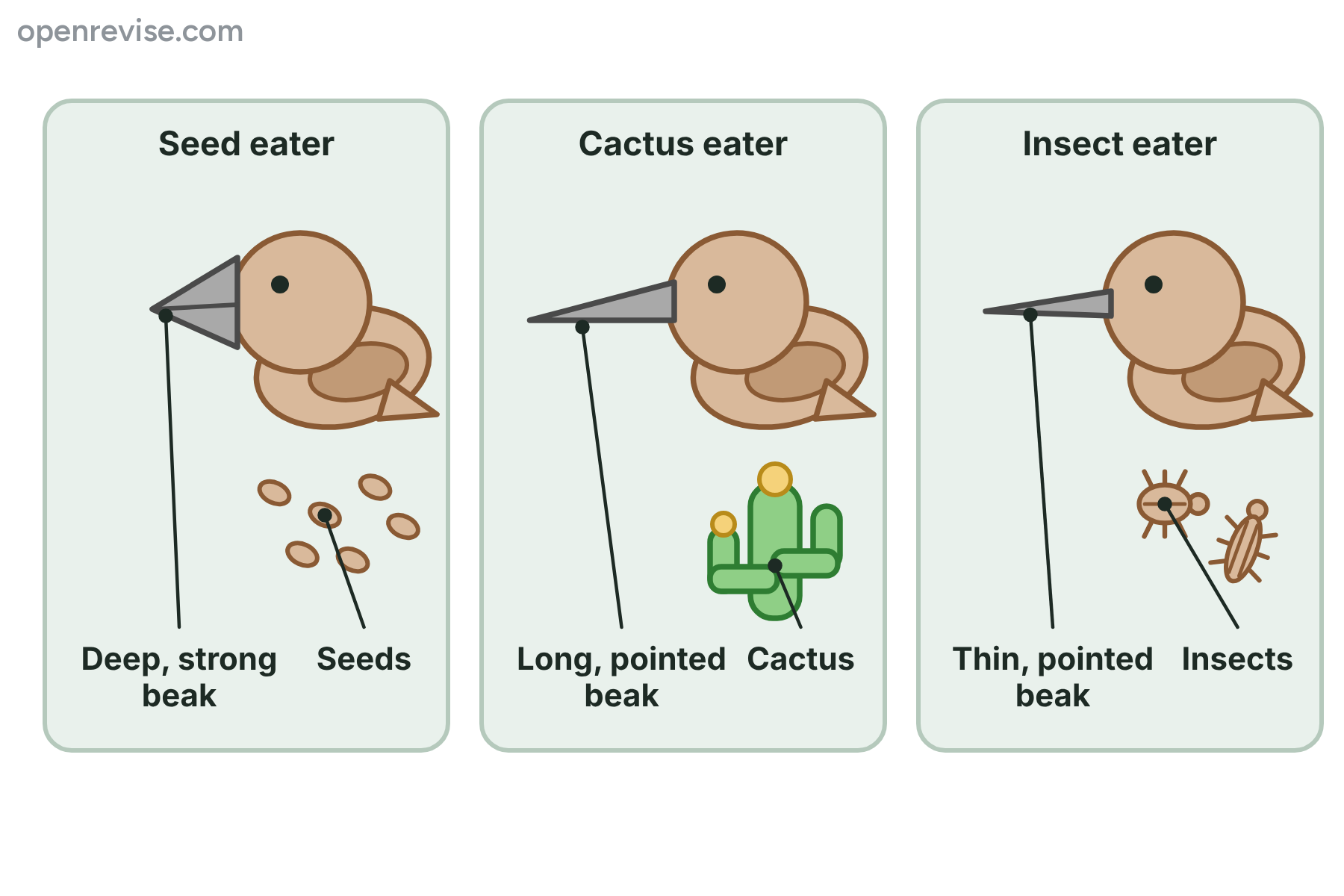
The diagram shows three species of finch from the Galapagos Islands. They are all descended from one species that reached the islands. Explain how natural selection could have produced the different beaks.
Show answerHide answer
Model answer
There was variation in beak size and shape in the original population, caused by mutations. On the different islands, the different foods were the selection pressure. The finches with beaks best suited to the food, such as a deep beak for cracking seeds, survived and bred more. They passed on the alleles for these beaks, so over many generations the beaks became more suited to the food on each island.
Mark scheme
- Variation in beaks in the original population, from mutations — 1 mark
- Different foods were the selection pressure on different islands — 1 mark
- Birds with the best-suited beak survived and bred more — 1 mark
- They passed on the alleles, so the beak type became more common over generations — 1 mark
-
4 Give [3 marks]
Darwin's theory was not accepted by everyone when it was published. Give three reasons why it was resisted.
Show answerHide answer
Model answer
Any three from: it conflicted with the religious belief that each species was created separately; it suggested that humans are related to other animals; Darwin could not explain how features were inherited, because genes were not known; the changes are too slow to be seen in a lifetime; the fossil record had gaps; some scientists preferred other ideas, such as Lamarck's.
Mark scheme
- First reason — 1 mark
- Second reason — 1 mark
- Third reason — 1 mark
-
5 Explain [3 marks]
Explain why the rediscovery of Mendel's work in 1900 helped to make the theory of evolution more widely accepted.
Show answerHide answer
Model answer
Darwin could not explain how features are inherited, which was one of the main objections to his theory. Mendel showed that features are inherited as separate units, which were later called genes. This gave a mechanism of inheritance and explained how variation can be passed on from parents to offspring, so natural selection could work.
Mark scheme
- Darwin had no explanation of inheritance — 1 mark
- Mendel showed that features are inherited as units, later called genes — 1 mark
- This explained how variation is passed on, which supports natural selection — 1 mark
-
6 Calculate [2 marks]
A seedbank sows 250 seeds from a stored sample and 205 germinate. Calculate the percentage that germinate.
Show answerHide answer
Model answer
\(\frac{205}{250} \times 100 = 82\) per cent.
Mark scheme
- \(205 \div 250 \times 100\) — 1 mark
- 82 per cent — 1 mark
-
7 Explain [3 marks]
Explain how seedbanks help to maintain biodiversity.
Show answerHide answer
Model answer
Seedbanks store seeds from many species and varieties, which preserves their genetic variation. If a species or crop variety is lost from the wild, for example through disease, climate change or the destruction of its habitat, it can be grown again from the stored seeds. The alleles that are stored, such as for resistance to disease, may be useful for breeding in the future.
Mark scheme
- Store seeds from many species and varieties, which keeps their genetic variation — 1 mark
- A species or variety that is lost can be regrown from the stored seeds — 1 mark
- Stored alleles may be needed in the future, for example for disease resistance — 1 mark
-
8 Discuss [6 marks]
Discuss the impact of the theory of evolution by natural selection on modern biology.
Show answerHide answer
Model answer
The theory explains why living things are so varied and related, and it is the central idea of biology. It underlies classification, because species are grouped by how closely they are related, and DNA sequences are used to produce evolutionary trees. In medicine it explains why bacteria evolve resistance to antibiotics, such as MRSA, so doctors avoid overusing antibiotics, and why new flu vaccines are needed each year. In agriculture it explains why pests become resistant to pesticides, so farmers change the chemicals they use. It also led to the study of how variation is inherited, which helped to develop genetics. In conservation, natural selection needs genetic variation to work, so species with little variation are at greater risk, and seedbanks store the variation of plants as insurance against loss. Overall the theory has changed biology from the description of living things to the explanation of them, and it has practical uses in medicine, agriculture and conservation.
Mark scheme
- Explains the variety and relatedness of living things — 1 mark
- Classification and evolutionary trees — 1 mark
- Medicine: antibiotic resistance or flu vaccines — 1 mark
- Agriculture: resistance to pesticides or herbicides — 1 mark
- Conservation of genetic variation, for example seedbanks — 1 mark
- A reasoned conclusion about the overall importance of the theory — 1 mark
Quick check
-
1
What did Darwin observe about the finches on the Galapagos Islands?
Show answerHide answer
B: Their beaks differed from island to island
The finches on different islands had different beaks, suited to the food that was available on each island.
-
2
Which scientist developed the idea of natural selection independently of Darwin?
Show answerHide answer
D: Alfred Russel Wallace
Alfred Russel Wallace reached the same idea and sent his essay to Darwin in 1858.
-
3
In what year was On the Origin of Species published?
Show answerHide answer
A: 1859
Darwin published the book in 1859, a year after the joint announcement with Wallace.
-
4
Why could Darwin not explain how features are passed on?
Show answerHide answer
C: Because genes were not yet known
Genes, DNA and mutations were not known at the time. Mendel's work was published in 1866 but not noticed until 1900.
-
5
Which of these was a reason why many people did not accept Darwin's theory at first?
Show answerHide answer
D: It conflicted with the belief that species were created separately
Many people believed that each species had been created separately, and the theory seemed to contradict this.
-
6
How does a seedbank store seeds so that they last for decades?
Show answerHide answer
B: Dried and kept at a low temperature
Seeds are dried and frozen, which almost stops respiration and germination, so they stay alive for a long time.
-
7
Why is genetic variation in a species important for its survival?
Show answerHide answer
C: It means some individuals may be suited to a change in the environment
With variation, some individuals may have alleles that suit a changed environment, so natural selection can act.
-
8
Which of these is an impact of the theory of evolution on modern medicine?
Show answerHide answer
A: It explains antibiotic resistance in bacteria
Natural selection explains how bacteria become resistant to antibiotics, so that doctors use them more carefully.