Biology · Natural Selection and Evolution
Natural Selection
Why are the peppered moths in a Manchester wood a different colour from their great-great-grandparents? This lesson is for both Combined Science and separate Biology. It covers the variation that exists in a population, where new variants come from, and how natural selection makes the variants best suited to an environment more common.
Learning Objectives
- 1State that there is usually extensive genetic variation within a population of a species.
- 2Describe how mutations produce new variants, and why a variant may be an advantage in one environment and a disadvantage in another.
- 3Explain how natural selection acts on variation, through selection pressures, survival and breeding and the passing on of alleles, so that a population becomes better adapted over generations.
- 4Use the peppered moth to explain natural selection, and avoid the common mistake of saying that individuals change.
Retrieval practice
-
1
What is a mutation?
Show answerHide answer
A random change in the base sequence of DNA.
-
2
What is a variant of a gene also called?
Show answerHide answer
An allele.
-
3
What is the phenotype of an organism?
Show answerHide answer
Its observable characteristics, produced by its genes and the environment.
-
4
Name two things that cause variation in a species.
Show answerHide answer
The genes that were inherited and the environment.
Populations evolve, individuals do not
A population is a group of individuals of the same species living in the same place. Natural selection is a process that happens to populations, over many generations. A single moth, rabbit or bacterium does not change its genes because it needs to. Instead, the population changes because some individuals are better suited to the environment, so they survive and breed more successfully, and the next generation has more of their alleles.
Variation within a population
Individuals in a population of one species are not identical, and much of the difference is genetic.
-
Extensive variation
There is usually extensive genetic variation within a population. Different individuals carry different alleles of many genes, so they have different phenotypes.
-
Shuffled in every generation
Sexual reproduction mixes the alleles. Meiosis makes gametes that are all different and random fertilisation combines them, so each offspring has a new combination of alleles.
-
Why it matters
If every individual were identical, a change in the environment would affect them all in the same way and there would be nothing for natural selection to work on. Variation is what allows a population to adapt.
Mutations: where new variants come from
Sexual reproduction shuffles the variants that already exist, but only mutations can make a new one.
-
Random
A mutation is a random change in the base sequence of the DNA. It does not happen because the organism needs it, and it cannot be aimed at a useful result.
-
Most make no difference
Most mutations have no effect on the phenotype. A few harm the organism, and a very few give an advantage.
-
An advantage depends on the environment
Whether a variant helps depends on where the organism lives. A dark colour is a disadvantage on pale bark but an advantage on bark blackened by soot.
-
Passed on only through gametes
A mutation can be passed on to offspring only if it happens in a cell that makes gametes. A mutation in a skin cell, for example, is not inherited.
Natural selection step by step
Natural selection explains how evolution occurs: the variants best suited to the environment become more common.
-
1
Variation
Individuals in the population have different alleles, so they have different phenotypes. Some of these variants came from mutations.
-
2
Selection pressure
Something in the environment, such as predators, disease, competition for food or a change in climate, makes it harder for some individuals to survive and breed than others.
-
3
Survival and breeding
The individuals with phenotypes best suited to the environment are more likely to survive, and so they breed more often and have more offspring.
-
4
Alleles passed on
Their offspring inherit the alleles that gave the advantage, so the alleles are passed on to the next generation.
-
5
Over many generations
The advantageous allele becomes more common in the population, so the population becomes better adapted to the environment.
Peppered moths in two woods
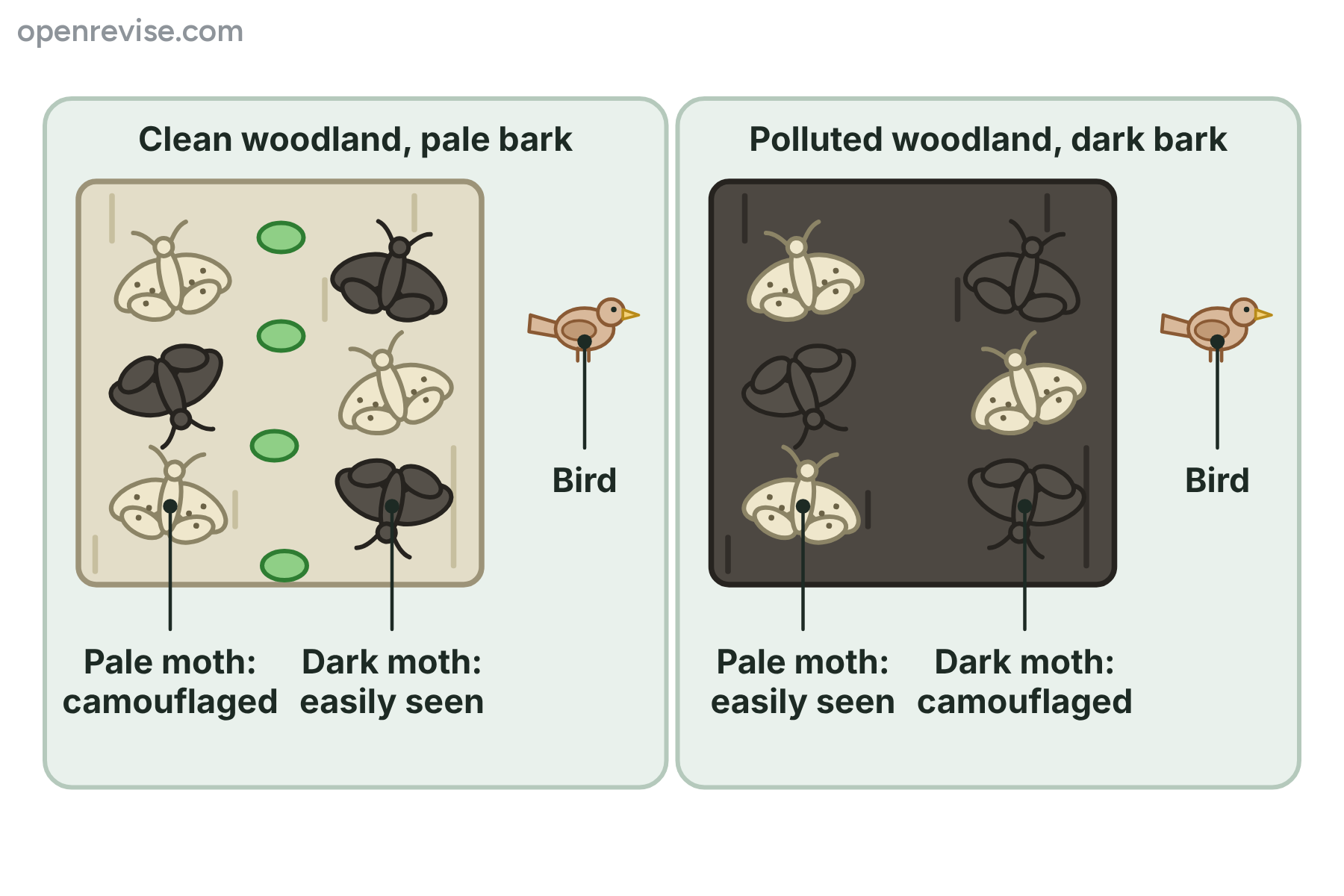
A moth that matches its background is camouflaged, so the bird is less likely to eat it.
Case study
The peppered moth
Before the Industrial Revolution almost all peppered moths (Biston betularia) in Britain were pale, which hid them on lichen-covered bark. A rare dark form was first recorded near Manchester in 1848. As factories blackened the trees with soot and killed the lichens, birds found the pale moths easily and the dark form became common, reaching about 98 per cent of the moths near Manchester by 1895. After clean air laws in the 1950s and 1960s reduced soot, the bark became paler again, and the dark form became rare.
How the population changes over generations
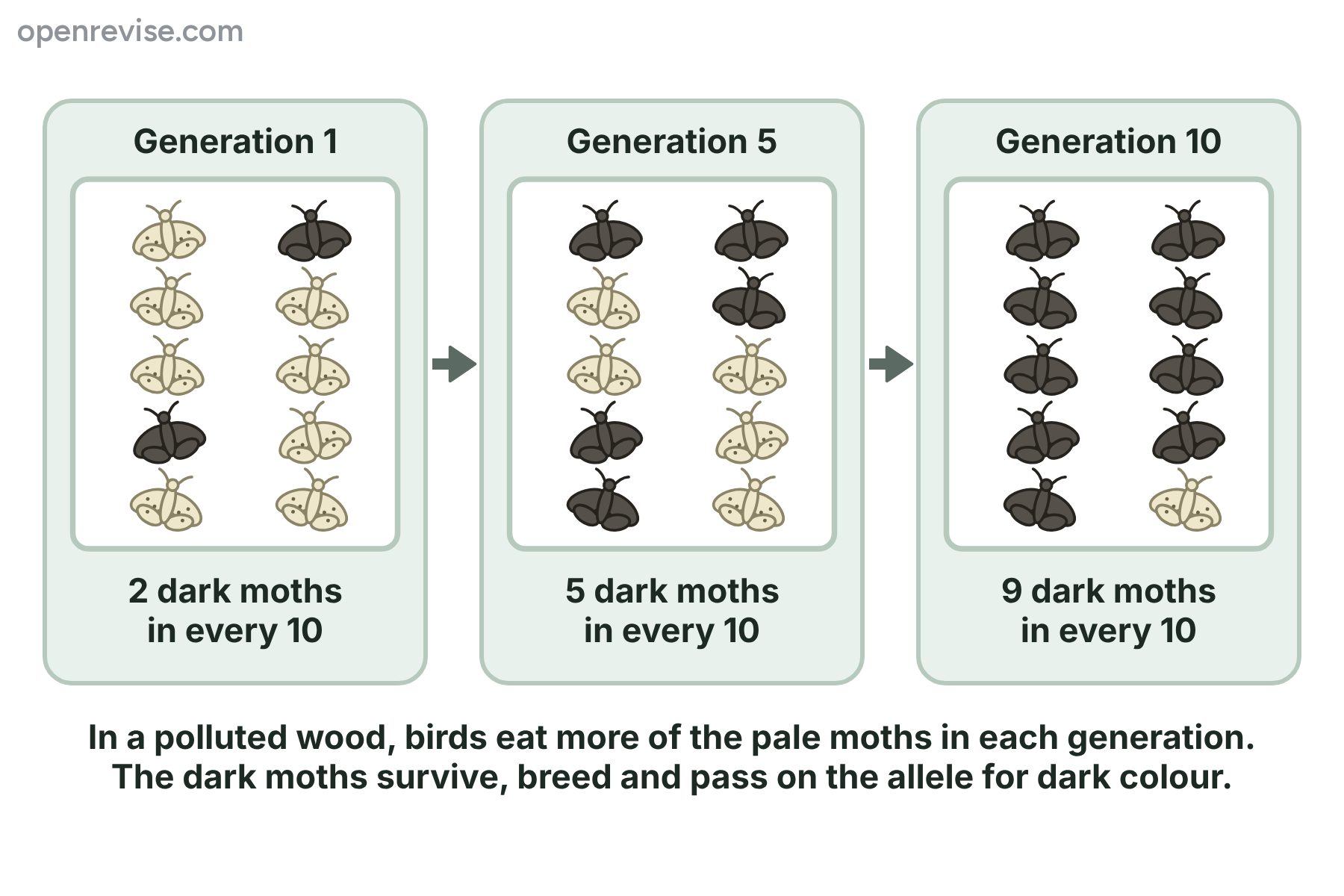
The change is in the population: the dark allele becomes more common in each generation.
What the moth story shows
Each step of natural selection can be pointed to in the peppered moth.
-
Variation
Some moths carry the allele for a pale colour and a few carry a variant for a dark colour, which arose from a mutation.
-
Selection pressure
Predation by birds. In a sooty wood, birds see and eat the pale moths first.
-
Survival and breeding
The dark moths survive longer, so they lay more eggs than the pale moths do.
-
Alleles passed on
The offspring inherit the allele for dark colour, so it becomes more common in each generation.
Did the birds really select the moths?
In the 1950s Kettlewell released marked dark and pale moths in a polluted wood near Birmingham. He released 154 dark moths and recaptured 82, and released 64 pale moths and recaptured 16. Calculate the percentage of each kind that was recaptured and say what this suggests.
Show the solutionHide the solution
- 1 Percentage of dark moths \(\frac{82}{154} \times 100 = 53.2\), so about 53 per cent
- 2 Percentage of pale moths \(\frac{16}{64} \times 100 = 25.0\), so 25 per cent
- 3 Compare The percentage recaptured is about twice as high for the dark moths
- 4 Conclude More dark moths survived the birds in the polluted wood, so the dark colour was an advantage there
AnswerAbout 53 per cent of the dark moths and 25 per cent of the pale moths were recaptured. More dark moths survived in the polluted wood, which supports the idea that birds ate more of the pale moths.
Saying it correctly
Say this
- The dark moths were more likely to survive and breed
- A mutation produced a new variant, by chance
- The allele for dark colour became more common in the population
- The population evolves over many generations
Not this
- The moths changed colour so that they could hide
- The moths needed to be dark, so they mutated
- Each moth became better camouflaged during its life
- Natural selection is the survival of the strongest
The big idea
Natural selection does not change individuals: it changes the population, because the variants best suited to the environment survive, breed and pass on their alleles.
Natural selection
Natural selection
-
Variation
- genetic
- alleles shuffled in sexual reproduction
- extensive within a population
-
Mutation
- random
- new variant
- most have no effect
- an advantage depends on the environment
-
Selection pressure
- predation
- disease
- competition for food
- climate
-
Survival and breeding
- best suited survive
- more offspring
-
Over generations
- alleles passed on
- allele becomes more common
- adaptation
Summary and exam focus
- There is usually extensive genetic variation within a population of a species.
- New variants arise from random mutations, and most mutations have no effect on the phenotype.
- A selection pressure means that individuals with the phenotypes best suited to the environment survive and breed more.
- Their alleles are passed on, so over many generations the advantageous allele becomes more common and the population becomes better adapted.
- Natural selection acts on populations, not on individuals, and mutations are random and not caused by need.
Exam focus
Explain how natural selection led to dark peppered moths becoming more common in industrial areas of Britain. (6 marks) (6 marks)
Put the steps in order and use the key words: variation or a mutation, selection pressure (predation by birds), survival and breeding, alleles passed on, and more dark moths in later generations. Say that the moths did not change colour. Name the advantage: camouflage on dark bark.
Key terms
The words this lesson expects you to use. Each one is linked from the first place it appears above.
- Population
- A group of individuals of the same species living in the same place.
- Genetic variation
- Differences in the alleles carried by individuals of the same species.
- Mutation
- A random change in the base sequence of DNA that may produce a new variant.
- Variant
- A different version of a gene, also called an allele.
- Selection pressure
- A factor in the environment, such as predation, disease or competition, that affects the survival and breeding of individuals.
- Natural selection
- The process in which individuals with the variants best suited to their environment survive and breed more, so their alleles become more common.
- Adaptation
- A feature that helps an organism to survive and reproduce in its environment.
- Camouflage
- Colouring or markings that make an organism hard to see against its background.
- Predation
- One animal, the predator, hunting and eating another, the prey.
You've finished the notes
Check your understanding
Test yourself while it is fresh. Start with the flashcards, then try the exam questions.
Something here looks wrong?
Tell us what and we will go and look. It goes to whoever writes these pages, nobody else, and we do not ask who you are — so there is nothing to sign and nothing comes back to you.