Exam questions · Biology · Natural Selection and Evolution
Natural Selection
- 7 exam questions
- 21 marks
- 8 quick checks
-
1 State [1 mark]
State what causes a new variant of a gene to appear.
Show answerHide answer
Model answer
A mutation.
Mark scheme
- A mutation (a change in the DNA base sequence) — 1 mark
-
2 Describe [2 marks]
Peppered moths in a wood are eaten by birds. Describe what is meant by a selection pressure.
Show answerHide answer
Model answer
A selection pressure is a factor in the environment that makes it harder for some individuals to survive and breed than others. In the wood, predation by birds is the selection pressure, because the moths that are easiest to see are eaten.
Mark scheme
- A factor in the environment that affects survival and breeding — 1 mark
- A suitable example, such as predation by birds — 1 mark
-
3 Explain [3 marks]
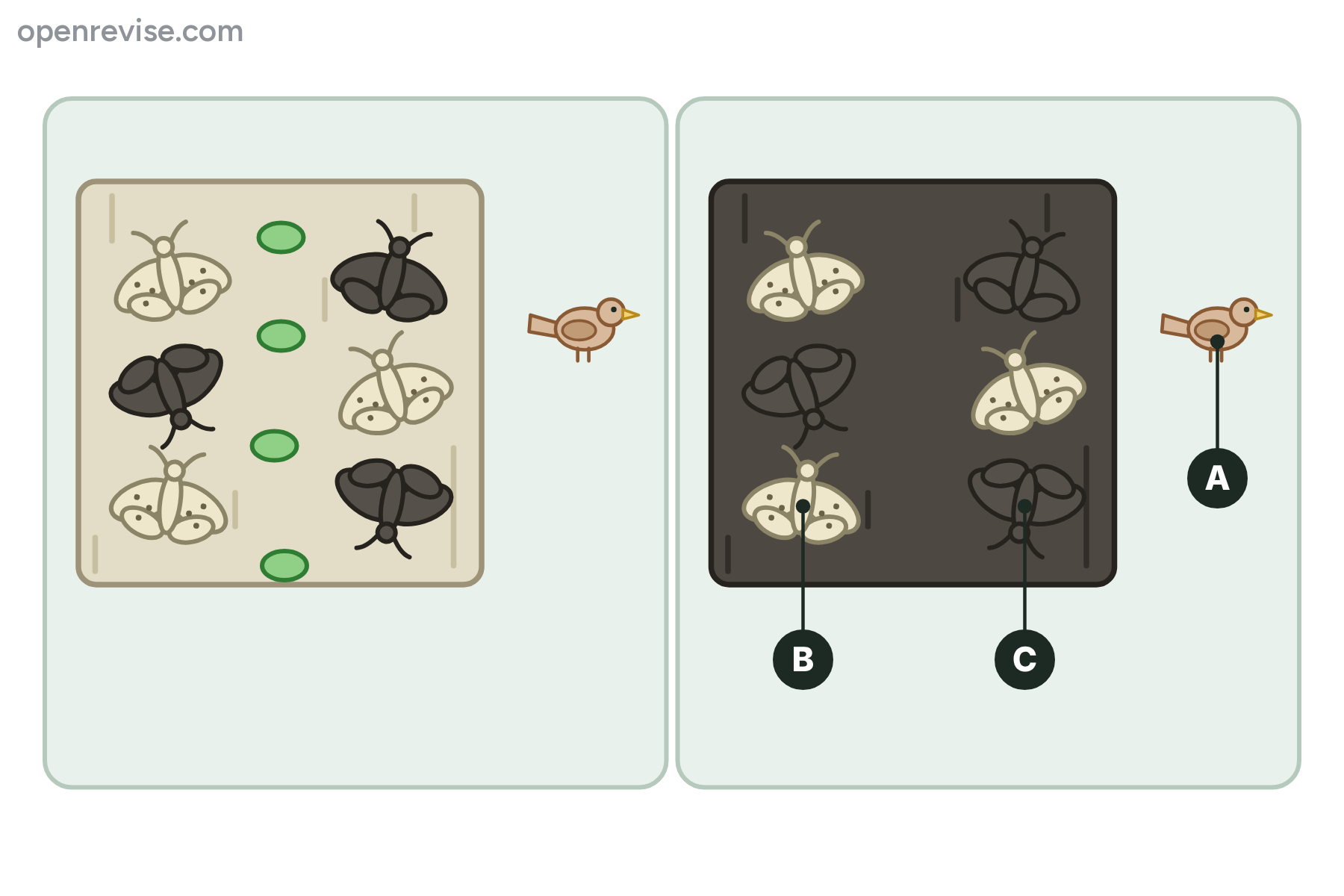
The diagram shows moths on tree bark in a clean wood and in a polluted wood. In the polluted wood, A is a bird, B is a pale moth and C is a dark moth. Explain why B is more likely to be eaten by A than C is.
Show answerHide answer
Model answer
In the polluted wood the bark is dark. The pale moth B is easy to see against the dark bark, so the bird can find it and eat it. The dark moth C is camouflaged, so it is more likely to survive.
Mark scheme
- The bark in the polluted wood is dark — 1 mark
- B is easily seen by the bird (against the dark bark) — 1 mark
- C is camouflaged, so it is less likely to be eaten — 1 mark
-
4 Calculate [2 marks]
In an experiment, 473 dark moths and 496 pale moths were released in an unpolluted wood. Later 30 dark moths and 62 pale moths were recaptured. Calculate the percentage of the pale moths that was recaptured. Give your answer to the nearest whole number.
Show answerHide answer
Model answer
\(\frac{62}{496} \times 100 = 12.5\), which is 13 per cent to the nearest whole number.
Mark scheme
- \(62 \div 496 \times 100\) — 1 mark
- 13 per cent (12.5 per cent gains 1 mark) — 1 mark
-
5 Explain [4 marks]
A student says, "The peppered moths changed colour so that they could hide from birds." Explain why this statement is wrong.
Show answerHide answer
Model answer
Individual moths do not change colour because they need to. Dark moths first appeared by a random mutation. The dark moths were better camouflaged in the sooty woods, so they survived and bred more. Their offspring inherited the allele for dark colour, so over many generations the population contained more dark moths.
Mark scheme
- Individual moths did not change colour — 1 mark
- The dark variant arose by a random mutation, not because it was needed — 1 mark
- Dark moths were camouflaged, so they survived and bred more — 1 mark
- The allele was passed on, so the population changed over generations — 1 mark
-
6 Explain [3 marks]
After the Clean Air Acts of the 1950s and 1960s, dark peppered moths became less common in Britain. Explain why.
Show answerHide answer
Model answer
Less soot was produced, so the tree bark became paler again and the lichens returned. The dark moths were now easy for birds to see, so more of them were eaten. The pale moths were camouflaged, survived and bred more, so the allele for pale colour became more common.
Mark scheme
- The bark became paler (less soot) — 1 mark
- Dark moths were easily seen and eaten — 1 mark
- Pale moths survived, bred and passed on their allele — 1 mark
-
7 Evaluate [6 marks]
Kettlewell released marked moths in two woods and recaptured some of them later. In the polluted wood near Birmingham he recaptured 53 per cent of the dark moths and 25 per cent of the pale moths. In the unpolluted wood in Dorset he recaptured 6 per cent of the dark moths and 13 per cent of the pale moths. Evaluate how far these results support the idea that birds select moths that are easily seen.
Show answerHide answer
Model answer
In the polluted wood the percentage of dark moths recaptured is about twice that of the pale moths, which suggests that more pale moths were eaten by birds. In Dorset the opposite pattern appears, with about twice as many pale moths recaptured, which suggests that birds ate more of the dark moths against the pale, lichen-covered bark. Together the results support the idea that moths that match their background survive. However, a recapture rate is not a direct measure of predation, because some moths may have flown away, died of other causes or not been found. The number of moths released was different in each case, and the experiment was done at one time in two places, so it should be repeated and the birds seen eating the moths to be sure.
Mark scheme
- Dark moths recaptured about twice as often as pale in the polluted wood — 1 mark
- Pale moths recaptured about twice as often as dark in the clean wood — 1 mark
- This supports the idea that birds eat the moths that are easy to see — 1 mark
- Recapture is not a direct measure of predation (other causes of loss) — 1 mark
- Different numbers released, one experiment, two places — 1 mark
- A suggested improvement, such as repeating it or observing the birds — 1 mark
Quick check
-
1
Which of these is the original source of a new variant of a gene?
Show answerHide answer
C: Mutation
New alleles arise only from mutations. Sexual reproduction shuffles variants that already exist.
-
2
Which statement about mutations is correct?
Show answerHide answer
A: They are random, and most have no effect on the phenotype
Mutations are random changes in the DNA, and most have no effect on the phenotype.
-
3
In a sooty wood, why were pale peppered moths eaten more often than dark ones?
Show answerHide answer
D: They were easily seen by birds against the dark bark
Birds were the selection pressure. Pale moths were easy to see against the dark bark.
-
4
What is a selection pressure?
Show answerHide answer
B: A factor in the environment that affects survival and breeding
A selection pressure is a factor in the environment, such as predation, that affects which individuals survive and breed.
-
5
Which is the best way to complete this sentence? Natural selection changes the characteristics of ...
Show answerHide answer
A: a population over many generations
Natural selection acts on a population over generations, because individuals cannot change their own alleles.
-
6
What must happen for a mutation to be passed on to offspring?
Show answerHide answer
C: It must be in a cell that makes gametes
Only a mutation in a cell that makes gametes can be inherited. The offspring then carry the new variant.
-
7
A population of beetles shows no genetic variation at all. What is the likely result of a big change in the environment?
Show answerHide answer
B: No variants are available to be selected, so the population may not adapt
Without variation there are no better-suited variants to be selected, so the whole population may be affected in the same way.
-
8
After natural selection has acted for many generations, what is true of the population?
Show answerHide answer
D: The advantageous allele is more common
The alleles that gave an advantage have been passed on and are now more common, so the population is better adapted.