Flashcards · Biology · Natural Selection and Evolution
Natural Selection
-
What is a population?
A group of individuals of the same species living in the same place.
-
Is there usually little or extensive genetic variation within a population?
Extensive: individuals carry different alleles.
-
Where do new variants come from?
From mutations, which are random changes in the DNA.
-
Does a mutation happen because an organism needs it?
No. Mutations are random, and not aimed at a useful result.
-
What happens to most mutations?
They have no effect on the phenotype.
-
Can the same variant be an advantage in one place and a disadvantage in another?
Yes. The advantage depends on the environment, such as dark colour on sooty bark.
-
Name three selection pressures.
Predation, disease, competition for food or mates, and a change in climate.
-
What is natural selection?
The survival and breeding of the individuals with variants best suited to the environment, so their alleles become more common.
-
Which individuals are more likely to breed?
Those with phenotypes best suited to the environment.
-
What is passed on to the offspring in natural selection?
The alleles that gave the parent its advantage.
-
Do individual organisms change by natural selection?
No. The population changes, over many generations.
-
What was the selection pressure on peppered moths in sooty woods?
Predation by birds.
-
Why were pale peppered moths eaten more in polluted woods?
They were easily seen against the dark bark.
-
What happened to dark peppered moths after the clean air laws?
They became less common, as the bark became paler again.
-
What does camouflage do?
It makes an organism hard to see, so predators are less likely to find it.
-
Why can a population with no variation not evolve?
There are no better-suited variants for natural selection to favour.
-
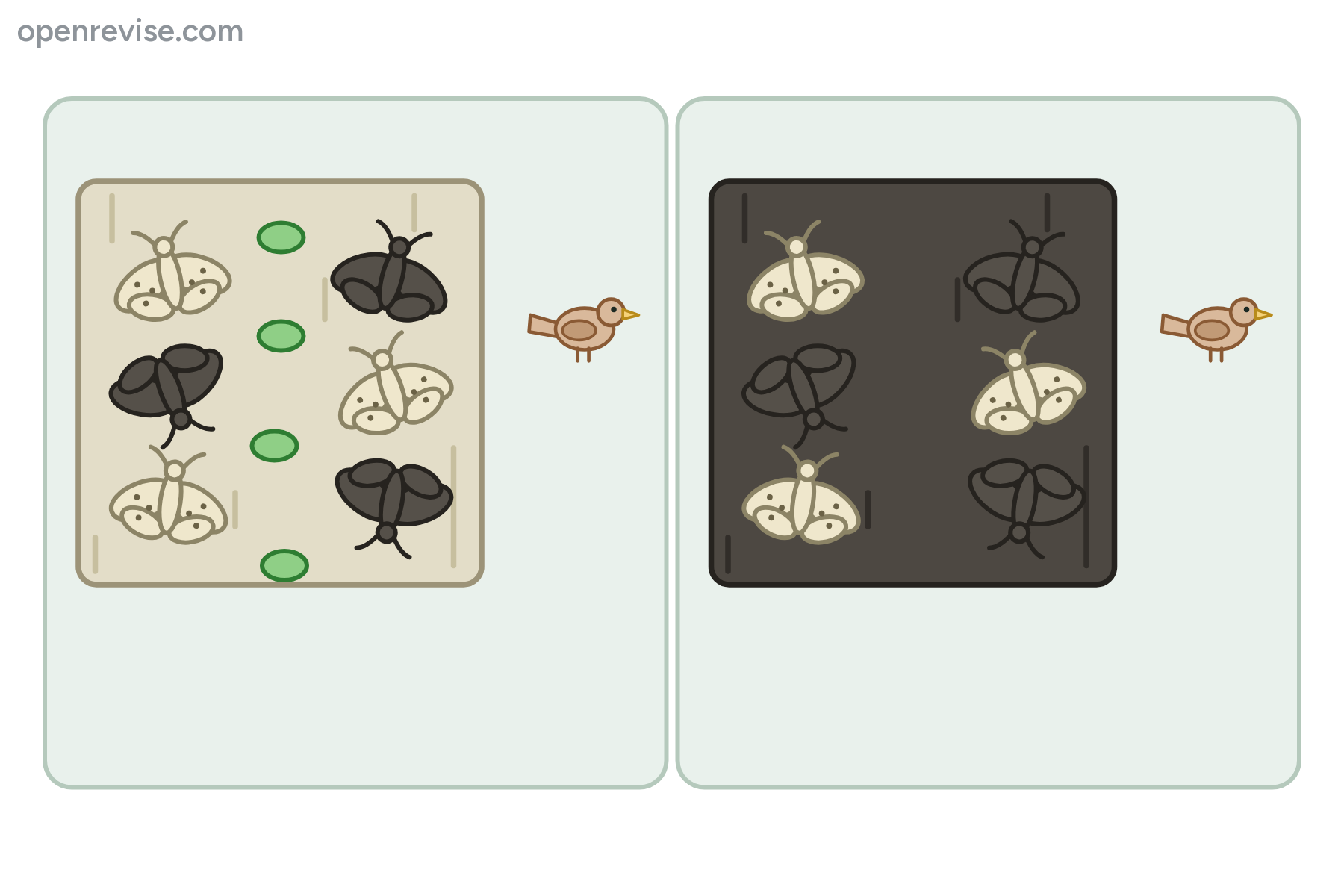 Explain which moths are more likely to survive in each wood, and why.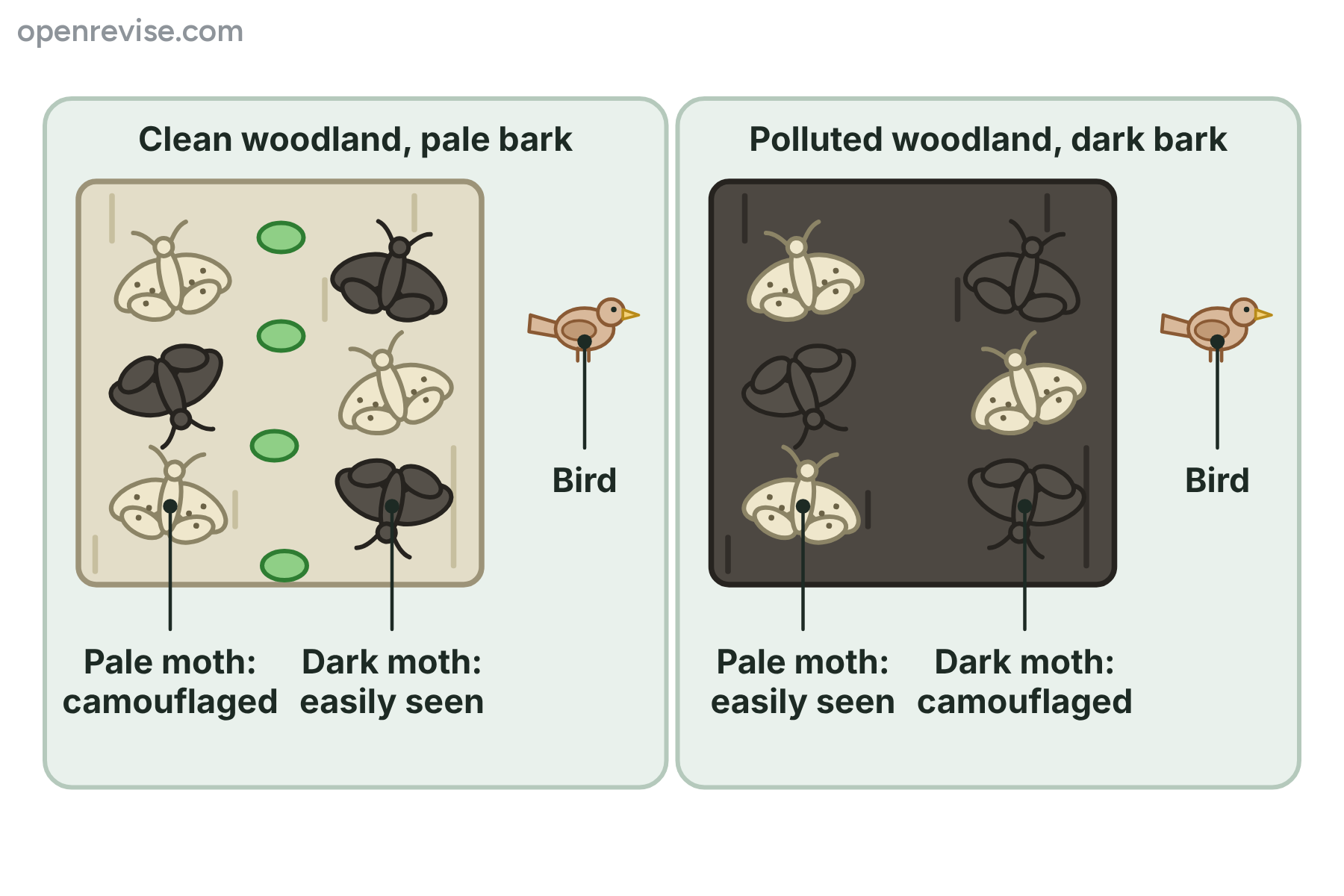
On pale bark the pale moths are camouflaged and the dark moths are eaten by birds. On dark bark the dark moths are camouflaged and the pale moths are eaten. The camouflaged moths survive, breed and pass on their alleles.
-
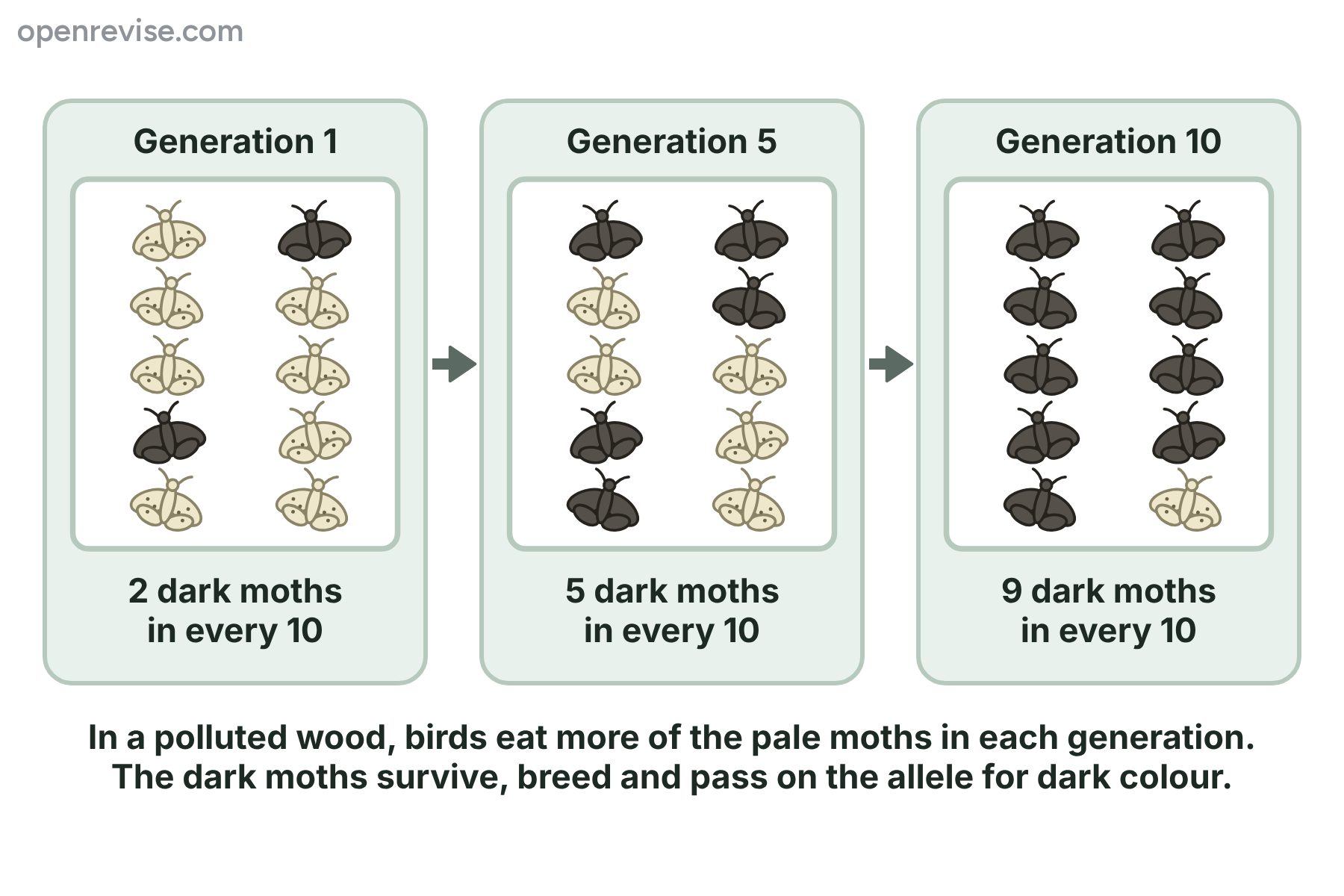 Describe what the diagram shows and explain why it happens.
 The proportion of dark moths rises from 2 in 10 to 9 in 10. Birds eat more of the pale moths, so more dark moths survive and breed, and the allele for dark colour becomes more common.