Biology · Natural Selection and Evolution
Evolution and the Formation of New Species
A horse and a donkey can have a baby, but the baby, a mule, can almost never have babies of its own. This lesson is for both Combined Science and separate Biology. It covers evolution as a change in a population over time, and how populations that are kept apart can evolve into new species.
Learning Objectives
- 1Describe evolution as a change in the inherited characteristics of a population over time, through a process of natural selection.
- 2Define a species, and explain why two organisms that produce infertile offspring belong to different species.
- 3Explain how isolation of populations can lead to the formation of new species.
- 4Explain how evolution accounts for the biodiversity of living things on Earth.
Retrieval practice
-
1
What is natural selection?
Show answerHide answer
The process by which the individuals with the variants best suited to the environment survive and breed more, passing on their alleles.
-
2
What is a selection pressure?
Show answerHide answer
A factor in the environment, such as predation or disease, that affects which individuals survive and breed.
-
3
Where do new variants come from?
Show answerHide answer
From random mutations.
-
4
What is a population?
Show answerHide answer
A group of individuals of the same species living in the same place.
Change over generations
Natural selection acts on one generation at a time, and the changes are small. Evolution is what these small changes add up to over a long time. Add up enough of them, and a population can become so different from its ancestors that it is no longer the same kind of organism at all. This lesson looks at evolution, and then at how it can split one species into two.
What evolution is
Evolution is a change in a population, not in an individual, and the change is in the characteristics that can be inherited.
-
Inherited characteristics
Evolution is a change in the inherited characteristics of a population over time. In genetic terms, some alleles become more common and others become less common.
-
Through natural selection
The change happens through the process of natural selection. Variants that are best suited to the environment survive and breed more, so they pass on their alleles.
-
Over time
The change takes many generations. A bacterium can divide every 20 minutes, so bacteria can evolve in days, but an animal such as an elephant evolves over many thousands of years.
-
Not always to a new species
A population can evolve and still be the same species. If the change is big enough, and the population is kept apart from the rest of its species, it may result in the formation of a new species.
What a species is
A species is the basic unit that biologists use to name and group living things.
-
Definition
A species is a group of organisms that can interbreed to produce fertile offspring, which are offspring that can themselves have young.
-
The mule
A horse and a donkey can mate and have a mule. A mule is sterile, so horses and donkeys are different species. Horses have 64 chromosomes and donkeys 62, so a mule has 63 and its chromosomes cannot pair up properly in meiosis to make gametes.
-
The limits of the idea
The definition cannot be tested on organisms that reproduce asexually, such as many bacteria, or on fossils. A few different species can also produce fertile hybrids.
-
Isolation
Two populations of one species that cannot meet and interbreed are isolated from each other. Isolation is the first step in the formation of a new species.
Same species or different species?
Same species
- Can interbreed, for example two horses
- The offspring are fertile
- Alleles are shared through breeding, so the population stays alike
- Together they make one population or several linked populations
Different species
- Cannot interbreed, or the offspring are infertile
- A horse and a donkey have a sterile mule
- Alleles are no longer shared between them
- Each evolves separately, in its own way
How isolation can form a new species
The change from one species to two is slow, and it usually takes the five steps below.
-
1
Isolation
A population is split into two groups by a barrier, such as a river, a mountain range or the sea. The groups can no longer interbreed, so there is no sharing of alleles between them.
-
2
Different environments
The two groups live in different conditions, so the selection pressures on them are different, for example in climate, food or predators.
-
3
Different mutations
Random mutations happen in each group, and they are different, so each group gets its own new variants.
-
4
Different selection
In each group, the variants best suited to its own environment survive and breed more, so the alleles in the two populations become more and more different.
-
5
New species
After many generations the two groups are so different that, even if they meet again, they can no longer interbreed to produce fertile offspring. They are now two species.
Isolation and the formation of new species
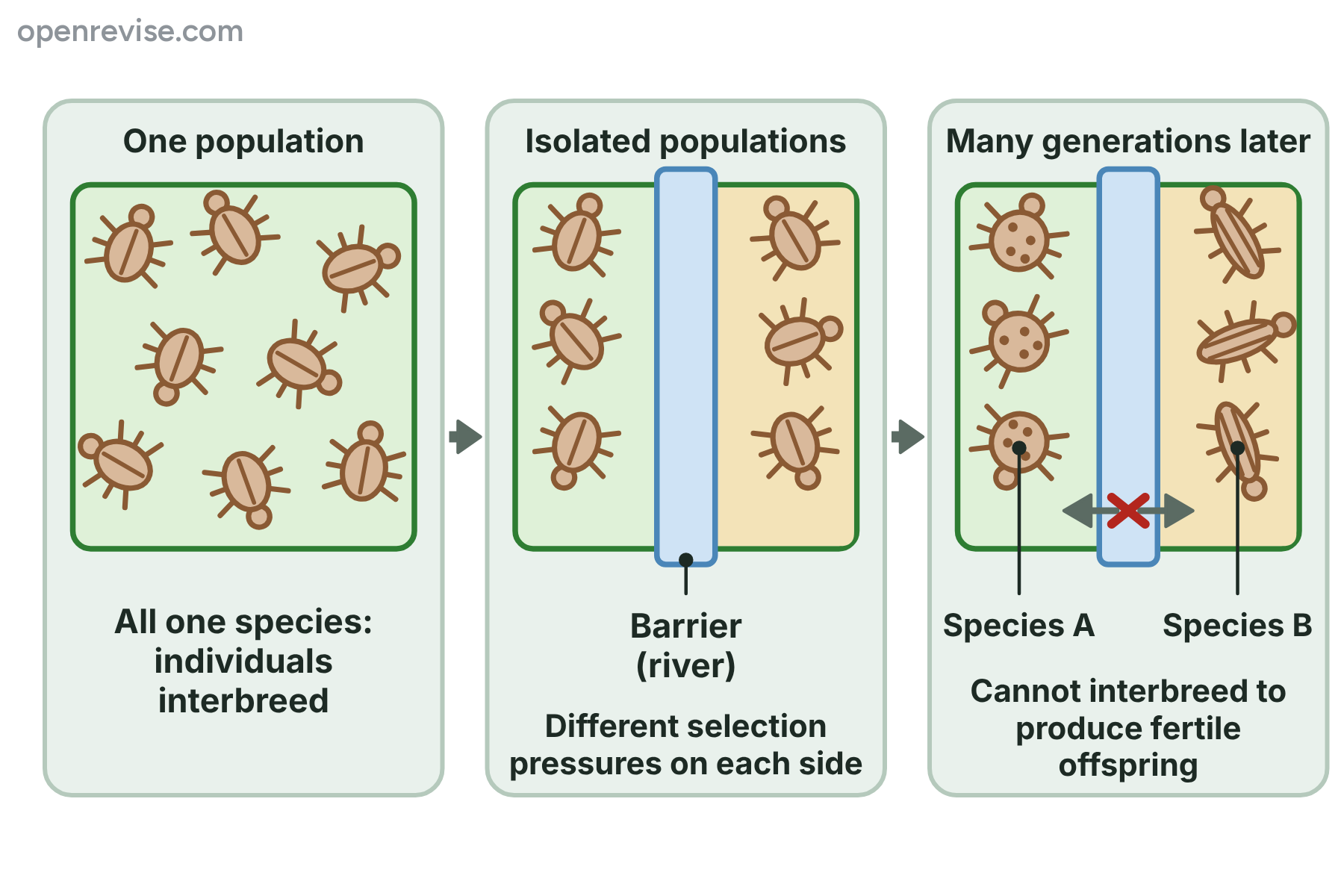
Isolation, different selection pressures and time can turn one species into two.
Ways in which populations become isolated
Anything that stops two groups of one species from breeding together can start the process.
-
Geographical barriers
A river that changes course, a new mountain range, a glacier, a desert, or rising sea level that turns hills into islands. This is the commonest cause.
-
Islands
A few individuals that reach an island, by flying or floating, are cut off from their species on the mainland. Islands often have unusual species that are found nowhere else.
-
Different breeding times
Two groups may flower or breed in different seasons, so they do not meet.
-
Different mating behaviour
The females of a species may choose a mate by his song, display or colour. If the groups evolve different signals they stop choosing each other, even when they live side by side.
Case study
The cichlid fish of Lake Victoria
Lake Victoria in East Africa contains over 500 species of cichlid fish, and almost all of them are found nowhere else. They evolved from a small number of ancestors in about 15 000 years. Different groups of fish became adapted to different food, such as insects, snails and other fish, and in different parts of the lake. The females of many species choose mates by the colour of the males, so the groups stopped breeding together. Many of the species have since been lost, after the Nile perch was introduced in the 1950s and the water was polluted.
Evolution and biodiversity
Evolution explains why there are so many kinds of living thing, and why they are related.
-
Branching
Every time one species splits into two, the tree of life gets a new branch. After billions of years of this there are millions of species.
-
Common ancestors
All living things are related, to varying degrees, because they share ancestors. Two species that split recently, such as the horse and the donkey, are close relatives.
-
Biodiversity
Biodiversity is the variety of living things. It increases when new species evolve and decreases when species become extinct.
-
Adaptation
Each species is adapted to its own habitat, because natural selection favoured the variants that suited it.
A mistake to avoid
The idea of evolution is often described in a way that makes it sound as if animals plan to change.
-
Not on purpose
Animals do not evolve because they want or need to. Variants arise by chance and the environment selects between them.
-
Acquired features are not inherited
A giraffe that stretches its neck does not have longer-necked young. Only changes to the DNA in gametes are passed on.
-
Individuals do not evolve
One moth, one finch or one bacterium does not evolve. A population evolves, over many generations.
The big idea
A new species forms when populations that are kept apart evolve for so long, under different selection pressures, that they can no longer interbreed to produce fertile offspring.
Evolution and new species
Evolution and new species
-
Evolution
- change in inherited characteristics
- population
- over time
- natural selection
-
Species
- interbreed
- fertile offspring
- mule is sterile
-
Isolation
- river
- mountains
- islands
- different breeding times or mating signals
-
New species
- different selection pressures
- different mutations
- can no longer interbreed
-
Biodiversity
- branching of species
- common ancestors
- extinction removes species
Summary and exam focus
- Evolution is a change in the inherited characteristics of a population over time, through natural selection.
- A species is a group of organisms that can interbreed to produce fertile offspring.
- If two populations are isolated and exposed to different selection pressures, their alleles become more and more different.
- If they become so different that they cannot interbreed to produce fertile offspring, they are different species.
- Evolution has produced the biodiversity of Earth, and all living things are related through common ancestors.
Exam focus
Describe how the isolation of two populations of a species can lead to the formation of a new species. (4 marks) (4 marks)
Write the steps in order and link each one to the next. Start with the barrier that stops interbreeding, then say that the environments, and so the selection pressures, are different, that different variants are selected, and that after many generations the groups can no longer interbreed to produce fertile offspring.
Key terms
The words this lesson expects you to use. Each one is linked from the first place it appears above.
- Evolution
- A change in the inherited characteristics of a population over time, through natural selection.
- Species
- A group of organisms that can interbreed to produce fertile offspring.
- Fertile
- Able to reproduce and have offspring.
- Hybrid
- The offspring of parents from two different species, such as a mule.
- Isolation
- The separation of two populations of a species so that they cannot interbreed.
- Geographical barrier
- A physical feature, such as a river, mountain range or the sea, that separates populations.
- Interbreed
- To mate and produce offspring with another member of the same species.
- Adaptation
- A feature that helps an organism to survive and reproduce in its environment.
- Biodiversity
- The variety of living organisms in a habitat or on Earth.
- Population
- A group of individuals of the same species living in the same place.
You've finished the notes
Check your understanding
Test yourself while it is fresh. Start with the flashcards, then try the exam questions.
Something here looks wrong?
Tell us what and we will go and look. It goes to whoever writes these pages, nobody else, and we do not ask who you are — so there is nothing to sign and nothing comes back to you.