Biology · Defence Against Disease
Human Defence Systems
Your body has several lines of defence against pathogens. This lesson covers the barriers that try to keep pathogens out, and the white blood cells of the immune system that destroy those that get in.
Learning Objectives
- 1Describe the non-specific defences of the human body: the skin, nose, trachea and bronchi, and stomach.
- 2Describe how white blood cells defend the body by phagocytosis, antibody production and antitoxin production.
- 3Explain the role of the immune system in defence against disease.
- 4Explain why antibodies are specific to a pathogen.
Retrieval practice
-
1
What is a pathogen?
Show answerHide answer
A microorganism that causes disease.
-
2
What do platelets do?
Show answerHide answer
Help the blood to clot at a wound.
-
3
Name two functions of white blood cells.
Show answerHide answer
Engulfing pathogens and making antibodies or antitoxins.
-
4
What are toxins?
Show answerHide answer
Poisons made by bacteria that damage tissues.
Two lines of defence
Every day you breathe in, swallow and touch millions of pathogens, yet you rarely become ill. That is because the body has two lines of defence. The first line is a set of barriers that stop most pathogens getting in. They are called non-specific defences because they work in the same way against every pathogen. The second line is the immune system, which attacks the pathogens that do get in.
Non-specific defences
These are the body's first line of defence.
-
Skin
A tough barrier that most pathogens cannot get through. If it is cut, platelets form a clot, which seals the wound and forms a scab.
-
Nose
Hairs and sticky mucus trap particles and pathogens in the air that is breathed in.
-
Trachea and bronchi
Cells lining the airways make mucus that traps pathogens. Tiny hair-like cilia then move the mucus up to the throat, where it is swallowed.
-
Stomach
Produces hydrochloric acid, which kills most of the pathogens that are swallowed in food and drink or in mucus.
The body's non-specific defences
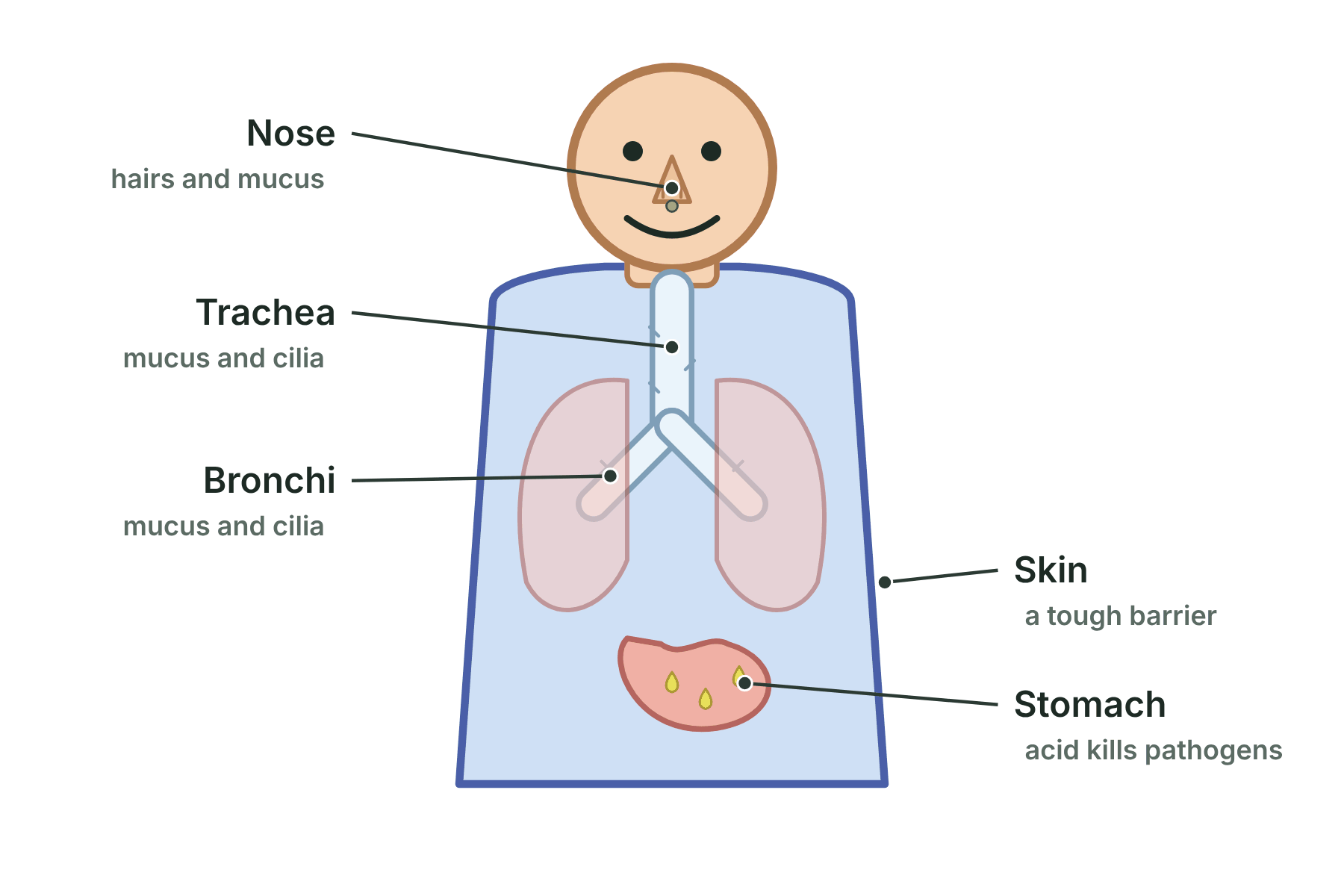
Each of these barriers tries to stop pathogens getting in.
The immune system
If a pathogen gets past the barriers, the white blood cells of the immune system try to destroy it. They do this in three ways.
-
Phagocytosis
A phagocyte engulfs a pathogen, takes it in and digests it with enzymes. This is non-specific, because a phagocyte can engulf many kinds of pathogen.
-
Antibody production
Lymphocytes make antibodies. Each type of antibody fits one type of antigen, a molecule on the surface of the pathogen, and sticks to it. The pathogen is then destroyed.
-
Antitoxin production
White blood cells make antitoxins, which neutralise the toxins produced by bacteria.
How white blood cells destroy pathogens
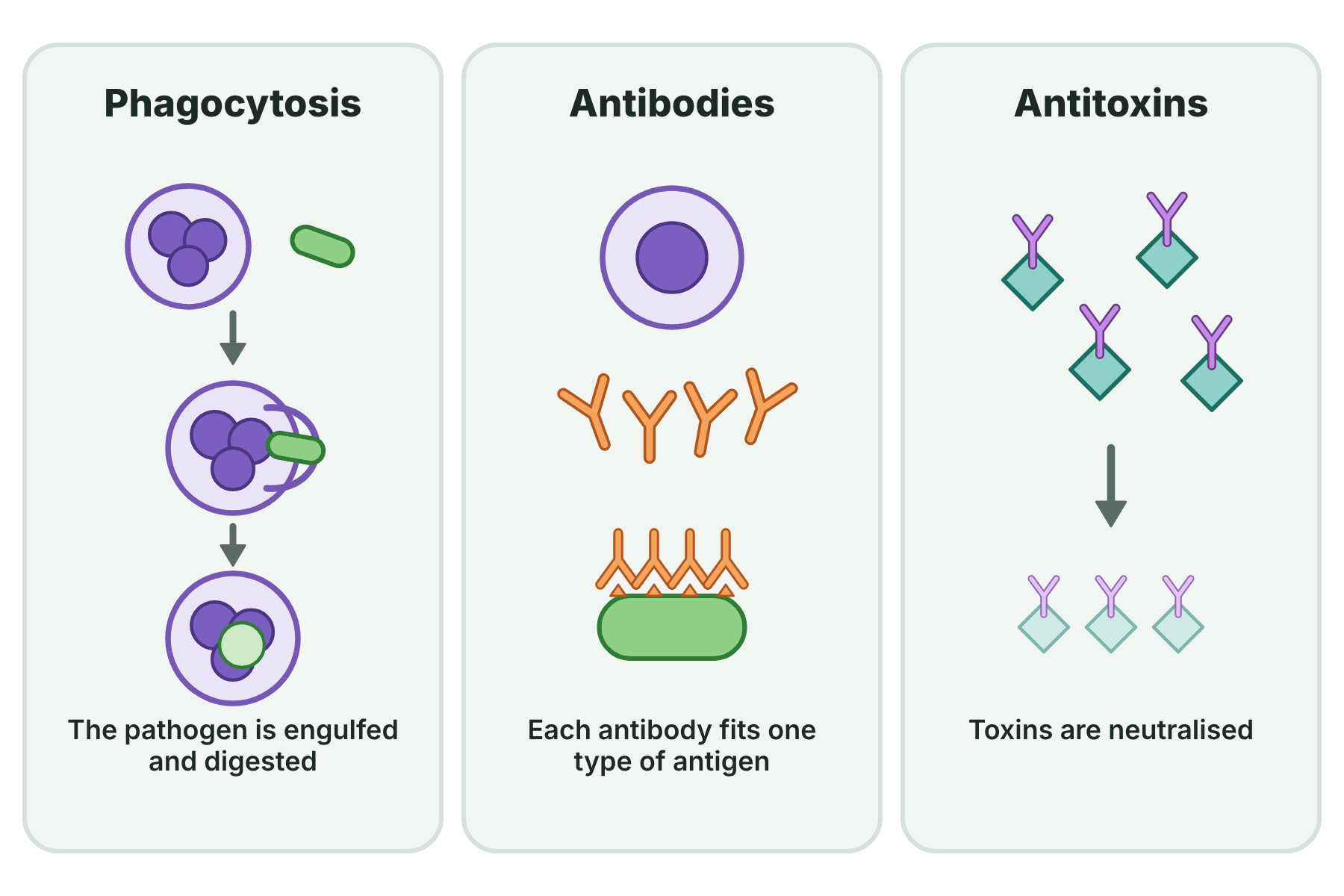
White blood cells defend the body in three ways.
Making the right antibodies
Every pathogen carries its own antigens, so the body has to make antibodies that fit them.
-
1
A pathogen enters
Its surface carries antigens that are different from the body's own.
-
2
Lymphocytes respond
A lymphocyte with a matching antibody starts to divide.
-
3
Antibodies are released
The cells make large numbers of the antibody that fits that pathogen's antigen.
-
4
The pathogen is destroyed
The antibodies stick to the pathogens, and phagocytes engulf them.
Non-specific defences and the immune system compared
Non-specific defences
- The same against every pathogen
- The first line of defence
- Skin, mucus, cilia and stomach acid
- Try to keep pathogens out
The immune system
- Antibodies fit one antigen only
- Attacks pathogens that get in
- Phagocytes, antibodies and antitoxins
- Destroys pathogens inside the body
Case study
Why does a cut heal and stay clean?
When you cut your skin, the barrier is broken and pathogens can get in. Platelets make the blood clot, and the clot dries into a scab, which seals the wound. Meanwhile white blood cells rush to the cut. Phagocytes engulf any bacteria that have got in, which is why a cut usually heals without infection, unless there are too many pathogens or the immune system is weak.
The big idea
The skin, nose, airways and stomach stop most pathogens getting in. White blood cells destroy the rest.
Defence against disease
Defence against disease
-
Non-specific
- skin
- nose
- trachea and bronchi
- stomach
-
Immune system
- white blood cells
-
Phagocytosis
- engulf and digest pathogens
-
Antibodies
- specific to one antigen
-
Antitoxins
- neutralise toxins
Summary and exam focus
- The skin, nose, trachea, bronchi and stomach are non-specific defences.
- White blood cells defend the body by phagocytosis, antibody production and antitoxin production.
- An antibody is specific to the antigen of one pathogen.
- Antitoxins neutralise the toxins that bacteria make.
- Platelets clot blood at a wound, forming a scab.
Exam focus
Describe how the human body defends itself against pathogens. (6 marks) (6 marks)
Organise the answer into two parts: first the barriers (skin, nose, airways with mucus and cilia, stomach acid), then the white blood cells (phagocytosis, antibodies and antitoxins). Add a detail for each so that each point earns its mark.
Key terms
The words this lesson expects you to use. Each one is linked from the first place it appears above.
- Non-specific defence
- A defence that works in the same way against all pathogens, such as the skin.
- Immune system
- The white blood cells that destroy pathogens inside the body.
- Phagocytosis
- The engulfing and digestion of a pathogen by a white blood cell.
- Antibody
- A protein made by white blood cells that sticks to a particular antigen.
- Antigen
- A molecule on the surface of a pathogen that triggers the immune system.
- Antitoxin
- A protein made by white blood cells that neutralises a toxin.
- Mucus
- A sticky liquid made in the airways that traps pathogens.
- Cilia
- Tiny hair-like structures that move mucus along the airways.
You've finished the notes
Check your understanding
Test yourself while it is fresh. Start with the flashcards, then try the exam questions.
Something here looks wrong?
Tell us what and we will go and look. It goes to whoever writes these pages, nobody else, and we do not ask who you are — so there is nothing to sign and nothing comes back to you.