Exam questions · Biology
Health, Disease and Cancer
- 21 exam questions
- 52 marks
- 24 quick checks
Health and Disease
Just this lesson-
1 State [1 mark]
State what is meant by a non-communicable disease.
Show answerHide answer
Model answer
A disease that is not caused by a pathogen and cannot be passed from one person to another.
Mark scheme
- Not caused by a pathogen / cannot be passed on — 1 mark
-
2 Give [2 marks]
Give two examples of non-communicable diseases.
Show answerHide answer
Model answer
Any two of: coronary heart disease, cancer, type 2 diabetes, emphysema (lung disease).
Mark scheme
- First example — 1 mark
- Second example — 1 mark
-
3 Explain [2 marks]
Explain why a person with HIV is more likely to suffer from other infections.
Show answerHide answer
Model answer
HIV damages the white blood cells of the immune system. The immune system can then no longer defend the body against other pathogens.
Mark scheme
- HIV damages the immune system / white blood cells — 1 mark
- Cannot fight other pathogens — 1 mark
-
4 Describe [3 marks]
Describe three ways in which different types of disease can interact.
Show answerHide answer
Model answer
A defect in the immune system makes infectious diseases more likely. Viruses that live in cells can trigger cancers. An immune reaction started by a pathogen can trigger allergies such as asthma. (Also accept: severe physical illness can lead to depression.)
Mark scheme
- A first correct interaction — 1 mark
- A second correct interaction — 1 mark
- A third correct interaction — 1 mark
-
5 Describe [2 marks]
A scatter diagram shows that as the amount of salt in the diet increases, blood pressure also increases. Describe the correlation and state whether it proves that salt causes high blood pressure.
Show answerHide answer
Model answer
It is a positive correlation. It does not prove cause, because there may be other factors, so further evidence is needed.
Mark scheme
- Positive correlation — 1 mark
- Does not prove cause / other factors — 1 mark
-
6 Explain [3 marks]
A study of the link between a disease and diet uses a sample of 20 people. Explain why a larger sample would give more reliable results.
Show answerHide answer
Model answer
A larger sample is more likely to represent the whole population. It reduces the effect of unusual individuals and chance, so a pattern found is more likely to be real.
Mark scheme
- Larger sample more representative — 1 mark
- Reduces the effect of chance / unusual individuals — 1 mark
- Results are more reliable — 1 mark
-
7 Explain [4 marks]
Explain how health can be affected by both physical and mental factors, giving one example of how each type of ill health can lead to the other.
Show answerHide answer
Model answer
Health is a state of physical and mental well-being, so both matter. Severe physical ill health, such as a long-term illness, can lead to depression or other mental illness. Mental stress can also affect physical health, for example by making a person less able to resist infection, because life situations and stress have a profound effect on physical health.
Mark scheme
- Health means physical and mental well-being — 1 mark
- Physical illness can lead to mental illness — 1 mark
- Stress or life situations can affect physical health — 1 mark
- A relevant example — 1 mark
Quick check
-
1
Which of these is a communicable disease?
Show answerHide answer
C: Measles
Measles is caused by a virus and can be passed from one person to another.
-
2
Which of these is a non-communicable disease?
Show answerHide answer
B: Cancer
Cancer is not caused by a pathogen, so it cannot be passed on.
-
3
How does HIV make other infections more likely?
Show answerHide answer
D: It damages the immune system
HIV attacks the white blood cells of the immune system, so the body cannot fight other pathogens.
-
4
What type of correlation shows one variable falling as the other rises?
Show answerHide answer
A: Negative
When one variable increases and the other decreases, the correlation is negative.
-
5
Which statement about a correlation is correct?
Show answerHide answer
C: It shows a link but not necessarily a cause
A correlation shows that two things are linked, not that one causes the other.
-
6
Why is a large sample better than a small sample?
Show answerHide answer
B: It is more likely to be representative
A large sample is more likely to represent the whole population.
-
7
Which virus can trigger cervical cancer?
Show answerHide answer
A: HPV
Some types of human papillomavirus (HPV) can trigger cervical cancer.
-
8
Which of these is an example of severe physical ill health affecting mental health?
Show answerHide answer
D: Depression following a serious illness
Severe physical illness can lead to depression and other mental illness.
Risk Factors and Lifestyle
Just this lesson-
1 State [1 mark]
State what is meant by a risk factor.
Show answerHide answer
Model answer
Something that is linked to an increased rate of a disease.
Mark scheme
- Linked to an increased rate of a disease — 1 mark
-
2 Name [2 marks]
Name two lifestyle factors that increase the risk of cardiovascular disease.
Show answerHide answer
Model answer
Any two of: smoking, a diet high in fat, lack of exercise.
Mark scheme
- First factor — 1 mark
- Second factor — 1 mark
-
3 Explain [2 marks]
Explain how obesity is a risk factor for type 2 diabetes.
Show answerHide answer
Model answer
Obesity makes it more likely that a person will develop type 2 diabetes. The body becomes less able to control its blood glucose level.
Mark scheme
- Obesity increases the chance of type 2 diabetes — 1 mark
- Blood glucose control is affected — 1 mark
-
4 Calculate [2 marks]
In a study, 45 of 500 people who drank a lot of alcohol developed liver disease. Calculate the percentage who developed liver disease.
Show answerHide answer
Model answer
45 ÷ 500 × 100 = 9%.
Mark scheme
- 45 ÷ 500 × 100 — 1 mark
- 9% — 1 mark
-
5 Explain [3 marks]
Explain why smoking during pregnancy is a risk to the unborn baby.
Show answerHide answer
Model answer
Chemicals in cigarette smoke pass from the mother's blood to the baby's blood. They can reduce the baby's growth, so it may be born with a low mass. They also increase the risk of an early birth.
Mark scheme
- Chemicals pass to the baby — 1 mark
- Low birth mass — 1 mark
- Early birth / miscarriage — 1 mark
-
6 Suggest [3 marks]
Studies show that people who eat a lot of salt have higher blood pressure. A newspaper says that salt causes high blood pressure. Suggest why the newspaper's conclusion might not be correct.
Show answerHide answer
Model answer
The data show a correlation, which is only a link. Other factors, such as weight, exercise or genes, might cause the high blood pressure. A causal mechanism has not been shown by the data alone.
Mark scheme
- It is a correlation / link only — 1 mark
- Other factors could be involved — 1 mark
- No causal mechanism shown — 1 mark
-
7 Discuss [4 marks]
Discuss the human and financial costs of non-communicable diseases at a national level.
Show answerHide answer
Model answer
The human cost includes pain, a lower quality of life and early death, as well as the effect on families who care for the person. The financial cost includes the cost to the health service of treatments, drugs and operations, and the cost of lost productivity when people are too ill to work. These costs are large for a nation because many people are affected by lifestyle-related diseases.
Mark scheme
- Human cost: pain / death / quality of life — 1 mark
- Human cost to family or community — 1 mark
- Financial cost: treatment — 1 mark
- Financial cost: lost working time — 1 mark
Quick check
-
1
Which of these is a risk factor for lung cancer?
Show answerHide answer
B: Smoking
Smoking exposes the lungs to carcinogens and is a major risk factor for lung cancer.
-
2
Which disease is obesity a risk factor for?
Show answerHide answer
C: Type 2 diabetes
Obesity increases the risk of type 2 diabetes.
-
3
Which organ is damaged by too much alcohol?
Show answerHide answer
A: The liver
Heavy drinking damages the liver, and it affects brain function.
-
4
What is ionising radiation an example of?
Show answerHide answer
D: A carcinogen
Ionising radiation, such as X-rays and gamma rays, can cause cancer.
-
5
Why can't a correlation alone prove a cause?
Show answerHide answer
B: Because other factors may be involved
Other factors could explain the link, so a causal mechanism is needed.
-
6
In a study, 30 of 600 people develop a disease. What percentage is this?
Show answerHide answer
C: 5%
30 ÷ 600 × 100 = 5%.
-
7
Which of these is a cost of non-communicable disease to a nation?
Show answerHide answer
A: The cost of treatment to the health service
Treatment costs for the health service and lost working days are costs to a nation.
-
8
What does the saying "many diseases are caused by an interaction of factors" mean?
Show answerHide answer
D: Several factors often combine to cause a disease
Diet, lifestyle, genes and the environment often act together to cause a disease.
Cancer
Just this lesson-
1 State [1 mark]
Name the type of tumour that is a cancer.
Show answerHide answer
Model answer
Malignant tumour.
Mark scheme
- Malignant — 1 mark
-
2 Name [3 marks]
Figure 1 shows two types of tumour. Name the parts labelled A, B and C.
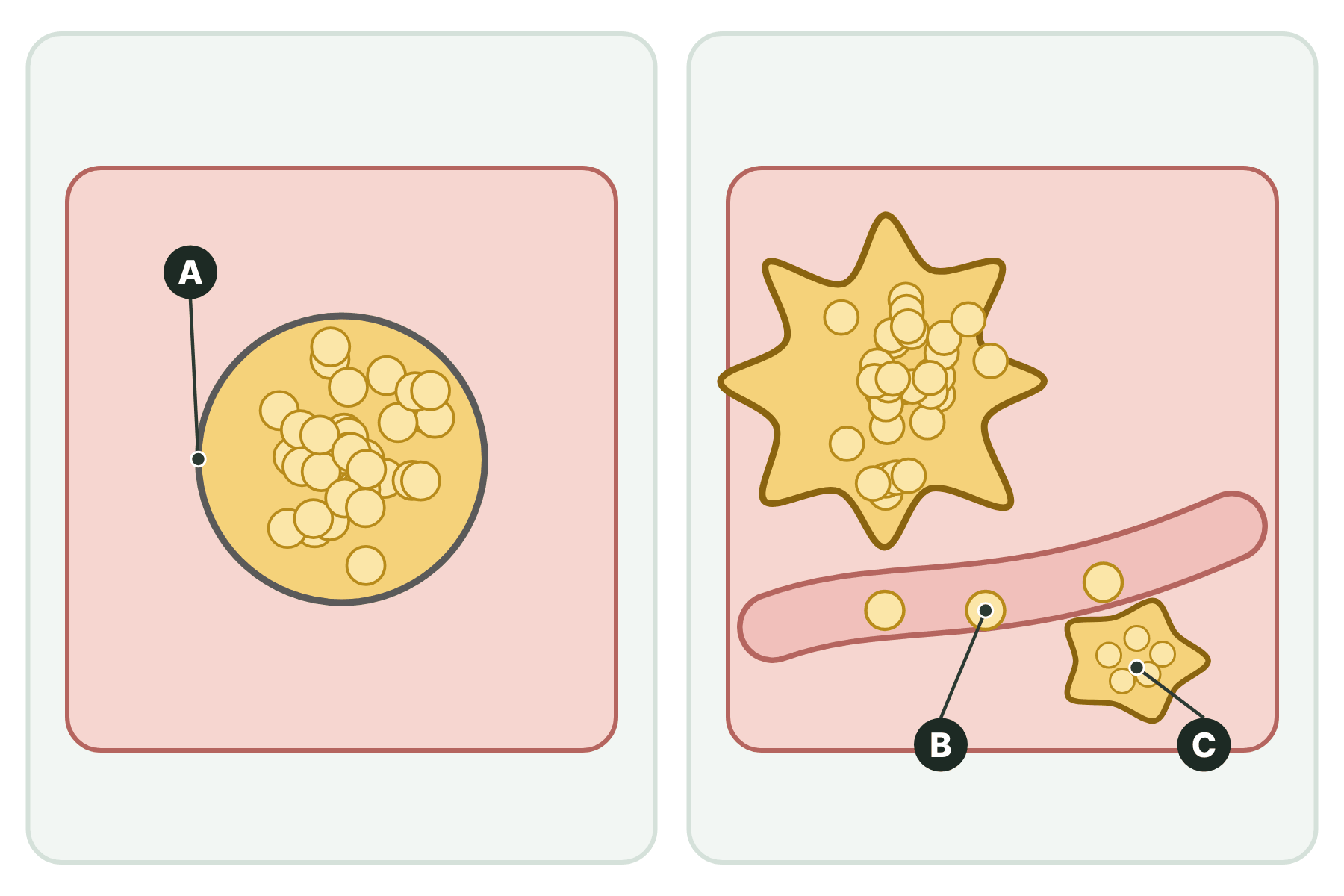
Show answerHide answer
Model answer
A is the membrane. B is cancer cells in the blood (a blood vessel). C is a secondary tumour.
Mark scheme
- A: membrane — 1 mark
- B: cancer cells in the blood — 1 mark
- C: secondary tumour — 1 mark
-
3 Describe [2 marks]
Describe what happens to cells in cancer.
Show answerHide answer
Model answer
Changes in the cells make them divide in an uncontrolled way. This produces a lump of abnormal cells, called a tumour.
Mark scheme
- Uncontrolled division / growth — 1 mark
- Forms a tumour — 1 mark
-
4 Describe [3 marks]
Describe how cancer cells from a malignant tumour can cause a secondary tumour.
Show answerHide answer
Model answer
Cells break away from the malignant tumour and invade the neighbouring tissues. They are carried in the blood to other parts of the body, where they settle and start to divide, forming a secondary tumour.
Mark scheme
- Cells break away / invade tissue — 1 mark
- Travel in the blood — 1 mark
- Form a new tumour elsewhere — 1 mark
-
5 Explain [2 marks]
A doctor tells a patient that their tumour is benign. Explain why this is good news.
Show answerHide answer
Model answer
A benign tumour is contained in one area and does not invade other tissues. It is not a cancer, so it does not spread.
Mark scheme
- Does not invade other parts of the body — 1 mark
- It is not cancer — 1 mark
-
6 Describe [3 marks]
Describe three risk factors that increase the chance of getting cancer.
Show answerHide answer
Model answer
Smoking and other lifestyle factors such as obesity. Carcinogens such as ionising radiation. Some viruses that live in cells, or genes inherited from a parent.
Mark scheme
- A lifestyle risk factor — 1 mark
- A carcinogen such as ionising radiation — 1 mark
- A genetic or virus risk factor — 1 mark
-
7 Compare [4 marks]
Compare benign and malignant tumours.
Show answerHide answer
Model answer
Both are growths of abnormal cells. A benign tumour stays in one area, usually inside a membrane, and does not invade other tissues, so it is not cancer. A malignant tumour invades neighbouring tissues and spreads in the blood to other parts of the body, where it forms secondary tumours. A malignant tumour is a cancer.
Mark scheme
- Both are growths of abnormal cells — 1 mark
- Benign stays in one area / does not invade — 1 mark
- Malignant invades tissue and spreads in the blood — 1 mark
- Malignant forms secondary tumours and is cancer — 1 mark
Quick check
-
1
What causes the lump in a tumour?
Show answerHide answer
C: Uncontrolled cell division
Cells divide in an uncontrolled way and build up into a lump.
-
2
Which type of tumour spreads to other parts of the body?
Show answerHide answer
B: Malignant
Malignant tumours invade other tissues and spread in the blood.
-
3
What is a secondary tumour?
Show answerHide answer
A: A new tumour formed by spread from the first
It is a new tumour formed where cancer cells from the first tumour have settled.
-
4
How do cancer cells usually spread round the body?
Show answerHide answer
D: In the blood
Cancer cells are carried in the blood.
-
5
Which of these is a carcinogen?
Show answerHide answer
B: Ionising radiation
Ionising radiation, such as X-rays, can damage DNA and cause cancer.
-
6
Is cancer a communicable disease?
Show answerHide answer
C: No, it is non-communicable
Cancer is not caused by a pathogen, so it cannot be passed on.
-
7
Where is a benign tumour usually contained?
Show answerHide answer
A: Inside a membrane
A benign tumour is usually inside a membrane in one area.
-
8
Which statement about lung cancer is correct?
Show answerHide answer
D: Smoking is a major risk factor
Smoking is a major risk factor and stopping reduces the risk.