Exam questions · Biology · Health, Disease and Cancer
Cancer
- 7 exam questions
- 18 marks
- 8 quick checks
-
1 State [1 mark]
Name the type of tumour that is a cancer.
Show answerHide answer
Model answer
Malignant tumour.
Mark scheme
- Malignant — 1 mark
-
2 Name [3 marks]
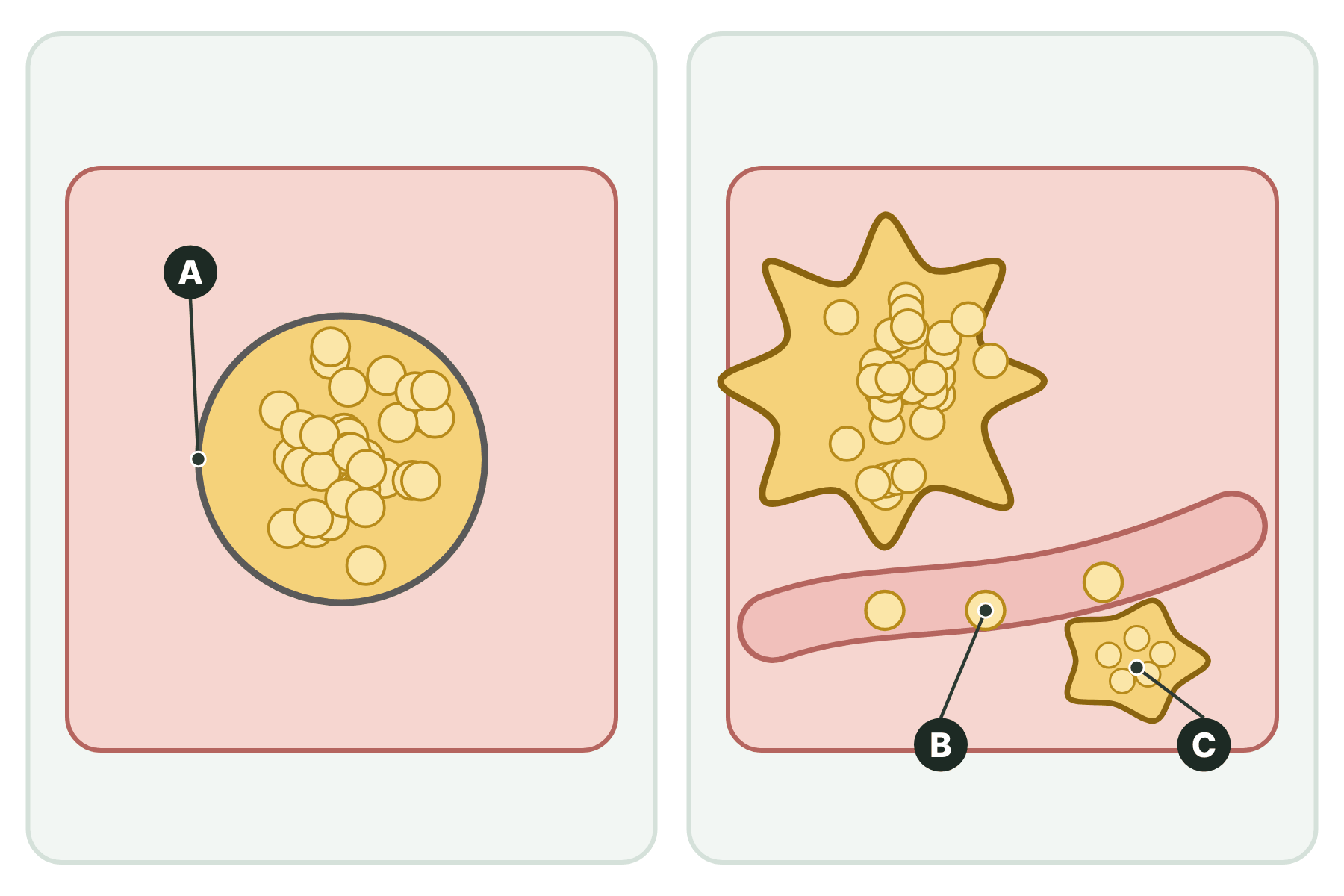
Figure 1 shows two types of tumour. Name the parts labelled A, B and C.
Show answerHide answer
Model answer
A is the membrane. B is cancer cells in the blood (a blood vessel). C is a secondary tumour.
Mark scheme
- A: membrane — 1 mark
- B: cancer cells in the blood — 1 mark
- C: secondary tumour — 1 mark
-
3 Describe [2 marks]
Describe what happens to cells in cancer.
Show answerHide answer
Model answer
Changes in the cells make them divide in an uncontrolled way. This produces a lump of abnormal cells, called a tumour.
Mark scheme
- Uncontrolled division / growth — 1 mark
- Forms a tumour — 1 mark
-
4 Describe [3 marks]
Describe how cancer cells from a malignant tumour can cause a secondary tumour.
Show answerHide answer
Model answer
Cells break away from the malignant tumour and invade the neighbouring tissues. They are carried in the blood to other parts of the body, where they settle and start to divide, forming a secondary tumour.
Mark scheme
- Cells break away / invade tissue — 1 mark
- Travel in the blood — 1 mark
- Form a new tumour elsewhere — 1 mark
-
5 Explain [2 marks]
A doctor tells a patient that their tumour is benign. Explain why this is good news.
Show answerHide answer
Model answer
A benign tumour is contained in one area and does not invade other tissues. It is not a cancer, so it does not spread.
Mark scheme
- Does not invade other parts of the body — 1 mark
- It is not cancer — 1 mark
-
6 Describe [3 marks]
Describe three risk factors that increase the chance of getting cancer.
Show answerHide answer
Model answer
Smoking and other lifestyle factors such as obesity. Carcinogens such as ionising radiation. Some viruses that live in cells, or genes inherited from a parent.
Mark scheme
- A lifestyle risk factor — 1 mark
- A carcinogen such as ionising radiation — 1 mark
- A genetic or virus risk factor — 1 mark
-
7 Compare [4 marks]
Compare benign and malignant tumours.
Show answerHide answer
Model answer
Both are growths of abnormal cells. A benign tumour stays in one area, usually inside a membrane, and does not invade other tissues, so it is not cancer. A malignant tumour invades neighbouring tissues and spreads in the blood to other parts of the body, where it forms secondary tumours. A malignant tumour is a cancer.
Mark scheme
- Both are growths of abnormal cells — 1 mark
- Benign stays in one area / does not invade — 1 mark
- Malignant invades tissue and spreads in the blood — 1 mark
- Malignant forms secondary tumours and is cancer — 1 mark
Quick check
-
1
What causes the lump in a tumour?
Show answerHide answer
C: Uncontrolled cell division
Cells divide in an uncontrolled way and build up into a lump.
-
2
Which type of tumour spreads to other parts of the body?
Show answerHide answer
B: Malignant
Malignant tumours invade other tissues and spread in the blood.
-
3
What is a secondary tumour?
Show answerHide answer
A: A new tumour formed by spread from the first
It is a new tumour formed where cancer cells from the first tumour have settled.
-
4
How do cancer cells usually spread round the body?
Show answerHide answer
D: In the blood
Cancer cells are carried in the blood.
-
5
Which of these is a carcinogen?
Show answerHide answer
B: Ionising radiation
Ionising radiation, such as X-rays, can damage DNA and cause cancer.
-
6
Is cancer a communicable disease?
Show answerHide answer
C: No, it is non-communicable
Cancer is not caused by a pathogen, so it cannot be passed on.
-
7
Where is a benign tumour usually contained?
Show answerHide answer
A: Inside a membrane
A benign tumour is usually inside a membrane in one area.
-
8
Which statement about lung cancer is correct?
Show answerHide answer
D: Smoking is a major risk factor
Smoking is a major risk factor and stopping reduces the risk.